Vacation

American photographer Judith Black unearths intimate pictures from a six-week road trip with her family
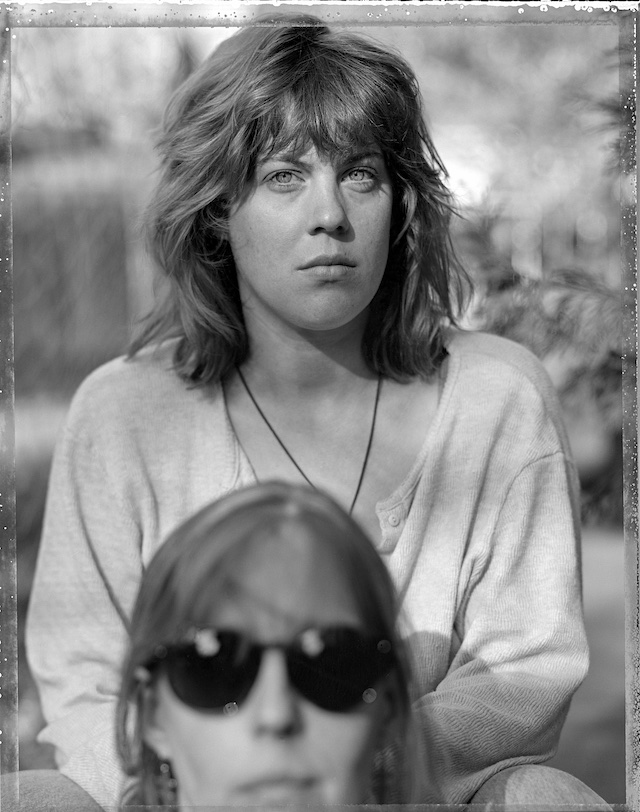
Johanna and Self, March 27, 1995, (Chico, CA) © Judith Black

Most might quake at the thought of being sat in a car for no less than 5,000 miles with their family – kids included. What with the hum of “Are we there yet?” echoing out of the backseat every five minutes or so; the vibrational thud as a punch smacks the arm; the endless rounds of Eye Spy and toilet breaks; travelling with your family isn’t always an easy one. But it was a pursuit that American artist Judith Black was keen to embark on with her four children around 40 years ago, which is now the focus point of her new photography book Vacation, published by Stanley/Barker.

After being awarded a Guggenheim Fellowship in 1986, Judith set out with the intention of a cross-country road trip to document the sweeping landscapes of the US, as well as the intimate and candid moments she experienced with her children – stopping off at New York, Chicago, San Francisco and various other memorable spots on the way. It took about six weeks in total from July 12 1986 to August 23; “We took some camping and a lot of photo gear,” she tells me, pacing the day’s drive to end up at a friend’s or family’s place. “We were on a tight budget. We kept track of the milage, gas, expenses and mostly to give the kids something to do.” Packed with snacks, entertainment, a 4×5 press camera, tripod, boxes of Polaroid Type 55 film, a flash and a bucket of sodium sulphite to process the negative, Judith and her family were prepped as much as can be. “I don’t remember how it all fit!”

On one stop, Judith and the family traversed to Lake Michigan to the summer cottage where her aunt lived. A hot day, Judith’s daughter “insisted on the punk look”; she snapped an image of them by the water’s edge, dunes in the background and her subjects caught in a moment that’s halfway between posing and candid. Her daughter placed in the middle in jet-black attire – almost as stark and monochrome as the series itself. Another depicts her sister’s newborn Matt at just a couple of weeks old. “They were on a swing at the park. The little frown on his brow…” It’s moments like this that make looking back on the series so momentous in its ability to mark an epoch of familial life; it’s like flicking through an old family album, a record of place and time where endless anecdotes can be uncovered. Below, I chat to Judith to hear more about the series, what family life means to her and the importance of documenting those closest to you. 
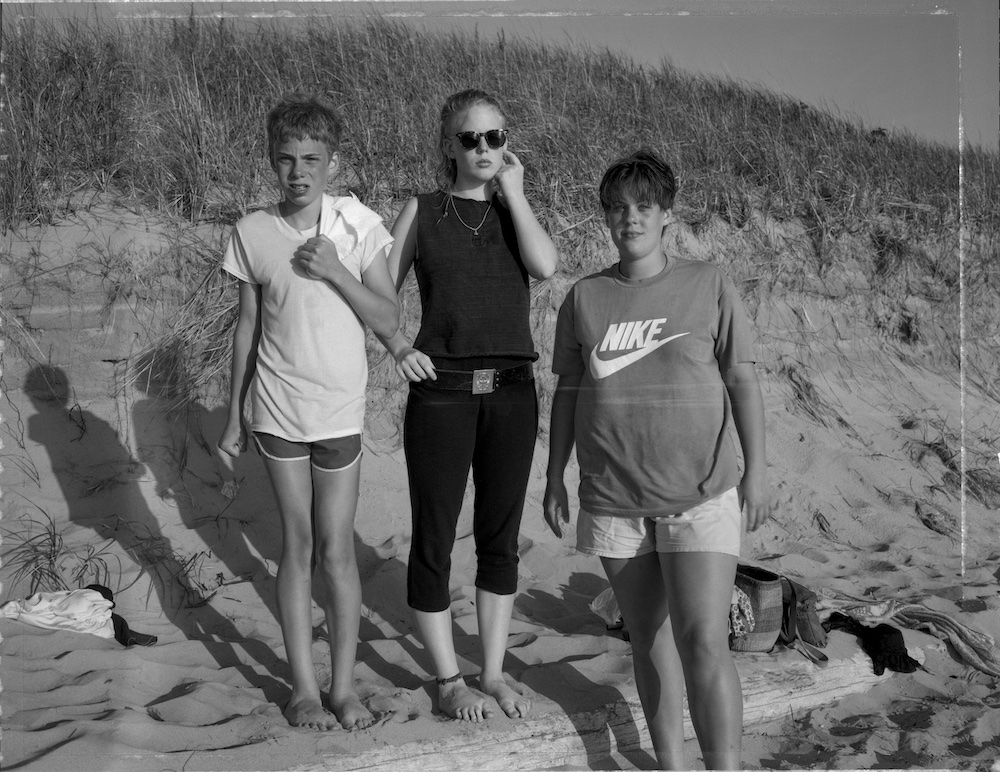
Erik, Laura, Johanna, July 20, 1986, (Lake Michigan) © Judith Black

What inspired you to go on a road trip with your family, and why turn it into a photographic series?

American photographers are aware that the cross-country trip of 4,000 to 5,000 miles one way is something of a quest. The road trip is made for discovering the country, having adventures, exploring the land (it’s huge, beautiful and ugly). The tradition goes back to the early exploration of the west, and the use of the new medium of photography to chart and record the land for the government, the amateur and the artist. Fast forward to the 1980s when I applied for a Guggenheim Fellowship, many recipients in photography have used the road trip to get out of their comfort zone… it was part of the idea of the fellowship: to travel. At the time, railroads joined the east and west coasts, American families of enough means travelled to see the national parks, the great cities, the wonders of the landscape. My thought was to follow in the footsteps of Edward Weston, Robert Frank and many others, but with my family in tow.

I set out on the journey partly because that was the focus of the Guggenheim grant, and partly just to see if we could make such a trip. I didn’t need to produce any results from the trip, so we were free to see what happened as we drove from place to place. My grant proposal was to make this journey from the east coast where we lived, to the west coast with my four children, and to photograph along the way. The kids were 18, 16, 15 and 12. Rob, my partner and step-father to the children, had traveled extensively, mostly by hitch-hiking; the hippie way. I didn’t know how the trip would work out, but it was a response to the more male adventure trip from Weston to Frank to Soth. 
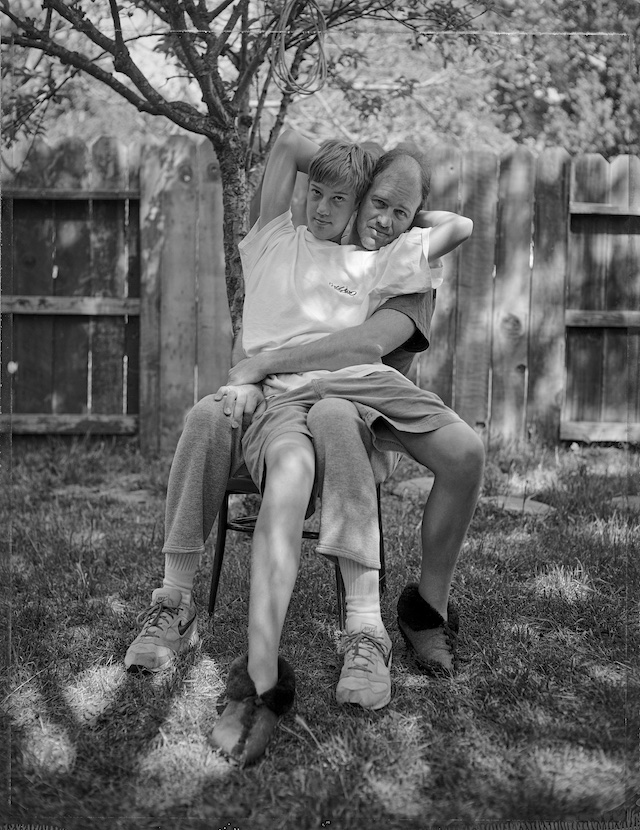
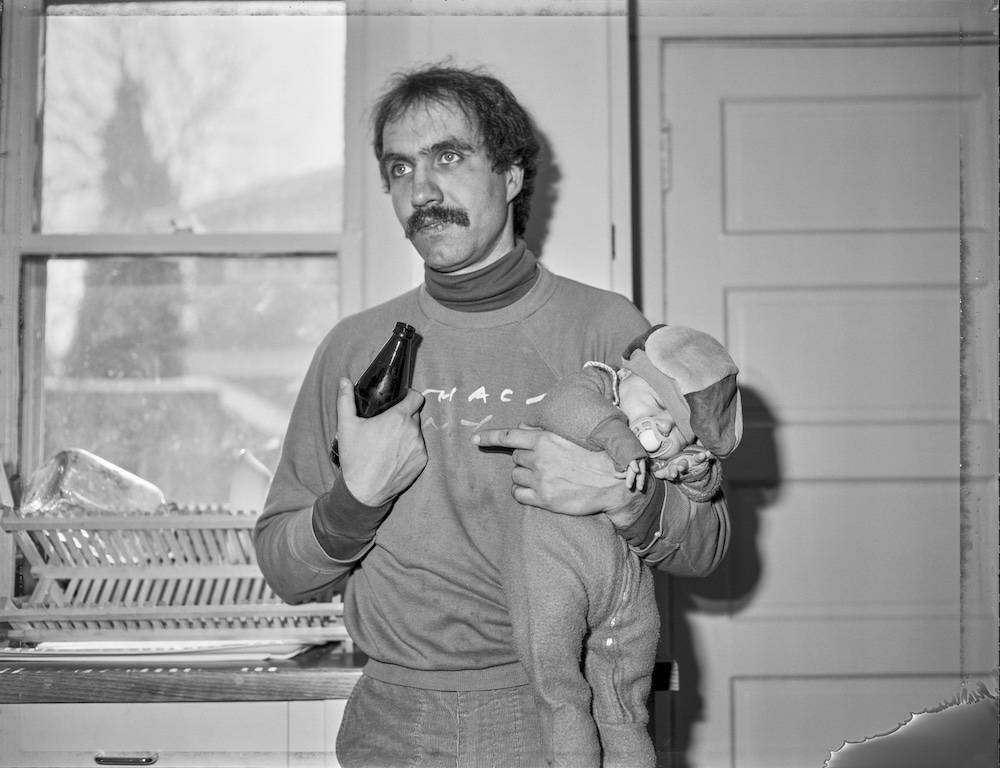
Hank and Christian, May, 2, 1993, (Palo Alto, CA) © Judith Black

What memories or anecdotes can you share from the trip?

The first photo in the book is one that I took with my first Brownie camera at age seven in 1951 – capturing Aunt Edie with her dog, Lance, at the family cottage in Michigan. In 1986, I was able to take another photo of her with her dog Rover in almost the same spot. The titles and notations in the book hint at the narrative by suggesting familial relationships. There are many other anecdotes, probably at least one for every stop we made! And for each of the trips included in the book. 

A trip with four kids who were teens? We didn’t kill anyone! Five people in the car for a long trip can cause some irritation, to say the least. We finally resolved who could sit next to whom on the last couple of days. My brother was driving by that time. One child could sit in the front, I could sit in the middle of the back seat and each child could touch me. Otherwise, we had a lot of ‘He touched me’, ‘She looked at me’; we were ready to be home!
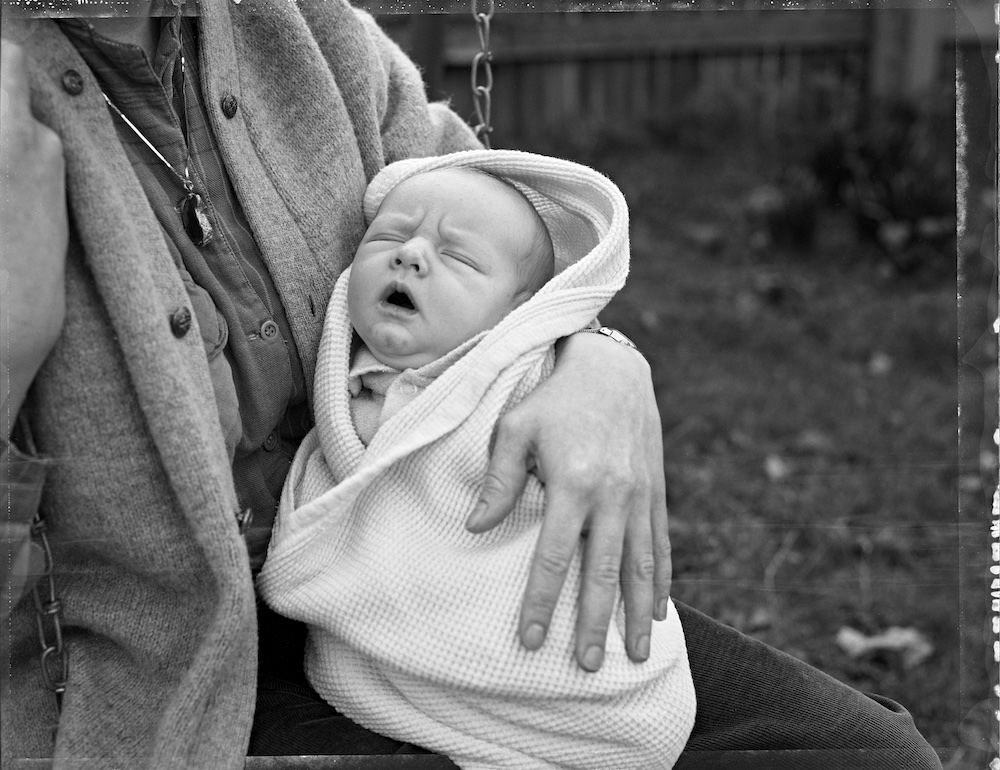
Maggie and Matt, March 1, 1986 (Seattle, WA) © Judith Black

The work is immensely intimate, which appears to be an intentional move photographically. Why work in this manner, and what stories are you hoping to share about your family?

I have been a mother since I was 23. With four children by the age 29, there was no time to leave home to explore even the streets close to home. I was about 34 when I returned to school to earn a masters degree so that I might be able to support my family. Photography seemed like a better choice pragmatically, rather than painting! So, I quickly realised that the intimate self-portraits and portraits of my family were what I knew best and could reveal with some kind of honesty. The photos in Vacation are about those times when I was on ‘vacation’ from being home. Sometimes it was the cross-country trip, sometimes it was when the kids were on vacation with their father, sometimes it was during visits to see my folks on the west coast. These are times most of us experience and they can be really fun or they can be upsetting. 
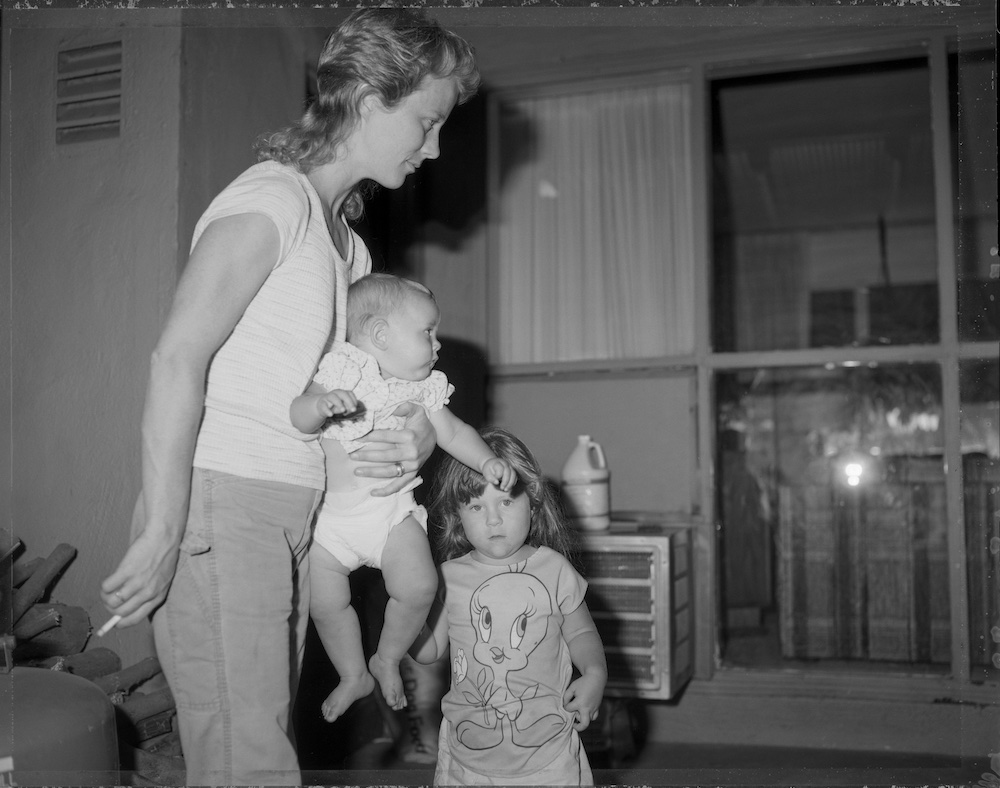
Dianna, Miki, Angie, August 15, 1986, (Concord, CA ) © Judith Black

Any particular meaning you’re trying to convey in the work?

What is that Tolstoy quote about families? ‘Happy families are all alike; every unhappy family is unhappy in its own way.’ Not all family stories are happy. Not all are really awful. But all have some kind of complication. The memories that our family album photos hold are different for each member. There is a complicated story for almost all the photos in this book, especially since we are looking back over almost 40 years.

What’s next for you?

Right now, I’m enjoying the success the two books I’ve published – knowing that people around the world will connect somehow with our ‘family album’ amazes me in some way. The people are particular to our family, but the stories hidden or written in the titles are more universal. It would be wonderful to have an exhibit of the vintage prints. I loved working in the darkroom and it would be nice to do that once again before too long. That would be a big project!


Judith Black’s Vacation is published by Stanley/Barker
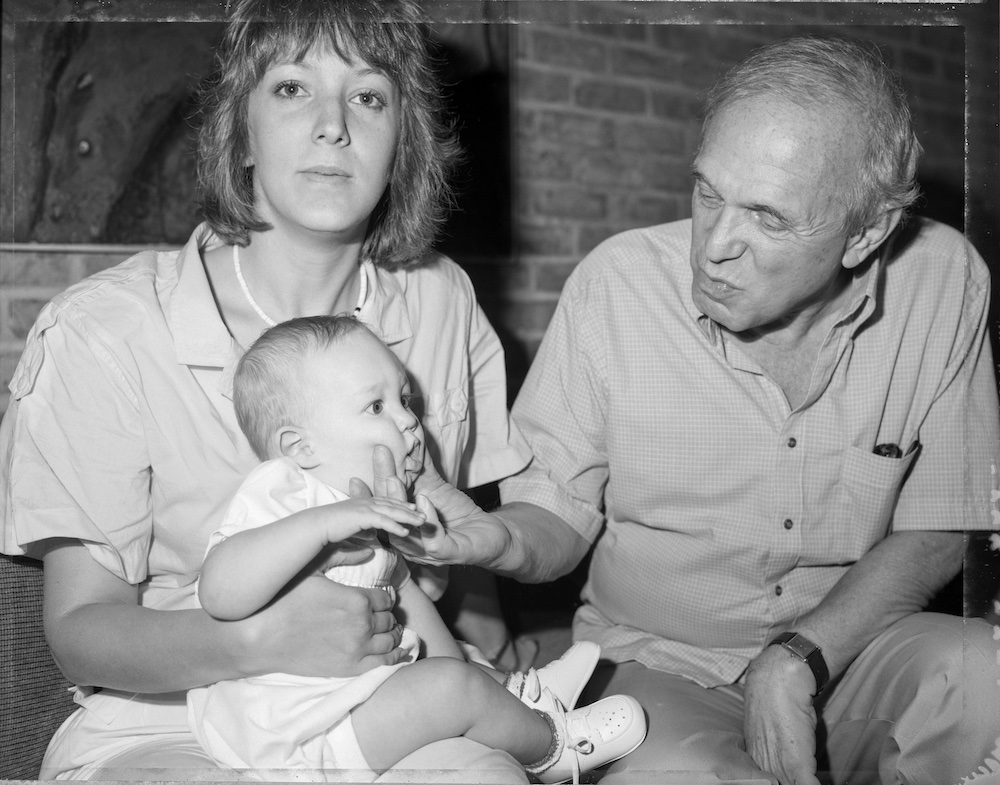
Lynne, Milt and Christopher, August 31, 1986, (New York City, NY), Rob’s family © Judith Black
Til and Robbie, February 15, 1987, (Ithaca, NY) © Judith Black
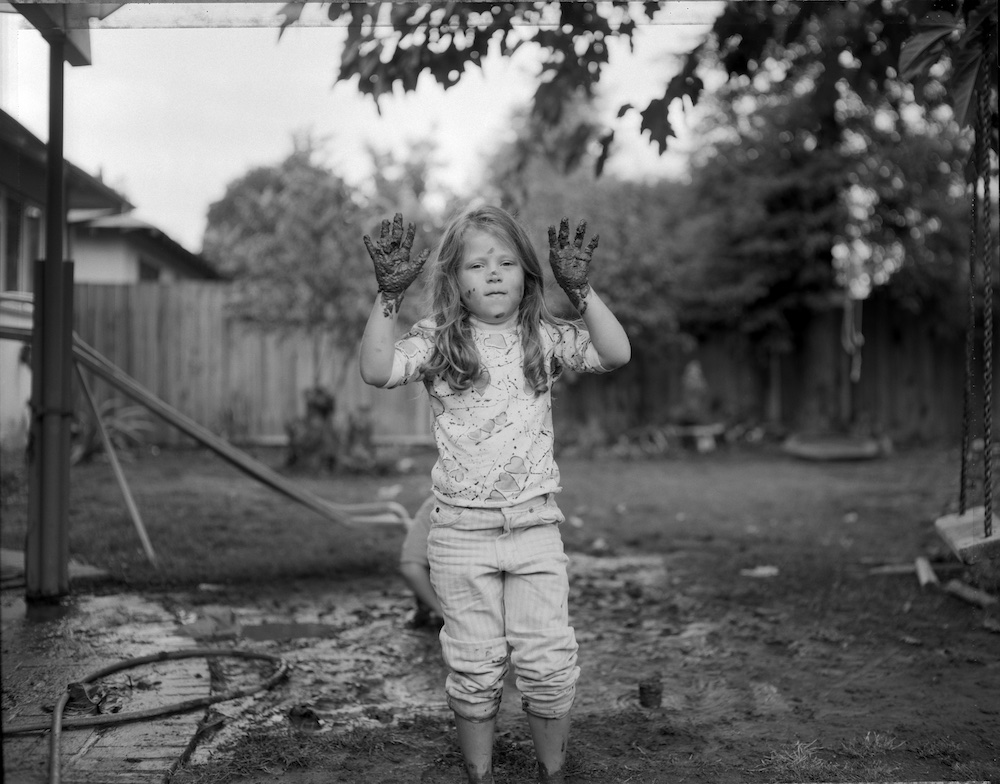
Angie, September 17, 1989, (Concord, CA) mud monster © Judith Black
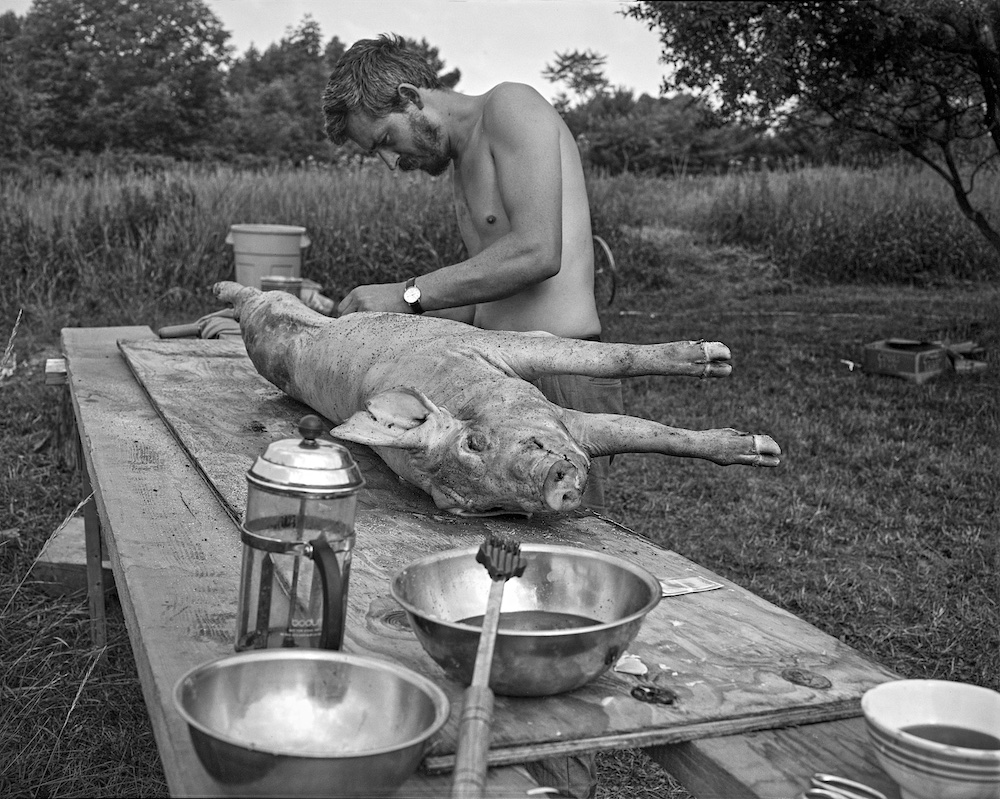
Pierre and Pig, July 6, 1991, (Ithaca, NY), 40th birthday bash © Judith Black
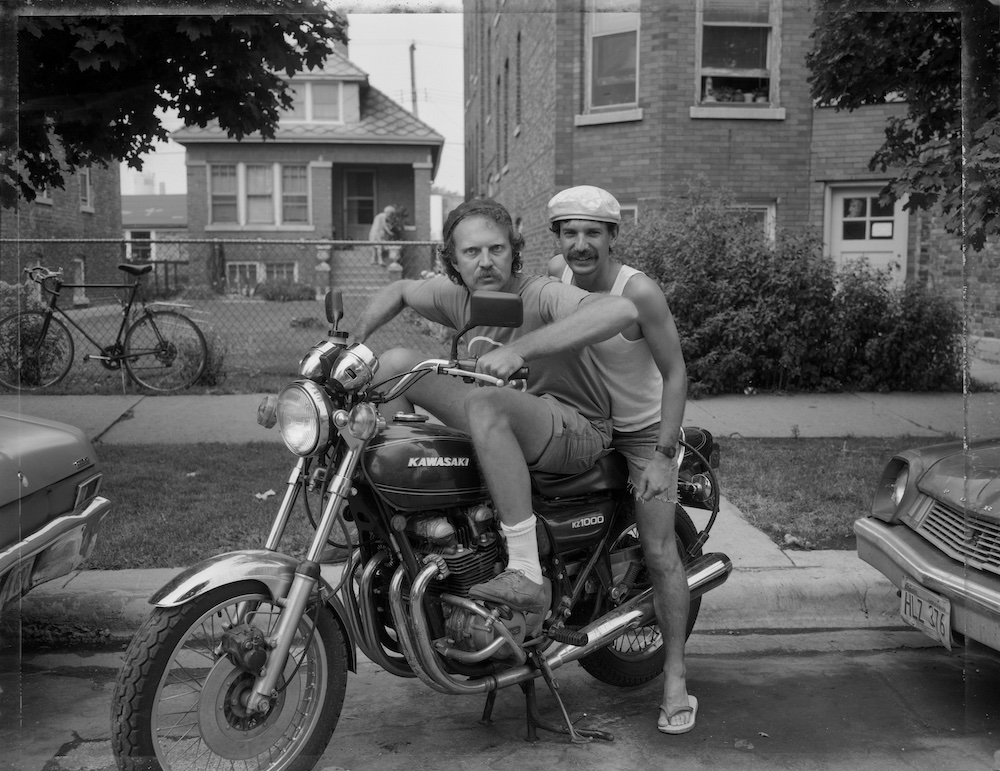
Jim and Rob, August 1986, (Chicago, IL) © Judith Black

Orejarena & Stein

What’s it really like working with your other half? A photographer and video artist discuss

Andrea 2020

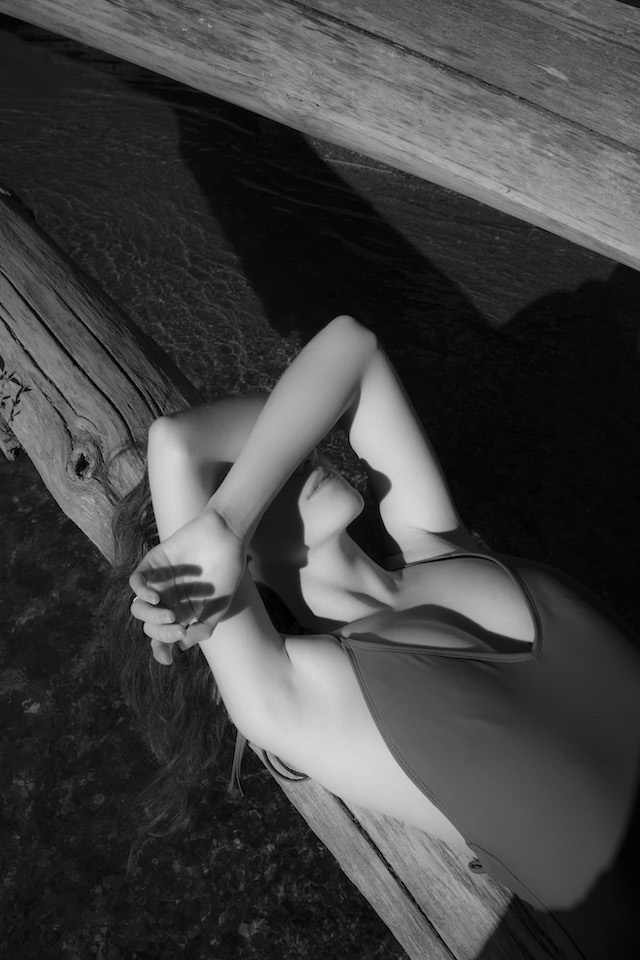
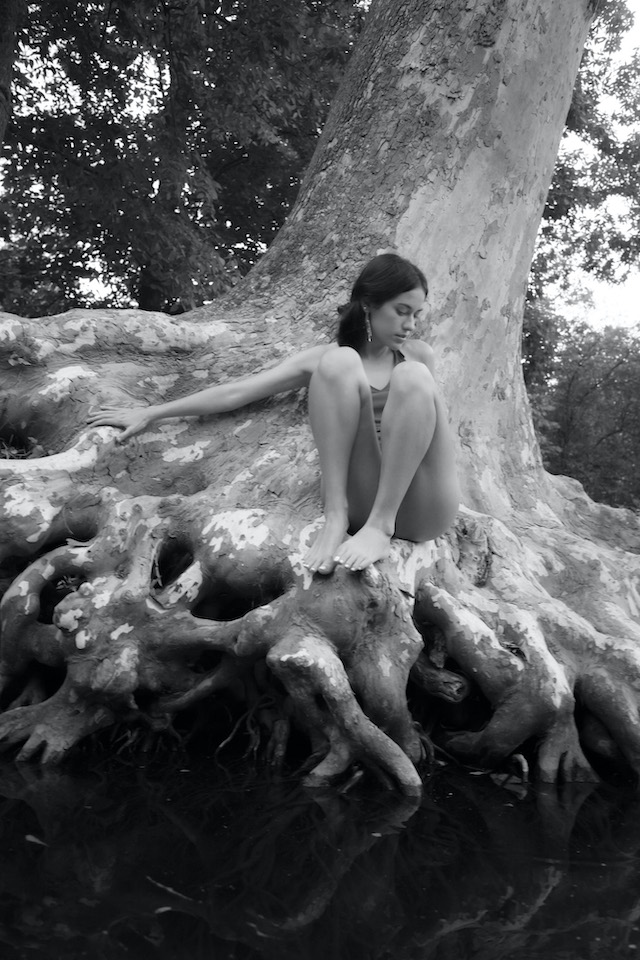
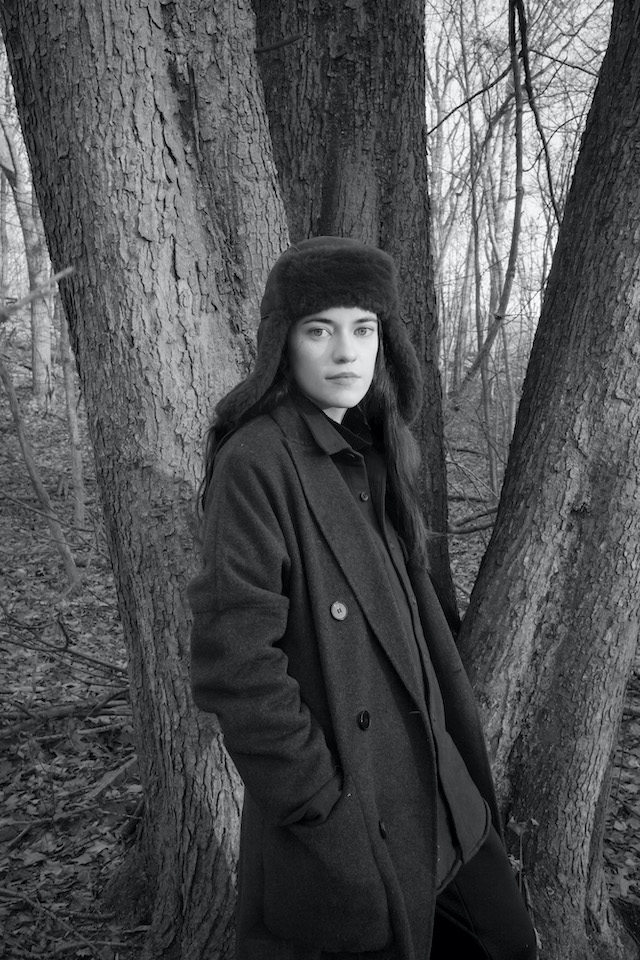
Some could say that working with your other half is as polarising as Marmite; it can either break or make you, with half thriving on its divisive flavour while the other forever steering clear. For two creatives Caleb Stein and Andrea Orejarena (aka Orejarena & Stein), their partnership is like spreading it on toast; it’s a logical pairing and natural mediation between communication, flexibility and a shared vision (to name a few benefits). Caleb, on the one hand, is a photographer who was born in London. He lived in New York for a decade before moving to Poughkeepsie in 2013 to study at Vassar College, which is where he met Andrea. He’s gone on to explore many wondrous and timely topics such as memory, mythology and narrative in relation to the United States. Meanwhile, Andrea is a Colombian-born American video artist who looks at play, fantasy and the American dream. Combined, they’re a powerhouse. And their ongoing project Andrea is pinnacle of that. 

Ever since their first meeting in university, Caleb has continued to take Andrea’s portrait. And what first started out as a documentation of their time together – not to mention the early stages of their relationship – soon evolved into a long-term collaboration between them both, aptly named Andrea. Below, I chat to Caleb and Andrea to find out more about the series and, more importantly, what working with each other is really like.

Andrea 2018

I’d love to begin by hearing about how you both met.

Andrea: It was great. We met on our first day of our freshman year at Vassar College. Caleb’s mother was dropping him off at the dorms. She flagged me down and asked if I could show them the dining hall. I happened to know where it was and I walked them over. When we arrived she said, “good I’ll stay here, and now can you show my son to his dorm?” It was hilarious. 

Caleb: She’s a yenta.

What’s the process like while working together? What roles do you take on, and how is it split?

A: We move fluidly between roles, without rigidity. We are working towards a shared vision, making something emergent that neither person could make on their own, something that could only be made between those two people. In terms of the physical act of photographing or filming, we are both involved in all of the decisions. The conceptual framework for the work stems from long term, in deep exchanges with each other. People often ask us who clicks the shutter (we both do). We pass the camera between each other and we never have two cameras on site.

C: That fluidity is very important, it allows us to remain open. In many ways, working as an artist duo is an exercise in questioning conservative (but still widespread) conceptions of authorship, and it’s an effort to move away from an individualistic, ego-driven practice towards something more collaborative and meditative. 

Andrea 2021

Tell me about your ongoing series, Andrea. What’s it about, and what stories are you hoping to share?

A: Andrea is a selection of portraits made as an artist duo. When we first met, Caleb began photographing me in passing and I wouldn’t mind or give it much attention. I grew up with my father recording every moment—we have hours and hours of Wiseman-style footage— so I am comfortable with the camera and I forget it is there quite easily. Eventually, for some reason, I started getting interested in the photos Caleb was taking of me. Then I started having opinions about them, and then, when he continued to ask for feedback, started directing him with the photography in the same way I directed him as the cinematographer for my videos. He’d take his photo, then we’d give it my take, then we bounce off each other’s ideas until it snowballed into a photo we both loved. The collaboration started quite smoothly and it took us a second to realise it was happening. There was a moment where it began to blur between Caleb asking me for advice, and me becoming invested in the formal aspects of the photograph from an auteur perspective. That crossing of the blurred line was what interested us. Blurring these lines is a way of challenging and subverting the male gaze and the long history of men photographing their partners. 

C: Yes, that’s an important aspect of the project – pushing back against a one-sided, only-male perspective. The photographs are made as a collaboration with a realtime, live monitor facing Andrea so that we can both contribute in equal parts to the final image. In other words, all of the creative decisions about the image, including the post-production process, are made as an artist duo. 

A & C: We are interested in questioning the traditional idea of who has a say in how their image is made. This work is also a personal archive intended to function as a set of lyrical, personal documents of our creative and romantic partnership.

Andrea 2018

What’s it like switching from photographer to model?

A I get to skip the step where I have to articulate a creative concept because I am directing myself. Caleb and I basically read each other’s minds so that doesn’t count either. In some ways, this work is a self-portrait, but made as an artist duo. I feel comfortable moving between the roles and blending the two. Apart from anything else, it’s a fun way to make work as an extension of our relationship. It’s also a natural extension of our life; we’re always photographing and filming, so this work comes about, just by living and embracing life. 

Can you share any stories or anecdotes from working on this series?

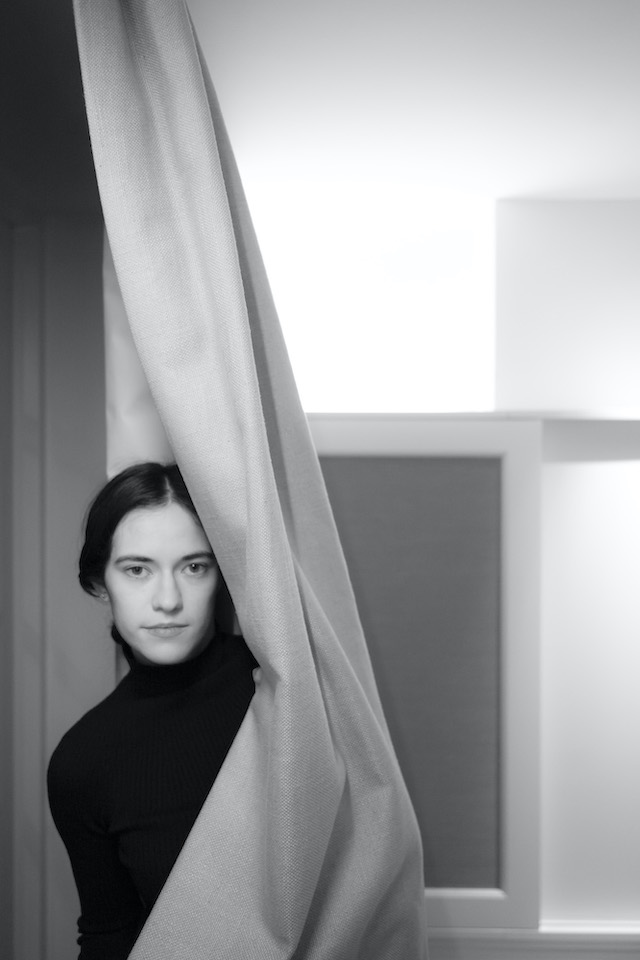
A: The curtain?

C: That’s a good one.

A: Ok, so, probably one of the first photos that I asked Caleb to make with my ‘take’ was of me behind a curtain. He was photographing me with my hand sticking out and then I asked him to take one for me, where I totally hid behind the curtain and then called it a self-portrait. We thought it was hilarious and had a lot of fun with this and then this opened up to us collaborating in making the photo of me behind the curtain with my face showing and looking directly at the camera. 

C: We were on the floor laughing about this. It was just a photo of a curtain, no one in sight. Very “conceptual”.  

Is it ever difficult working with your partner?

C: No! 

A: Not at all. There’s no thin ice.

What are the benefits?

A: We trust each other very much. Living life and making art get mixed together in a way I’m drawn to.

C: As am I. We talk about this often, and it feels like our love for each other finds a way into the work. 

A: Making work can take many forms, but we’re both interested in working from a place of love. That’s what it’s all about. 

Andrea 2020

What advice would you give someone who’s looking to work with their partner?

C: Listen to each other and let go of your ego as much as possible, it will open up into something rewarding and surprising. 

A: Have fun with it, don’t compromise – keep talking and debating until you both have a shared epiphany, then move forward with this decisively and with energy. 

What’s next for you both?

A: We are working on our next project American Glitch, which is a look at the slippage between fact and fiction and how this manifests in the American landscape. We are traveling to every state in the U.S. and living out of our car for the next year. We’ll also continue to work on Andrea throughout the year. 

Andrea 2020
Andrea 2021
Andrea 2020
Andrea 2020
Andrea 2021

Photography courtesy of Orejarena & Stein

Mango Season

Andrea Hernández Briceño, who’s part of this year’s Latin American Foto Festival, uses her medium to raise awareness of food insecurity in Venezuela

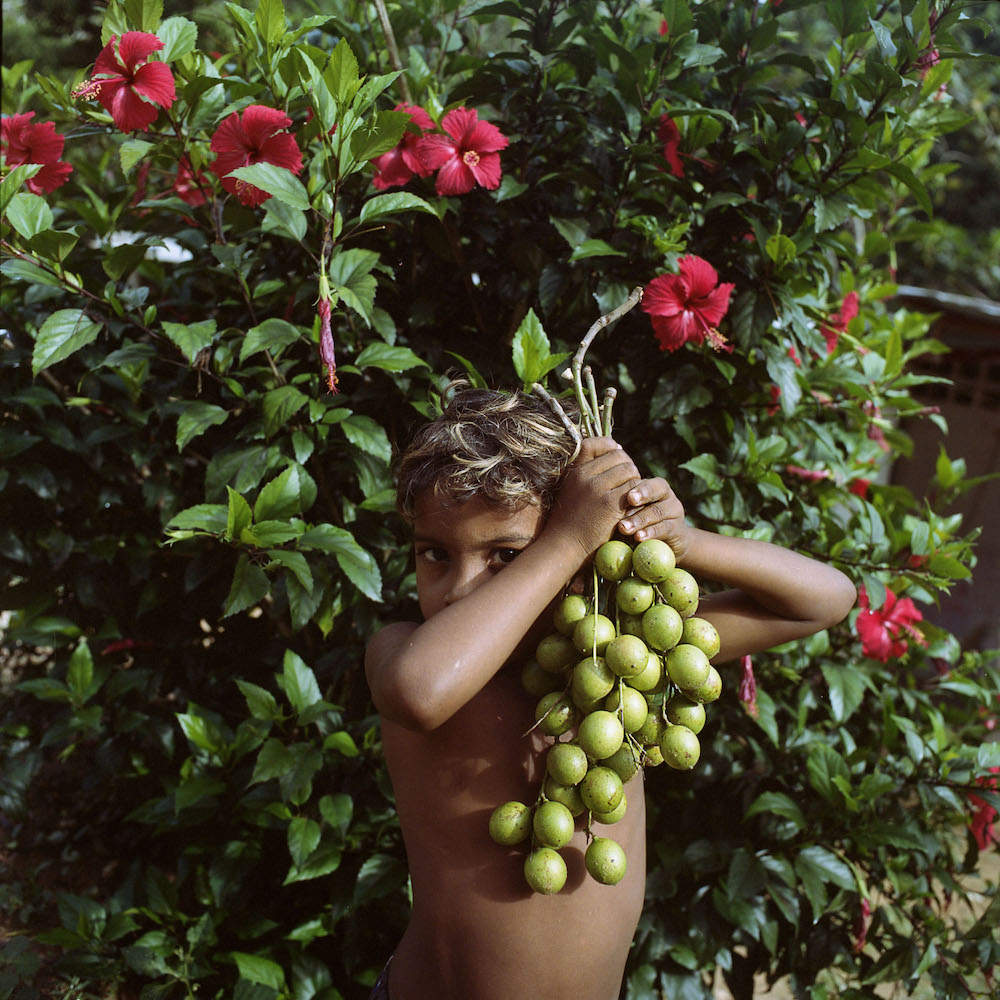
Alfred Flores, 5, holds a bunch of quenettes in Patanemo, Venezuela, on July 17, 2020. “He’s a demon”, everyone says. This just means that he’s a restless kid, not that he’s possessed by the devil or something. His family lives from the land, since they don’t earn enough to buy food in a supermarket. They trade what they hunt and grow with other people from the area. When he was born, life was different. This image is part of the Mango Season chapter of the project The Nature That Inhabits Us with the collective Ayün Fotógrafas. ©Andrea Hernández Briceño / Emergency Fund for Journalists by the National Geographic Society.

Launching this month is the fourth edition of the annual Latin American Foto Festival, hosted by The Bronx Documentary Centre and featuring large-scale photographs throughout the Melrose community. Within, and available to view online, the festival sheds light on a collection of notable image-makers, including Venezuelan photographers Andrea Hernández Briceño and Rodrigo Abd. Both of whom reflect on humanity’s relationship with nature, particularly focusing on the country’s fragility with oil industry, economic decline and the climate. Other photographers involved are Florence Goupil, Cristóbal Victor Peña, Pablo E. Piovano, Victoria Razo and Carlos Saavegdra.

Andrea, in particular, is a visual storyteller based in Caracas who’s “interested in many things, but especially in everything that touches the social sphere, migration and women’s issues.” After graduating from a Mass Communications major with a specialism in journalism, she continued her education at the International Centre of Photography in New York with a scholarship in Visual Journalism and Documentary Program. After which she decided to return to Venezuela, kicking off her career in the arts and forming part of the collective of women photographers united by Latin America, named Ayün Fotógrafas.

While back in Venezuela, Andrea started work on a photography project entitled Mango Season – delving into the annual dry season in which fruits begin to fall from the trees in all their sweet and generous abundance. Mango season, for many in the country, is a lifeline, and The United Nations’ World Food Program has reported that one-third of Venezuelans are suffering from food insecurity. Coupled with the pandemic and oil shortages, the country is in crisis. Below, I chat to Andrea to find out more about her work and what she hopes to achieve through her colourful and impactful imagery.

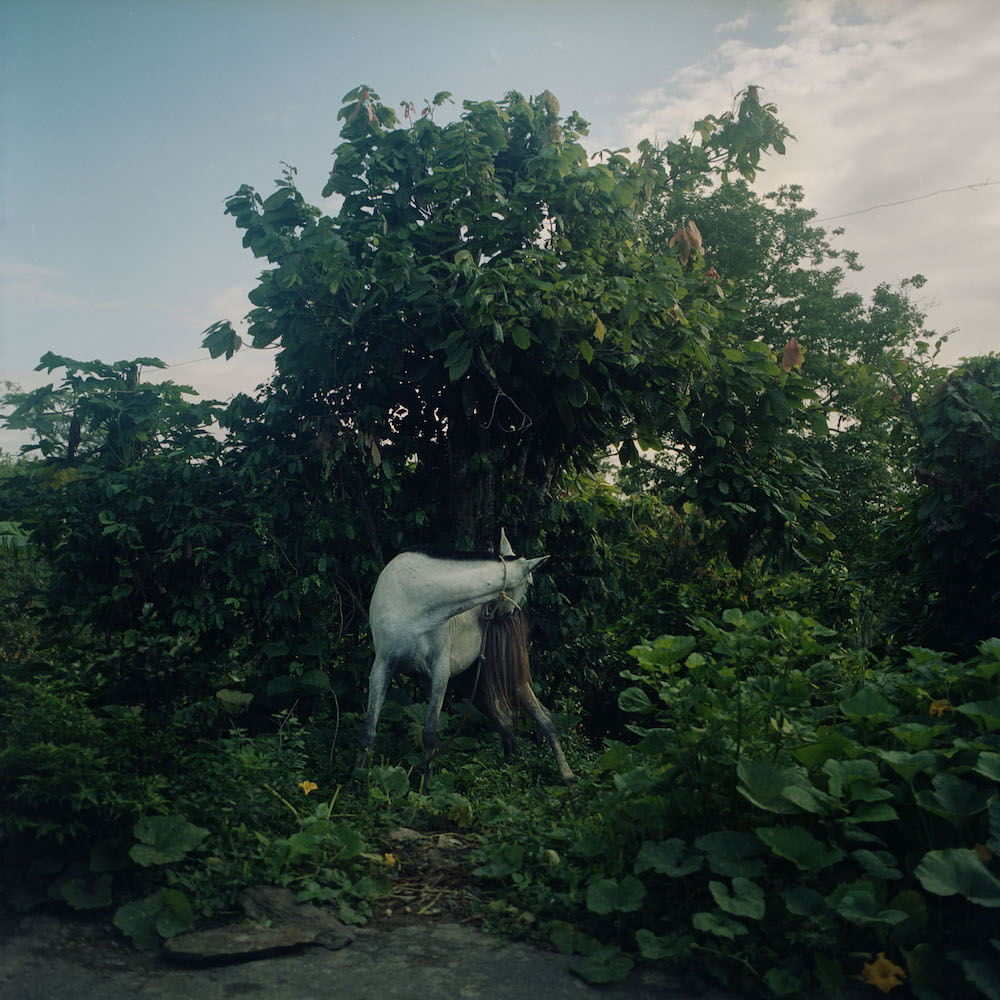
A working horse bites its tail during a break from carrying cocoa beans in a farm in Patanemo, Venezuela, on July 16, 2020. It is owned by the Flores family. They live from the land, since they don’t earn enough to buy food in a supermarket. They trade what they hunt and grow with other people from the area. This image is part of the Mango Season chapter of the project The Nature That Inhabits Us with the collective Ayün Fotógrafas. ©Andrea Hernández Briceño / Emergency Fund for Journalists by the National Geographic Society.

What’s your ethos as a photographer, and what stories do you strive to tell?

The stories that move me the most are the one’s where I can clearly convey the dignity of the people that I’m portraying. I believe that this connects the audience to the people portrayed and feel very satisfied when I think I’ve achieved it.

I’m a storyteller and one of the biggest and most transversal stories now is food insecurity. It affects more than 90% of Venezuelans. 

Can you give some more context into the mango season in Venezuela, how is it celebrated?

The mango season lasts about four months and during this time, people have a little bit of food guaranteed. It is not exactly celebrated because we used to think of the mango season as a problem: when they fell, they could break a windshield or dent the hood of a car, they also rotted on the floor and brought flies and disease. But today, its meaning is changing to something good. They don’t rot anymore on the floor because there’s always someone that picks them up.

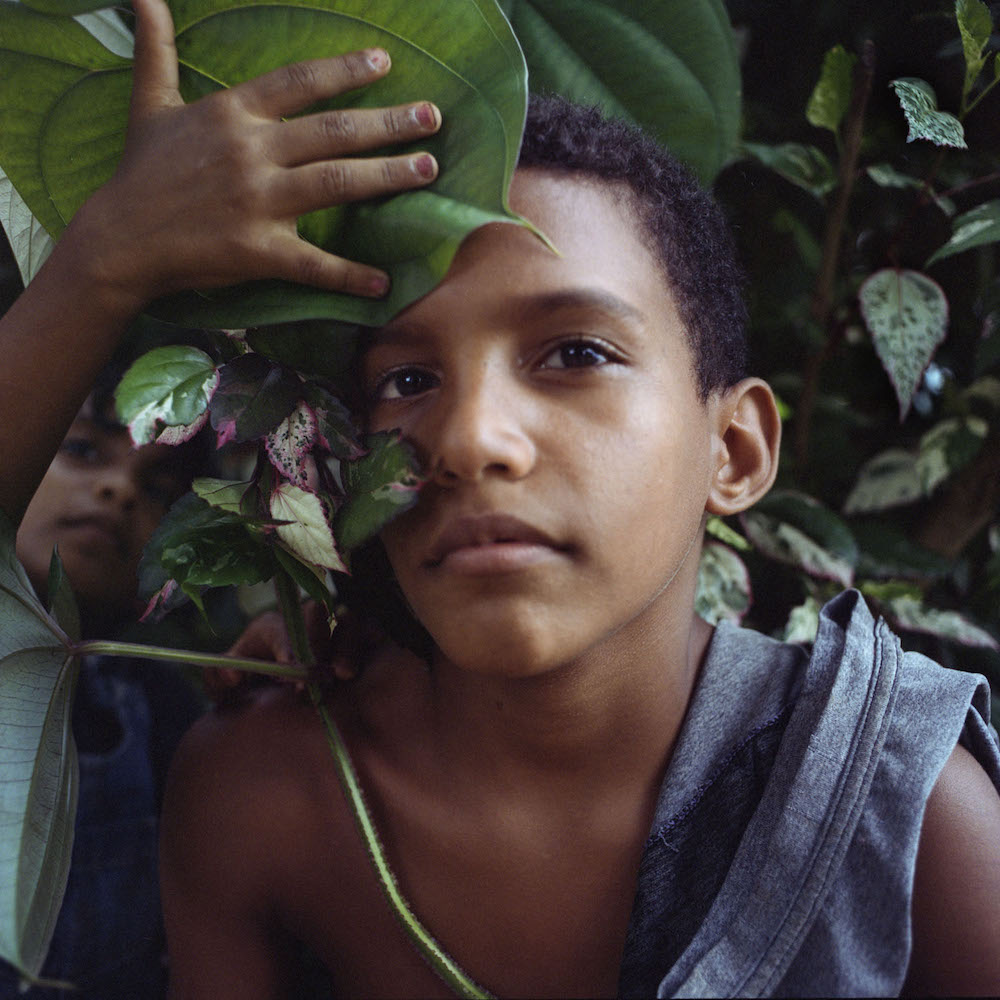
Luis Alfredo Flores, 11, poses for a portrait in a cocoa farm in Patanemo, Venezuela, on July 16, 2020. This land is worked by his family. They live from it, since they don’t earn enough to buy food in a supermarket. They trade what they hunt and grow with other people from the area. This image is part of the Mango Season chapter of the project The Nature That Inhabits Us with the collective Ayün Fotógrafas. ©Andrea Hernández Briceño / Emergency Fund for Journalists by the National Geographic Society.

How has mango season changed over time, has it been affected by climate change and the pandemic?

Climate change hasn’t affected the mango season very much. These trees actually bear fruit during the dry season.

For the last six years, the mango season has changed its meaning into something good because of the social, political and economic crisis. So when the pandemic began, it just felt as if another element was added to the whirlwind of terrible living conditions (we also have fuel shortages now, ironically in an oil producing country). But it shifted my perspective and made me think of a different way to make this abstract story into something visual: it made me look for moments that showed the beauty, strong will and dignity of Venezuelans in this adverse situation.

Do you have any personal anecdotes or stories to share about mango season?

At the beginning of the pandemic, everything stopped. It felt as if we were suspended in the air. There was so much free time. So I went almost every day at my parents house. They have a big backyard with mango trees and they had just put some seeds for grass. I talked a lot with my dad; about love, family and expectations. We sat there drinking coffee or something stronger in the afternoon, watching the grass grow. Literally.

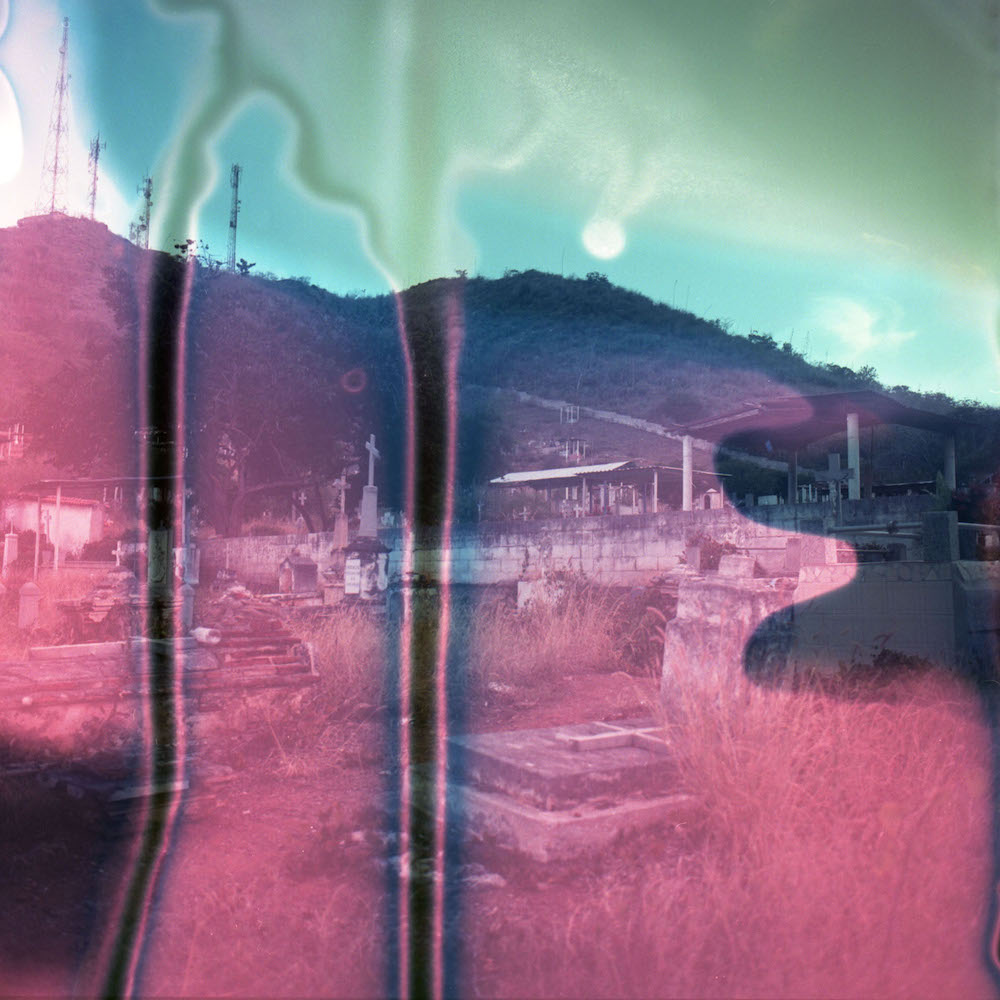
The Choroni cemetery in Venezuela, on January 30, 2021. This photograph (a damaged negative, a happy accident) This image is part of the Mango Season chapter of the project The Nature That Inhabits Us with the collective Ayün Fotógrafas. ©Andrea Hernández Briceño / Emergency Fund for Journalists by the National Geographic Society.

In terms of your imagery, from what I’ve gathered you’ve shot in quite a colourful and joyous manner – which is a contrast to the important topics addressed. Is this intentional, perhaps to make harsher topics more digestible?

The collective imagery of Venezuela is quite different to this body of work. My country is almost always portrayed as a sad, miserable place because there is a crisis going on. I’ve also added to this imagery because it is real, necessary and important for our history. But I also think that it is essential to show the in-between moments of calm, joy and connection. It is a different way to portray our humanity. I think it makes the audience feel a little bit closer to us because they can see themselves in the magic of everyday life and nature.

As your work’s now part of the Latin American Foto Festival, what do you hope to achieve? What can the audience learn about Venezuela, nature and the environment?

Being part of this festival has been a dream of mine since I came four years ago. I thought it was an amazing way to bring the power of photography into a community. With this work I hope to broaden the horizons of the people that look at Mango Season. I wish to make it easier to recognise the humanity in others, even if they are in far away places. And I also hope to bring the people that I photographed In Caracas, Patanemo, Choroní, San Antonio de Los Altos and Chuspa closer to the people in The Bronx and the US. It’s just a dream, but I think it can come true because my dream of exhibiting at this festival came true.

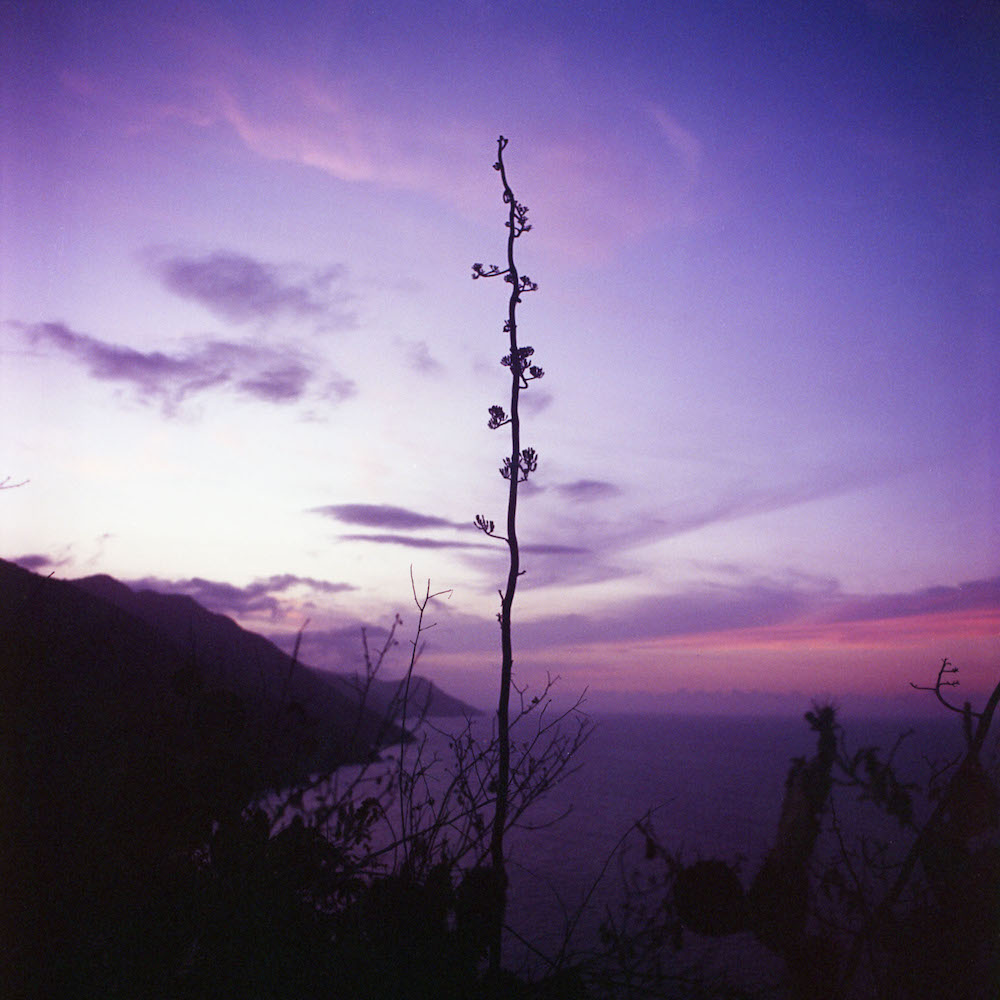
View from the highest mountaintop in Choroni, Venezuela, on January 30, 2021. This image is part of the Mango Season chapter of the project The Nature That Inhabits Us with the collective Ayün Fotógrafas. ©Andrea Hernández Briceño / Emergency Fund for Journalists by the National Geographic Society.
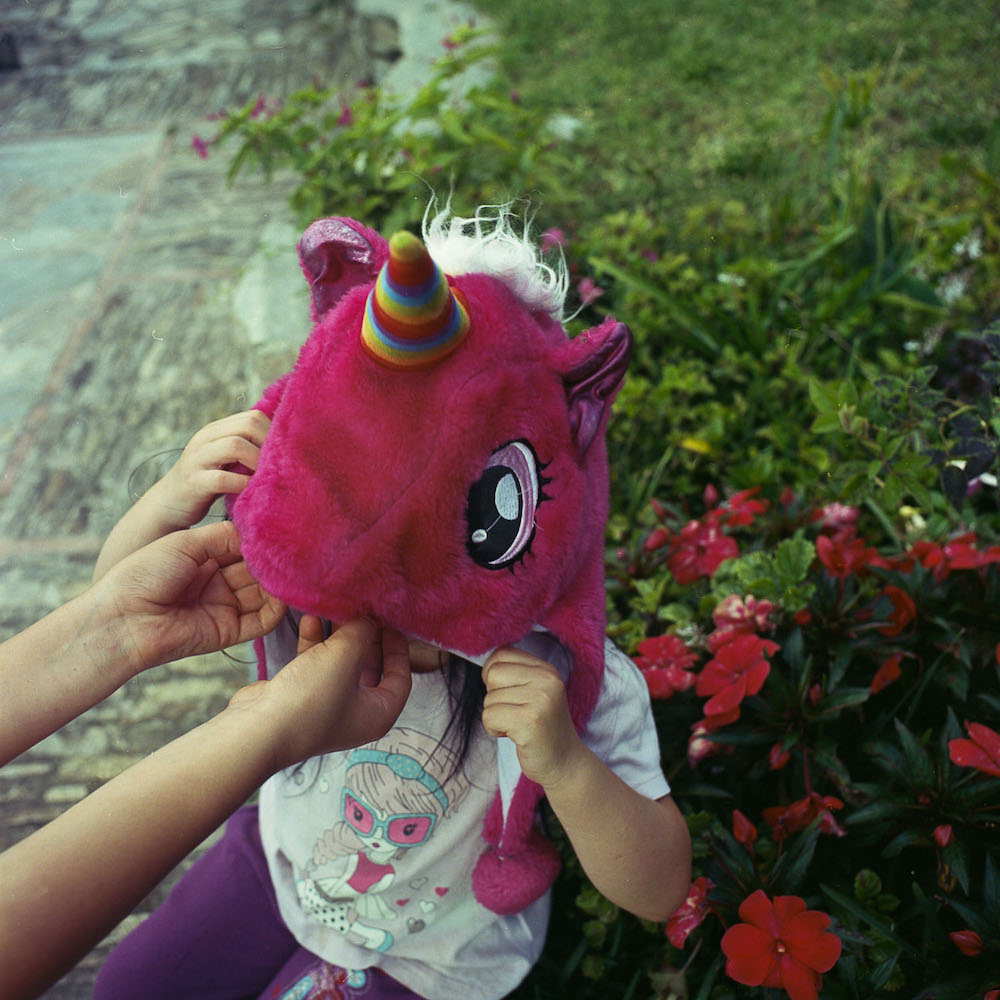
A girl straightens her little sister’s unicorn hat in Galipan, Venezuela, on October 4, 2020. This image is part of the Mango Season chapter of the project The Nature That Inhabits Us with the collective Ayün Fotógrafas. ©Andrea Hernández Briceño / Emergency Fund for Journalists by the National Geographic Society.
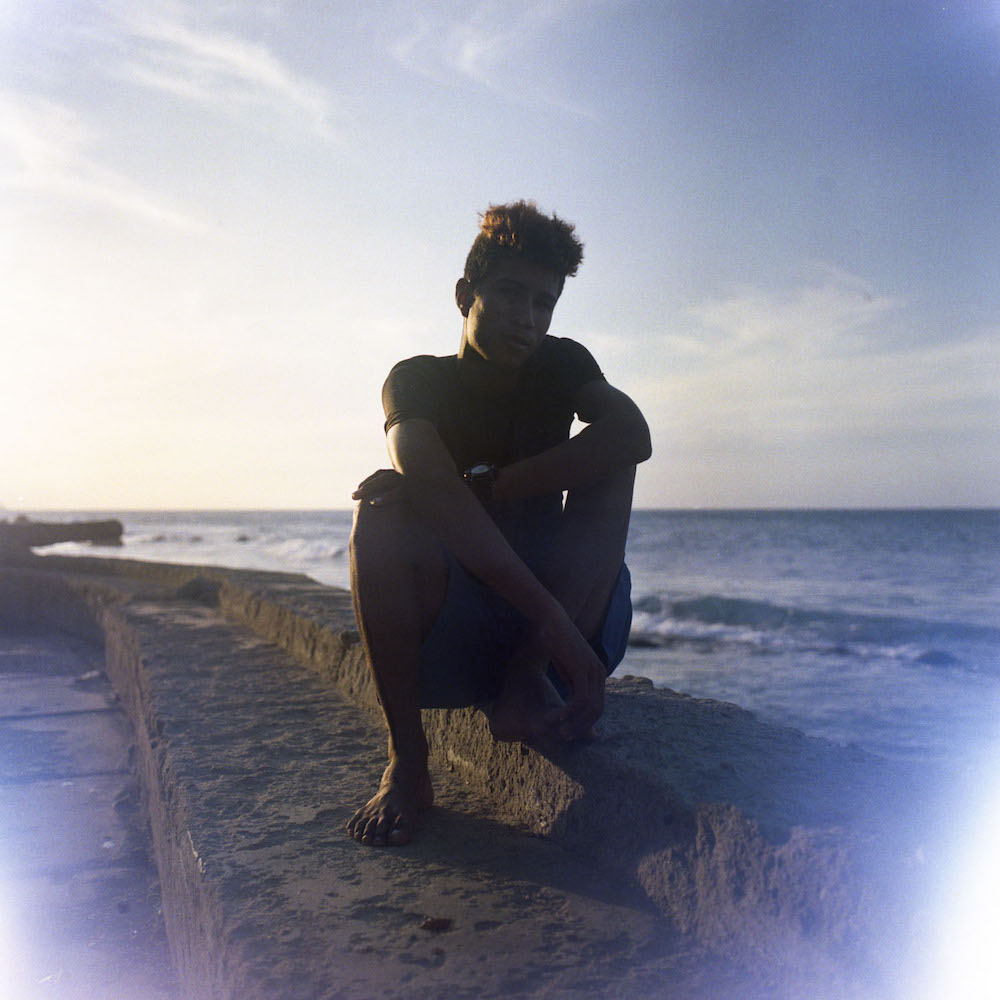
A fisherman sits on the “malecón” in Choroní, Venezuela, on January 31, 2021. This image is part of the Mango Season chapter of the project The Nature That Inhabits Us with the collective Ayün Fotógrafas. ©Andrea Hernández Briceño / Emergency Fund for Journalists by the National Geographic Society

Finding Common Ground

Kemka Ajoku’s new series captures migration and settlement of Black people in the UK after the Windrush era

The After Party

A photographer of fashion and portraiture, Kemka Ajoku – who’s born and raised in London – strives to rewrite the stories of Black British culture. Done so through a mix of personal projects and commissions, Kemka has documented all sorts of meaningful tales from the locals of Lagos, busy in the tasks of their everyday jobs, and the beauty of brotherhood in the post-adolescent stage of life. Each picture he takes reverberates with purpose and passion; he’s a storyteller of truth, and someone who employs visual art as a tool for spreading his messages.

Over the last year, which has been a difficult one for many, if not all, Kemka has managed to find a sense of fulfilment. Not only did he graduate at the end of 2020 form a degree in Mechanical Engineering, he also arrived back home and broke away from the educational system for the first time in his life. “I felt free to creatively understand more about who I am,” he tells me, “looking back at my lineage as a guide to learning more about myself, having never given myself the space or time to truly be introspective.”

Gestural Greetings

A period of self-awareness and contemplation, Kemka’s ventures out into the ‘real world’ arose alongside the arrival of the pandemic. Coupled with the increase in racist hate crimes and injustice the globe, he began to question his role as a photographer, “a Black British photographer for that matter.” A sense of responsibility emerged: “a need to document the life of my people both in Nigeria and the diaspora,” he says. “To me, this was more important than taking a pretty photo. And so, a paradigm shift took place within me, a shift which led to me working with more intentionality, giving more meaning to the work with the hopes of lasting the test of time.”

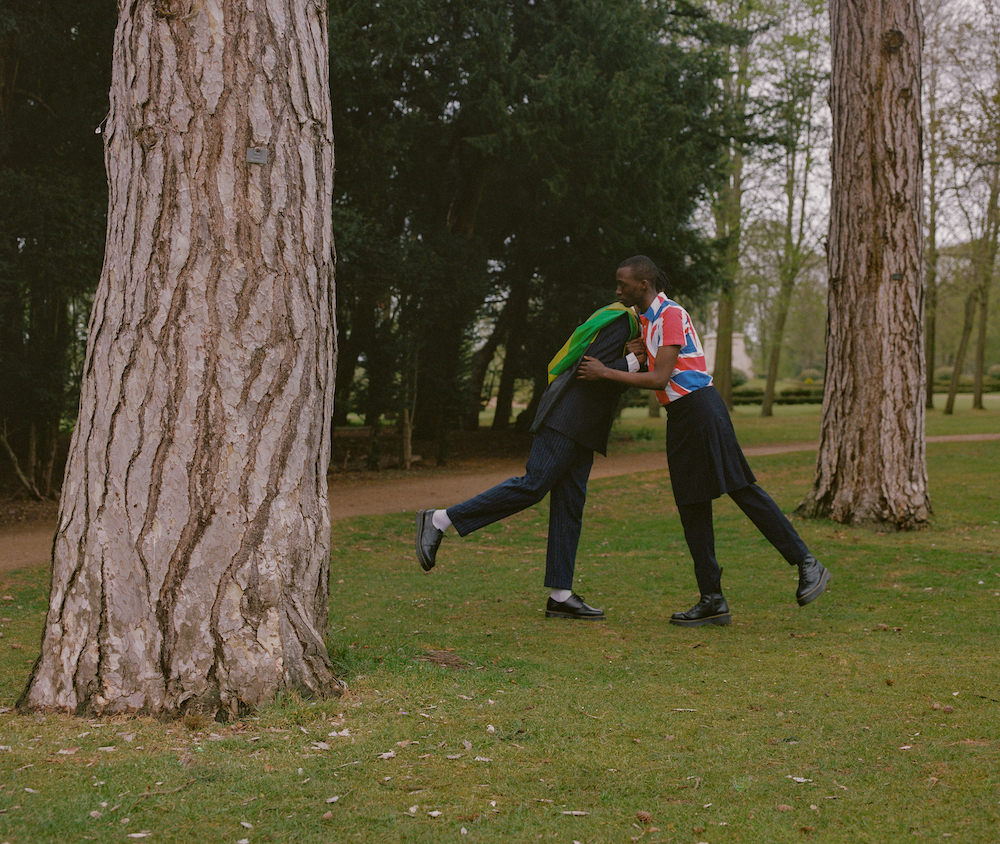
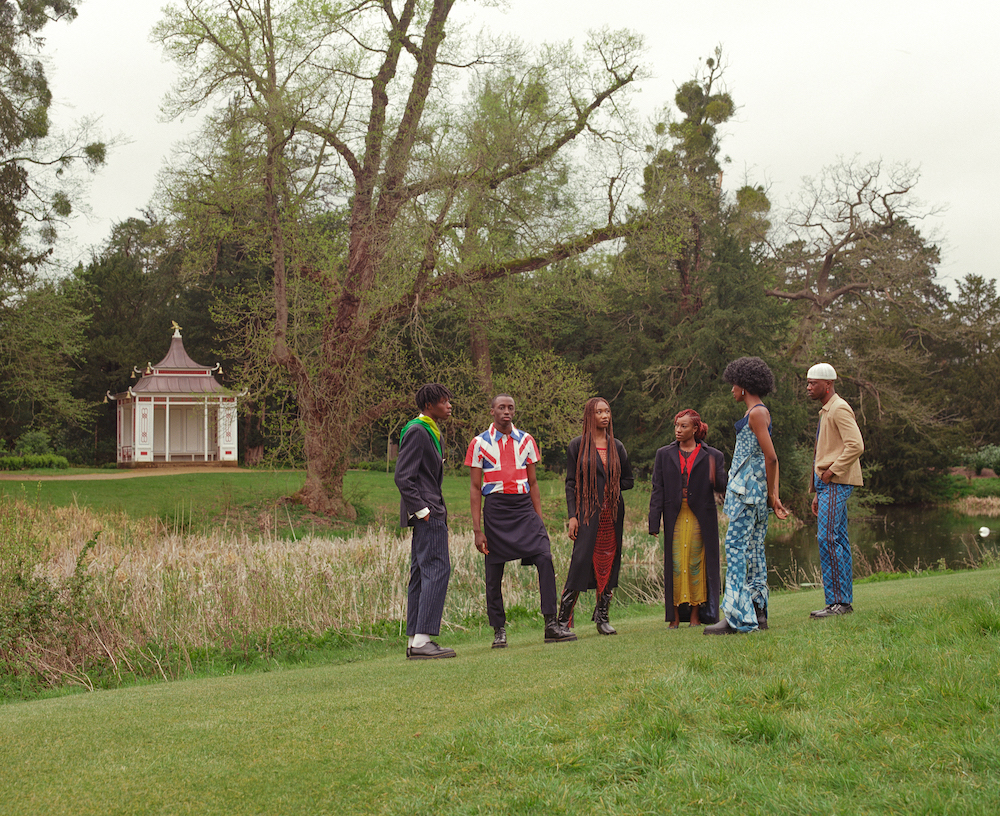
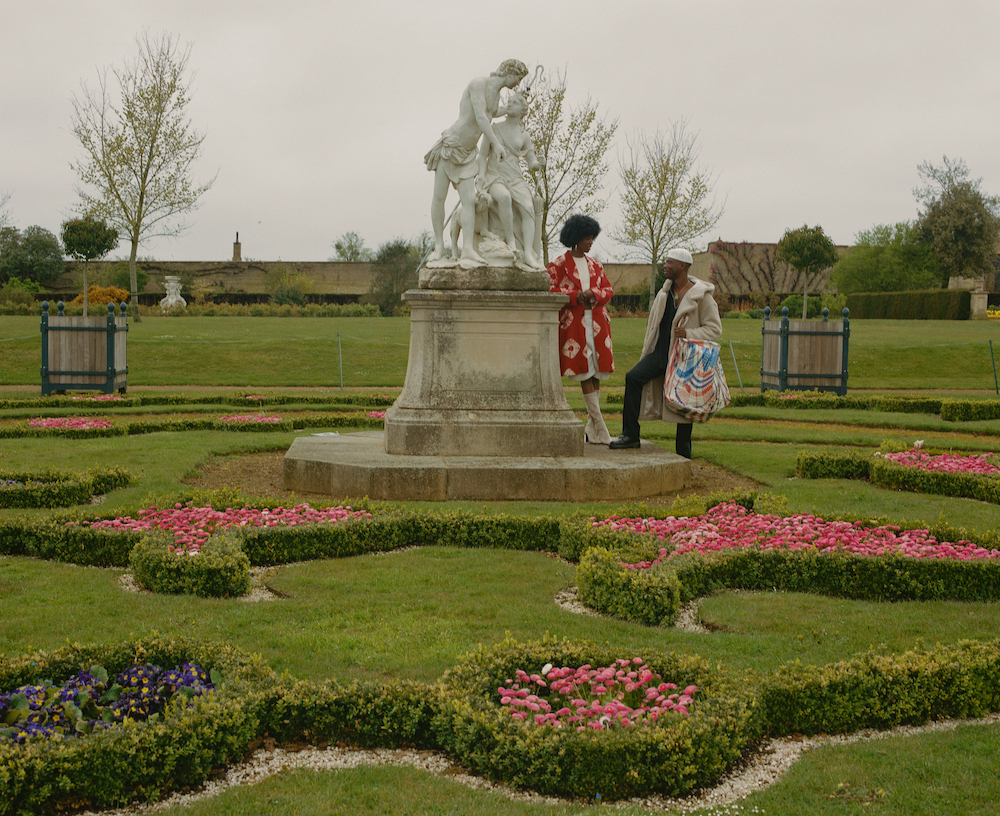
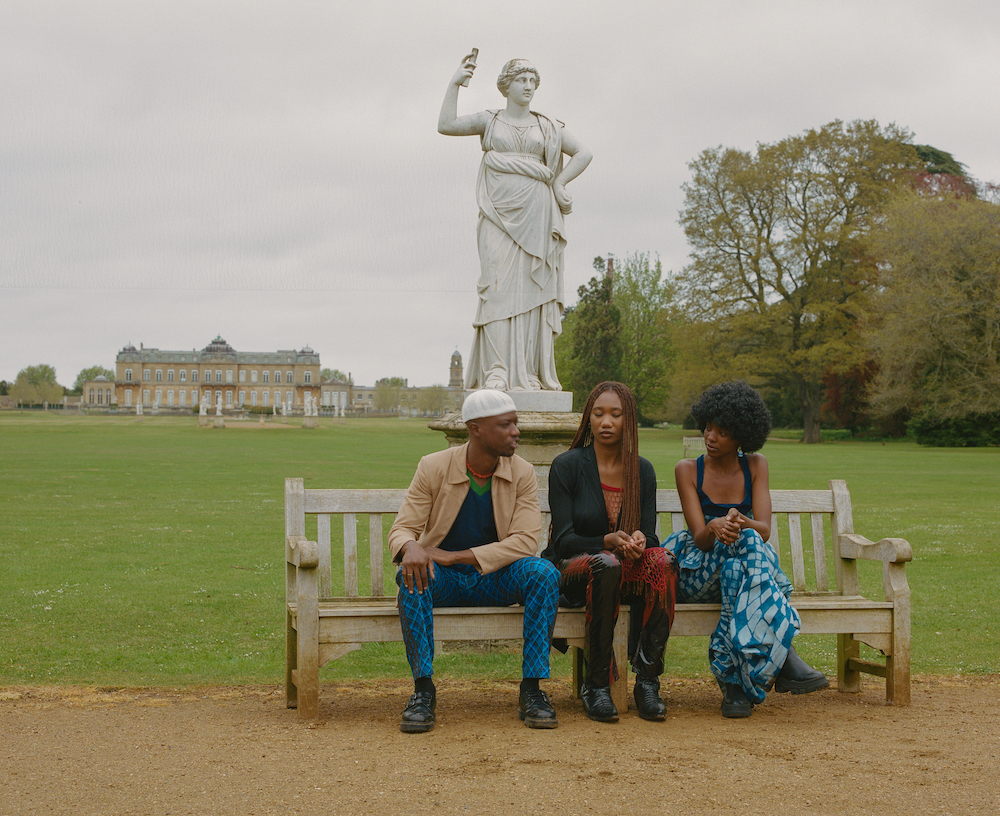
This matured sensibility has manifested into his latest photo series, titled Finding Common Ground. Months in the making, the body of work is currently exhibiting at Wrest Park as part of the England’s New Lenses project with Photoworks, in partnership with English Heritage’s Shout Out Loud programme. In comparison to his previous series – although motivated in their own right – Kemka has never worked with such drive and ethos. “I sat down and really articulated what I wanted to achieve before picking up my camera.” A lengthy bout of research and exploration later, he came to learn more about the migration and settlement of Black people in the UK after the Windrush era, “a story that me, my parents, and their parents are part of.”

Tami’s Portrait

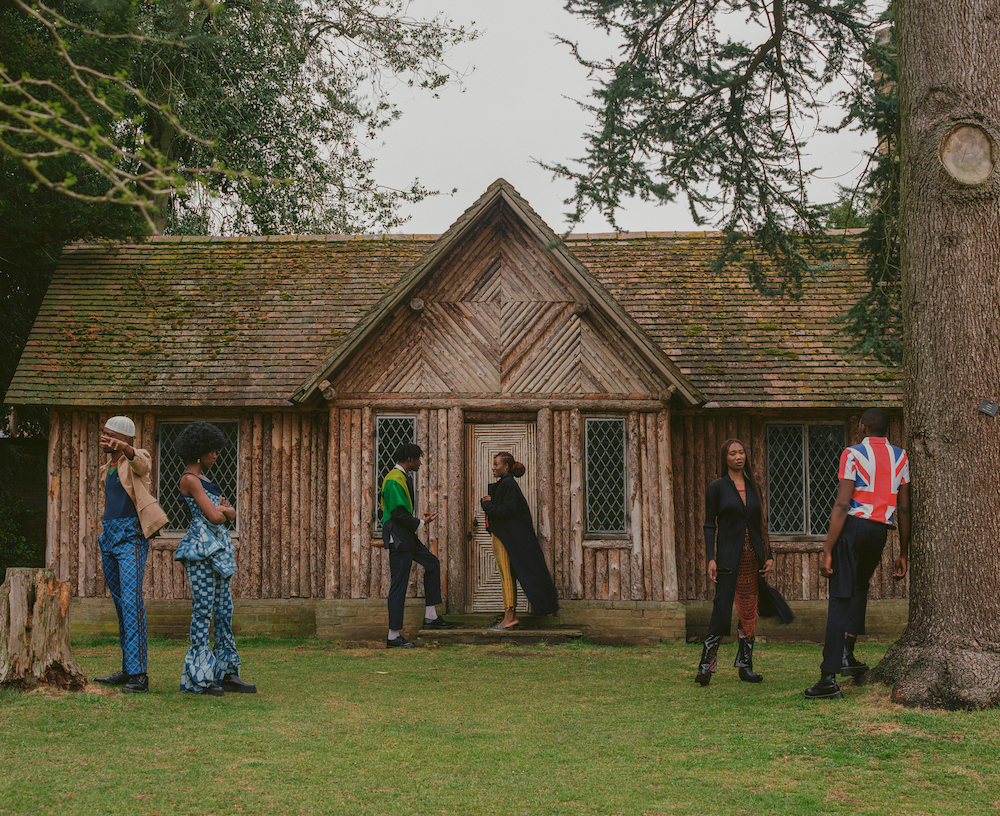
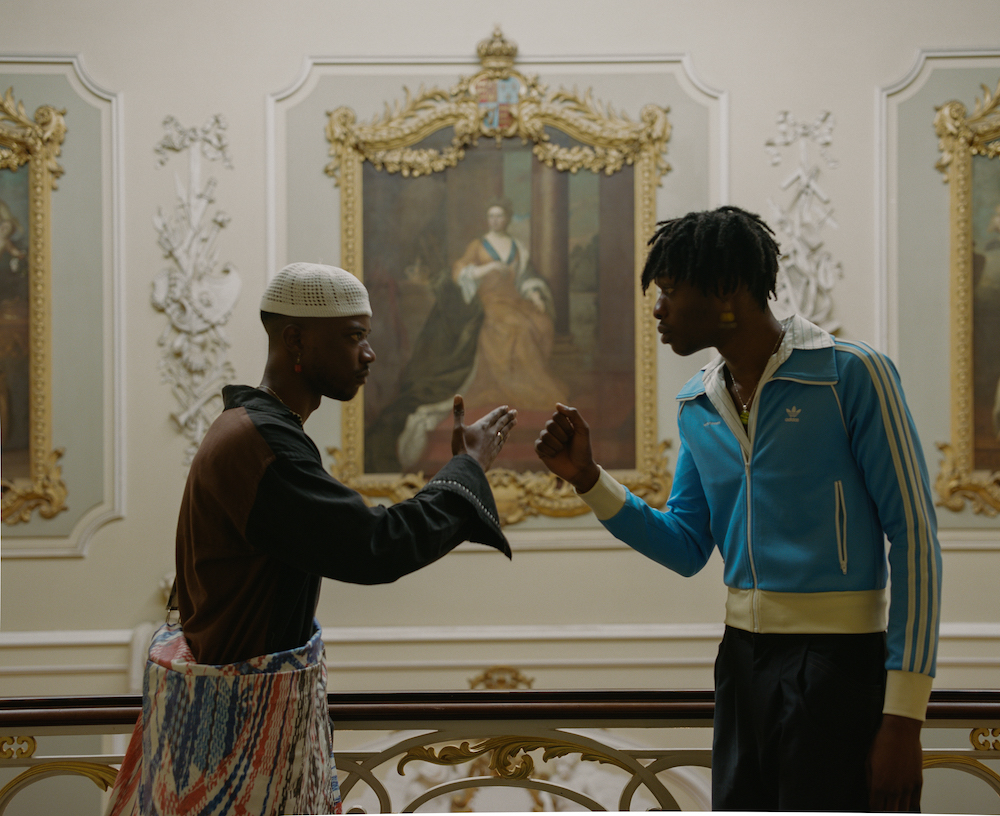
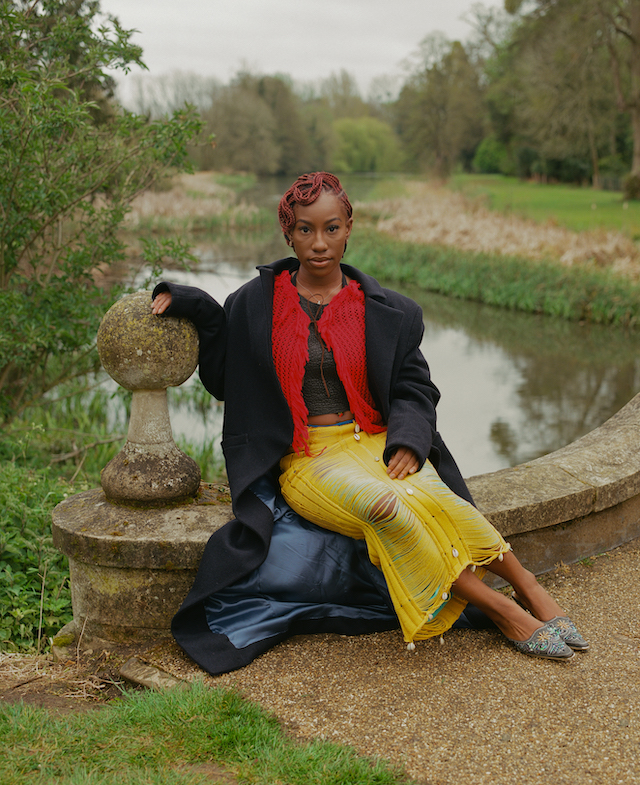
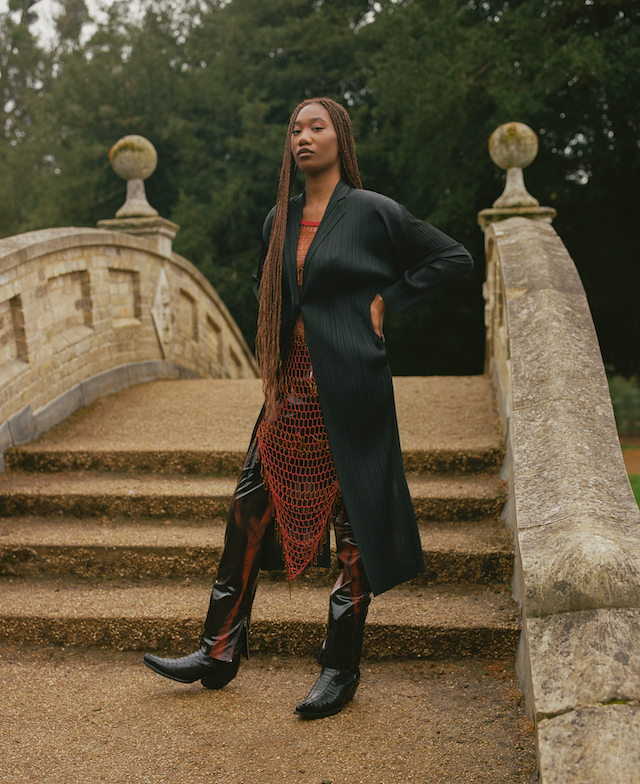
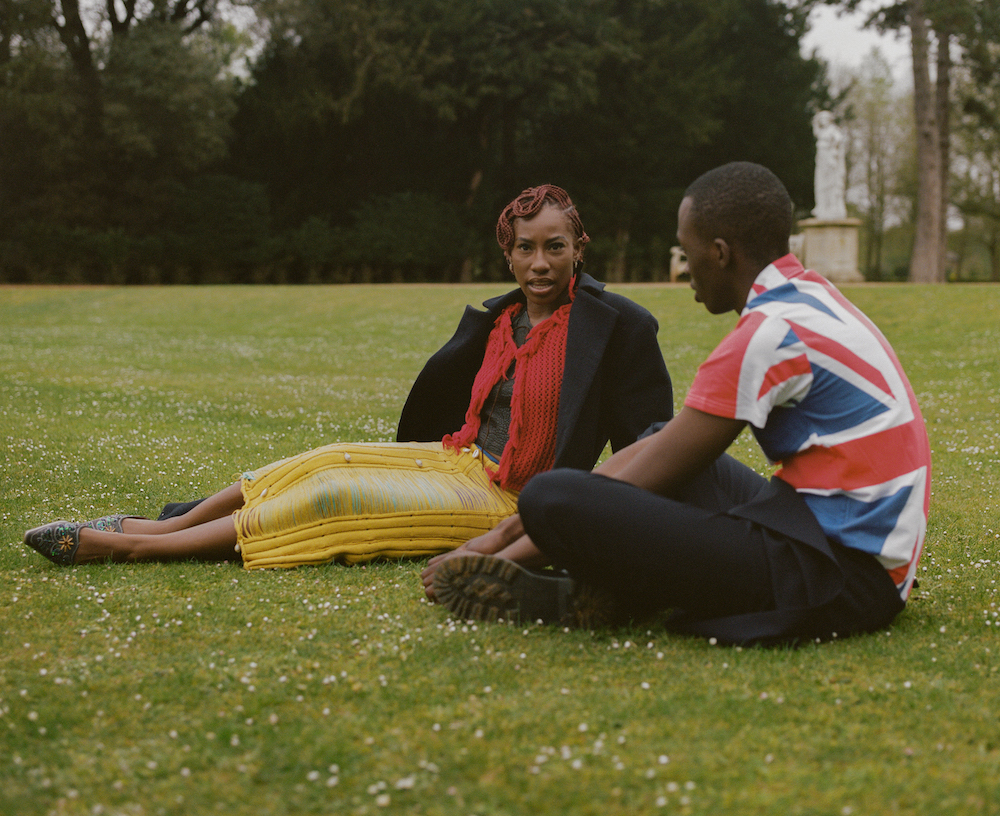
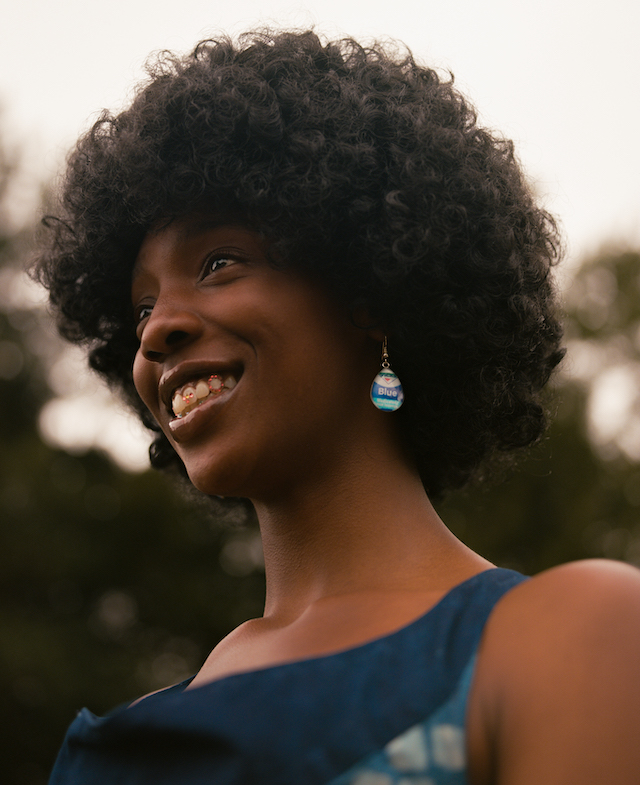
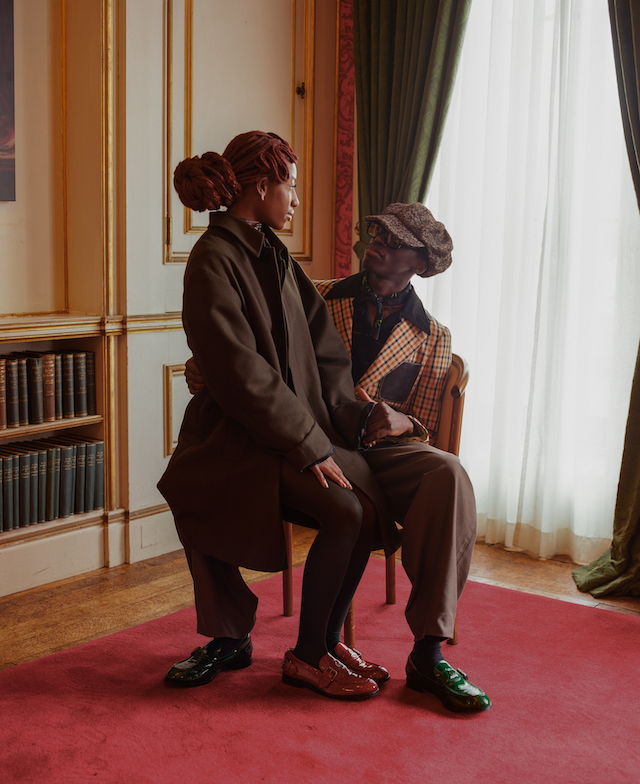
The photos involved are therefore contemplative, powerful and historical. Shot in Wrest Park, Bedfordshire, the location protrudes with British heritage as it’s built atop the style of an 18th Century French Chateau. He cast a selection of his friends to sit for him, each representing a specific demographic within the Black British community. Referred to as “characters”, Kemka explains how each of his models’ personas have been developed from “watching British Blaxploitation films from the 70s and 80s; films such as Black Joy, Babylon Burning an Illusion and Pressure to name a few.” To accentuate this, Kemka worked with stylists Daniel Obaweya, Charles Ndoimu and Lingani Noah who assisted with adorning the models in Black British clothing lines from both young and more established labels. 

Western Union

“The styling for this project was broken into two parts, highlighting two generations of Black British citizens,” adds Kemka, “from the tailored style of the late 40s and early 50s, to the more relaxed and youthful looks of the 70s and 80s. Fashion is an important part of British culture, used in a way to express identity with the community one associates themselves with. Many fashion nuances migrated from foreign land have interwoven with British styling over recent years, and this integration of style was a focal point in styling the models.”

Observing the completed works and you’ll notice how the poses or gestures appear to have been caught in a freeze frame – recording not only that moment in time, but also an experience and learning exuded from the photographer who’s captured them. “The intention with this work is to artistically depict an important era in Black British history (not in a common documentary photography fashion) that will have longevity long after I’m around,” he concludes. “Thinking back to my intentions as a photographer, one thing I revert to is the legacy my work will have for other Black British creatives, looking for a reference upon which to build their creative career upon.”

One View of the Temple
Kozy’s Portrait
Couple in Wrest garden
The Consultation
Wrest River
The Essence of Chi
Lover’s Rock

Credits:

Photographer: Kemka Ajoku

Assistant Photographer: Anu Akande

Talent: Kozy, Ore Ajala, Amidu Kebbie, Chieloka Uzokwe, Tami Bolu, Feranmi Eso

Hair: Shamara Roper

Styling Team: Daniel Obaweya, Charles Ndiomu, Lingani Noah

Special Thanks: Mahtab Hussain, Ingrid Pollard

And special thanks to Photoworks and English Heritage for giving me the opportunity to create this body of work through their ‘England’s New Lenses’ project

Growing Spaces

Chris Hoare’s new book documents the rise in allotment-goers over lockdown

Tara gets stuck into gardening at St Paul’s Community Garden, with the help of her three daughters, Ashti, Arianne and Astera © Chris Hoare

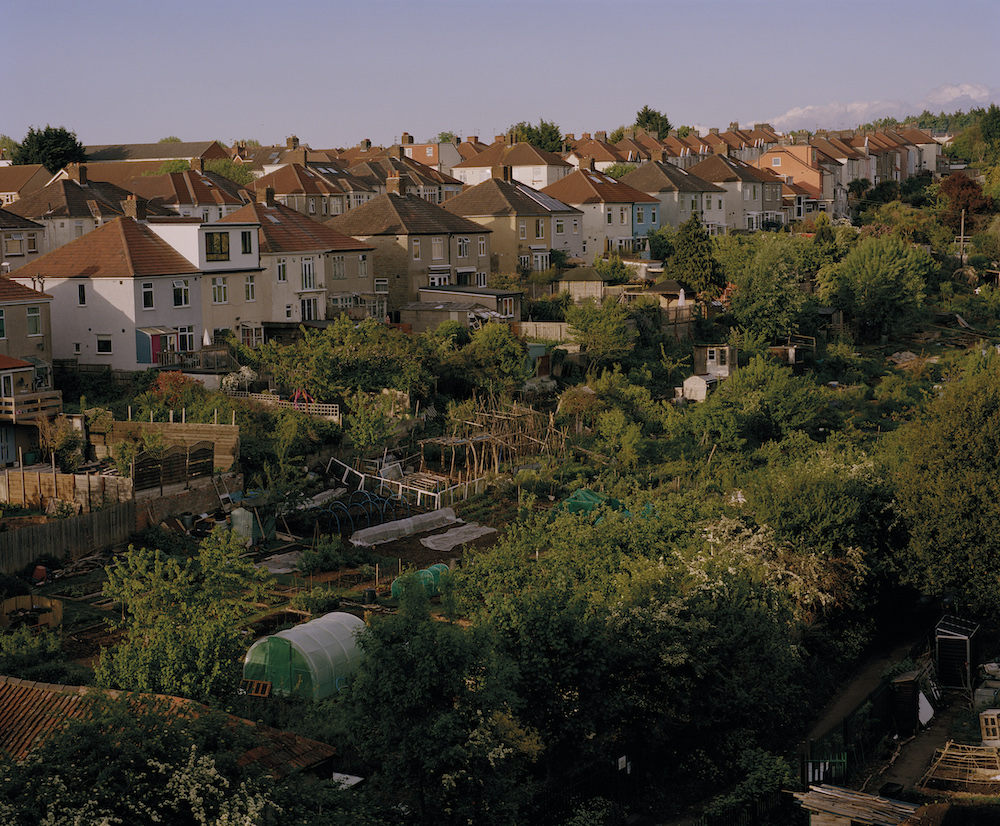
The allotment garden is a place of tranquility, a blissful haven away from the home and hum of city life. Not only does this designated plot of land give its gardener access to a sustainable source of food – in turn contributing to pollination, biodiversity, local climate and soil fertility – it’s also a place of community. It brings people together and has thus been a lifeline for many over the course of the pandemic.

A year after the first lockdown was imposed, more and more are we yearning to be amongst nature. This has given way to an increased demand for allotments, turning the humble allocated space into a highly sought after commodity. It’s an interesting (although expected) transformation, considering how the allotment first made appearances during the Second World War, after the “Dig for Victory” agriculture campaign came into play and encouraged Britain to grow their own produce. And what was then a historically working class necessity soon evolved into a hobbyist pastime, with recent years breaking down these stereotypes and reaching a crescendo amongst the younger population. 

View over Royate Hill Allotments, taken in June © Chris Hoare

Although an estimated number of 300,000 allotments can be found around the UK, these supplies are in fact dwindling. A paper, published by Imperial College London researchers at the Centre for Environmental Policy, states there’s now thousands – 30,000 to be exact – of hopeful gardeners remaining on waiting lists, with a four to five year delay in receiving a plot of land. What’s more is that numerous London sites have closed in recent times, resulting in a thinning supply and cuts to the size of existing units. 

Chris Hoare, a Bristol-based photographer, assesses this increment in his new body of work and book, Growing Spaces, published by RRB PhotobooksA documentation of allotment-goers in the southwestern city, the project was commissioned by Bristol Photo Festival for its expansive exhibition set to launch this summer. “It felt important to be documenting this urge that society was having for the outdoors at such a historic moment,” he tells us. 

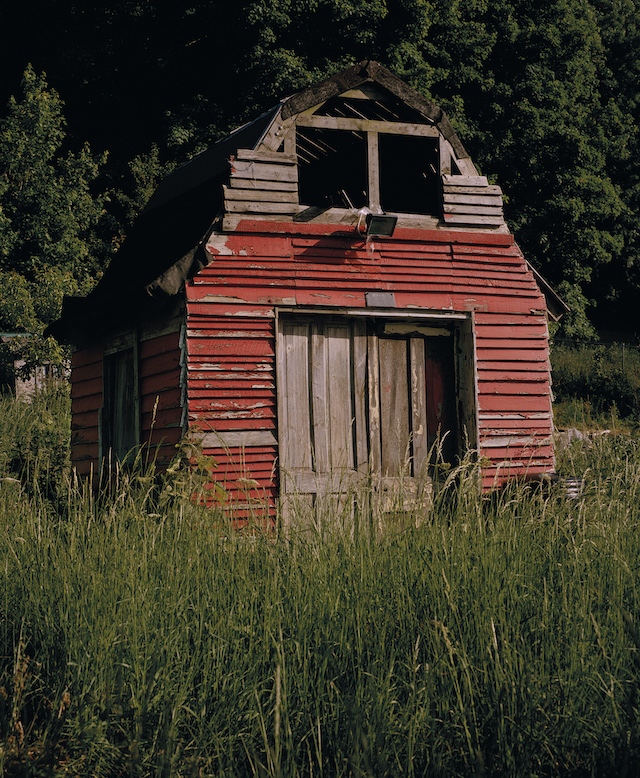
Abandoned shed, Bedminster © Chris Hoare

Having spent his childhood years on the edge of Bristol, Chris went on to study a BA in Photography at Falmouth University before returning to his hometown for an MA in Bristol UWE. Surprisingly, Chris’ relationship with allotments was next to nothing prior to the making of this series. Besides nurturing some “mildly successful” tomato plants in previous times, he simply wasn’t aware of this flourishing community of growers. “For the most part, they are private spaces even though everyone has a statutory right to one,” he adds. “It’s this ‘right’ that any one can own one that interested me as I made the work. I feel like they hold a special place in British society and it’s easy to overlook their significance.”

“At a time when land ownership is so unattainable for so many and urban areas become more tightly congested, they signify a little piece of paradise,” he continues. “The growing itself is only one part of the rich experience that many have when owning an allotment; it’s an important one of course, but there is so much more going on and a genuine sense of community in these spaces, which is a rare thing in this day and age.”

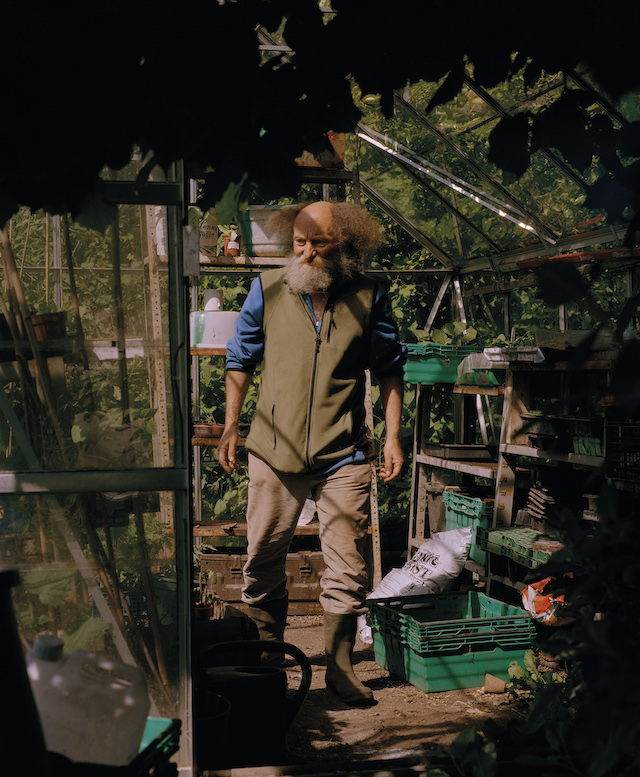
Mike Feingold in his greenhouse early May. Mikeis well known within the Bristol growing community, particularly because of the role he has played in promoting the philosophy of Permaculture. Alongside this he is the rep of an allotment site with an orchard containing 50 different varieties of apple, Royate Hill © Chris Hoare

Growing Spaces, in this case, lenses those who find solace in these divided and grassy perimeters. Amongst the tonal shots of flowers and crops, there’s a sense of ease and calm that protrudes throughout his photographs. Many of Chris’ subjects are those that he met fleetingly, while others he’d revisit time and time again, sometimes spending hours with each encounter. The only tricky part of it all was getting beyond the locked gates of the sites, which inadvertently maintains the assumption that allotments are indeed a privatised sphere only available for the selected few.

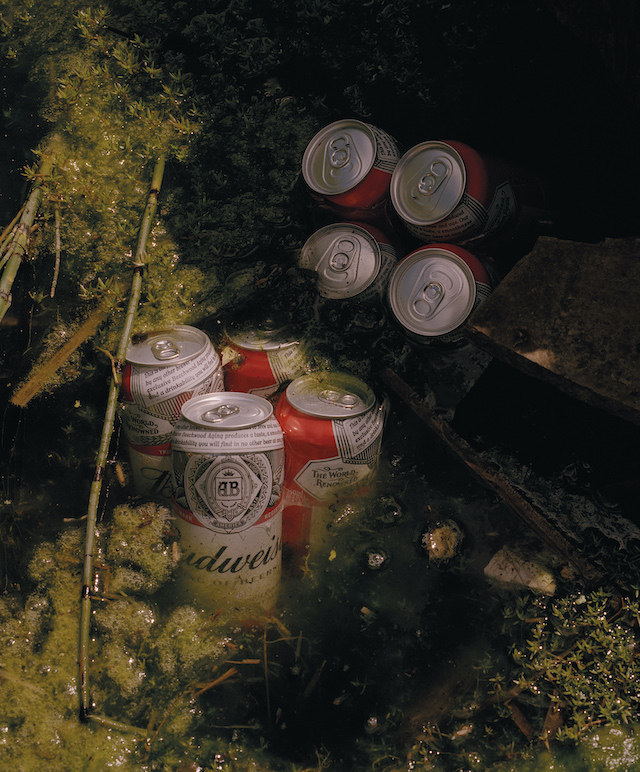
Chris continues to reminisce of one allotment in particular, owned by a couple who later became good friends of his. The first meeting occurred during a blissful Saturday in May, and he’d decided to venture to this “oasis in the city” – “it’s an easy place to spend time, hours drift away as afternoon quickly turns into evening, usually ending with a fire or BBQ,” he says. Having visited this plot more than the others, Chris sums up the memory with an image of Budweiser cans floating in an earthy pond, giving a new meaning as to what the allotment can provide for its gardeners. 

A pack of Budweiser keeps cool in a pond on a hot Saturday afternoon in late spring, Ashley Vale © Chris Hoare

Despite the uncertain future of the UK’s green spaces, there’s been a great resurgence in those visiting and using their allotments. But for now, this increase in demand currently outweighs availability. “I can’t see this changing for some time,” he reflects, “particularly given how this past year has altered our thinking around the importance of green spaces, thinking local and growing your own and the need for outdoor community activities.” So what will come of the humble allotment, and how will these plots affect our lands? Time can only tell, but rest assured that this is a positive moment for sustainable food cultivation.

Growing Spaces by Chris Hoare is published by RRB Photobooks and will be exhibited at Royal Fort Gardens, Bristol this summer as part of Bristol Photo Festival

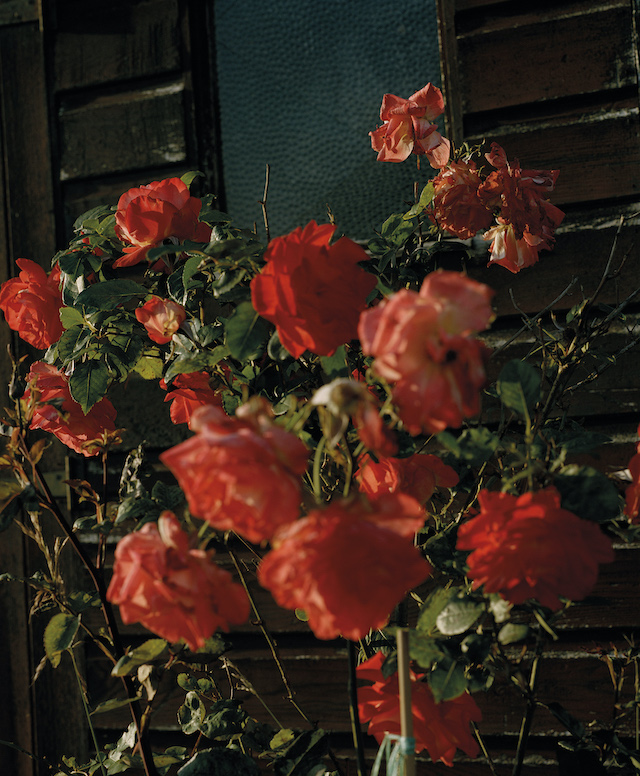
Sunset roses, Speedwell © Chris Hoare
Lexi shield’s her eyes during the apple pressing at the Totterdown Community Orchard © Chris Hoare
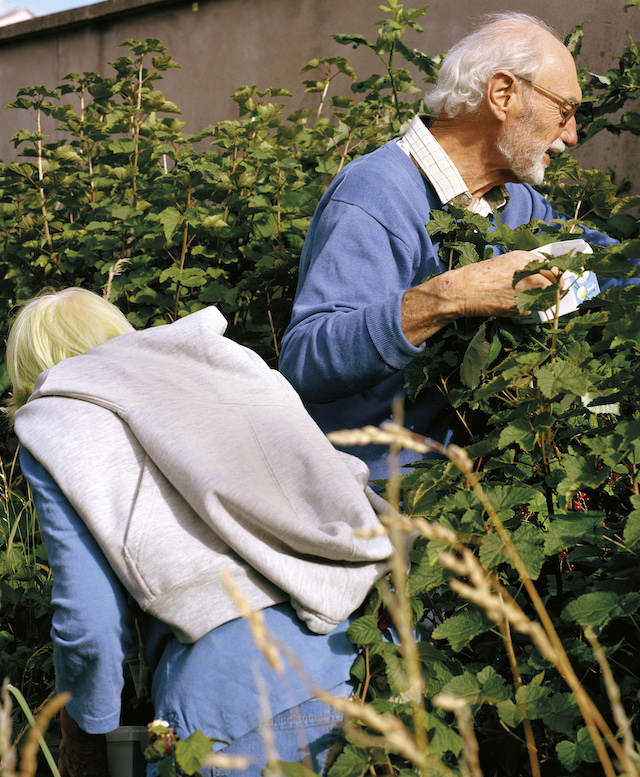
Members of Patchwork Community Gardening Group picking raspberries during a meet up, Bedminster © Chris Hoare
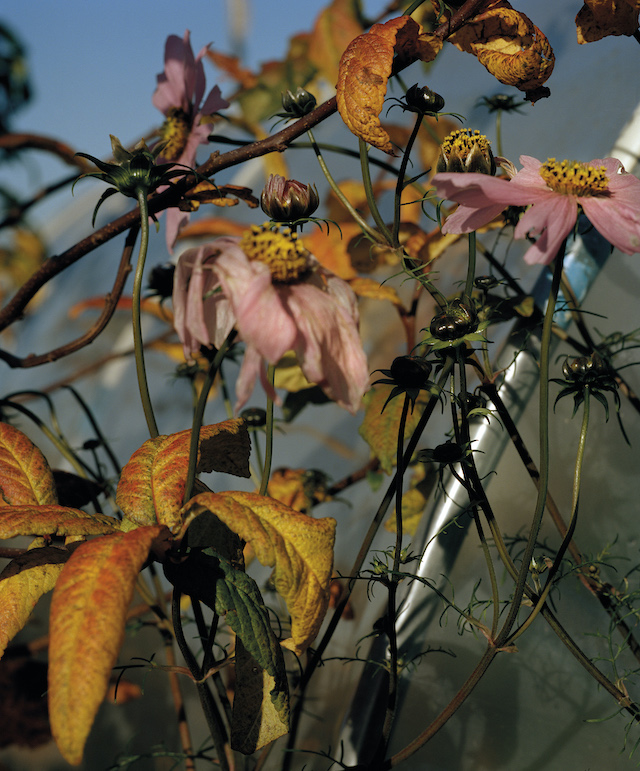
Late flowers collide with autumn leaves, Thingwell Park © Chris Hoare
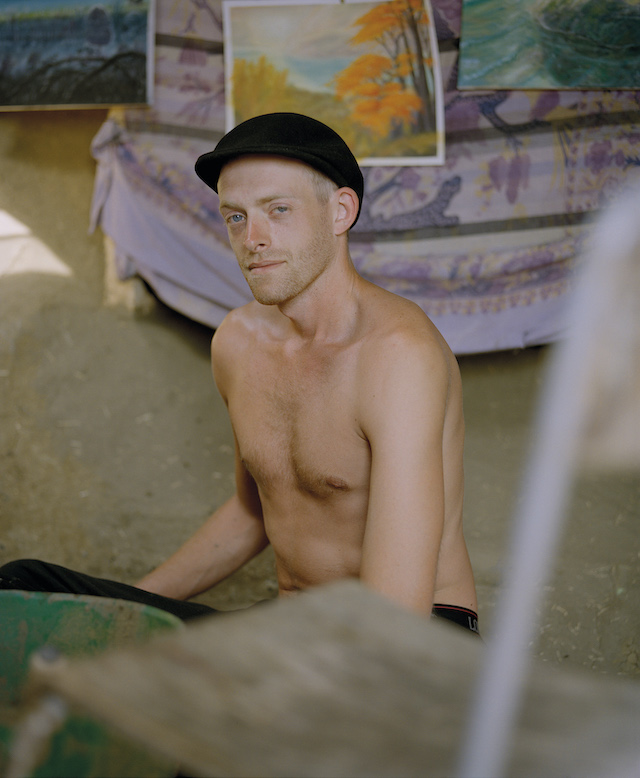
Joe has utilised the space on his allotment to create a shed which doubles up as an art studio. Alongside tending to his own allotment, he is also regularly on hand to help some of the elderly allotment plot holders, particularly throughout lockdown © Chris Hoare
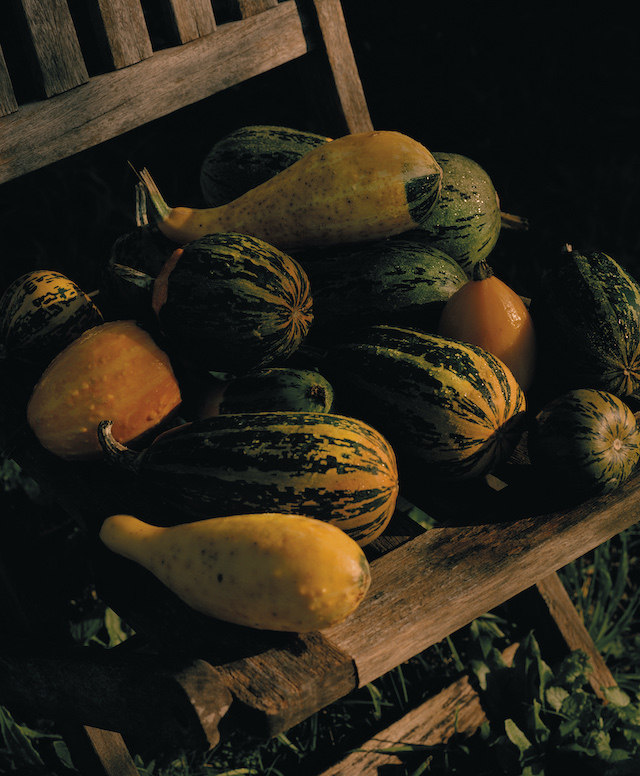
Winter squashes, Thingwell Park © Chris Hoare
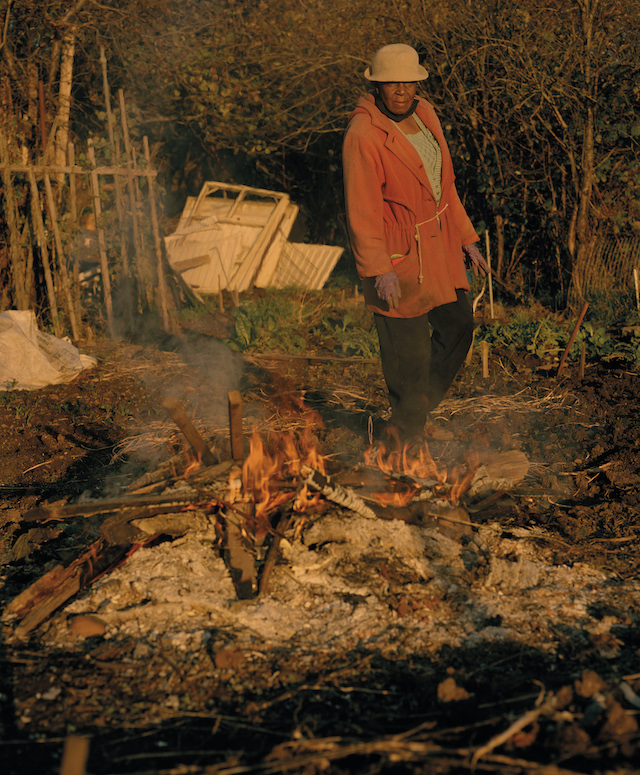
Tina throws the last of the wood onto the flames, before leaving the allotment on Bonfire Night, Thingwell Park © Chris Hoare

Lifelines

Eric Rhein’s new book tells the personal story of an artist’s life during the time of AIDS

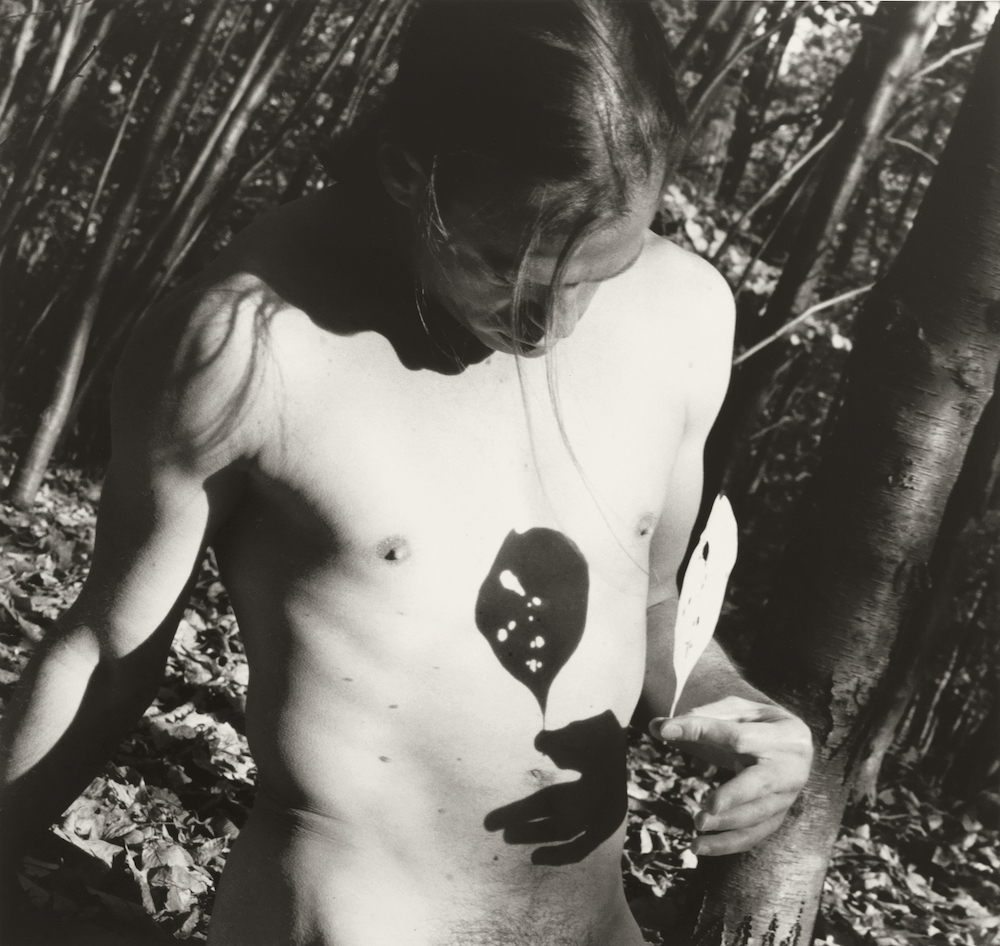
Company, Self-Portrait (1998)

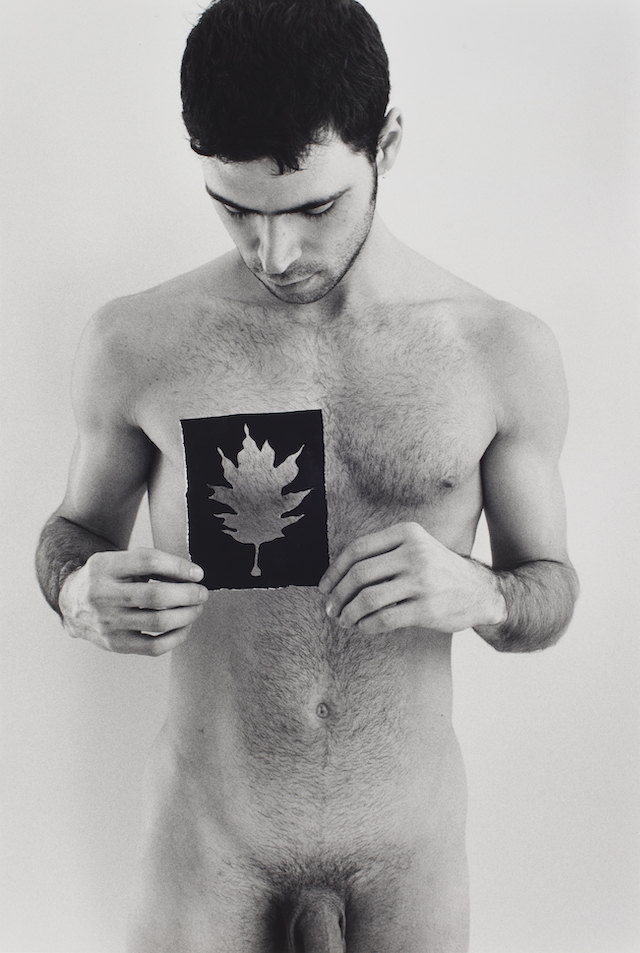
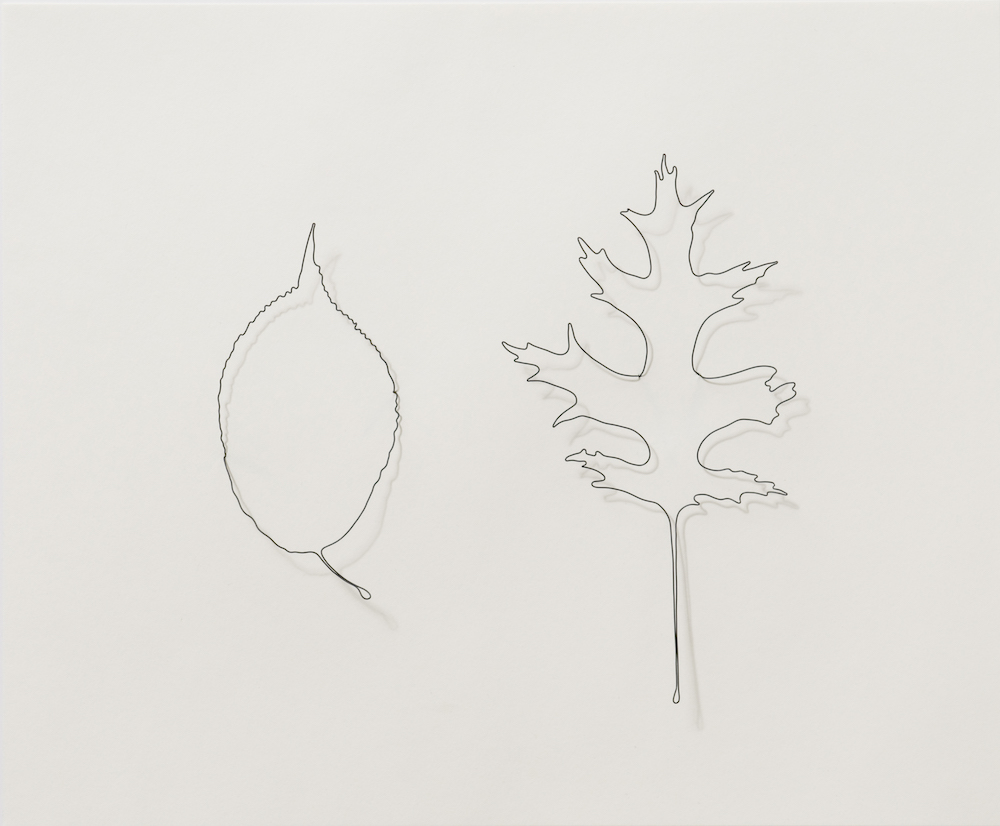
There always tends be a few key moments that drive every creative’s practice. For Eric Rhein, a multimedia artist who grew up in New York’s Hudson Valley, it was the childhood summers spent between the Ohio River Valley and the Appalachian Mountains of Kentucky. “These fertile regions are richly linked to the natural world,” he says, “and are influences that emerge throughout my artwork.” So much so that Eric has long explored these naturalistic tendencies through a broad mix of mediums, flitting effortlessly from wire drawings and sculpture, to photography and collage. His works have now been exhibited widely in the US and internationally, with countless features in The New York Times, Huffington Post, Artnews, Vanity Fair and Art in America to name a few.

Another defining moment for Eric arose when he moved to New York City in 1980, aged 18. Pursuing a scholarship at School of Visual Arts, he began to explore new artistic outlets, like that of building butterfly puppets for George Balanchine’s production of the ballet, L’Enfant et les Sortileges (which translates to The Spellbound Child). “I became saturated in the vital East Village arts scene,” he says. “It was a unique community that permanently altered the city’s cultural and creative landscape, which was in turn deeply altered by the AIDS crisis.” Eric tested HIV positive in 1987 at the age of 27, and with his diagnosis, all of these previous inclinations towards the natural world – alongside themes of resilience, vulnerability and transcendence – grew with even more pertinence. This manifested into a new body of work, titled Lifelines. 

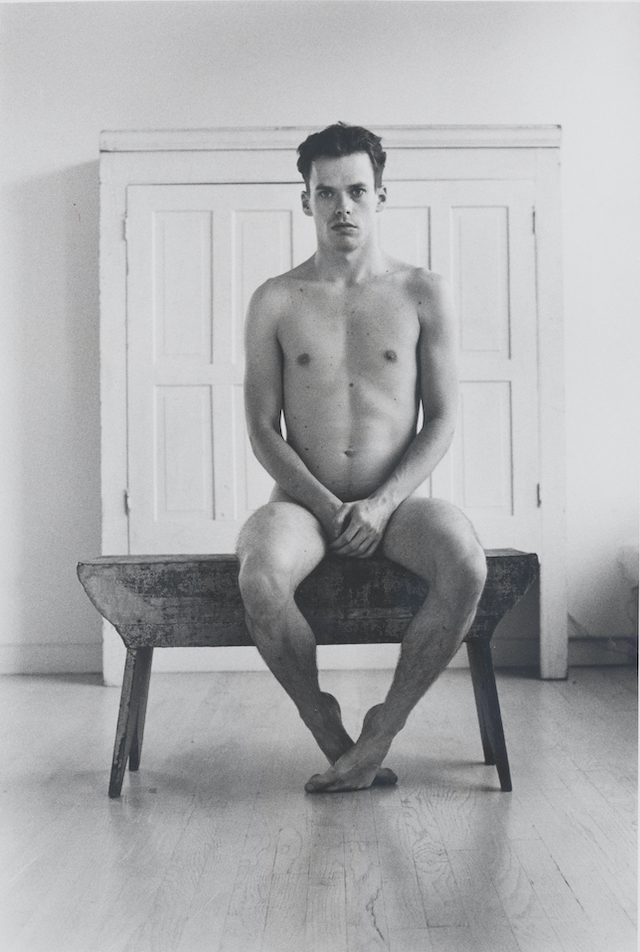
Seated, Self-Portrait (1992)

A compilation of tonal, monochromatic photography and mixed-media, Lifelines is a series of artworks taken and collected between 1989 and 2012, now published as his debut monograph by Institute 193 and featuring essays from Mark Doty and Paul Michael Brown. The project emerged after shooting his first self-portrait, named Seated, captured in 1992 after this mother had gifted him a Nikon 35mm film camera. At the time, he wasn’t quite aware of the fact that he was about to embark on a three-decades-long piece of work, lensing his own experience of living through AIDS, as well as his friends and lovers. But in doing so, he ended up recording an important and personal period of history.

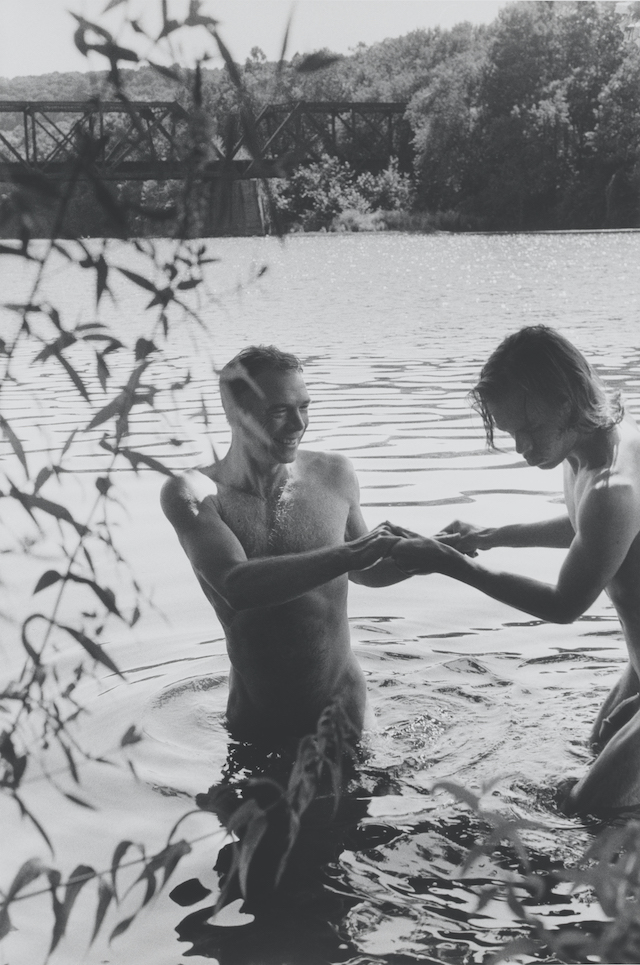
River, Self-Portrait with Russell Sharon (1994)

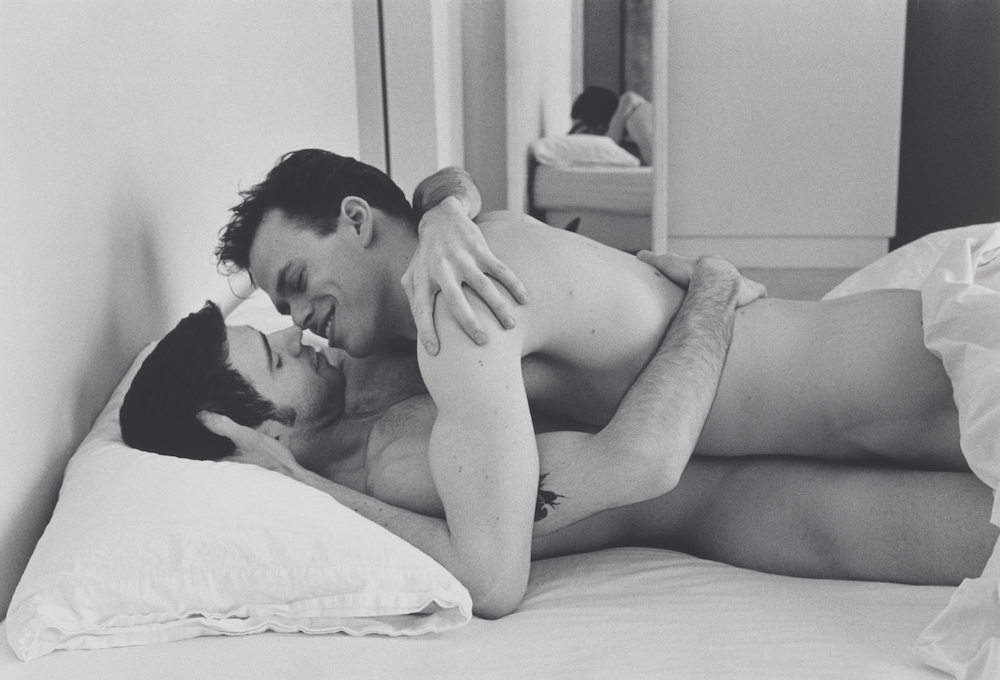
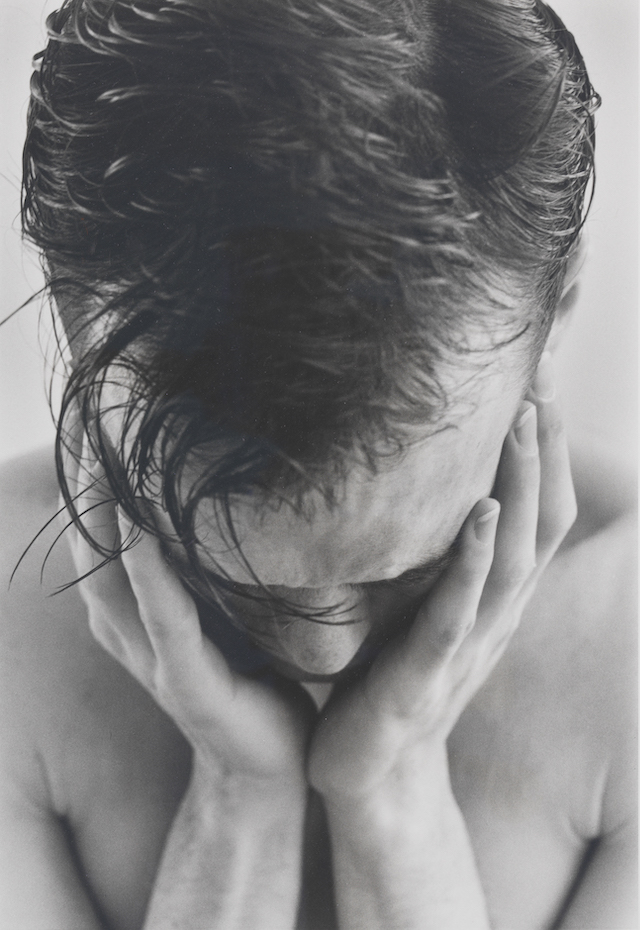
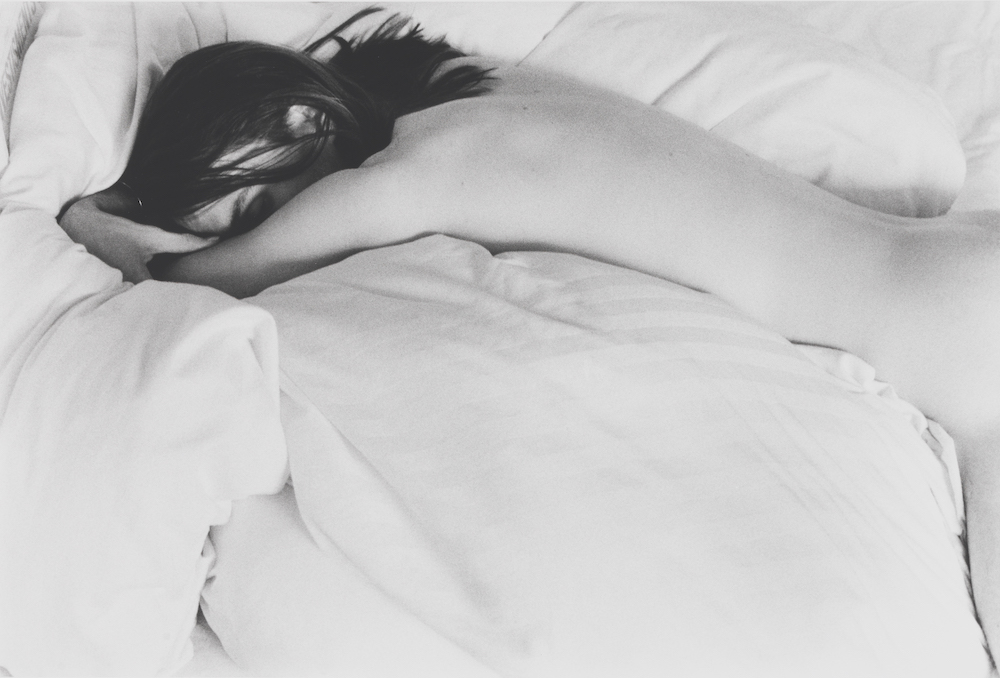
The photographic work featured in Lifelines was shot over many years and in a variety of circumstances. To detail as such, Eric was sure to include marked dates with each corresponding image, building a comprehensive timeline of an artist’s life during the time of AIDS. All of which is processed as silver gelatine prints, whereby the grain protrudes with a diffused, dream-like quality, endorsed by the photographer’s reliance on natural light. “In some of the photographs, our bodies, enveloped in sheets, are illuminated within sun-drenched interiors,” he notes, “while in others, photographs were lit through windows, doorways or tree branches.”

Having held back on publishing this work previously, Lifelines now depicts the full breadth of Eric’s experience: starting from the diagnosis, right through to his “return to life” brought on by the arrival of protease inhibitors in 1996 – a class of antiviral drugs that are now widely used as a treatment. “Some of the photos show me at moments when I was physically fragile, and others were taken after my ‘renewal’, when I was more robust,” he says. Meanwhile, several of Eric’s subjects within this project are no longer with us, and many of which were HIV positive when their portraits were taken. 

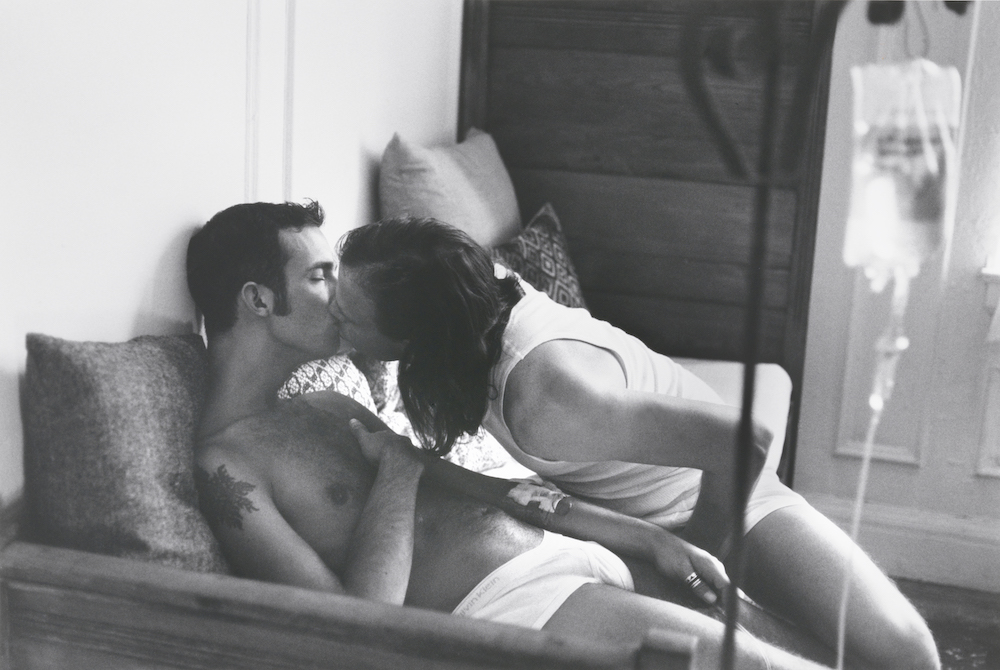
Kissing Ken (1996)

One image in particular, William – Silhouette, is a photograph of William Weichert, captured in 1992 during a summer spent on Martha’s Vineyard. Eric reminisces of how his lover wanted to be a pop star: “he wrote songs with lyrics like Hair Like Oprah, Butterfly Kisses, Love From Above and What About Tomorrow”. He passed away from complications of AIDS in 1996 at the age of 28, not long after the lifesaving protease inhibitors were released, which sadly weren’t effective for him.

Negative Space is a further picture shot in 1993 of his then-boyfriend Jeffery Albanesi. The title is suggestive of the fact that Jeffery was HIV-negative during this time – and still remains so – and looks at the tricky (and reassuring) relationship of being with a HIV-positive man. Meanwhile, Kissing Ken, from 1996, was lensed over the summer while Eric was part of a study for the incoming protease inhibitors, which successfully lowered his viral load, causing it to become undetectable. “While I was rapidly gaining health, my then-boyfriend Ken Davis had yet to be accepted into a study and was in declining health, which necessitated him having daily HIV medication drips. We’re shown in the apartment that I shared with I’m in East Village.”

Jeffery, Negative Space (1993)

These intimate and autobiographical works are housed amongst a complimentary mix of material-based pieces – like water-splashed marks and collaged findings. Each was composed from his hospital bed in 1994, while his health was extremely fragile. The AIDS memorial leaves, too, are of great significance to the artist, notably as they honour the people who Eric has known to have died with complications from AIDS.

It becomes evident throughout Lifelines, and with all of his activist-driven endeavours for that matter, that Eric is devoted to telling the difficult narratives around AIDS. He was close to death, and he wants nothing more than to put this new body of work in front of an audience who will appreciate his story.

Lifelines is published by Institute 193 and can be purchased here.

Photography by Eric Rhein.

Loving, Self-Portrait with Jeffrery Albanesi (1993)
Jeff and Tim (1996)
Rain, Self-Portrait (1993)
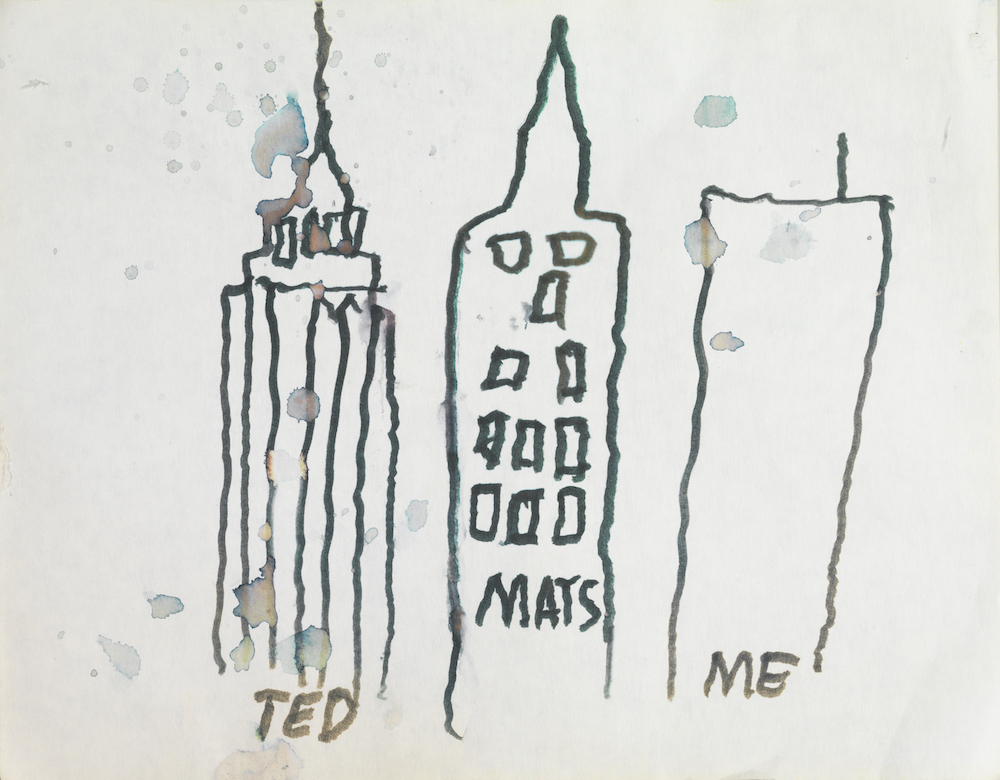
Ted Mats Me
Dodge, Slumber (1994)

Massimo Vitali: Disturbed Coastal Systems

The Italian photographer discusses scouting locations, the politics behind his work and the changing status of Europe’s beaches

Massimo Vitali is known for his large-format photographs of crowded beach scenes. A former photojournalist and cinematographer, Vitali has committed the second half of his adult life to travelling across the globe. “At the beginning of the season I look up places to shoot,” he says. “Sometimes people I know will talk to me about new locations, sometimes I will want to go back to places I’ve been before.” It’s this tradition of visiting and re-visiting beaches that has reinforced his idea of them as places of perpetual change. “If you really wanted, you could go to the same beach for twenty years and every year it would be different,” he explains. 

“When I first started taking pictures, beaches had no connotations. They were places where people could not think about anything, and be totally at ease.” Today, the same beaches are still holiday destinations, he says, but they are also the troubling backdrops of the European migrant crisis. For Vitali, an artist who has spent the last two decades documenting holidaymakers along the coastlines of the continent, as well as further afield, the beach has become a looking glass into the heart of the lives of Europeans. Of the current political climate, Vitali notes: “There is a vague sense of doom.”

New work in the Italian photographer’s current exhibition at the Benrubi Gallery in New York, Disturbed Coastal Systems, was primarily shot on the beaches of Portugal, where over a million Syrian, Afghan and Iraqi refugees first set foot on the shores of Europe. Vitali continues to look at the tension between the human habitat and the natural world with his latest photographs. Throughout the images, man-made saltwater pools and concrete piers break up natural scenery and hint at ways coastlines are occupied.

While at first glance Vitali’s photographs can seem almost saccharine, on closer inspection there is an unexpected depth beneath the bubblegum colour palette – something that feels both timeless and fleeting. “I try with my pictures to be in the middle, in the middle of something that is not long lasting, like walking on a thin line between what is already there and what is changing all of the time.”

Disturbed Coastal Systems is on show at the Benrubi Gallery in New York until 17 June


Alasdair McLellan X Margaret Howell

Fashion designer Margaret Howell and photographer Alisdair McLellan reveal a new exhibition, which will show off the fruits of a 13-year long collaboration

For five seasons, Margaret Howell’s love for the varied landscapes of Britain and the clean simplicity of modernism have been encapsulated through the lens of British photographer Alisdair McLellan. Now, or the first time, the pair will exhibit 40 images from the 13-year long collaboration in a specially curated show.

The partnership, which began in 2004, has been shaped by Howell’s “very distinct vision of the British Isles” suggests McLellan. “She loves it when the weather is typically British and isn’t bothered when we’re shooting if it’s raining in summer, or sunny in winter,” he says. “She understands that this is the way the country happens to be and goes with it. Margaret prefers to shoot in black and white too, which is brilliant.”

“I know what I want our photo campaigns to achieve and Alasdair knows how to achieve it,” Howell adds. “His judgment, vision and tenacity make for a valuable partnership.”

Since they first began working together, McLellan has produced over 40 photographs for Howell, all of which capture the brand’s hallmark aesthetic of quiet, contemplative beauty. Celebrating the diversity of Britain’s geography, the images were shot at a plethora of unassuming locations, including Wensleydale in North Yorkshire, Devils Dyke in East Sussex and, for SS17, the historic seaside town of Hastings.

McLellan’s images will be exhibited at Margaret Howell, 34 Wigmore Street, London, from 17 February – 19 March. The exhibition will coincide with Howell’s first combined AW17 menswear and womenswear runway presentation at London Fashion Week.

Showing the Impossible: Syria’s refugee crisis

Attempting to capture the plight of Syrian refugees, photographer Giles Duley visits a camp in Lebanon to illuminate the complex stories of its inhabitants

Khawla, 12 years old, at the makeshift camp where she lives near Tripoli, Lebanon. September 2014
Khawla, 12 years old, at the makeshift camp where she lives near Tripoli, Lebanon. September 2014 Photo – Giles Duley

In my work as a photographer I’ve documented many refugees’ stories: in Bangladesh, South Sudan, Angola and Afghanistan to name just a few. But the Syrian refugee crisis was the first I’ve witnessed from its beginning. Over the past four years I’ve spent much of my time in Lebanon, Iraq and Jordan, or following the refugee trail across Europe. While I can never truly understand, those years have given me some insight.

My work doesn’t focus on the dramatic, the scenes of mass exodus or panoramas of camps. Instead my work focuses on the mundane, the daily: documenting families and their journey. Many of these families I have revisited over the years, and it is through their experiences I try and tell the story.

One of the hardest things has been to watch the children of those families grow, as hopes of peace and returning to Syria fade. To bear witness to a whole generation stuck in limbo, often uneducated, highly vulnerable, bored, listless and increasingly without hope. Children left maimed by the war, disabled children unable to access basic medical care, psychological scars manifested in eating disorders: just some of the stories I’ve tried to tell.

Children like Khawla, a Syrian refugee living in Lebanon who I first met in 2014. At the time she was 12 years old and lived in a small makeshift camp by the sea, a few miles from Tripoli. She lived with her sister, six brothers and mother. Her father was missing in Syria. The camp was on wasteland by a cement factory, the air thick with its dust. There was little protection from the elements, the children got sores from insect bites and everyday there was the threat of eviction.  There were no schools for the children, no jobs, the hospitals and doctors too expensive. The United Nations High Commissioner for Refugees provided Khawla’s family with food coupons, but there was no support for accommodation or shelter provided. The tent Khawla lived in was made from blue tarpaulin, torn down movie posters and salvaged wooden posts. It neither protected them from the heat or sheltered them from the cold.

Her family had fled their home in Idlib, Syria after three years of living in the midst of a brutal civil war. With no end to the war in sight and with living conditions becoming impossible, they took refuge in the relative safety of Lebanon. There though, they had nothing. Without a father her family was particularly vulnerable.

For a while her mother and sister worked in a salt factory; like many refugees they were taken advantage of, paid far below the normal rate. While they worked, Khawla looked after the tent and two of her brothers, both of whom are disabled. Then one day there was an accident, the tent burned down and what few possessions they had were lost.

For Khawla this was the end; she could take no more. She swallowed rat poison in a suicide attempt and told her sister that she had done it to help the family – one less mouth to feed.

Khawla didn’t die. Her sister told her mother and they managed to get her to hospital. She spent 13 days in intensive care, pushing the family further into debt.

How do you photograph a story like that? How do you do justice to Khawla without exploiting her vulnerability? For weeks I visited her family and the camp, without finding the photograph. If it doesn’t feel right, I’d rather not even get my camera out of the bag. Yet her story had to be told, for she is not alone. Increasingly there are stories of young Syrian refugees feeling suicide is their only option.

Finally, though, the photograph did come to me. We were sitting outside chatting, when Khawla walked by, the setting sun behind her. In that moment I saw the image. The glare of the light would come close to fogging my film, leaving her silhouette almost ghostlike, the image reflecting her own frailty. It’s as if she is about to fade away.

In May 2016, two years after first meeting them, I revisited the family. Things have changed little, if anything they have grown worse. Khawla, who is so quick to learn, doesn’t attend school. She has a nervous smile that lights up a room, yet still talks daily of suicide and a desire to end the suffering. The family is struggling to survive with no breadwinner and the two disabled boys needing extra support. Since her suicide attempt Khawla has had no counselling or psychological intervention.

But she is not alone, in the region there is a whole generation of children suffering like Khawla. According to a Unicef report, an estimated 3.7 million Syrian children (one in three of all Syrian children) have been born since the conflict began five years ago, their lives shaped by violence, fear and displacement. In total, Unicef estimates that some 8.4 million children (more than 80 per cent of Syria’s child population) are now affected by the conflict, either inside Syria or as refugees in neighbouring countries such as Lebanon.

Syria’s next generation is growing up uneducated, marginalised and brutalised; they are vulnerable, exploited and often without hope. Who is to blame? What can be done? Ask any Non-Governmental Organisation (NGO) and of course they will say the solution is peace in Syria. But as more regional and world powers become involved, that seems unlikely any time soon.

The reality for now is that the world has to find ways to help the children in Syria, in the camps in neighbouring countries and those who’ve resettled in Europe. There are amazing projects being run, individuals dedicating their lives to help and NGOs providing support – but it is not enough until every Syrian child has access to education and a safe environment. It is, after all, this generation that will be expected to rebuild their shattered country. They are the hope for the future in the region and they cannot be abandoned. 

Giles is a photojournalist and triple amputee whose recent work has focused on the impact of conflict on civilians. He was awarded a fellowship from the Royal Photographic Society in 2013, and has won several awards at the Prix de la Photographie Paris: P×3. He is currently photographing the long-term effects of conflict on communities around the world for a five-year project called Legacy of War.

Photography Giles Duley

This article is taken from PORT issue 19, out now.