Barry Keoghan

With no formal training and a career defined by taking risks, Barry Keoghan has never been one to follow the rules. Here, the Oscar-nominated actor opens up about his unique approach to his craft, why he still seeks out challenges, and how he’s finally finding a sense of calm in the chaos of Hollywood

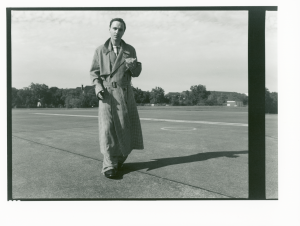
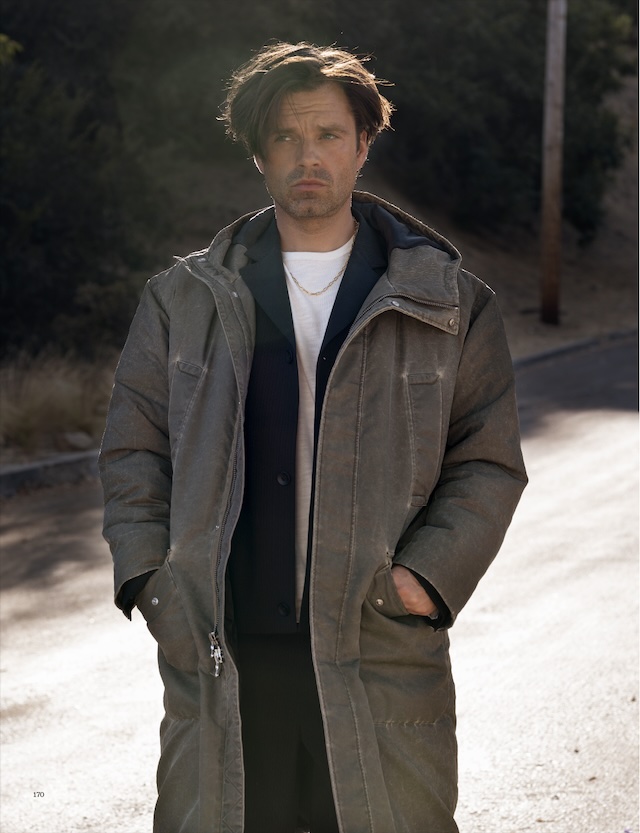
Barry Keoghan at Park Hotel 45. Keoghan wears Manolo Blahnik AW24 throughout. Sweater Zegna Oasis Cashmere, trousers Margaret Howell. Photography Christopher Anderson

Barry Keoghan has started brushing his teeth with his left hand. He explains the method in his madness duly: “Because I’m doing that, I have to be present. I’m not thinking about getting in the car, or getting to work, or what I’ve got to do that day, or anything else. I’m focused on brushing my teeth,” he says over the phone from the Isle of Wight, where he’s preparing for a new role, as well as the upcoming Peaky Blinders film shoot, enjoying a few days of calm before the storm.

The toothbrush anecdote is to illustrate a wider point: when he took acting classes earlier this year at the prestigious Stella Adler Academy in Los Angeles, he was intimidated by the academic, technical approach. “But not in a bad way,” he clarifies. “There were moments where I had to get up on stage, or do a scene, and I just found it really hard.” Perhaps the idea that an Oscar-nominated actor could find acting classes a tough crack sounds absurd; Keoghan himself is also sceptical. “But it was that fear I wanted to feel again. I wanted to learn, y’know? Be dropped in the deep end and see how other people do it.” While he speaks highly of the acting classes and everyone he met at the academy, his experience confirmed to Keoghan that he’s quite happy feeling his way through. Through a turbulent childhood in Dublin, he has – very much against the odds – risen to become one of the most recognisable young actors in Hollywood. And he did it all with absolutely no formal training, making him an anomaly within the heavily schooled British and Irish film industries.

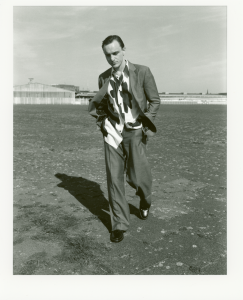
Vest Ami Paris, trousers Burberry

“My whole thing is to come across as engaged and authentic as possible on the screen,” he explains. “I think for me, to train to do that… sometimes you’ve lost already because you’re trying. Whether it’s in boxing or acting, I’m always trying to not think so much about what’s coming next – to be instinctual. And when you’re not thinking about what comes next… the worry’s gone for a second. Maybe two seconds,” he concludes. “I think this is why I loved working with Andrea so much, she very much has that same feeling.”

This is Andrea Arnold who, for her sixth feature, Bird, cast Keoghan as Bug – a young father covered head to toe in tattoos of insects, trying to fund his upcoming wedding by selling hallucinogenic toad slime. Keoghan is the bad-but-trying dad of the film’s protagonist, Bailey, who develops a friendship with a strange outsider looking for his family. When Keoghan met Arnold in an east London fish and chip shop to discuss working together, she gave him a toffee apple. “I remember then I had to get on a plane and bring the toffee apple through customs and security, with it in the plastic tray,” he laughs. “Customs were looking at me going, ‘Are you okay?’ And I was like, ‘Am grand!’ That’s what I really remember about meeting her.”

This is not the answer one might expect when asking an actor about their first impressions of a world-renowned filmmaker. But it is a uniquely Barry Keoghan answer; he is partial to tangents, asides, and doing a bit. Perhaps it was bold of me to assume I, a person with ADHD, could have a 40-minute conversation with another person who also has ADHD without getting distracted, but we do end up having a lengthy chat about the Isle of Wight’s only cinema all the same (they’re currently showing Wonka if you were wondering). A conversation with Keoghan is less a matter of asking questions and receiving answers than it is a matter of keeping pace.
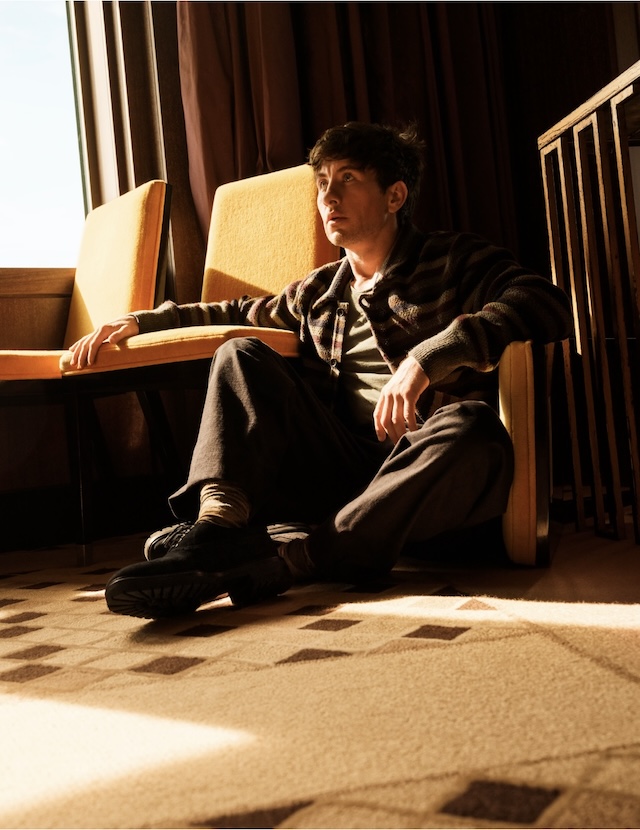
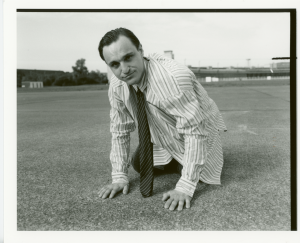
Cardigan Oliver Spencer, vest Ami Paris, trousers Margaret Howell

The same could be said for his acting. Over the last seven years, since his breakout role as a spaghetti-scarfing sociopath in Yorgos Lanthimos’ The Killing of a Sacred Deer, Keoghan has been cutting a bold path through the film industry, gravitating to films that utilise his charisma for nefarious purposes. Chief among them, of course, is Emerald Fennell’s Saltburn, which scandalised and tantalised Hollywood last year and saw Keoghan quite literally bare it all.

With the world at his feet and press at his door, Keoghan’s name was suddenly attached to flashy projects. He was supposed to face off against his countryman Paul Mescal in this autumn’s hotly anticipated Gladiator sequel, sending hearts a-flutter around the globe; ultimately Keoghan left the project, and signed on for Bird. When I first interviewed Keoghan, in 2018 on the press tour for Bart Layton’s American Animals, he told me then he wanted to work with Arnold. I remind him of this. “Isn’t that insane?” he laughs as though he’s surprised at his own audacity. “Isn’t that crazy?”

This dream director list (which lives in his iPhone’s notes app) has been mentioned before; he’s also ticked off working with Chloé Zhao (Marvel’s Eternals), Martin McDonagh (The Banshees of Inisherin) and Emerald Fennell, but he’s quick to say he wants to work with all of them again. He’s still keen to talk shop with Barry Jenkins, and laments that despite being at both the Cannes and Toronto Film Festivals this year, he hasn’t had chance to watch Sean Baker’s Anora yet – another one who’s on the list. Some might refer to this as “manifesting”, but it’s not just about ticking names off a wish list; Keoghan possesses an infectious enthusiasm for his craft that goes beyond name-checking cool directors.

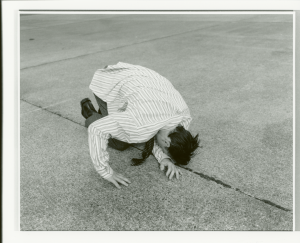
Tank Top Connolly, trousers Canali

When he lived in Los Angeles briefly, he used to ride his BMX down to Quentin Tarantino’s historic New Beverley Cinema and see whatever was showing: “I remember seeing Bullitt there,” he notes. “I saw all this amazing Japanese cinema, and they’re all on these gorgeous old prints – and sometimes the sound wouldn’t quite match up with whatever you were seeing, but God, I loved it. They were beautiful.” He laments that everyone’s always searching for a new gimmick in filmmaking. “I think the films I’m drawn to, they’re the ones that really understand a community,” he says. “That aren’t tryna be all flashy.” I agree and mention Mike Leigh – a fantastically unfussy filmmaker. “Mike Leigh!” Keoghan responds enthusiastically. “Ken Loach! Or Andrea Arnold,” he adds playfully. “I’m starting to understand the industry, y’know, after what, 11, 12 years, but it can go from one day you’re just at home and then the next day you’re on a massive movie set and you basically don’t have to do anything for yourself.” Keoghan says. “It’s quite dangerous, even though people have good intentions and want to look after you, there can suddenly be all these distractions.”

Keoghan knows this all too well. His meteoric ascent after Saltburn premiered at Telluride last year has been well-documented. Suddenly there are headlines and gossip and constant scrutiny – with those also comes the promise of financial success, and that can be appealing when you’re from a working-class background, still a minority within the film industry. “I don’t feel pressured into taking something because money is calling. I mean, you wanna have a life, and you wanna have savings, you wanna buy a house, you wanna do it all, all things like that – but…” he trails off a little, contemplative. “That can’t always be the focus. Some people want to be working all the time, and that’s fine for them. But for me, I feel like every time I work it takes a little something from me. Sometimes it’s things I don’t even know about.”

Rollneck Burberry, trousers Connolly

Keoghan isn’t someone who can leave it all on set at the end of the day. The intensity that is praised so widely in his performances comes from a real place; past collaborators have compared him to a wolf, a fox and a shark. “That was Emerald!” he pipes up giddily. “She said it about my eyes, but I don’t think sharks have very nice eyes, so what was she tryna say?!” Such comparisons are apt; there is something inscrutable and mesmerising about him, both on-screen and off. In Bird, he’s all smiles and sunshine until he’s very suddenly not; a volatile presence whose love for his daughter (at least initially) seems conditional on her willingness to do exactly what he tells her. But as Keoghan notes, Arnold has an innate understanding of her characters, which are built in collaboration with the actors (and often non-actors) portraying them. And while Keoghan mentions that he’s been going to therapy and is enjoying the experience, there’s still a part of him that likes to process his emotions through his work. “When I’m looking at a script, I’ve gotta think, ‘Have I played this character before? Is this giving me a challenge, or showing me a new filmmaker? Is it going to change my perspective?’” And then, he adds, “Is it worth it, physically and emotionally?”

Sweater Zegna Oasi cashmere

This concern tracks with Keoghan’s tendency to be drawn to darker stories and characters, such as the sullen sheep farmer’s son Jack in Christopher Andrews’ Bring Them Down, which premiered in September at the Toronto Film Festival. The quietly brutal thriller pits Keoghan against Christopher Abbott in rural Ireland, where two families clash as a bitter longstanding feud comes to a violent head. This is par for the course for Keoghan, who has become the go-to for filmmakers with a “Freaky Little Guy” in their script but, in Bring Them Down, Keoghan’s performance is defined by its apparent normalcy, until things spin out of control. Here he’s the lamb rather than the lion; a late scene between him and co-star Aaron Heffernan is a masterclass in non-verbal performance, as visible disgust and despair slowly register on Keoghan’s face.

This visceral quality in his work and his palpable enthusiasm is what has drawn so many filmmakers to Keoghan so far. He’s recently finished shooting with Waves director Trey Edward Shults, starring alongside The Weeknd and Jenna Ortega in a buzzy project he can’t say anything about. What he can talk about, though, is his long-gestating personal project inspired by his own turbulent upbringing. “I feel like I’ve not had a chance to really pour myself into something, y’know, to really bring my own stuff forward,” he explains, “And I feel right now I can do that in a constructive way because I’ve had a lot of good therapy – now I can pick stuff out that I want to revisit, find places I want to go back to, to bring certain feelings to the surface and use them creatively.” He mentions Charlotte Wells’ Aftersun (“Fucking gorgeous movie”) as an inspiration. “In terms of the relationship, I thought it was so beautiful and so delicate. Here, it’s a young boxer on the cusp of success, as he’s fighting for full custody of his little sister, ’cause their mum’s an addict. I want to focus on that, and this idea of who and what to fight for, and what success means for an inner-city kid.”

I mention that, like Arnold or Andrews, no one knows that community better and that authenticity is rare when it comes to working-class stories. He laughs and tells me about going to Dublin to shoot a short film for Gucci’s Absolute Beginners project in 2020; he shot on black and white 16mm, hiring a first-time actor he found at a boxing gym. “He looked at me and said ‘Is this a joke? You playing a game?’ and I really had to convince him I was legit,” Keoghan recalls. “But that’s what I wanna do with my film,” he assures me. “Four-three ratio, black and white 16mm, non-professional lead,” He sounds, as ever, enthusiastic and determined. But then he adds, in Keoghan fashion: “knowing me, I’d probably leave the lens cap on for the whole thing.”

Photography Christopher Anderson

Styling Mitchell Belk

Production Art-Engine

Groomer Charley McEwen 

Shot on location @45parklane

Special thanks to @circlepr


This article is taken from Port issue 35. To continue reading, buy the issue or subscribe here
Sebastian Stan

Beloved for Captain America, I, Tonya, and his recent Emmy-nominated role in Pam & Tommy, Stan reflects on a career shaped by diverse characters. Now, with A Different Man and The Apprentice, he’s exploring deep questions about identity, ambition, and the complexities of portraying one of America’s most influential (and controversial) men, Donald Trump

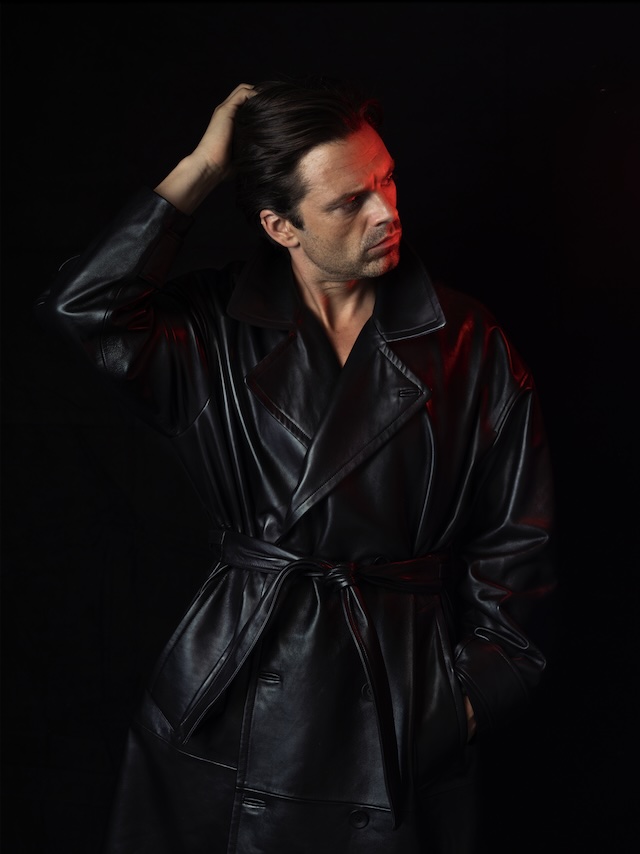
Sebastian Stan wears Rag & Bone throughout. Photography Jim Goldberg

The first time Sebastian Stan tried acting, he hated it. At 9 or 10 years old, he played a Romanian orphan in an Austrian film called 71 Fragments of a Chronology of Chance (1994). Between the waiting around, night shoots, and general pressure-cooker energy, the whole experience had been pretty anxiety-inducing. “I think the idea of a set was just really terrifying,” he recalls. The 42-year-old mainstay admits to being a Leo, but a rather reluctant one, he says, not that extroverted or hypersocial. “I know my mom always thought I was creative simply because I would impersonate the people in our family, or birds or whatever I would see around me.” Nowadays, when he does speak, it’s with the compelling ease of someone who’s spent equal time commanding impressive rooms and in their own head trying to crack the great questions of the world – sounding off passionately about the perils of social media (“there’s so much noise in today’s world”) or the last incredible film he watched (Sing Sing and it was “pure heart”).

Born in Romania and raised in Vienna until he was 12, it wasn’t until immigrating to America as a preteen that Stan found his way back to the craft at all. Attending Stagedoor Manor summer camp aged 15, in the Catskill mountains of upstate New York, his spark was reignited. “That place was really magical and made me fall in love with (acting again); I couldn’t think of anything else as exciting to me as performing was,” he says. “Some of it was about not ever being sure of what to be when I grew up. I kept thinking that you could be a lot of things if you did this.”

So far, he’s been a wayward socialite, a cannibal, a space surgeon, a ski patrol villain, a heavy metal drummer, a supernatural student and a World War II veteran turned brainwashed Soviet operative, to n ame but a few. He’s not an actor you’ll find in the same role twice. With that said, his name has reached household status through a decade-long Marvel stint, with the two films Stan finds himself at the helm of this year being his most ambitious forays yet. 33 years on from his awkward beginning, the actor’s commitment to film appears to still be very much in bloom. “I think I’m at a point in my life where I’m trying to understand things on a deeper level,” he explains. “I can’t say I know everything, you’re always growing, always having to explore. I think it’s important to stay curious, to stay in a certain degree of healthy discomfort… I want to be part of important storytelling that’s asking important questions and reflecting our time.”

In A Different Man, an A24 production directed by Aaron Schimberg, Stan takes on the role of an aspiring actor called Edward with neurofibromatosis, a genetic condition that results in the extensive growth of benign tumours. He undergoes a clinical trial that cures him of his physical symptoms, but his new life turns out to be far from what he dreamed for himself. It’s a winding surrealist investigation into the social impacts of disability, alienation, representation and self-image: its gaze is unflinching, its narrative self-referential and its humour pitch-black. Stan has already won the Silver Bear for Best Leading Performance at the Berlin Film Festival for A Different Man.

The second release, The Apprentice, follows a wildly different arc. Directed by Iranian-Danish filmmaker Ali Abbasi, it tracks a young Trump as he falls under the nefarious mentorship of infamous legislator Roy Cohn. Dubbed ‘an American Horror Story’, it’s a sobering yet deeply entertaining snapshot of the making of one of America’s most influential men. Yet even within the dynamic, prescient story, the actor’s take on Trump is subtle and human, and the tone of the film is less moralising and more matter of fact.

Though the narratives of these two projects are starkly different, you can’t help but find the common threads. Both are set in New York and document a transformation, and both centre a feverish pursuit of some ideal imagined self. A Different Man was filmed back in 2022, and The Apprentice only wrapped in February of this year, but Stan agrees it’s a curious double-header. “I’m weirdly finding parallels between them that I never thought I would. Identity, self-truth, self-abandonment. This idea that we’re always chasing in America, whether it’s image or status or an inability to accept failure and to take ownership over mistakes.”

For the Trump film, that real-life denial was almost the ending of their work of fiction. After years of false starts, Trump’s legal team attempted to block the film’s release in the US altogether and they struggled to find a distributor willing to take on the risk of pissing off a potential President. “For to edit it and get it to Cannes in some finished version itself in five months was just insane. There was no idea if the movie was going to come out,” Stan says. On an individual level, the task felt equally murky and intimidating at first. “You’re trying to tell a story about somebody that’s so famous, who everyone has an opinion about: either extreme love and adoration or hate and animosity. And everyone’s got a version of the guy, so you think, well what do I…” he shrugs, “how do I find my way into it?” Ultimately, they landed on this film as a means of peeling back the layers of one of the most polarising figures of our time. It’s less caricature and more character study as it explores his relationship with his father, his ambitions, the man he was before the slogans and affectations.

Executive producer Amy Baer has spoken about the choice to call on a non-American director to provide a new lens on the intricacies of American culture, propaganda and patriotism. With Stan’s own immigrant story, his perspective adds another dimension to that prism too. Memories of walking down Fifth Avenue in awe and wonder as a kid, staring up at all the big buildings – he tapped into a hunger and drive to portray early Trump as a young man desperately trying to be a part of The Club. “I guess with my experience coming to this country, it was communicated to me even from Eastern Europe that this is the place where you can make something of yourself, you can have a good idea… and you could just succeed,” Stan says. The Apprentice asks, “but at what cost? What happens to a person’s humanity?”

Throughout the film, you witness Trump espousing about “bringing back New York”, even remarking on Reagan’s campaign slogan ‘Let’s Make America Great Again’ towards the end, an ideology he would go on to repurpose for his own candidacy. It’s a fascinating yet depressing origin story of a nationalistic rhetoric that echoes today as a Trojan horse for corruption and greed. “It’s complicated. That’s why I think there’s value in exploring it,” Stan urges. “This American Dream idea is a really powerful driving force that also comes with consequences.”

Perhaps the most complex part was the toxic relationship with his sometimes-partner-in-crime played staggeringly by Jeremy Strong. “I think he was the best partner I’ve ever had in anything I’ve worked on,” Stan declares with a smile. “You know when you’re standing in front of a fire and you feel the heat of it and there’s crackling in the air? That’s how it felt.” Amidst quite a gruelling, isolating filming schedule, it’s the aspect Stan speaks about most fondly.

Clothing Fendi, Necklace & Bracelet Cartier, Boots Givenchy

Swinging between dominant and intimate, transactional and paternal, from comical to devastating, both stayed in character throughout the shoot and undertook a colossal amount of research to be prepared for infinite possible improvised routes. “Creatively, makes things interesting is when you’re not in control. You do all this preparation to be prepared to be surprised,” Stan says. Shot documentary-style in moments, Abbasi might give each of them notes in private to shift the tone of a scene, and they’d find themselves responding instinctively within their roles. “The only way you can achieve that is if, to some degree, you find that person in you. And I can certainly tell you,” he pauses briefly to consider his landing. “There is a version of Trump that existed in me. And I’ll make the argument that there’s a version of Trump that exists in all of us. And that part of our job, part of our interest, should be figuring out what that is. I think we have to acknowledge and expose the things in us that are not so easy to admit, in order to further protect the things we need to fight for. You can’t ignore it.”

In that moment, it’s clear that it’s an argument as true of our discourse on Trump as it is of Stan’s other role in A Different Man. His character Edward is driven to obsession and madness when he witnesses the thriving life of a person with the same disfigurement he was quick to shed, the very thing he believed to be the root of all his misfortune. Right before his transformation, Edward has been ignoring a leak in his ceiling for weeks, and the damage is getting worse. When he’s finally forced to call for a repair, the super arrives and is appalled at how bad he’s allowed it to get. He tells Edward frustratedly, “you should have fixed this sooner”. In that moment, it feels as though he’s talking about a hundred things at once. From Edward’s own issues with doubt and self-acceptance that cling to him even when he is no longer ‘different’ to our own society’s discomfort with, and the misunderstanding of disability altogether. We cannot be afraid to look.

“Edward makes a decision that he thinks is going to improve his life, but he’s not making it for himself. He’s making it because he’s watched other people and he’s grown up in a society that’s told him this is what works,” Stan explains. “Essentially, he abandons himself and he spirals down trying to further live with that painful acknowledgement. I think we have to be conscious of when we’re making decisions that go against who we are and what we truly want.”

In true indie style, squeezing in around the schedule of their makeup artist who was on another project at the same time, Stan had some hours to kill most mornings in prosthetics before filming which he’d spend navigating the city he calls home: “one of the gifts that I was given which I’m very grateful for was the experience that I had walking around New York City as Edward.” With reactions to him ranging from invisibility to hypervisibility, it shifted his entire understanding.

“I’ve been there like everybody else thinking, oh, if I had that. Or you see someone on Instagram and you’re like, oh my God, look at that life, they have the best life; you get caught up in these things.” It’s both reassuring and a little disheartening that, unlike his superhuman alter ego, a star like Stan is still not immune to the very human insecurities us civilians face of joy-stealing comparisons. “There’s this idea I’ve been thinking about a lot with my therapist actually,” he laughs. “He was saying ‘I am me and you are you.’ I was like… yeah! But you forget. We have to understand our own experience and then understand someone else’s. But we have to try to understand it not through our own emotional… vomit.”

When I ask Sebastian what he does for fun, to unbecome his characters and shed their existential weight, he cites reading (mostly non-fiction) and travel (to see other cultures). “I always feel like I’m not learning enough,” he laughs. You get the sense that this year is a juncture for Stan, always revered for being grounded and likeable, but perhaps waiting for opportunities like these to enrich and express other sides of himself as an actor and voice within culture. “Both of these films came at an interesting time where I’m thinking about if I’m at mid-life, this second half of my life. What is it that I want to be a part of and one day look back and be proud of?”

And that’s not to say fun is off the table for Stan. He’s passionate about laughter as a release in a difficult world. “I think it’s just as important, we have to protect humour,” he tells me with an urgency. “I love comedies, romantic comedies, action.” In fact, there’s a top-secret action movie passion project that he has in the works and hopes will come together in the right way. “There are also things in Marvel I want to do and explore with ol’ Bucky Barnes,” he smiles, presumably in reference to the new Marvel film Thunderbolts, slated for a 2025 release, in which he stars alongside Florence Pugh, Harrison Ford and David Harbour. “Otherwise I just want to keep learning how to be a human being. I’m telling you,” he laughs, “I feel like it’s pretty hard.”

Photography Jim Goldberg

Styling Reuben Esser

Production Hyperion LA

Hair Jamie Taylor using Augustinus Bader

Hair Erica Adams

Represented by A-Frame Agency


This article is taken from Port issue 35. To continue reading, buy the issue or subscribe here

Free The Stones

Documenting Stonehenge’s solstice and equinox celebrations, Freddie Miller’s latest project strives to restore free festivals and keep ancient rituals alive

Freddie Miller: Free The Stones, Girls

Every solstice, thousands of people from all walks of life flock to Stonehenge, whether it’s druids, pagans, travellers or families taking their kids out for a magical sunrise celebration. On a usual day, the site is guarded by ropes, but for two hours during the solstice or equinox, the English Heritage lets everyone roam freely around the historic stones as they have done for decade’s past. However, this protected space and its ancient rituals are now under threat.

When Freddie Miller, a Bristol-born London-based photographer, attended a Beltane druid ritual last year while doing research for a project, he met a new friend named Sid Hope. He was passing around flyers which Miller thought looked like a “trippy cross between acid rave posters and DIY cut’n’paste punk zines”, with the words ‘Stonehenge Festival Campaign’ printed on the top. “A subculture clash if you will.” They exchanged a few words and Miller came to learn about Hope’s campaigns to reinstate a free festival at Stonehenge where, back in the 70s, up to 60 thousand people could gather for the solstice. That was until Thatcher wagged her wand and put a stop to the celebrations at the ‘Battle of the Beanfield’ in 1985, a brutal police crackdown which stopped the festivities in a flashpoint. Yet many, like Hope, are pushing to keep these ancient rituals alive.

Freddie Miller: Free The Stones, Hug
Freddie Miller: Free The Stones, Acid House

Miller first visited the site in the winter solstice of 2014, and he’s always wanted to do a project on the subject. He’s long been interested in subcultural studies and counter-culture, particularly people subverting the mainstream with ideas and philosophies about life – whether that’s drill rappers, truckers, bikelife kids, mudlarkers, pagans, or those attending solstice at Stonehenge. “I think this is more important than ever in our increasingly alienating world,” he explains. “So I often find myself trying to tell stories to celebrate different subcultural movements in an aesthetically driven way.” So it was a match made in collaborative heaven, and Miller began documenting Hope and his campaign to create a sunset-drenched new photo project and film, titled Free The Stones! 

The series began in 2023, and throughout you’ll see people hugging rocks; waving a British flag with an acid house smiley; wearing mediaeval outfits; sporting pagan skulls as headdresses; enjoying a sense of community, togetherness and energy. Girls gathering nearby the rocks, families enjoying their outing. A mobile home pausing for a quick pitstop roadside. People getting lost in the magic of the stones, wearing ancient garb, and caught in freeze frames that could have been taken thousands of years ago. “I wanted to celebrate Stonehenge, its magnetic pull, the primal energy it gives people,” says Miller. “I was really interested in the crossover of subcultures that around it too, whether it’s pagan, free festival, new age traveller.” Miller worked with Josh Homer and Peter Butterworth on the film, alongside Hope – of course – and the people he’d met at Stonehenge. 

Freddie Miller: Free The Stones, Standing Stone

Speaking of his subjects, Miller recalls meeting a guy named Mad Alan outside the Royal Courts of Justice at a save Stonehenge protest. “He had tattoos all over his face and even in his eyes,” he says, “He was really nice.” There was also someone with a pet crow, and apparently he met Ronnie Wood from the Rolling Stones at the equinox and was “none the wiser when introduced – he’d have been a great addition to the project.”

The project was built on a few pillars, one of which is to shed light on the people who attend the solstices, showing freedom of thought and a point of difference to the way they live their lives – the other side that is often ignored in modern civilisation and its portrayal in the media. Miller adds, “I learnt traveller culture is real and met people from the community who are dedicated to pursuing their own way of life, on the road and away from a ‘normal’ society. I admire their spirit, warmth and self-sufficiency. It didn’t seem like an easy way of life (at least to me) and I respect their commitment to living that way.” The other pillars include elevating Hope’s campaign in order to bring back the Stonehenge free parties, and lastly, raising awareness of how the site is more than just a hotbed for tourism. It’s a place of “real energy where people can revert to their primal roots – even for a few hours”, he says.

It’s been recorded by English Heritage that Stonehenge was built in stages; the first monument around 5,000 years ago, and the stone circle around 2500 BC. For comparison, it’s several thousand years older than the pyramids. Many visitors have been visiting the archaeological site of Stonehenge for years, yet its future is looking precarious due to plans to widen the A303 road which runs adjacent to the stones – people are petitioning to devoid these plans and, if absolutely necessary, build a tunnel instead to avoid destruction. “I learnt that over and above Stonehenge being a tourist hotspot and sometimes a political bargaining chip with the ongoing A303 road tunnel debate, it is a sacred space for modern day pagans, travellers and free festival rebels,” says Miller. “It occupies such a space in our national consciousness, cutting across our culture, and everyone has their own interpretation of what it’s about, which I find fascinating.”


Freddie Miller: Free The Stones, Home
Freddie Miller: Free The Stones, King Arthur
Freddie Miller: Free The Stones, Mad Alan
Freddie Miller: Free The Stones, Sid
Freddie Miller: Free The Stones, Sid at Home
Freddie Miller: Free The Stones, Protest
Freddie Miller: Free The Stones, Pagan Chieftain
Freddie Miller: Free The Stones, Two Druids
Freddie Miller: Free The Stones, Travelling Family

Five artworks exploring India’s changing landscape

The Imaginary Institution of India: Art 1975-1998, an exhibition organised by the Barbican in collaboration with the Kiran Nadar Museum of Art, explores pivotal moments in India’s socio-political history through nearly 150 artworks. Below, assistant curator Amber Li highlights five standout pieces from the show, each revealing powerful narratives of identity, resistance and change during late-20th century India

Gieve Patel, Off Lamington Road, 1982-86 Collection Kiran Nadar Museum of Art, New Delhi © Gieve Patel Courtesy Galerie Mirchandani + Steinruecke and Kiran Nadar Museum of Art

Gieve Patel – Off Lamington Road, 1982–86

This epic painting captures a crowd moving through a busy alley, located off an important road in Mumbai where Gieve Patel worked as a doctor. 

Across the painting, men and women stand or squat in small groups to talk. On the right, musicians accompany young people dancing, some dressed in colourful clothes. Celebration is side-by-side with destitution: two bandaged, leprous children beg for alms, and a woman lies naked and bleeding in the foreground. Patel’s work often depicts people on the fringes of society. The painterliness with which these figures are portrayed verges on abstraction, conveying the transience of the crowd.

Madhvi Parekh, Village Opera-2, 1975 © Madhvi Parekh Courtesy DAG

Madhvi Parekh – Village Opera-2, 1975

Madhvi Parekh’s oil paintings provide, for her, a way back to the idyll of village life. They depict remembered landscapes from both her childhood village of Sanjaya, Gujarat, and her subsequent travels. She painted Village Opera-2 after attending an artist’s camp organised by artist G. R. Santosh in Kashmir in 1975. The copper pots she saw there inspired the black anthropomorphic figures at the centre of this work. Working first with oil paint, Parekh then used oil pastels to add small, vibrant creatures which resemble birds, fish, snakes and amphibians. The scene floats in a colourful net of dots and lines, patterns drawn from the folk crafts of Rangoli and embroidery that she had practised as a child. 

Arpita Singh, My Mother, 1993 © Arpita Singh, Courtesy Talwar Gallery

Arpita Singh – My Mother, 1993

Arpita Singh’s monumental painting, My Mother, records the chaos of communal violence exploding across India in the early 1990s. The artist’s mother looms dignified and stoic in the foreground, while militiamen in bottle-green uniforms enact scenes of devastation behind. Shrouded bodies line the streets and victims lie stripped on the ground.

Singh had started work on a portrait of her mother when riots erupted in Bombay (Mumbai). Unable to keep these two elements from spilling into one another, the painting represents collapsing boundaries between home and nation, private and public, and the real and the imagined.

Vivan Sundaram, House, 1994, from the series Shelter, 1994-99 Photo by Gireesh G.V. Photo courtesy The Estate of Vivan Sundaram

Vivan Sundaram – House, 1994

Vivan Sundaram was concerned throughout his career with the urgency of using art to confront political realities. After the demolition of the Babri Masjid, a 16th century mosque, by right-wing Hindu militants in 1992 and the ensuing Hindu-Muslim communal violence in the early 1990s, Sundaram, like some other artists at this time, turned towards making installations. The walls are made from handmade paper, derived from a handmade fibre called Khadi which Mahatma Gandhi promoted as an indigenous fabric which symbolised anti-colonialism. Although the walls are thin and fragile, they are also a call to resistance against violence and a commitment to peace. 

Nalini Malani, Remembering Toba Tek Singh, 1998 Installation view, World Wide Video Festival, Amsterdam, 1998 © Nalini Malani

Nalini Malani – Remembering Toba Tek Singh, 1998

Nalini Malani made this work in response to nuclear tests carried out by the Indian government in Pokhran, in the Rajasthan desert in 1998. In this installation, a woman from Pakistan and a woman from India fail to fold a sari together while footage plays of the aftermath of the nuclear bombings of Hiroshima and Nagasaki. The video installation builds on Toba Tek Singh, a short story by Pakistani author and playwright Saadat Hasan Manto about forced displacement during Partition, which you hear Malani reading from in the film.

The work conveys the artist’s searing anger at India’s nuclear tests, and at the absurdity and senselessness of ‘one set of people killing the other only because there is some land that you want, or there is some religion that is considered to be more superior than the other’.

The Imaginary Institution of India: Art 1975-1998 opens at Barbican Art Gallery on Saturday 5 October 2024. Entry to the exhibition will be free on 26-27 October as part of the Barbican’s Open Gallery weekend

Almost Always Quietly Heartbreaking

An early look at a Palme d’Or candidate

It seems there’s not a single critic at Cannes immune to the charms of Sean Baker’s Anora. The raunchy tragicomedy features a star-making performance from Mikey Madison who, following turns in Scream (2022) and Tarantino’s Once Upon a Time in Hollywood (2019), plays the titular role with acerbic vigour and honed panache. Ani, as she prefers to be called, is keen to downplay her Uzbekistani roots, until they land her in the lap of Ivan (Mark Eydelshteyn), a wealthy 21-year-old kid who lavishes her with extravagant tips and encourages her to speak Russian. Ivan, a bouncing, wiry, mop-haired stoner, is immediately taken by Ani, who compliments his anastrophic English and introduces him to slower sex. “I think I love you,” he blurts, still inside her.

An erotic dancer by trade, Ani begins to picture an alternate life for herself through the lens of Ivan’s riches. We watch her negotiate her obligations to HQ, the Manhattan strip club where she’s employed, struggling to book time off and fighting with other aggressive, fiercely competitive dancers. So when Ivan asks her – while they’re loved up and drugged up in bed together in Las Vegas – to marry him, the fantasy begins to crystallise.

The pair wed in matching beige finery: Ivan in a suit jacket over his bare chest (save for a couple of silver necklaces) and Ani wearing a silky nude corset and ripped denim cutoffs. This sequence, as well as the movie’s nudity-heavy opening scene, is set to a remix of Take That’s ‘Greatest Day’, a 2008 single that Baker apparently chose by happenstance, punching the words into Spotify and listening to whatever came up. This song choice serves to emphasise the flighty, fantastical elements of Ani’s Pretty Woman experience, but also seems to underscore it as a kind of joke. 

Back in New York, Anora briefly shifts its tone from rom-com to home invasion thriller, pivoting to slapstick before settling back into dramedy mode. In the absence of Ivan’s manic rabbit energy, Ani looks on as her dream life begins to crumble from underneath her. Though she puts up a fierce fight, she is manhandled and restrained by three Armenian henchmen (led by frequent Baker collaborator Karren Karagulian): the harried employees of Ivan’s billionaire oligarch parents, who have been tasked with the mission of getting their son’s quickie marriage annulled. 

The film has earned multiple comparisons to Uncut Gems (2019), Josh and Benny Safdie’s frenetic crime thriller, but Baker seems to have more affection for his protagonist and is clearly invested in her inner life. Early on in the film, we follow Ani home on her subway commute at the end of a night at HQ, the red tinsel streaks in her hair — strands that catch the deep purple of the club lights — tucked beneath a beanie, her body wrapped in loose, dark street clothes.

But in creating a character that’s so easy to root for, Baker flattens her a bit. As Sophie Monks Kaufman observes in her Little White Lies review, the filmmaker never gives the audience a chance to root against Ani, and the script “does not afford her character the same chances to be despicable” as it did for Simon Rex’s pornstar protagonist in Red Rocket (2021): “The opportunism of her attachment to Ivan is under-explored and instead, her affection for him is played up.” In this way, Ani cleaves a little too close to the ‘hooker with a heart of gold’ trope, which describes a sex worker stock character whose fair morals are written to compensate for their less acceptable profession.

However, the note that Baker elects to leave us on is a complex, poignant one, and Madison’s bravura performance is such that you never see it coming. If there were any justice in this world (Cannes), it would win the festival’s top prize. But Anora understands that life isn’t always fair. In fact, it’s almost always kind of quietly heartbreaking.

Hari Nef

Catching up with the model, writer and actress

HARI NEF AT IMG WEARS CELINE THROUGHOUT

Let the record show that at 9am on a bright March Monday, Hari Nef attended her first day of jury duty – ever – at the Manhattan courthouse on Centre Street. Our interview could not be put off, on account of a tight deadline, so we agreed at the last minute to meet during her lunch break. I selected a Cantonese restaurant on Canal based purely on its auspicious name: August Gatherings. I’ll confess to picturing a restaurant packed to the gills with influential figures celebrating success or hashing out deals, so much so that I wondered if we’d have trouble snagging a table. But when I arrived the place was half-empty, and Nef, having been released for lunch earlier than expected, was already seated. She had courteously ordered a dim sum sampler intended for sharing.

“It’s like going to the DMV, it’s boring,” said the 31-year-old actress, model and writer when I asked for any initial reactions to her mandated morning of video watching and form filling. She’d brought a book with her to pass the time (Cyrus Dunham’s memoir A Year Without a Name) and had just finished it before lunch. She said, of jury duty, that “it’s been knocking for me for a second now and I just want to get it done.” Now, the timing was right: she’d returned to her apartment in the Meatpacking District from a whirlwind four-city fashion month and Oscar weekend. There, Nef had bidden farewell to the protracted promotional tour that accompanied Greta Gerwig’s box office hit Barbie, in which Nef played one of the dolls. In the past year she had also portrayed the (very cool, exciting, yet self-deflating) role of magazine profiler in Sam Levinson’s show The Idol, a glossy fantasia about a modern-day pop star living in LA, and starred alongside Parker Posey in Thomas Bradshaw’s play The Seagull/Woodstock, NY.

Nef was never as big a reader as she was a movie-goer, although she enjoys both. She got her start doing internships and writing gigs in and around the fashion industry. The first kind of writing she did, outside of school (Nef grew up in Newton, Massachusetts amidst a vigorous academic milieu where she was “encouraged to write from all different points of view”), was her prolific posting on fashion forums. She moved to New York to do her undergrad at Columbia and started writing here and there about fashion, dating and art. The first pieces she ever published were her sex columns for the now defunct Adult Magazine. “I was really trying to be some kind of self-styled Carrie Bradshaw,” Nef told me.

It wasn’t until 2015, when she became the first trans woman to sign with IMG Worldwide and booked a recurring role on Transparent that her screen career really began to take off. It was around this time that I started to keep an eye on her as well. The modelling and acting work kept coming, but I paid at least as much attention to the outfits she wore on red carpets and the movies she added to her Letterboxd. When her name cropped up on playbills for off-Broadway productions of of Jeremy O Harris’s Daddy and Denis Johnson’s Des Moines, I was one of many who rushed to get tickets. She’s a star in the classic sense: not just a talent who lights up the screen, but a personality you crave fashion tips and enigmatic judgments from.

Suit Model’s Own

During the professional lull in which I encountered her – between two sessions of waiting for her name to be called, or not, and the bigger lull of waiting on backers for her next acting projects – Nef told me, “I don’t exactly know what the next thing is, honestly.” In other words, it was the perfect time to get some writing done and talk about said writing with me. But she couldn’t tell me much, except that she’s working on a screenplay, and has entered the research-overload phase of drafting. “I feel like I’ve done enough and that I’ve been delaying the actual writing process for a while now by just doing more research,” she said. “I like to sit down to it and have the day. I’m still kind of finding my process, for sure.” This is her second major attempt at a screenplay. The first focused on New York City culture workers in early 2017, an era characterised, according to Nef, by “the rabid search for certain voices that could rise in opposition to other voices. Money being thrown around and thrown at people who probably didn’t have that much or probably never expected to make that much.” The project moved along for years before fizzling out. Nef referred to the experience as “the definitive professional heartbreak of my 20s”.

I asked Nef if she felt there was some crucial connection between the two arts – writing and acting. She said she doesn’t think they relate much at all, that writing, for her, is more like painting, or any other creative activity one does alone. “I don’t really enjoy writing as much as I enjoy acting because it’s so solitary,” she said. “I find it easier to get things done through collaboration, and I guess I just find it easier to be accountable to other people than to be accountable to myself.” She went on to elaborate what this means to her from an artistic and industry standpoint: “A working actor has to be really skilled at unsheathing, offering, and protracting their intimacy in a way that’s probably not intuitive. You have to compartmentalise.”

As if in demonstration of this flexibility, Nef wore to our meeting a variation of day-to-night (or audition-to-club) look: black blazer over black T shirt, little-to-no makeup, brown roots now dominating the carroty-red bob she’s preferred for the better part of two years. I commented on the smartness of her self-styling (“very professional future jury member”) and asked if she was trying to get a seat in that juror pen. “I don’t want to be selected,” she replied slowly, making room for each word, “but I won’t navigate that at the expense of my dignity – ever.”

Based on the evidence of Nef’s demeanour available on the Internet – including witheringly funny tweets and YouTube videos of the actress displaying quicksilver wit as she gets ready for events – I had prepared myself for the possibility of fast-talking blitheness. But the version of Nef I encountered was subdued, comfortable with silence, and took her time answering my questions. Perhaps sitting in the lawful quiet of the courthouse had contributed to this disarmingly attentive state, but that didn’t make it seem any less real. Her words always had intention behind them and registered as deeply considered rather than laboriously practiced (although why not both?). Nef frequently spoke in pithy, playful, slyly analytic sentences of the sort most authors would be happy to begin or end their stories with. Sentences, certainly, that no profile writer would ever want to waste:

On recently rewatching Paul Verhoeven’s Showgirls: “I can’t stop thinking of the scene where Elizabeth Berkley and Gina Gershon are bonding over both having eaten dog food before.”

On Joan Didion’s novel Play It as It Lays: “I mean, obviously I can’t resist an actress, I can’t resist show business, I can’t resist a self-destructive schism between fantasy and reality – I love all that stuff.”

On Sally Rooney’s Conversations with Friends: “Just straightforward enough and just nuanced enough to read – and succeed.”

She was particularly eloquent on the subject of Candy Darling, the legendary trans actress and Warhol superstar whom Nef will be portraying in an upcoming biopic. I asked her whether, after years of playing rabbis and culture workers, shifting to such a rebellious, underground, glamorous figure as Candy felt like a significant change. Objecting to my use of the word “rebellious”, Nef explained that she doesn’t see Candy as a rule-breaker at all. “Trust me,” said Nef, “she would rather have been Kim Novak than a downtown queen who could do a really great Kim Novak at a dinner party. She was, in her work, trying to make that miracle happen on the screen or on the stage for however long she had. Candy came up amid the civil rights movement and the earliest days of gay liberation – she was not interested in any of that. She was interested in Hollywood, and actresses, and acting. I think she wanted to be a star as much as she wanted to be a woman.”

It was not the only time that Nef spoke admiringly of an actress whose work is grounded in a kind of sublime stubbornness. “It was Isabelle Huppert’s birthday the other day,” said Nef. “She’s one of my favourites. There’s this video of hers I retweeted where she’s doing the actress roundtable that year she was nominated for Elle, and the moderator asks ‘has there ever been a role that’s changed you,’ and she very quickly was like ‘no.’ I love that.” I asked Nef if a role has ever changed her. “No.” She went on, “I love the idea that is not going home and twisting herself into a knot, allegedly, writing pages and pages about her character’s history or what she ate for breakfast that day. That you can get such a raw, powerful, and psychologically complex performance just by staging an encounter between yourself and a mindset, or a situation, or a character, or a physicality.”

Time and again our conversation returned to this tension between what an actress shows in her performance or to her public, and what she withholds. Oblique entryways into this subject matter ranged from Todd Haynes’ wonderful new film May December (which – to put it chastely – is about an actress researching a role) and rampant social media use (“there are parts of myself that I’ve shown to everybody that I’ll never get back,” said Nef). Over further courses of dim sum and chicken with broccoli, Nef told me she is less online now than she used to be – or, at least, she’s relocated her more personal content to private accounts.

“That sounds great!” I exclaimed, doing my best to sound affirming with an entire shrimp dumpling in my mouth, “More and more people are making that choice, and I support it, always!” “Sorry, shrimp,” I added. “Yeah, they’re not easy to eat, these things,” said Nef, generously.

At a certain point our conversation drifted from discussing the vision of Hollywood portrayed in Play It as It Lays, to Nef suggesting it would be her first choice of book to adapt for screen, to my suggesting that Sofia Coppola should direct, and Nef sensibly countering: “I feel like the Sofia Coppola movie is, like, while Maria was still booking acting roles when she was in her 20s and just starting to perceive the panic, and pain and hopelessness that she is fully mired in in Play it as it Lays.”

I like this reading. Coppola, after all, is one of those artists – like Huppert, like Nef – who does not seem much transformed from job to job. Or who at least wants to project steadfastness. Perhaps what I’m describing is something like artistic integrity, though fierce determination seems even more apt. These are women who would sooner see the world warp around their desires – their vision – than change themselves. “I think the idea of someone like Sofia making films about women in constrained environments kind of looking outward onto the world around them and through some kind of mirror back at themselves, wrestling with the idea of piercing it, there’s a grace to that,” mused Nef. “I just threw a rock at the glass. What else could I do?”

These days, it appears that the mirror is intact again. Nef has gone private. There are parts to play, boundaries to marvel at and wrestle with, at least for now. She is the comic actress, the cool customer, the holed-up writer, and – mere hours after we settled up and parted ways – just another New York City chick who wasn’t chosen for jury duty.


Photography BRUCE GILDEN AT MAGNUM PHOTOS

Styling IAN MCRAE

Hair BLAKE ERIK at FORWARD ARTISTS using ORIBE

Makeup OLIVIA BARAD

Nails SONYA MEESH at FORWARD ARTISTS using MANUCURIST

Special Thanks to SATELLITE SPACE

Production PRODUCTION FACTORY

Producer SAM GRUMET


This article is taken from Port issue 34. To continue reading, buy the issue or subscribe here

Unearthing Time

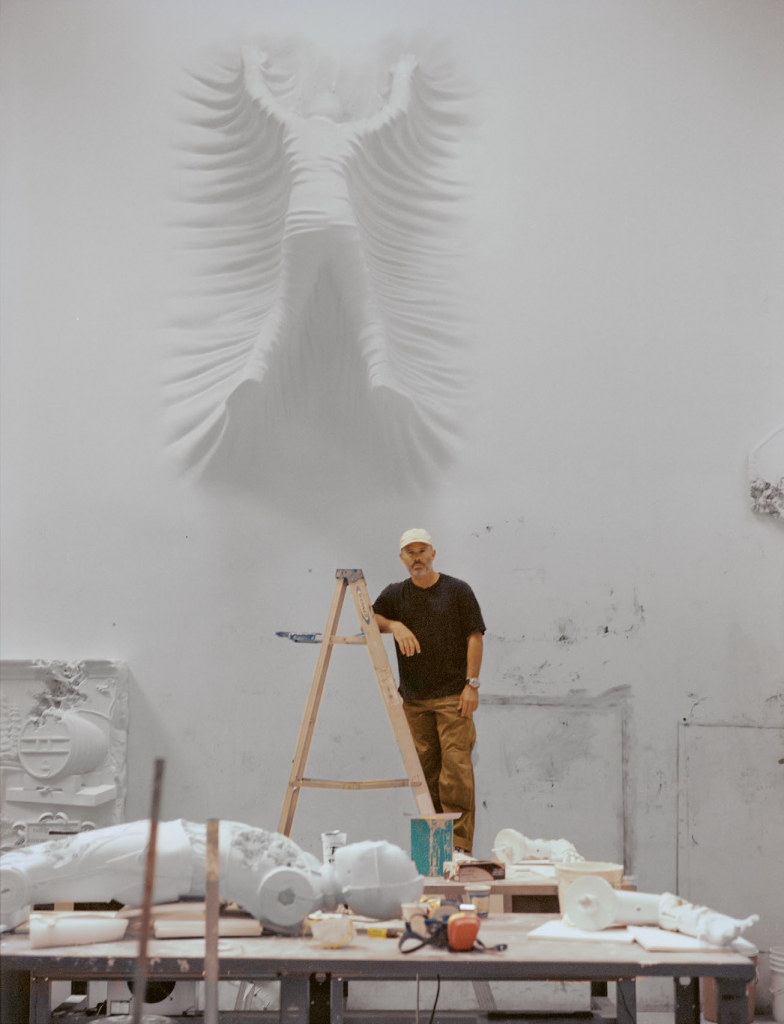
Exploring the artistic alchemy of Daniel Arsham

All Photography ANDINA MARIE OSORIO

In the realm of contemporary art, where innovation and bravery collide, one name emerges with an irrefutable resonance – Daniel Arsham. An enchanter of temporal dimensions, Arsham has spent the past 20 years transforming cultural objects into eroding artefacts, producing works that could both be plucked from ancient history or from an unfathomable day far, far ahead in a dystopian future.

Much like an alchemist of antiquity, Arsham’s creations sit in what he coins an “archaeological universe” – a civilisation that banishes the clock and is populated by ageless fictional artefacts. Spanning multiple disciplines from sculpture to painting, Arsham’s practice can therefore be likened to an orchestrated symphony that dances on the delicate thread of time. To celebrate Arsham’s momentous career and a two-decade collaboration with gallerist Emmanuel Perrotin, the artist is opening two solo exhibitions taking place simultaneously in Perrotin’s spaces in Paris and New York this September. Debuting multiple series of works inspired by his archive – a project with Star Wars, sketches etched into hotel stationery and updated versions of his antiquity sculptures, for example – all those who set foot into the galleries will be given the chance to observe his evolution over the years. Right now, there’s a deep sense of reflection permeating the air. “A lot of the work that I make today,” he admits, “I don’t think I would have been able to create 20 years ago.”

Born in Cleveland, Ohio, and raised in the sun-stroked streets of Miami, there are a couple of catalytic moments that inspired the practice of the now New York-based artist. In 1992, Hurricane Andrew blitzed its way through Florida and destroyed Arsham’s family home in its path. It’s not an event that he thinks about every day, but certainly one that went on to inform the character and ethos of his work. “A lot of my works have this sense where they appear as if they’re in a state of decay or erosion, or they’re falling apart,” he says. “The idea around destruction and reconstruction is buried in the deep recesses of my subconscious.”

Arsham attended Design and Architecture Senior High School in Miami and was later awarded a scholarship to study a Bachelor of Fine Arts degree at The Cooper Union in New York. Here, he was able to dabble in different mediums including painting, sculpture and photography, and ultimately sow the seeds of his distinctive vision. “The school was really an education about concepts and ways of making rather than the medium in which it sits,” he explains. After this, Arsham travelled back and forth between Miami and New York, which led to the meeting with gallerist Emmanuel Perrotin. “I began my career with him,” he says. Since Arsham joined 20 years ago, the gallery itself has expanded from a single space in Paris to multiple branches in Miami, New York, Shanghai, Hong Kong and Tokyo. “As my work has evolved, the gallery has as well,” he reflects. “I think it’s quite rare today for artists to have relationships with galleries like this. I was 23 when I began with the gallery, and it feels like a part of me, my history and my family.”

Just like time itself, Arsham’s interests in varying mediums have ebbed and flowed. In fact, his journey is not too dissimilar to the way a river ceaselessly carves its course, with the first bend marking his journey as a painter, before the gentle stream ships him off to other disciplines. As Arsham is colour blind, however, he’s always found painting to be a little challenging, “especially in the use of colour”, he says. As such, he turned his focus on the tonalities of colour instead, and all his artworks pre-2010 are swashed in monochrome gradients with hints of blue and green.

For the next 10 years, Arsham became interested in sculpture and began manipulating architecture – ‘Falling Clock’, a sculpture that gives the illusion of time melting off the wall, is one of his best-known pieces from this era. When Covid-19 hit and studios were closed, however, a lack of space and available tools meant that Arsham wasn’t able to work on larger-scale pieces. It was a perfect opportunity to return to painting, which he practised “pretty heavily” in the time proceeding. So much so that the exhibitions launched after 2020 saw an influx of new paintings and revamped ideas from the past that he “hadn’t quite concluded 10 years ago” – such as a series of landscapes “that look like they could have been made thousands of years ago, in the present or some potential future”.

Alongside his personal endeavours, Arsham co-founded design studio Snarkitecture in 2008 with Alex Mustonen and has continued to place collaboration as a fundamental part of his practice. To date, he’s conceived projects with multiple brands including Tiffany & Co., Adidas, Dior and Porsche, and has worked with music producer Pharrell Williams, choreographer Merce Cunningham and designer Hedi Slimane. Throughout his far-reaching work, though, there’s a consistent theme of decay and rebirth. His work is not merely a sanctuary for artistic creation; it’s a sanctum where subjects like ancient Greek busts, cars, film characters or emojis go through a metamorphosis. His Future Relics series sums this up best, which sees time-bending objects excavated from the present. “It’s as if you’re looking at an archaeological object that is from your own life,” he says. “There’s a bit of a confusion or dislocation that you feel; you don’t quite know where the objects are from.”

One of Arsham’s latest displays of timeless decay is a new collaboration with Star Wars, a project he’s dreamt of since childhood. Three years in the making and on view at Perrotin, Arsham was granted licence to turn Star Wars characters like R2-D2 and Darth Vader into archaeological relics, effectively creating a Star Wars universe that’s undergone a time-melting makeover in true Arsham style. This project, as with all of his work, is inherently there to confuse you, to make you question when, why and how it was made. But once you peel away the layer of magic, you’ll see that his
pieces are all created with traditional casting techniques, but constructed from a medley of unexpected materials, like crystal, volcanic ash, patina bronze and stainless steel.

To achieve this eroding effect, Arsham mixes wax with sand and applies it to the affected areas – this causes the material to lose its bond and fall away. “It’s a bit of trial and error because the moulds are sealed, so I cannot see inside them when they’re being cast,” he explains. “Some of the works have to be cast multiple times in order to get them to work properly. But over the years, I’ve gotten better at that process.”

When walking into any gallery space in which he’s exhibiting, there’s an odd sense of dislocation that will arise from the experience. On one side, you have decaying faces, almost rotting structures that have disintegrated over time, and familiar objects that appear to be blowing in a constant state of dizzying movement. On the other side, you have soft, textural paintings and architectural sculptures that melt into the walls. This perplexing state, according to Arsham, can open up new ways of thinking.

“It’s like an invitation to rethink your everyday life and how you interpret time,” he says. “So much of our everyday experience is governed by how many hours we have in the day and what we’re doing next week. The work invites you to escape that paradigm. When things are acting in a way that they’re not supposed to, it’s confusing. And that confusion can lead to productive thinking in other areas.”


This article is taken from Port issue 33. To continue reading, buy the issue or subscribe here

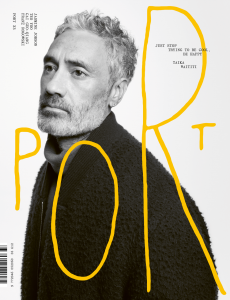
Taika Waititi

Catching up with the renowned actor, writer and director, off the heels of Next Goal Wins, a film following the 2014 American Samoa football team’s attempts to qualify for the FIFA World Cup. Doing a sports film is breaking new ground for Taika Waititi, but that’s never been a problem – it’s often what draws him to projects in the first place. Being nervous leads somewhere cool

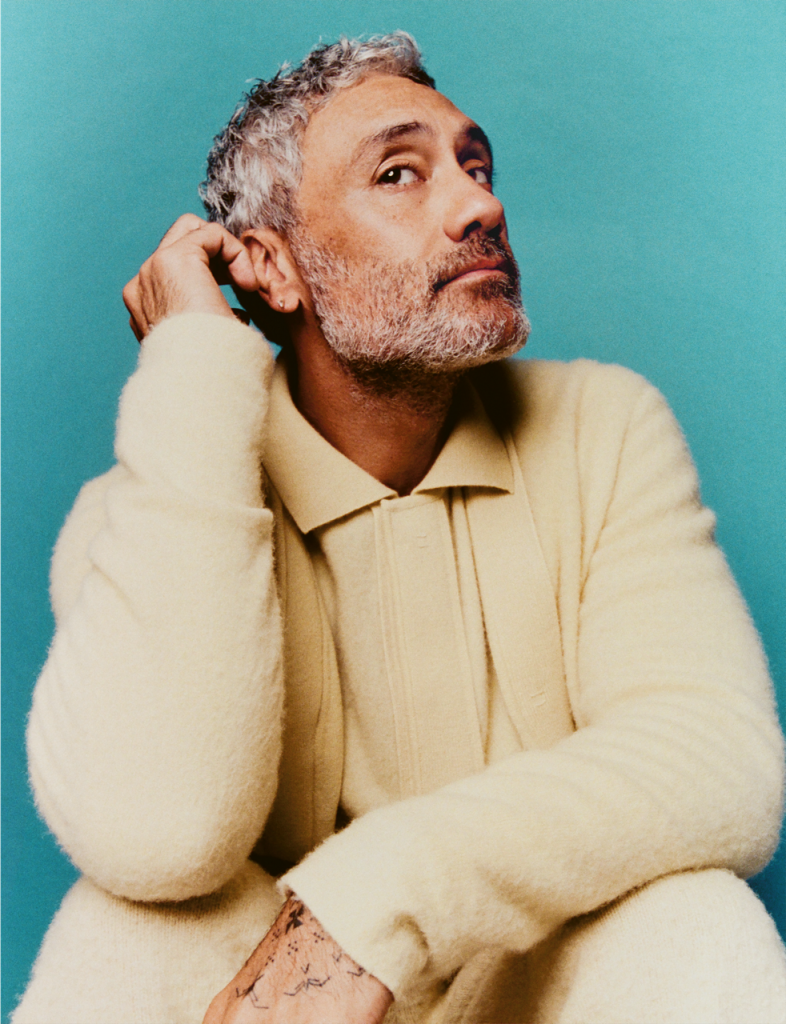
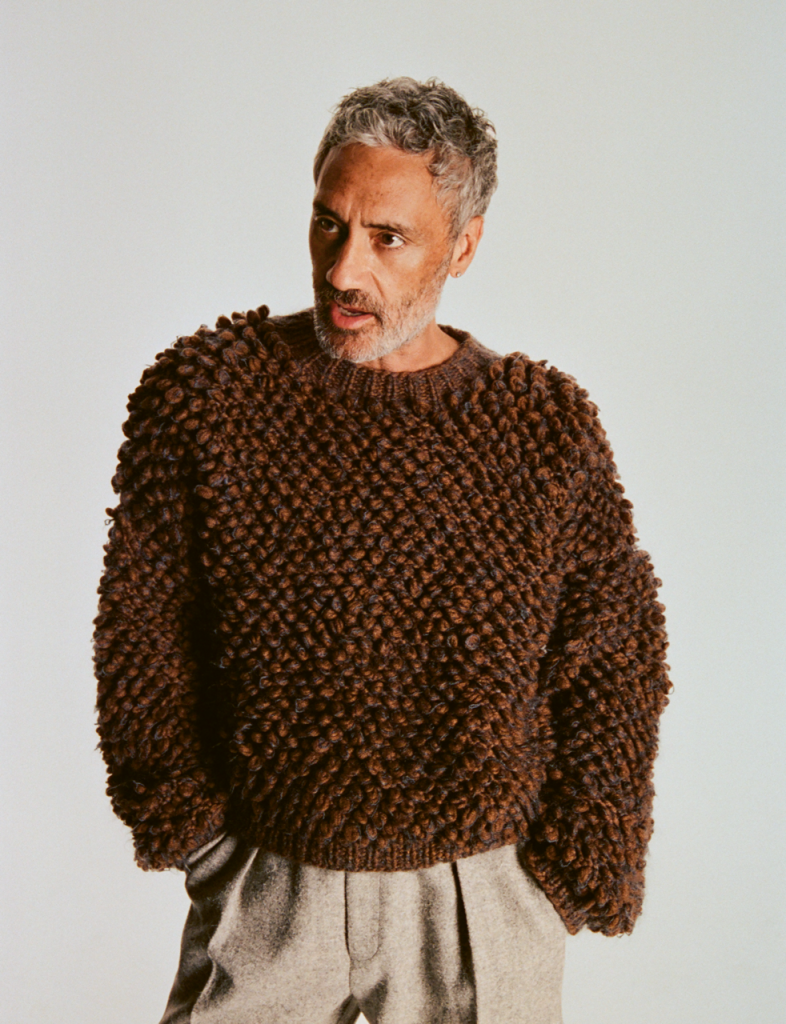
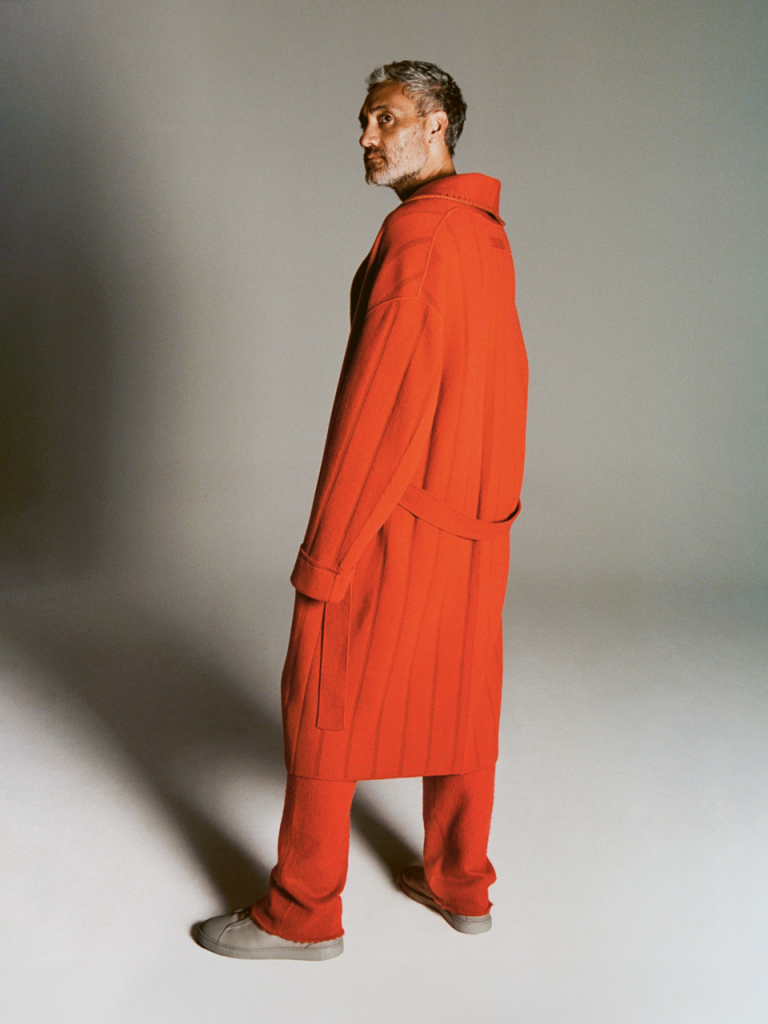
Taika Waititi wears ZEGNA WINTER 2023 throughout

Taika Waititi is 17 hours away from me. If I had the money and patience to take a flight from New York to Auckland, then I could have talked to him in person, but since time and budget are both big concerns, I agree to Zoom. And to be honest, talking to somebody on your computer screen isn’t the worst thing imaginable. It beats the phone. You can see the subject’s eyes as they’re contemplating their next words, watch their mouth to make sure they’re done talking so you don’t interrupt them. In the case of my talk with the director, writer, and actor who has spent the last decade carving out a unique spot for himself in film and television, it’s at least sunny where he is on his home island of New Zealand. He’s had enough success over the last few years that he can be there more, and in a place like Hollywood less. It’s almost noon where he is, nearly seven at night my time, and the rain is pouring outside my window. I appreciate seeing the sunshine on the other end. But for Waititi, whose first big hit outside his home country was the 2014 mockumentary What We Do in the Shadows, about a group of vampires living as roommates in the island’s suburb of Wellington, being home and not being stuck around the heart of the American movie industry is part of his process.

“Basically, I’m a tradesman,” he says. His mother is a teacher, his father was a farmer, and Waititi approaches what he does in a similar way as his parents. The difference of course, is he gets to make movies that millions of people see, put on Armani and Prada suits to walk red carpets all over the world, and let’s face it, he likely makes much more money than a teacher and farmer combined. But still, he sees it as “the same fucking thing. I just do versions of that where it’s…” He pauses a moment to think. It seems as if he’s going to maybe go a different route, but Waititi seems to follow through on all the thoughts he has and doesn’t really hold back. The word he was going to use was “glamorous”, but then he says that the life of a filmmaker isn’t all it’s cracked up to be.

“Eighty per cent of the meals I eat while I’m working in this industry are lukewarm food out of a cardboard box that’s been delivered from somewhere and it’s fucking shit. And it’s not glamorous. And it’s like every time I eat, [it] makes me sadder. I’m like, where’s this Bob Evans lifestyle I wanted where I’m fucking eating out at the fucking fancy places all the time.” Then he gets to the rub: “Then you do eat out at fancy places and you’re sick of that food and you’re sick of the people and I dunno, there’s no answers other than just like, you need to chill out and come live in New Zealand.”

Early on, New Zealand played a big part in Waititi’s work. It was where he set stories, worked with his friends, and shot his first four films. By movie number five, Hollywood came calling, the way the city has always been interested in “international” filmmakers. It’s not always the easiest transition for directors, and the history of cinema has more than a few big names from Italy, Korea, or France who did one or two films in sunny Southern California before taking the first plane home. Waititi’s first task was to take his vision and sensibility and not just direct a film in the Marvel Cinematic Universe – the type of film that is almost always at the centre of any conversation about The Death of Cinema, as well as an all-but-guaranteed box-office hit – but revamp a franchise focused on one of the company’s most famous superheroes, Thor. It was no small task, but not only did Waititi make a successful film that cleared over $800 million at box offices worldwide, critics actually liked Thor: Ragnarok. It was undeniably a Marvel film, but it was fun and more importantly, funny. It was noticeable that the director was able to do something on set that freed Chris Hemsworth up, making the fact that he was playing a very handsome Norse god something that the audience could laugh at. Somebody in the industry might call it the director’s “magic formula”, and if Waititi wanted, he likely could have coasted off the success for the rest of his career, getting somebody to drive him from his house in the Hollywood Hills down to the movie studio to make one big, easy money maker after another. But that’s not how he likes to do things. “It doesn’t matter what it is. It doesn’t matter if you think it’s going to be a home run from the beginning,” he says of his thought process behind any project he’s involved in. “Inevitably, you’re going to question why you made the film. Will anyone relate? Will anybody care or like it?”

That sounds like typical artist worry. No matter how successful you are, there’s always going to be a fear that people just don’t appreciate what you do. Yet the difference between somebody else worrying if people will like or appreciate their work and Waititi doing it is the fact that hardly anything he does makes sense when you first hear about it. His credits include writing, directing, and producing the What We Do in the Shadows vampires, a Marvel character, the pirates of the hilarious cult TV show Our Flag Means Death, and managing to carve some space between Mel Brooks’ The Producers and Quentin Tarantino’s Inglourious Basterds for a movie about Nazis that’s actually funny: 2019’s Jojo Rabbit, which went up for multiple Oscar categories, and netted Waititi the award for Best Adapted Screenplay. There’s no easy answer to how Waititi should follow up on any of his projects, and that’s part of the fun of following along with his career; you’re almost always surprised by what’s next. Following a return to the MCU with 2022’s Thor: Love and Thunder, Waititi did the most Waititi thing he could and went in the last direction anybody saw him going in by making a family-friendly sports movie, Next Goal Wins.

The reason was pretty simple: “I like sports films,” he says. He mentions classics like The Bad News Bears from 1976 or Cool Runnings, the 1993 feel-good Disney comedy about the Jamaican bobsled team at the 1988 Winter Olympics. The thing is that sports films – funny sports films that you can take the kids to – aren’t exactly going to get you compared to Hitchcock or Kubrick, but the movies Waititi mentions as his influences going into Next Goal Wins are the type that become cultural cornerstones for people who see them when they’re younger. You might have a ranking of your favorite Tarkovsky films, but if you were a kid in the 1990s, it’s almost certain a film like Cool Runnings or The Sandlot secretly means more to you. And besides, Waititi is his own director with his own sensibilities and interests. The one problem with that, however, is that the sport Next Goal Wins is centered around, football, isn’t actually a big interest of his. “I don’t really know anything about soccer,” he says. He’s a rugby fan. But watching the film this feature is based on, a 2014 documentary of the same name, something clicked. “This seems to be a weird move for me, doing a sports film. So that makes me nervous. And whenever I feel nervous about approaching something, I know that at least it’ll be interesting, and I’ll probably come up with something cool.”

The sports film can be tough to pull off. For every Rocky or Friday Night Lights, there are three schmaltzy stinkers full of dogs that can play basketball, kids inheriting then managing professional baseball teams, racist and sexist tropes, and the inevitable David vs Goliath storyline of the rag-tag bunch of misfits making it to the promised land against all odds and expectations. Waititi came up with a smart formula for Next Goal Wins: he embraces some of the fun and silly things you’d expect from a movie about a team sport from a film aimed at kids in the 1990s – maybe knowing full well those former kids, now adults, will form part of his audience – and, as he puts it, “there’s barely any sports” in the movie. More than a few directors, from William Friedkin to Hal Ashby, have learned first-hand how difficult it can be to shoot actors actually playing a sport their characters are supposed to excel at.

Beyond the way the film looks, or the brand of humour laced throughout, there is another huge, telling thing that lets the viewer know they’re watching a Waititi film. Next Goal Wins tracks the true story of the American Samoa national football team, considered the worst in the world after a decade of consecutive losses, starting with a 31-0 drubbing by Australia in 2001. The Samoan team doesn’t have big aspirations when Dutch-American coach Thomas Rongen (played by Michael Fassbender) arrives, and far from dreaming of winning the 2014 World Cup they train to qualify for, they just want to score a goal. That’s it. One goal would be great. It’s fun and heartwarming, and the reason Waititi makes it work where other directors might fail is because one of the big themes of his career has been telling stories about and with Indigenous people, both from the part of the globe he comes from in the South Pacific, and beyond. When I talk to him, the show he co-created with American filmmaker Sterlin Harjo, Reservation Dogs, is winding towards its series finale. The show has been lauded by critics as one of the best things on television, and a very moving, often funny portrayal of the lives of a group of Indigenous teenagers in a broken Oklahoma town. “My hope is we get to at least keep making stuff so that we can start surprising people,” he says.

It can be difficult to take stock of what Waititi is doing in real time. A director’s legacy-in-progress isn’t usually discussed while they’re still building an oeuvre, especially a director who has shown a knack for making big box office movies meant to please the masses like Waititi. But his work helping to get stories of and by Indigenous people and communities out into the world is something that’s long overdue, and his parallel place as a big-name filmmaker makes him the public face of a small, growing movement. He’s quick to point out how culture still sees native peoples worldwide, the very wrong assumptions and stereotypes that he’s trying to break down. “Everybody assumes the Pacific, it’s all tiki bars, but those are a made-up white thing. It’s all completely bastardised designs, people saying, I made it Polynesian-themed. But we hate tiki bars. Whenever somebody sees that stuff and says, it’s from your home, I’m like, I want to burn this thing down,” he says before adding, “So don’t invite me to your tiki party.” But it’s not just his part of the world that Waititi – who is Māori on his father’s side, and Ashkenazi Jewish on his mother’s – sees it in. “There are still places where this kind of shit is happening,” he says, before noting the almost annual news of some fashion house or attendees at a music festival in North America appropriating the dress of tribes that once lived on the same land. “In Spain and Ibiza – I mean, Europe is always 400 years behind everybody else – you go to these shops and they’re just full of Native American headdresses for white people,” he shakes his head in disbelief before mimicking a white person trying to justify their decision to don a feathered war bonnet as a style choice. “My grandmother is a Comanche princess!

Waititi can joke about it because that’s what he does; his first aim is to make people laugh, and laughter is a sneaky way to make people understand and accept things better. The big, unifying figure in his work – whether it’s vampires going about their unlives in the suburbs, Indigenous people living in a colonised world, or even the Norse God of Thunder trying to navigate the human world – is ultimately the outsider. It’s a theme he can identify with, in part just because of where he’s from. New Zealand is “an island of four-million people and we’re so far away from anything. If you want to escape, the nearest place is Australia, which is an absolute shithole,” he says. The two countries have long had a rivalry with one another, but growing up, it was always New Zealand that was last to get everything, including shows and movies from the US and UK that made Waititi and his friends work especially hard to develop their own culture: the movies, shows, and jokes that have come to define Kiwi humour over the last few decades. “We never really fit in with anywhere. But coming from places like New Zealand and Australia and the colonies, smaller places that have often been forgotten about, our cringe meter is very sensitive. We’ve spent our entire lives laughing at the cheesiness of Hollywood films and there’s always that scene between two best friends when one of them is about to die and they’re like, Yeah! We’re best friends. We’re going to open that bar together like we always dreamed. And you know in the next scene, that fucking dude’s dead.”

But Waititi also gets it on a personal level. “Also, coming from my mother’s side – what we call pākehā, or white – and my father being Māori, there’s a real clash of worlds. Growing up, I knew I was accepted in both worlds, but also, there’s a question you ask yourself: Am I dark enough to be Māori? Am I white enough? Am I European enough on the Jewish side? And I think I just gave up trying to be either of them, and just sort of traversed that little middle ground where I could dip in and out according to what social group I wanted to be accepted by.”

That awareness of the middle ground means Waititi understands the absurdity that comes with not being like everybody else, and how difficult it can make things, but also sees the beauty in it, that he translates into movies that people want to see. There’s an openness in his work, his films are for everybody. “We’re all clumsy,” he says. It’s a mission statement of sorts. It isn’t so much about good or bad as it is just trying to navigate our way through the world. “When we’re pretending we don’t want to fit in, we’re still trying to be noticed. People are like, oh, I didn’t care about that mainstream shit. You’re still trying to be noticed. The sooner we all realise that and just admit it and accept we’re all fucking fake-ass animals pretending our way through life, it just takes the pressure off. Just stop trying to be cool; be happy.”


Photography Jai Odell

Styling Julie Velut

Grooming Melissa DeZarate

Production Underhill Film


This article is taken from Port issue 33. To continue reading, buy the issue or subscribe here
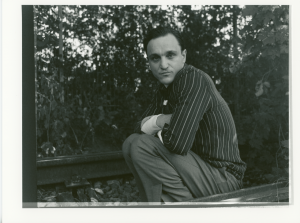
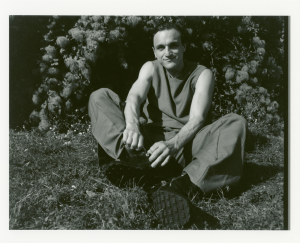
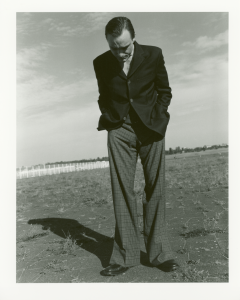
Franz Rogowski

Discussing his work and himself after the release of Passages, Franz Rogowski talks about the traps of selves both real and performed

Franz Rogowski wears PAUL SMITH AW23 throughout

At the end of Ira Sachs’ 2023 film Passages, the protagonist, Tomas, played by the German actor Franz Rogowski, endures two brutal, entirely deserved rejections by both his soon-to-be-ex-husband, Martin, and his estranged lover, Agathe. Bereft, on his knees, wearing a ridiculous outfit, he is hunched and suffering in the hallway of the grade school where Agathe works — he has interrupted her class to make his doomed entreaty – when a brusque employee shoos him away. His response is to get on his beat-up vintage racing bike and go. The final shots of the film show Tomas riding, skillfully but recklessly, with the energetic physical control Rogowski brings to pretty much every part he plays, through the streets and sidewalks of Paris. Maybe there are tears glistening in his eyes, but he is also free.

This was how, more or less, Rogowski would show up to meetings with Sachs during the making of the film. “He would always arrive out of breath on a bike, like, jumping a curb,” Sachs told me. “It inspired me to rewrite the end of the film with Franz as the kamikaze bike rider that he is.”

It’s a recognisable Berlin type, the beautiful man speeding past on a lithe French bike, and indeed I’d felt lucky when I saw Rogowski in that role once a few years ago, darting around a corner in Kreuzberg. So I was surprised when he rolled up to our breakfast on one of those weird little folding bikes, in startup blue, and a helmet. “German engineering,” he said. He was wearing a black T-shirt and jeans cuffed for the bike. “I’m getting old, and I have a bit of a back problem, and this has suspension in the back. I’m experimenting a bit with different kinds of exercises – some are dangerous, some are necessary.”

“It’s interesting,” he continued, “even sex can cause pain. Like, you need to find the right position. And to a certain extent, it feels ridiculous to be saying those things when you’re 37. But I guess that’s when it starts.”

The other dangerous exercise is rock climbing, but even without it, it’s not hard to imagine how Rogowski developed a back problem. A former dancer and theatre actor who was kicked out of Swiss clown school after leaving traditional school at 16, he has become, over the last several years, both a beloved star of European arthouse cinema and, according to the New York Times, an “unlikely sex symbol” for the sickening combination of his shy, sensitive face and thrilling physical intelligence. He is also, simply, one of the best actors working today, and so not to be trusted. But this is why we love actors: most people are not to be trusted, but actors are explicit about it. After an hour together I determined the random comment about sex made within the first five minutes of our interview was less an indication of put-on naughtiness and more a misguided attempt at acknowledging this uncomfortable situation. His background as a dancer is obvious in the graceful movements of his thick forearms and bouldered hands, but he is otherwise tentative and tense. He slumps, his shoulders rounded; he is so compact that he seems small, though he is not. When we met, he spoke with his head tilted to one side, bad for the back again, and focused his gaze almost exclusively at some point to my right.

He is often cast as a man complicatedly in love, thwarted by identity and circumstance. In Christian Petzold’s Transit (2018), he plays a refugee in a contemporary version of occupied France who begins posing as a dead writer in the hopes of getting passage on a ship to flee the Continent; when he meets the dead writer’s wife, who has come to Marseille to search for her husband, unaware that he has died, he falls in love with her, and struggles to tell her that the missed connections she believes she’d had with her husband have been with him – he’s been using the dead writer’s documents at the consulates where she’s been searching for him. In Thomas Stuber’s In the Aisles (2018), he is a forklift operator at a supermarket who falls for the married woman in charge of confectionery; he has a dark past, and she a dark present. In Petzold’s Undine (2020), his lover is a water nymph who can only live on land if she is in love with a mortal man, but if that man ever betrays her, she must kill him; Rogowski’s character, Christoph, shows up when this fate has already been set in motion, and he becomes caught up in the myth. In Sebastian Meise’s Great Freedom (2021), he is a gay man repeatedly imprisoned under Germany’s Paragraph 175, which criminalised sex between men in the country until an age of consent was established in 1969; the story spans more than 20 years, and twice his lovers end up in prison with him, though the most moving of the film’s several crushing narrative arcs is his romantic friendship with a convicted murderer and drug addict.

What unites these star turns with Rogowski’s smaller roles is a sense of complete openness; he is always going for it, emotionally and physically, as if he has considered no alternative. Sachs says he first knew he wanted to work with Rogowski when he saw Michael Haneke’s 2017 film Happy End, in which Rogowski plays a supporting role as Pierre, the moody, alcoholic son of a wealthy family. At one point in the middle of the film, Pierre appears on a karaoke stage, with the neon lyrics to Sia’s ‘Chandelier’ projected onto his torso. He follows them theatrically, and then he begins to vogue, and kick, and fling his arms into the air. His amateur singing voice transforms into grunts as his effort intensifies. He cartwheels one-handed, still holding the microphone. He does a handstand, balances his feet on the low ceiling, and sings a few bars upside down. He does several more cartwheels, pushes himself up from the ground into another handstand position, does pushups in the handstand, and rolls around on the floor. The audience, seen in the reflection of the mirror at the back of the stage, offers restrained encouragement; they can’t believe him. And then, suddenly, he stops. He’s hurt himself, or he’s going to be sick, or he’s realised he’s too drunk to be doing this. His entire body becomes tense with some kind of pain, and the audience grows quiet and concerned before he slowly crawls to the wall and pulls himself up.

In Passages, the obstacle to his character’s romantic prosperity is not society, or fate, but his own attention span. A mercurial director dissatisfied in his marriage to Martin (Ben Whishaw), Tomas meets Agathe (Adèle Exarchopoulos) at the wrap party for his new film and self-consciously dances, with that shy, sensitive face, into bed with her. The rest of the film observes Tomas following his conflicting desires, back and forth between them. He appears alternately strong and bird-chested, ripped and exposed, depending on whom he is trying to convince to stay with him despite their better judgment; his timing is often very funny. Reviewers have called the character “toxic”, manipulative, and a narcissist, even as they acknowledge how compelling he is. We agreed these terms are reductive. “He desperately wants to build and to relate,” Rogowski said, “but he’s very unstable, especially when it comes to relating to himself and knowing who he is. He’s highly dependent on feedback – emotional feedback, also cultural feedback, as an artist. So that’s why I think to a certain extent, he’s innocent.”

If the film’s final scene, on the bike, is inspired by Sachs’ actual relationship with Rogowski, the rest of the film is inspired by an imagined version of the actor. Sachs wrote the role of Tomas with Rogowski in mind, which means Sachs used an idea of Rogowski he’d gotten from his other roles to make a new character out of him. Rogowski was intimidated. “When you hear this line, you know, okay, I will disappoint that person,” he said. “I can’t possibly be who he thinks I am. And that’s something that happens more and more. The more people know you or think to know you, the more scary it can become to meet people in real life.” In this case, divergence from the character might not be so disappointing. Still, Rogowski says he puts “a lot of effort” into answering the question of who he is; he has developed a Profilneurose, a colloquial term for “when you’re kind of neurotic about your social profile”, seeking constant validation. “I don’t feel good about myself unless I create some kind of relationship with something other than me,” he said. “If I just exist, I feel like I shouldn’t.”
Surely this is true, to greater or lesser degrees, of everyone; we all want, as Rogowski does, to “be free”, but we need other people as much as they get in our way. From that perspective, starring in a film like Passages must have been especially tantalising, or disorienting. The film allows Tomas to seek the feedback he wants whimsically, without apparent fear of consequence, as if Sachs has translated the unbridled performances Rogowski delivers as an actor into a mode of relating to others. 

The film also avoids the constrained approach to questions of identity that its marketing suggested it might represent. “I slept with a woman last night,” Tomas says in the trailer, implying the film will feature conflict around Tomas’s sexuality; it does not, which creates a sense of momentum and possibility uncommon in contemporary anglophone cinema, even as many discussions of the film can’t help but touch on this untapped drama. “Cinema often tries to create a simplified version of life,” Rogowski said, “and maybe, therefore, we expect a queer movie to somehow also come up with some answers to all those nowadays quite complicated boxes and labels that were created around sexuality. I’m happy that the movie doesn’t really answer those questions.”

Because I’m not really a journalist, I am not bound to ask the prurient questions many other journalists have asked, or implied, about Rogowski’s love life and sexuality, to which he tends to respond with some expression of the evolved and conveniently evasive position that gender and sexuality are fluid, and categories like “man” and “woman” and “gay” and “straight” are limiting. An issue of theory versus practice. “The real division is not, you know, are you gay? Are you queer?” he told me. “The real division is, are you working class? Are you upper class? Where do you belong? I think more and more, there’s this little bubble of people that belong to the big capitals of the world, and they can move, and they’re free. And the rest have been pushed to the outskirts.” What journalists really want to ask, I suspect, is: would he sleep with me?

If we ask too much of actors – if we overstep with them, project onto them, want too badly to try our hand with them – it is because the actor can be what others cannot: someone else. He represents the fantasy that the roles we play in our public lives might not have to reflect, or affect, who we “really” are; in playing constant characters, the actor supports the comforting illusion that character is fixed, that there is a stable relationship between one’s public persona and private life. Off-screen, this responsibility is probably a burden; they are not who they play onscreen, but they also kind of are, if not before the role, then after.

Rogowski mentioned a hypothetical situation in which he might direct something, and I asked if he wanted to direct. “Every actor wants to be something else,” he said. “There’s a lack of authorship and a lot of pretending. And it kind of makes sense – the emptier you are, the more somebody else can fill you with something. And you’ll just be very, you know, happily pulling the plow because you’ve been standing around screaming, ‘I’m a horse! I’m a horse! Give me work!’” (He joke-screamed this part.) “But it’s not really yours – you’re an interpreter, you’re a vase to be filled with water or whatever. And I do feel this tension. I think I’m where I belong for now. But I hope I will grow into something that is not so dependent on others, to make circumstances to create.”

He was holding, motionless, a piece of bread for the duration of this monologue. “Do you feel empty?” I asked.

“Yeah,” he said. “I’m very much ADHD. My inner melody is like” – here he shook his head very fast and made a cartoonish noise to indicate craziness – “a terrible noise. Somewhere in between euphoria and depression.”

In Passages, Tomas’s wardrobe consists of flamboyantly androgynous and somehow sexily ill-fitting clothes that look borrowed from a girlfriend or found on the street: the famous mesh crop top becomes a sight gag; the loose-knit sweaters under which he wears nothing; the snakeskin jacket that’s a little too tight; the ratty brown teddy coat a little too big; the leopard-print pants that have lost their shape, and might have been designed for someone a bit taller. A person who dresses like this just puts on whatever he feels like wearing that day – with no forethought and little worry about appropriateness or convention. “He’s defying social norms, in a way that is both wonderful and uncomfortable,” Sachs said of Tomas. The character has a childish impulsivity and lack of concern for others that is the dark side of his dazzling outfits. Even when he dresses less obtrusively, his immaturity shows; at a holiday party, his belt, pulled too tight, is revealed to have ridden up, creating a small gap above his waistband.

Rogowski’s soulfulness invites tenderness, maybe even patronising, but his body is made for these confrontational clothes. He was allowed to keep some of his wardrobe after production was completed, and indeed both the character and his outfits seem to belong in Berlin, where everyone is trying out new identities at the bars and clubs, for better or worse, even past Rogowski’s age. In his 20s, Rogowski said, he did something similar – went to bars, to Berghain, trying “to find my chances – someone that would somehow take my hand.” Now, though, he says he has five or 10 friends and rarely goes out – not to bars, or parties, or concerts, or even to the cinema. When I asked where he wears the fabulous outfits from Passages, about which he’d expressed excitement in other interviews, he told me he just wears them at home.

“I’ve chosen to be in front of the camera, but the real me is actually somebody who loves to observe,” he said. “And a part of me also just wants to dissolve, you know, in a cloud of ketamine on an orgy and have it all at once.” (Ketamine has a dissociative effect that sometimes allows a person to imagine they can see themselves from the outside, among other things.) “But they’re different voices in your soul,” he continued, “and I guess one of the voices in me tells me that I don’t deserve to celebrate and to wear extroverted stuff. I have to earn it. And I haven’t earned it yet. Which I know is a silly and stupid, very German way of thinking, but I can only do it in a movie, or on a certain occasion that creates the circumstances. But when I’m out here in real life, I… I don’t know. I try to hide. I try to be on the bike as fast as I can, so I’m already gone before you see me.” This doesn’t sound like freedom. But that’s why I trusted it.


Photography Suffo Moncloa

Styling Mitchell Belk

Grooming Kristin Belger At Liga Nord Using Susanne Kaufmann and Ghd

Production Vers 


This article is taken from Port issue 33. To continue reading, buy the issue or subscribe here

Don’t Look Now

Do more frames per second help or hinder the true meaning of what you’re watching? From Issue 9, The Film Issue

How real should a movie be? How far should it reproduce the world in which we live and breathe and go about our business? Ever since the first 3D feature in 1922, filmmakers have tried to push as far in the direction of total realism as possible – to make the audience feel they are “in the picture”. Essential to making a film seem “real” is its speed, or the number of frames projected per second to create an acceptable illusion of movement.

Traditionally, economics was the deciding factor. After the chaos of frame rates in silent cinema, 24fps was settled on as the lowest number that could produce a smooth illusion of movement- more would increase the amount of film stock and the expense of production. Thomas Edison reputedly said that anything less than 46fps would be too hard on the eye.

At last Edison has an ally. In 2012, the director Peter Jackson filmed The Hobbit at the HFR (high frame rate) of 48fps – it was shot digitally and in 3D for an even more immersive sense of reality. HR introduces a new problem however: the illusion of real space, and the clarity of detail, may well seduce the eye but they leave the mind unsatisfied. A century of “normal” movies has accustomed us to the aesthetic pleasures of comparing fantastic vs realistic. Perhaps we don’t want to “live” cinema so much as enjoy a cinematic experience.

Some film experts would have welcomed HFR, seeing it not as a violation of cinema but as a true expansion of it. The Soviet director Sergei Eisenstein, enamoured with the “American mountains” (the Russian term for the fairground rollercoaster ride), thought cinema should be a vehicle for terrifying thrills – a revolutionary shock to our cosy submersion in old-fashioned dramatic illusion.

Given the historical perspective, Peter Jackson was right when he said there is nothing magic about 24fps. The contradiction that keeps coming up is that while cinema continues to transform itself technologically, we’re still looking for something essentially cin-ematic. “The cinema is truth 24 times a second,” Jean-Luc Godard once said. But is 48 times a second simply the truth taken too far?
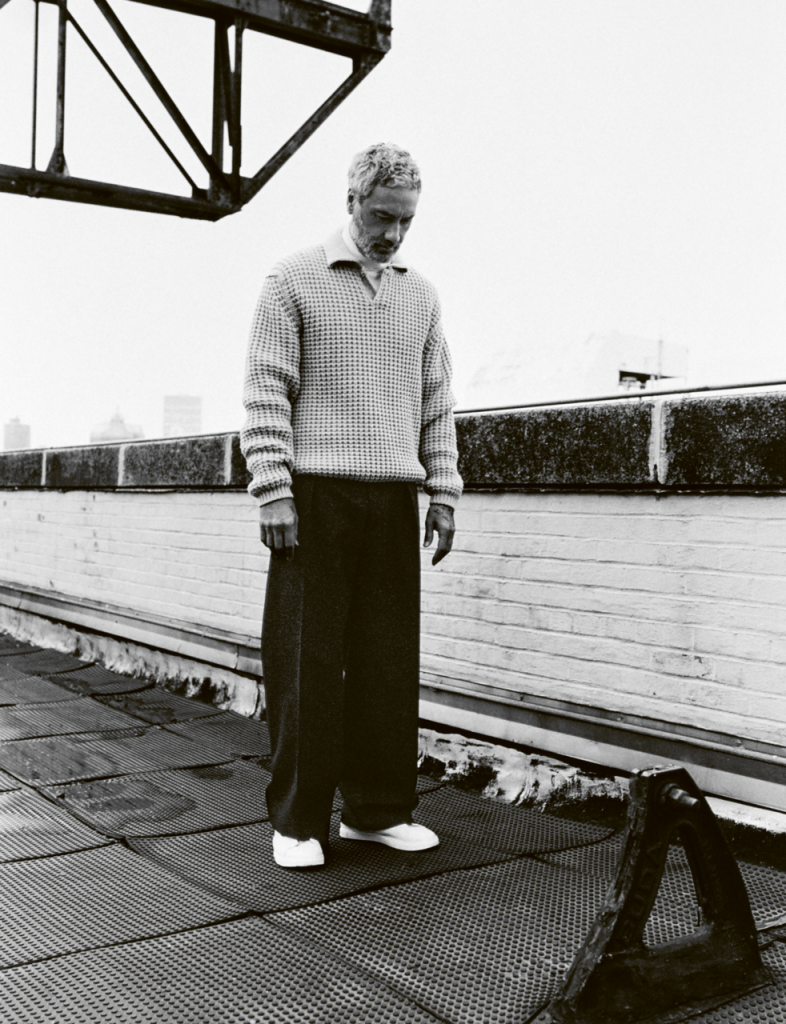
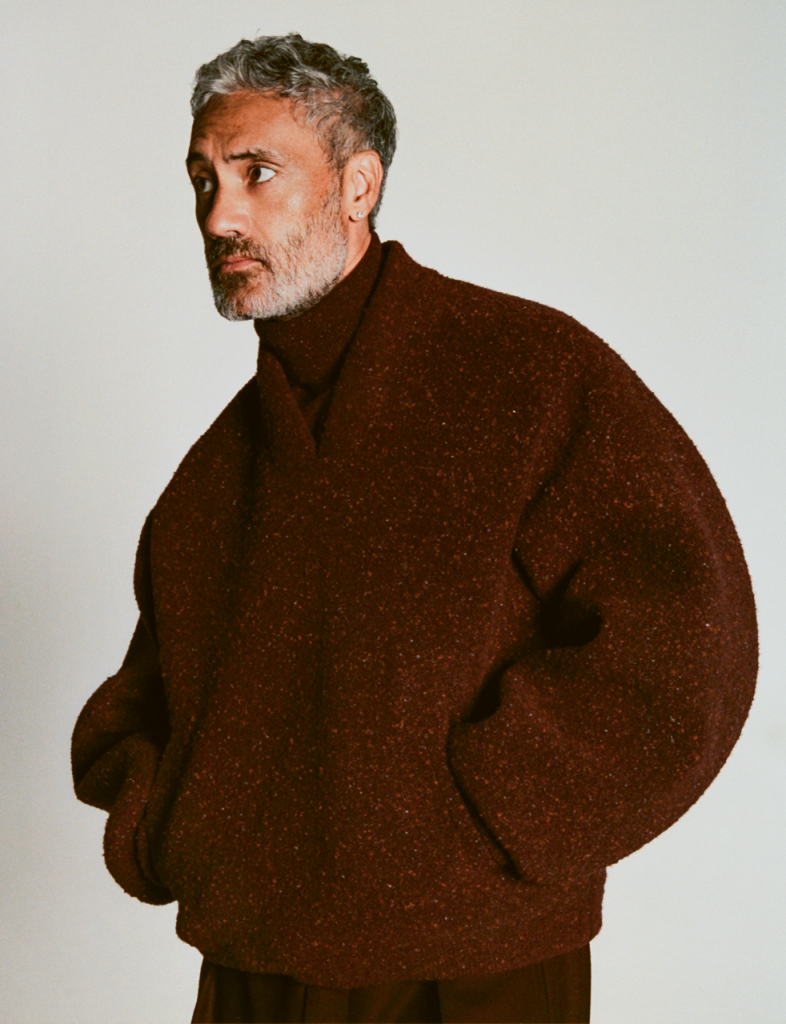
Complaints about The Hobbit range from it seeming like a video game to the illusion-destroying way it exposes the reality of makeup and special effects. Perhaps total immersion in a film is not the same as being able to assess its real artistic value, or perhaps there’s another truth about HR we haven’t discovered yet. In nearly a century, the argument for and against 3D still remains unset tled and it looks like HR may become partof a similar long-running debate.