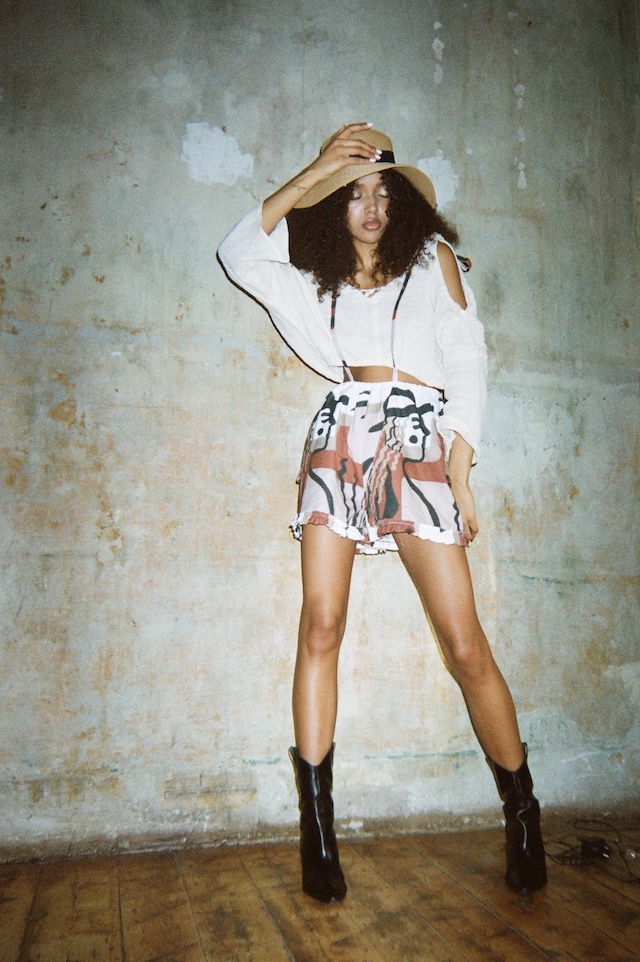
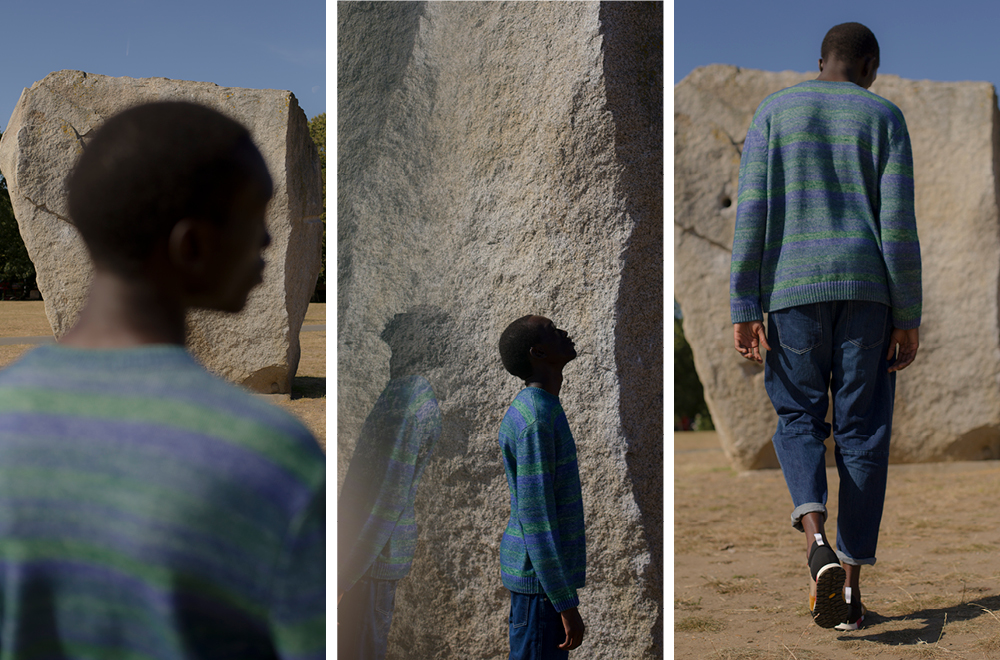
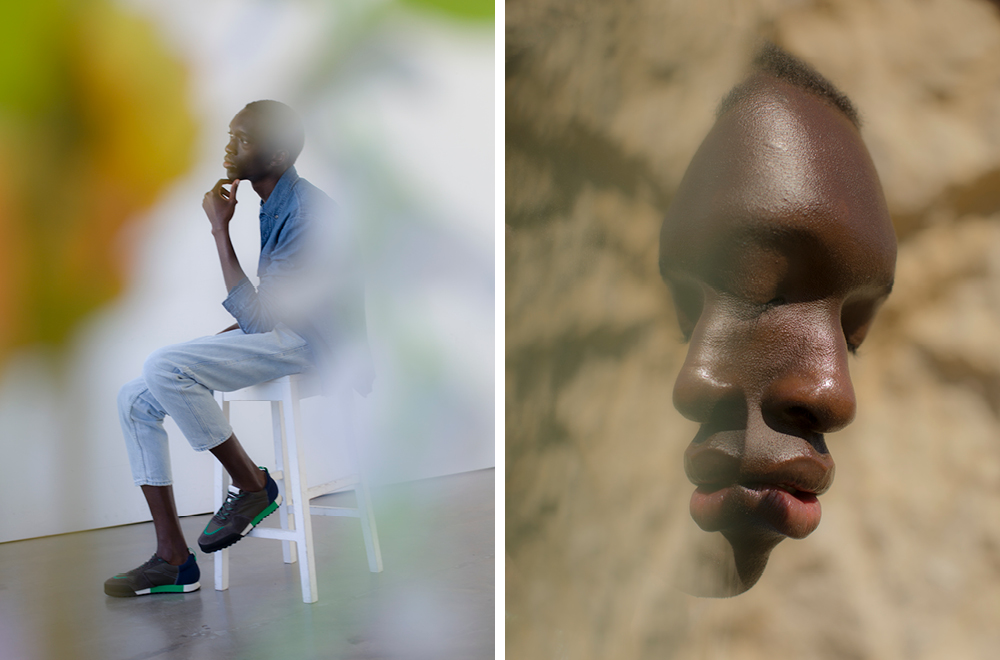
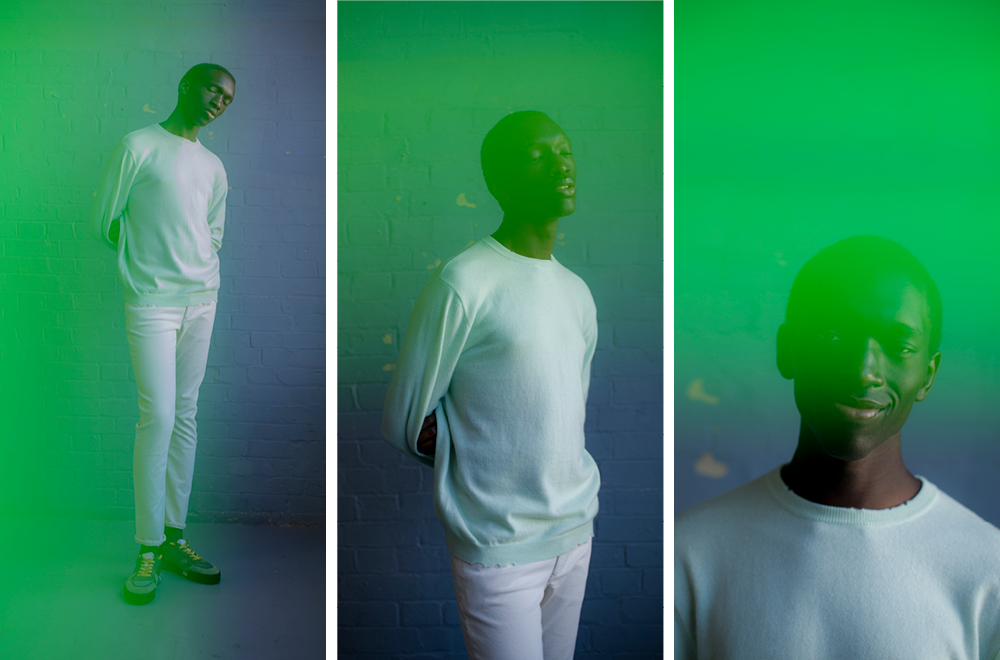
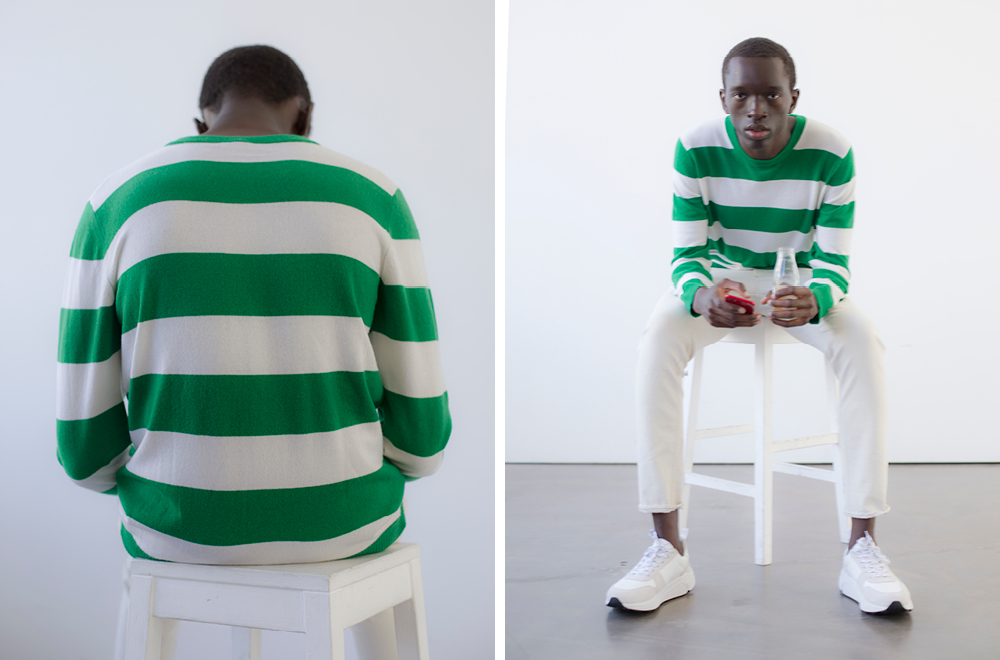
The designer and label founder uses upcycling as a sustainable alternative to the current fashion system
What will the future hold for sustainable fashion? With Glasgow’s COP26 prompting goals and recommendations for a more environmentally conscious world, now has never been more crucial to reassess our relationship with the planet – and our clothing. When it comes to the fashion industry, there’s much to be learnt and adopted in order to reduce the impact it has on the environment. This includes net-zero emissions by 2050 latest, to waste elimination and erasing the global supply chains – not to mention increasing education of how to better address the climate emergency through manufacturing and more conscious and sustainable business models.
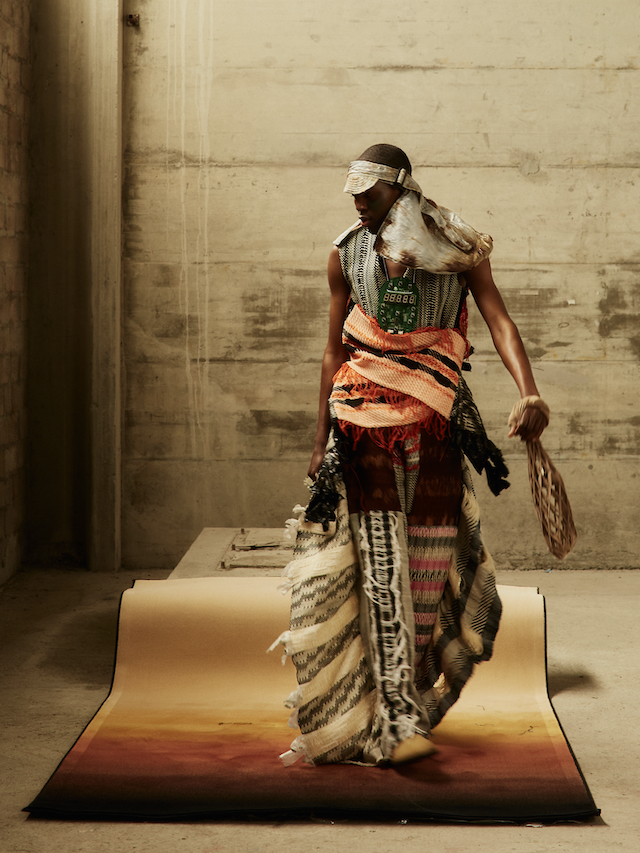
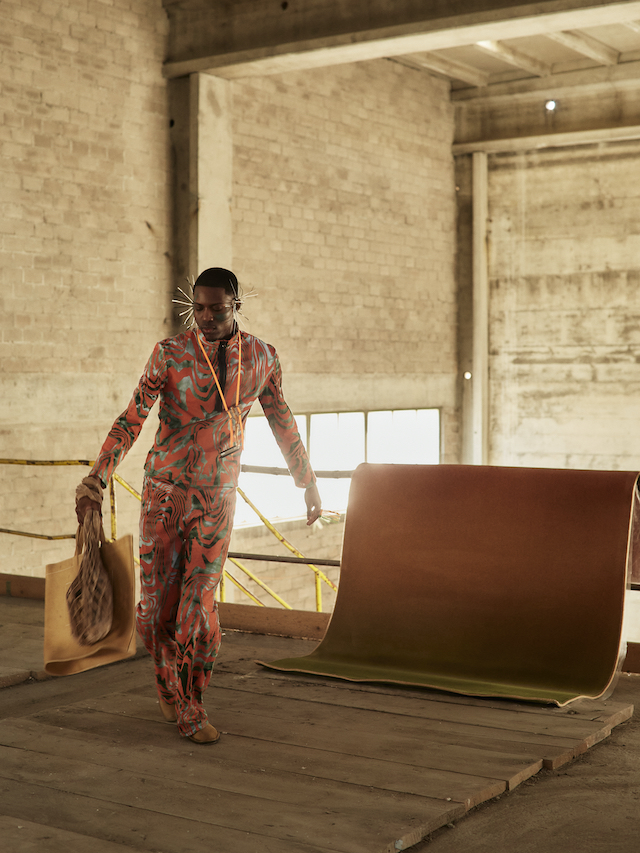
The anticipation for change is heartfelt across the globe, but now, perhaps it’s time to shine light on the industry folk who are already doing their bit. Like Rafael Kouto, a fashion designer who launched his own avant-garde fashion label with the environment in mind. Conceived with upcycling at its core, the label of the same name aims to tackle textile waste, dead stock and other materials in the creative and production lifecycle. “The goal since the beginning has been about cultivating an uncompromised approach to sustainability as it exclusively uses the technique of pre and post-consumer upcycling to create new clothes and accessories,” he tells me.
Rafael grew up on the Italian side of Switzerland in Ticino to a Togolese father and Swiss mother. He studied fashion design at FHNW-HGK in Basel, followed by an MA in fashion matters from the Sandberg Institut in Amsterdam. From working at Alexander McQueen to Maison Martin Margiela, Carven and Ethical Fashion Initiative, he garnered the necessary experience to excel in his profession. Equally, these past roles enlightened an alternative fashion system and proved that a more sustainable and viable option was possible; this is the moment he decided to focus his practice on upcycling and sustainable strategies, “with a particular focus on open source and craftsmanship,” he says.
In 2017, Rafael therefore decided to launch is own fashion brand, which has now gone on to win numerous awards such as the Swiss Design Awards in the Fashion & Textile category for both 2018 and 2019 (he was also the finalist in 2020), plus the Gerbert Ambiente Design Preis 2020 and 2021. To date, he’s also been published in the pages of magazines such as Vogue, Harper’s Bazaar and Dazed. He also applies his knowledge and know-how to a series of upcycling workshops in collaboration with various institutions, alongside teaching as an associate professor in Fashion Design at the IUAV in Venice.
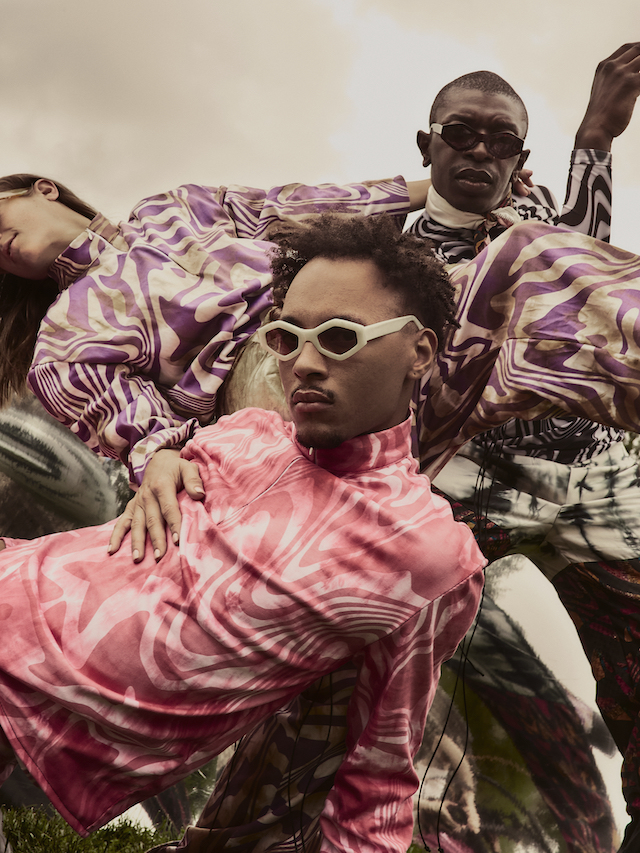
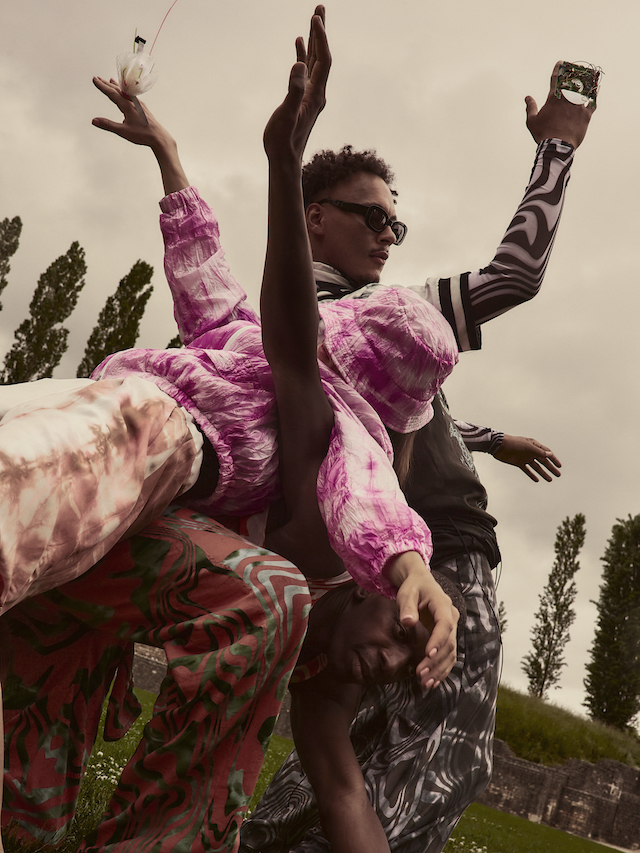
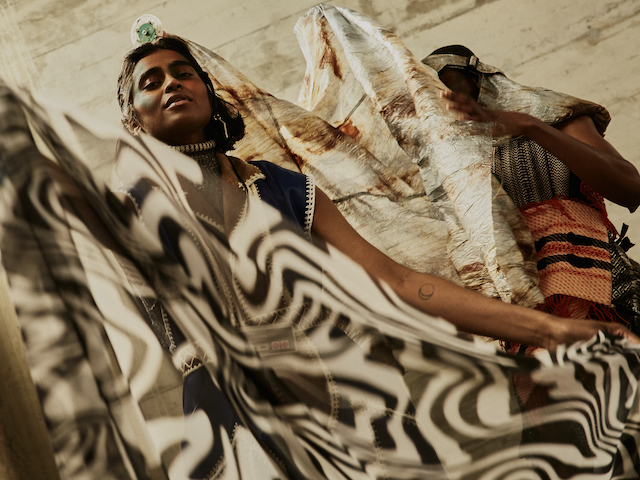
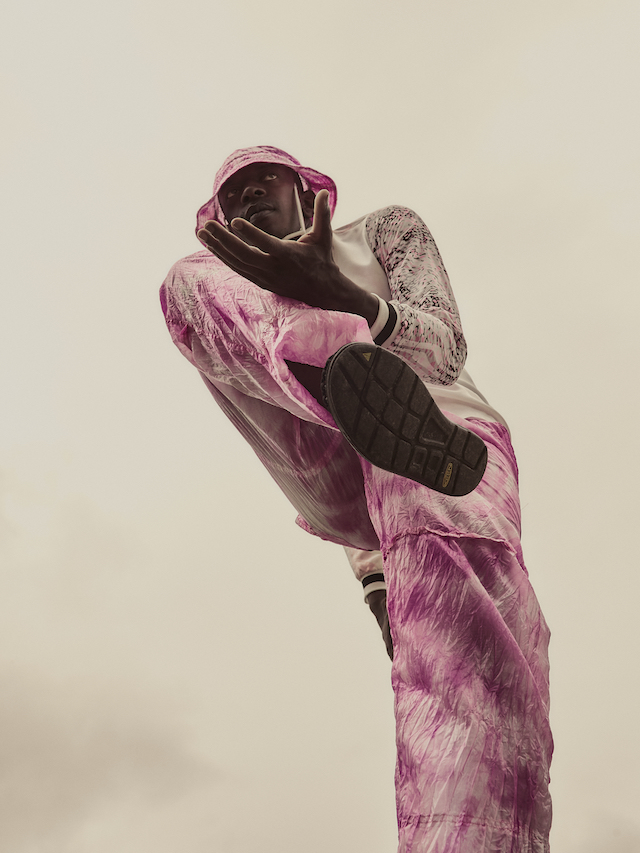
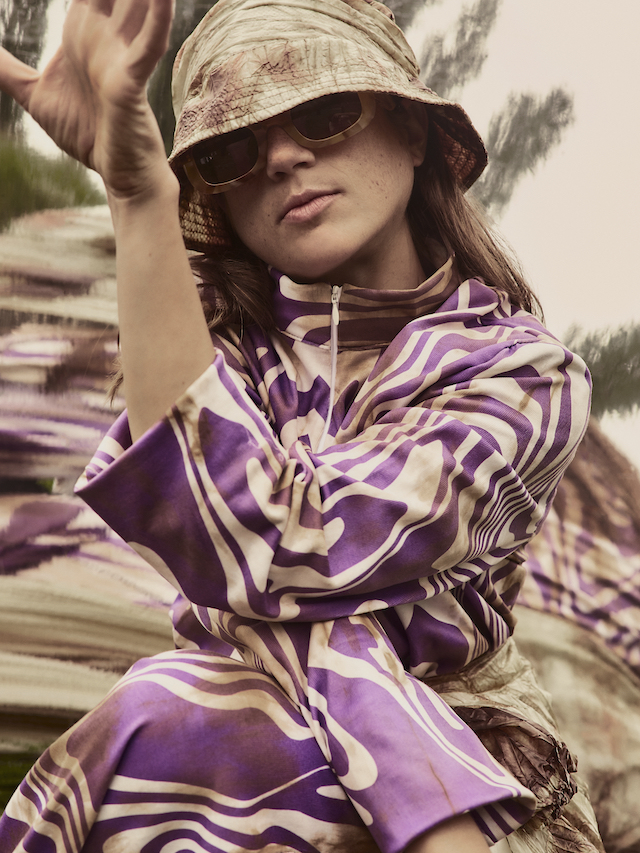
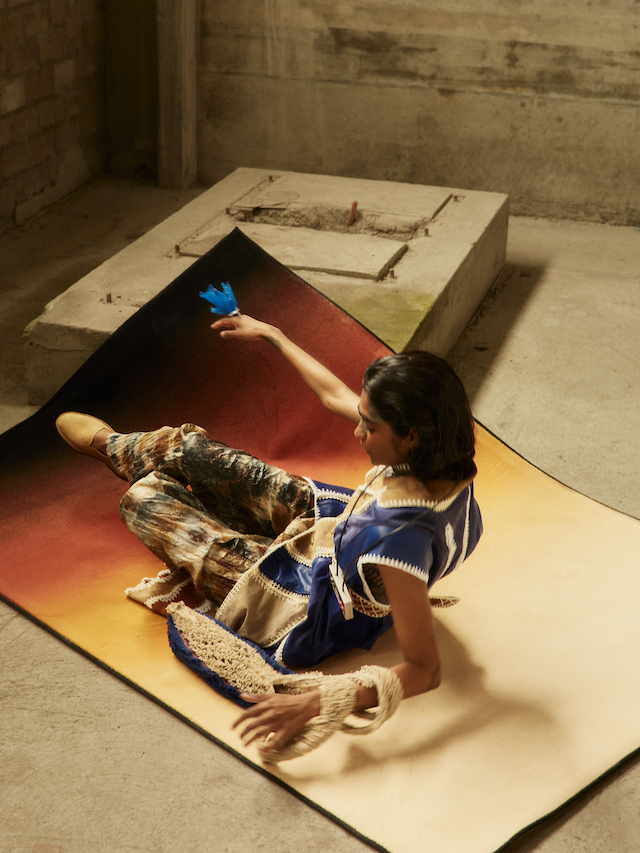
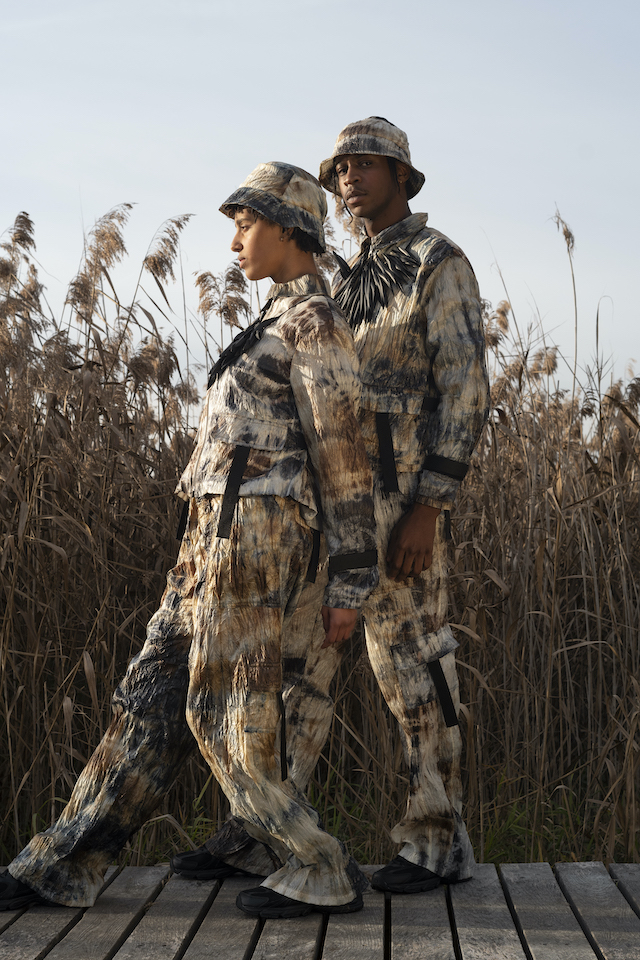
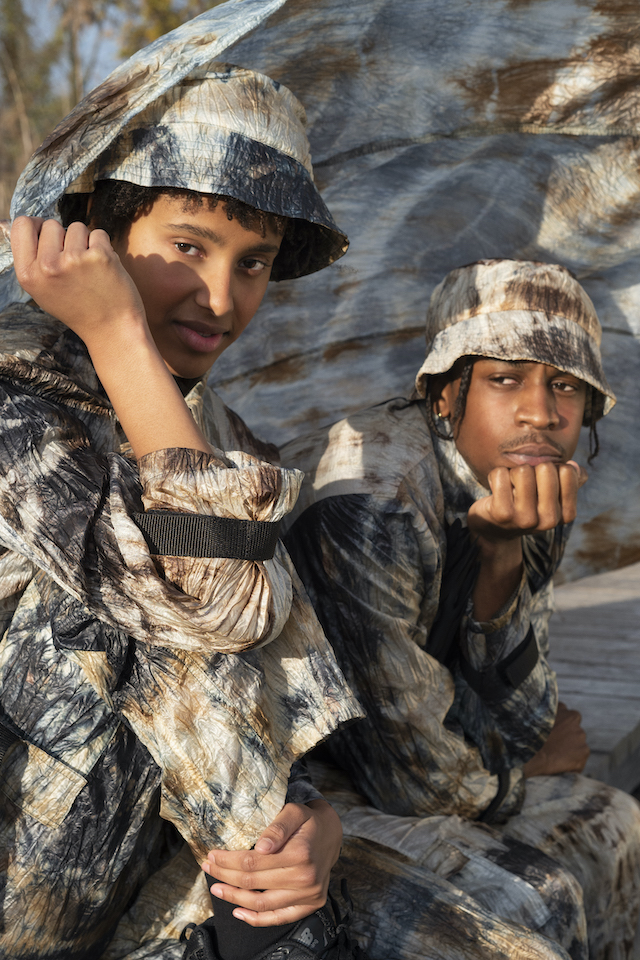
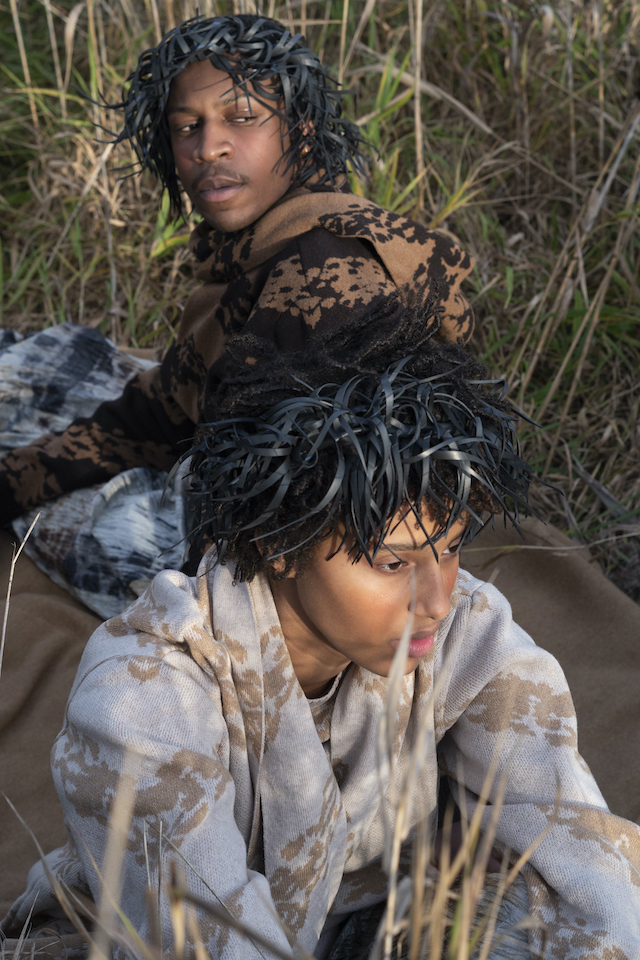
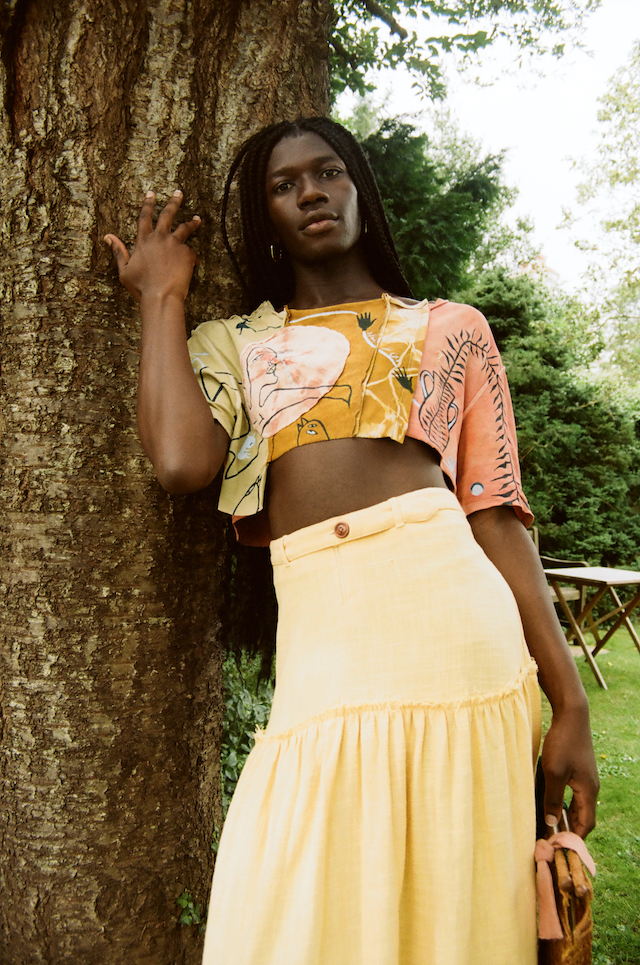
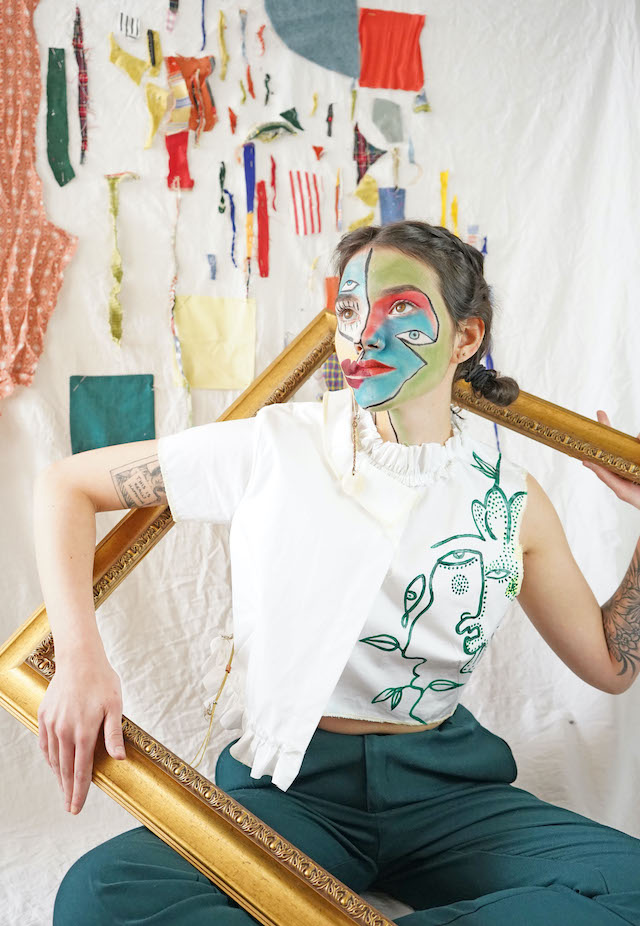
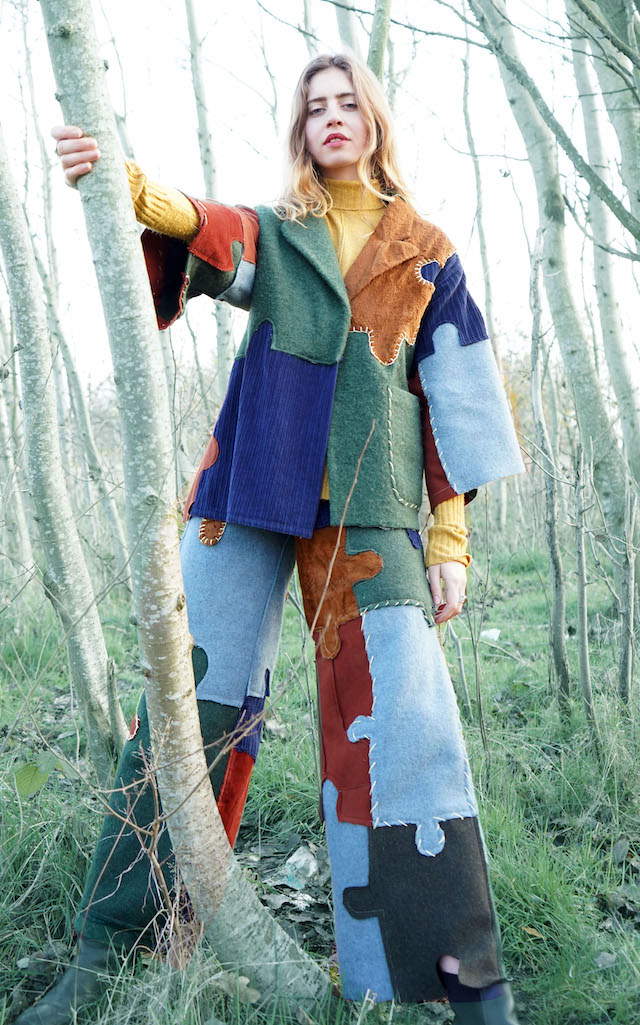
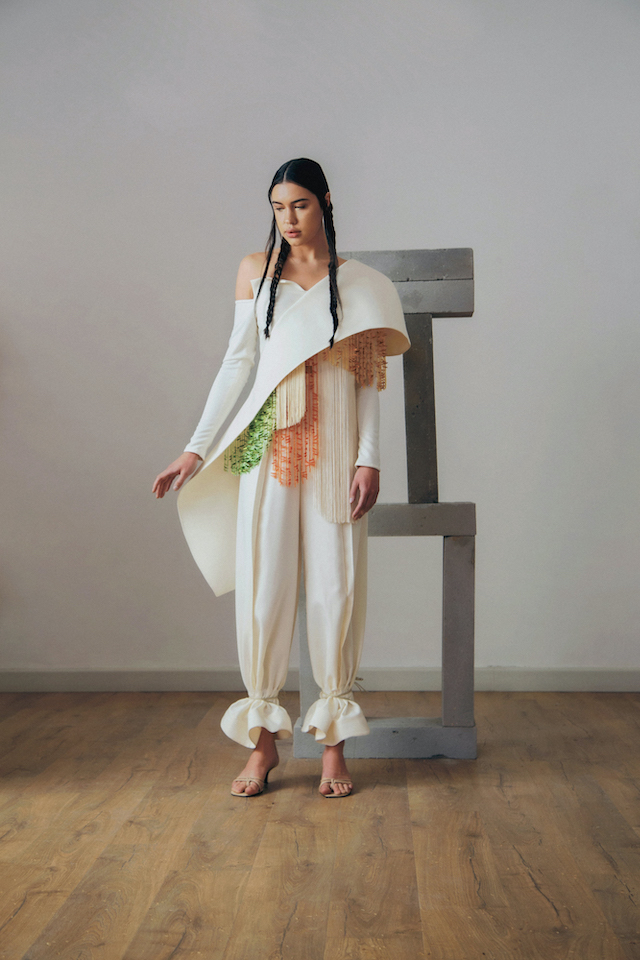
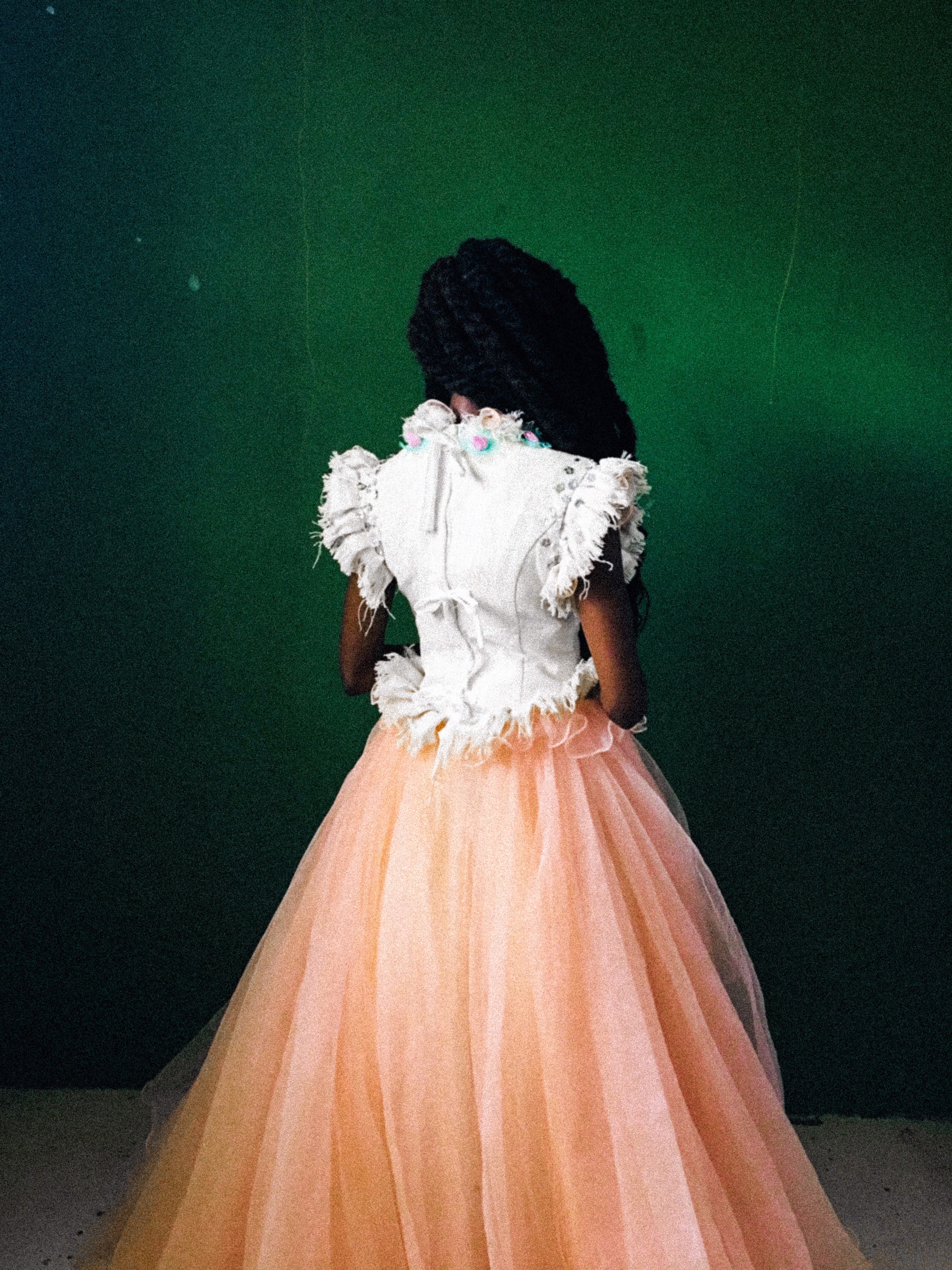
Throughout all of Rafael Kouto’s output, garments are construed with utmost credibility to materiality, source and process. Amassing in timeless collections abound with pattern and colour, everything is created in Switzerland through the upcycling of existing dead stock garments or fabrics, “with different traditional couture techniques as crochet, screen printing and knitting,” he says. The result of which is a consciously designed label replete with bespoke clothings for the wearer, bound in a post-modern blend of tie-dye, 70s swirls and traditional African prints. “The collections have a hybrid aesthetic between African and the West, therefore I envision the Afro descendants community embodying those values and all the loves of the aesthetic of course.”
Rafael’s approach to fashion design and manufacturing is commendable. The industry – and our planet – is so awash with garments that they’re bursting at the seams of landfills and our wardrobes. There’s simply too much in the world and, along with more sustainable business practices, our consumer habits need to adapt. “With the brand, we are contributing on a small scale, but I think that the most important part is about proving that a sustainable alternative to the current system is possible and to engage the users through upcycling workshops and other activities into the creative and production process,” explains Rafael.
So what does Rafael aspire for the future? “My hope is that fashion will head into a more sustainable, local, social, ethical and community direction,” he says. “I think that idea of expanding as the biggest fashion houses and bands will be replaced by small scale and niche businesses. In this case, I think the mind set of the industry still needs to change and not be based on a constant need to consume compulsively. But, it’s something that has to change also from the brands’ perspective.”
Founded by Sarah Krause and Sarah Seb, the sustainable fashion brand uses soil regeneration to combat climate change
Photography by The Earth Issue
The thoughts of fashion becoming fully sustainable has left many feeling hopeless, uninspired or drained by the constant disappointment of the industry. Not only are brands not doing enough in terms of curbing the warming climate, but consumers are left slightly bemused as to the active steps they should be taking – thrifting, buying less, choosing consciously and buying from conscious brands all seem like reasonable guidelines. But what does it really mean for a brand to be sustainable? And is our trust dwindling?
Helping to rebuild confidence is Sarah Krause, a Londoner with an Austrian and Mexican heritage. She set up Solai alongside Sarah Seb, fashion designer and creative director, as a response to the increasing pressures on the planet. Left feeling “disheartened” by the fashion industry, there remained a glimmer of excitement as she noticed the influx of sustainable practices coming into the fore. “I wanted to see clothing on the market that was creative and modern whilst also being ethnically made and genuinely good for the planet,” she shares. “Ultimately though, I wanted to go a step beyond and create clothing that was not just sustainable, but actively climate-beneficial.”
Photography by The Earth Issue
To address this, Sarah turned her focus towards soil regeneration. Perhaps a term that some may not be familiar with, regenerative farming looks at exhausted soil, and is the solution for creating healthy ecology and, among other things, helps to reverse the effects of climate change. By definition, to regenerate means to regrow or be renewed; so think of the clothing lifecycle in this sense as being continuous and mindful of damage and restoration. “If we could work with regenerative farmers to grow our clothing fibres, we would play a role in reviving degraded lands and creating a carbon sink in the soil,” she says. “This approach to land management has proven to be one of the most effective ways of combating climate change and, to me, there was a clear interesting with the fashion industry. The idea was simple, but incredibly powerful.”
Solai therefore partners with a collective of farmers and artisans in Erode, Tamil Nadu, that of which had “successfully revitalised” acres of once degraded lands through regenerative agriculture and “indigenous wisdom”. The proof is in the output, and Solai’s collections since birth have shown the benefits of tech and conscious sourcing. By 2022, for instance, the brand will make the majority of its clothing carbon negative, derived from regeneratively grown cotton. “The remainder will be made from pre and post-consumer recycled materials, including cotton and wool, so that we can keep existing fabrics out of the waste stream and save ample natural resources in the process,” says Sarah. A recent product in the works, for example, is the “very first photosynthetic top”, which translates to a coating which “captures carbon” and “releases oxygen” while being used. Like something from a dystopian future, perhaps a photosynthetic garment is hard to comprehend, yet Solai are making it a reality.
Photography by The Earth Issue
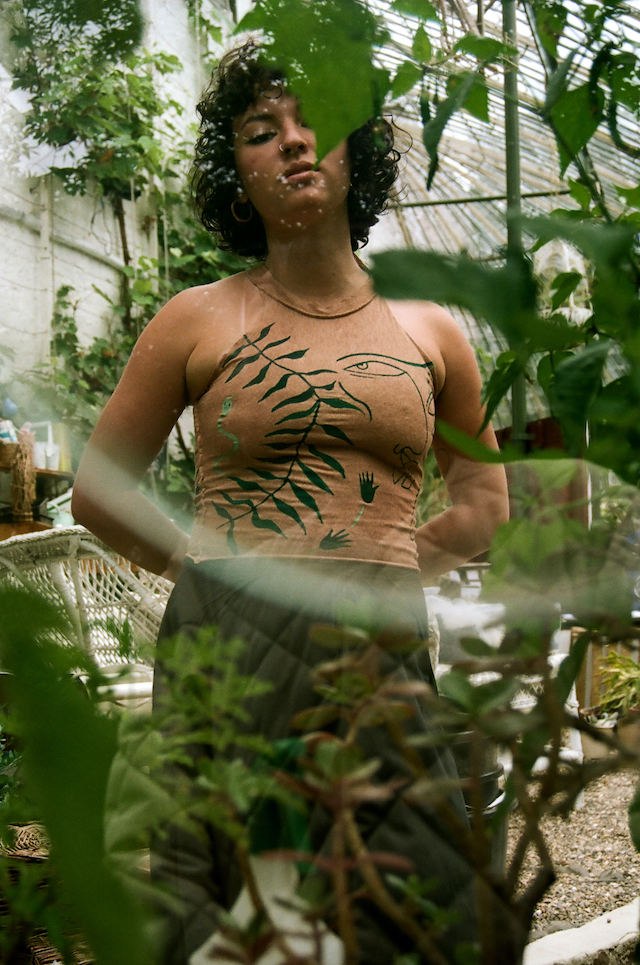
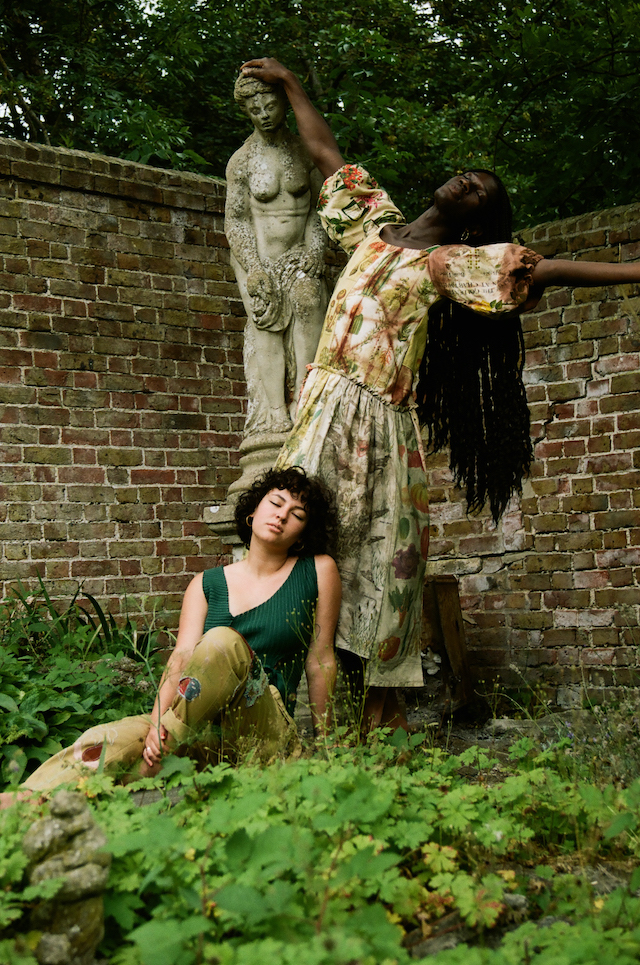
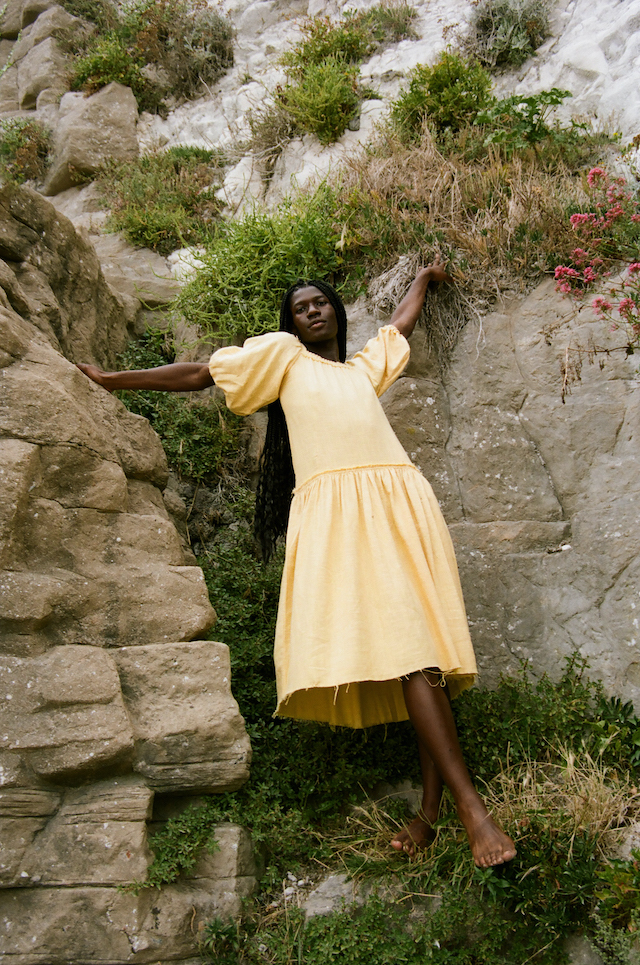
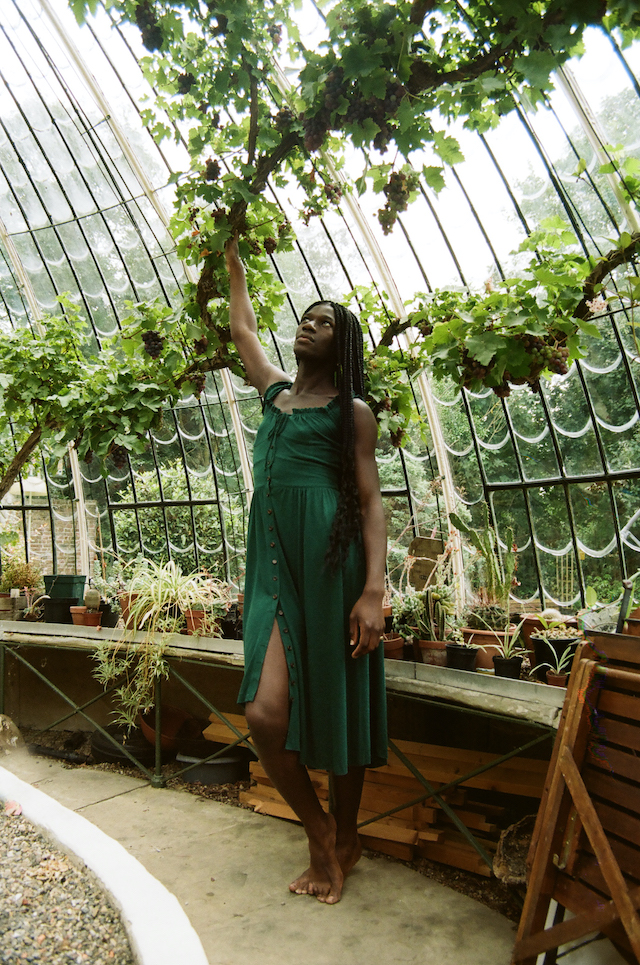
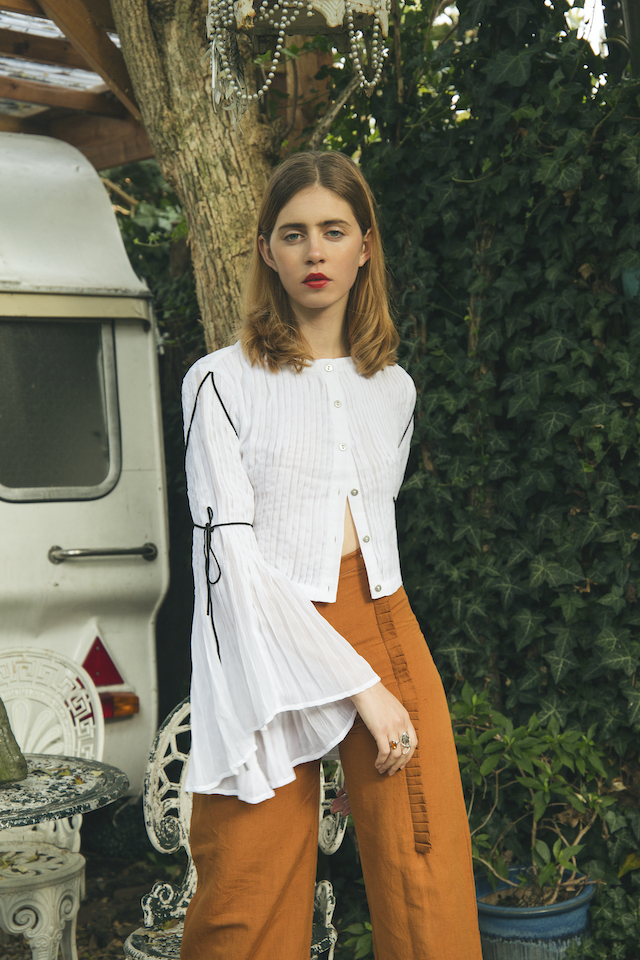
Besides the somewhat biophillic sounding clothing design, Solai has also recently launched its Revival and Eco Collection, shot and produced by the environmentally conscious agency The Earth Issue, headed up by Elena Cremona and Isabelle Landicho. Captured amongst the Italiante Glasshouse and Tea Garden in the Ramsgate area, the collection presents soft silhouettes, intricate embroidery and mossy undertones – crafted from tencel, linen and sustainably farmed organic cotton, plus naturally dyed colour palettes drawn from annatto seeds. It’s type of clothing that doesn’t adhere to any outdated stereotypes of what sustainable clothing may look like.
“Although seeing a constant barrage of greenwashing can be demoralising at times, overall I’m hopeful for the future of the fashion industry,” says Sarah of her hopes for the future. “I remember even a few short years ago, so few people were talking about sustainability in fashion and I’d have a hard time trying to get people interested in the topic. But now, I think it’s increasingly on people’s radar and I’ve seen a genuine shift in attitude, with greater commitments to make better, more conscious choices. Crucially, I think fast fashion brands have to majorly scale down their production and put some of their vast marketing budgets into the hands of their labourers. It’ll be interesting to see if people and planet prevail over hefty profit margins!”
Photography by The Earth IssuePhotography by The Earth Issue
Melda Auditia’s structural, hand-crafted graduate collection seeks to examine the notion of femininity
Growing up in Indonesia, Melda Auditia was surrounded by craft. From pottery and textiles to jewellery and ceramics – plus the rich, natural fibres used to build them – needless to say that this exposure would steer the work of Melda, affecting both the composition and themes addressed in her own creations.
The designer, who’s now living in Tokyo, learnt to appreciate the process of handcrafting from a young age. “That’s what made me fall in love with fashion in the first place,” she tells me. The skill of making a quality garment or object from hand takes mastery, time and patience, which is a welcomed contradiction to the constant hum-drum of city life in Tokyo. “Life in Tokyo is incredibly fast-paced, so it’s super easy to forget that there are so many beautiful little details in my surroundings. But one thing I’ve learnt to do is to carve out the time to slow down and take in the little details, because when I let myself absorb everything, that’s when I get inspired.”
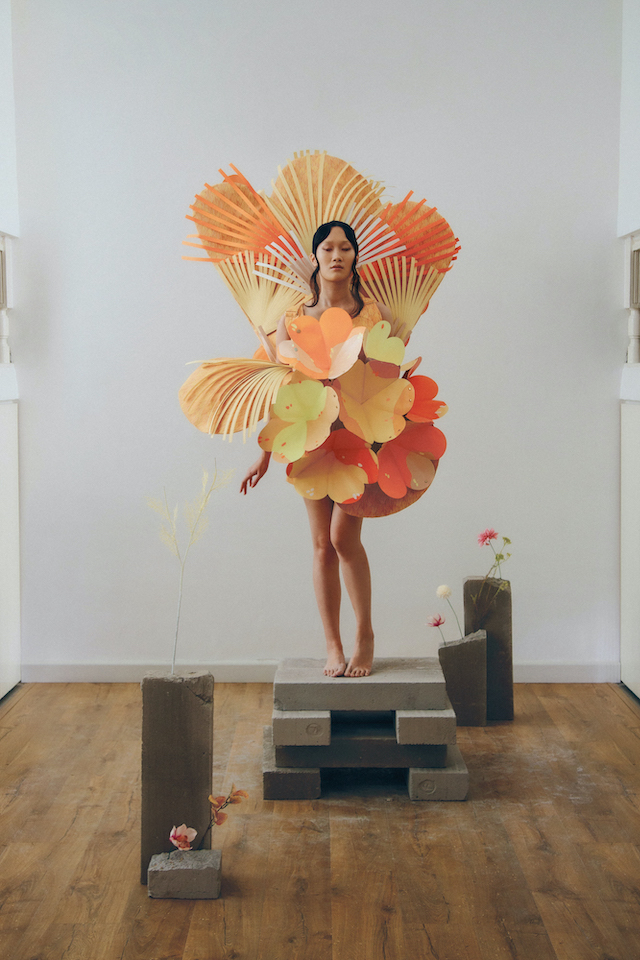
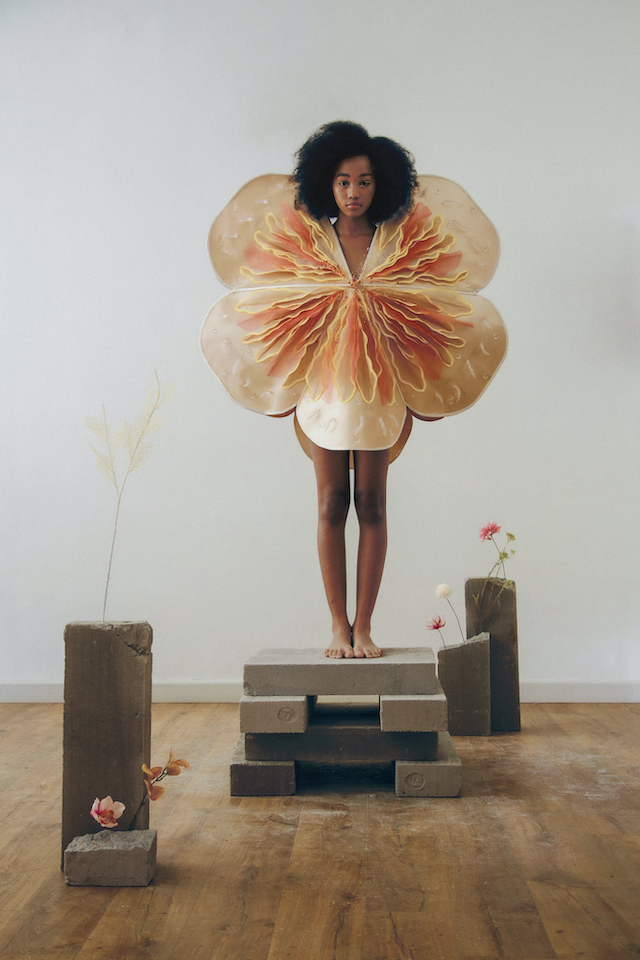
While pursuing a degree in fashion design at Bunka Fashion Collage in Japan, Melda began to employ the use of textiles and fabrics as a way of exuding her love of handcrafted processes. But, equally, it was also perceived as a way of discussing cultural and social issues that were greatly affecting the world. And this is exactly how Bloom was borne; a collection comprising large-scale flower dresses that seek to examine the subject of femininity.
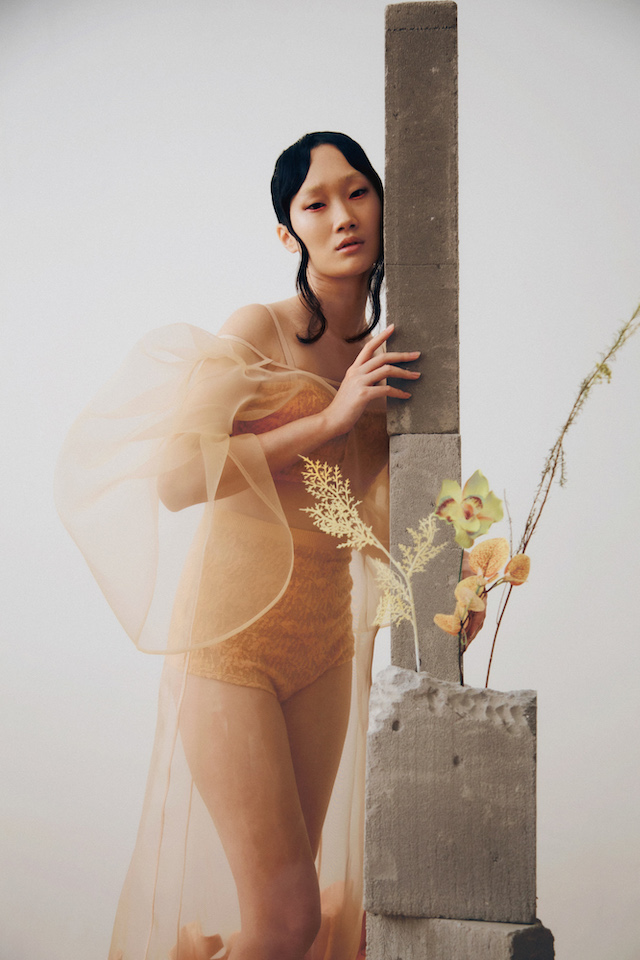
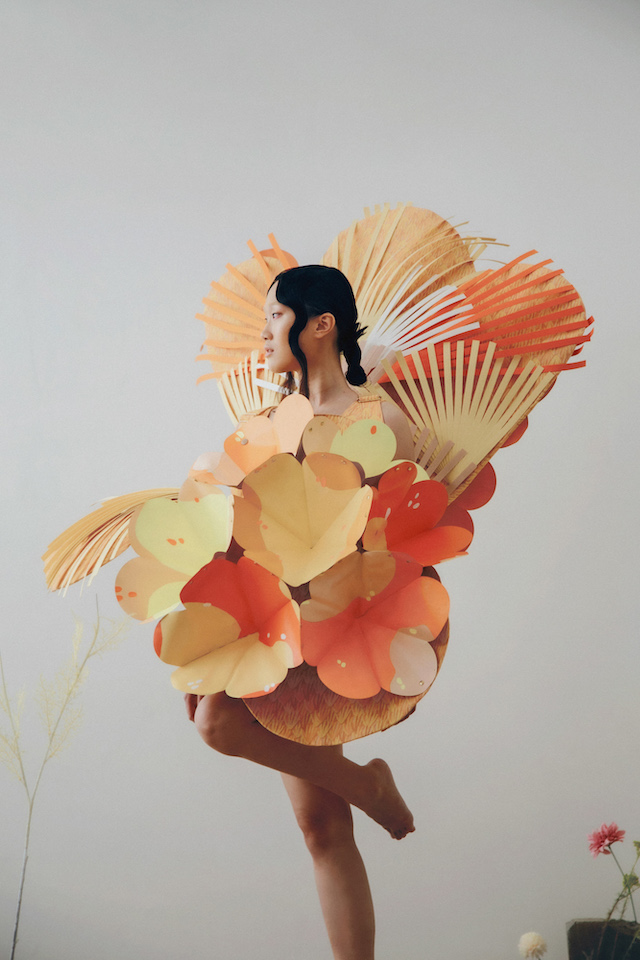
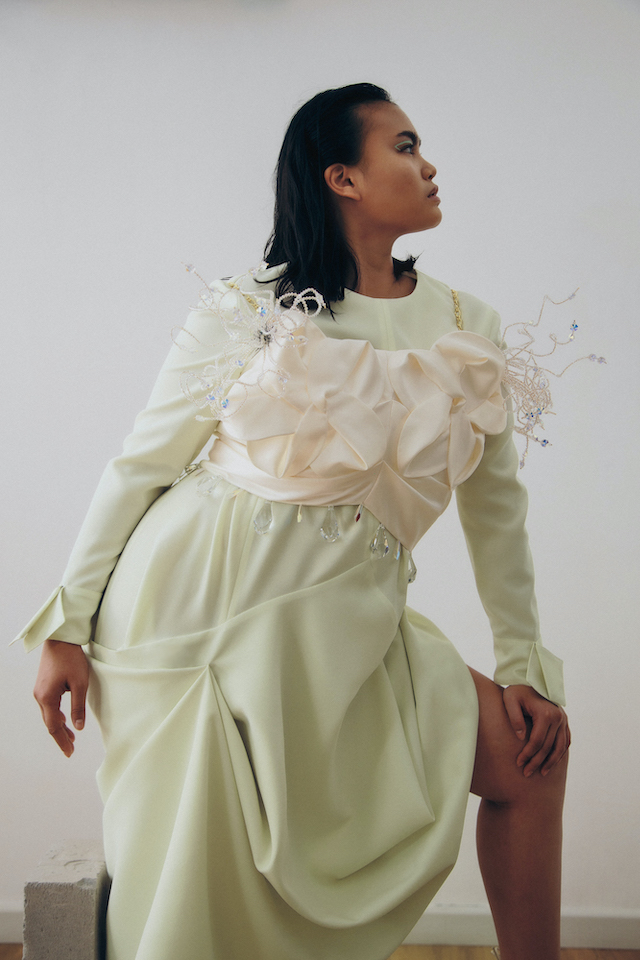
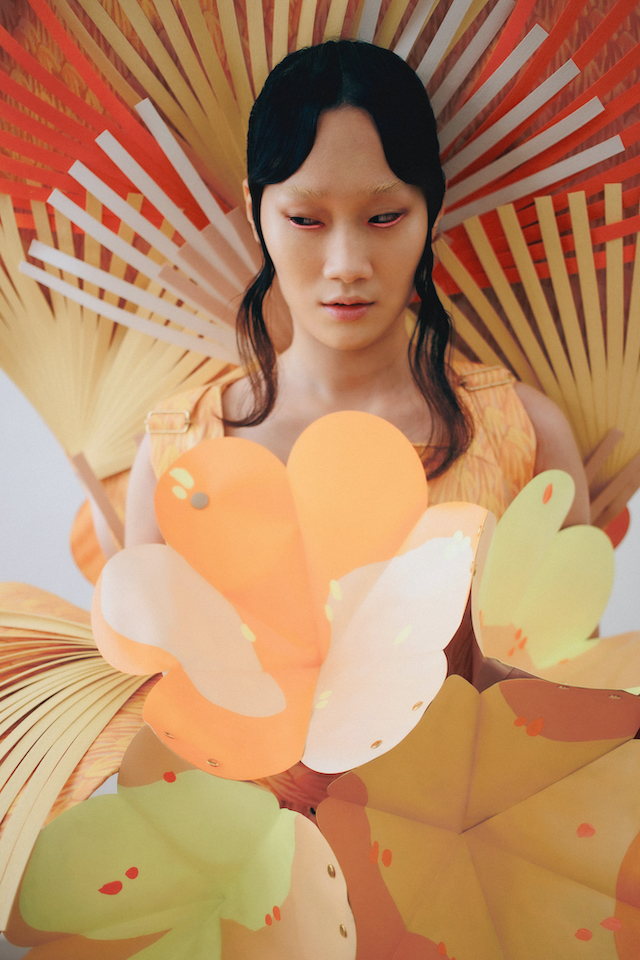
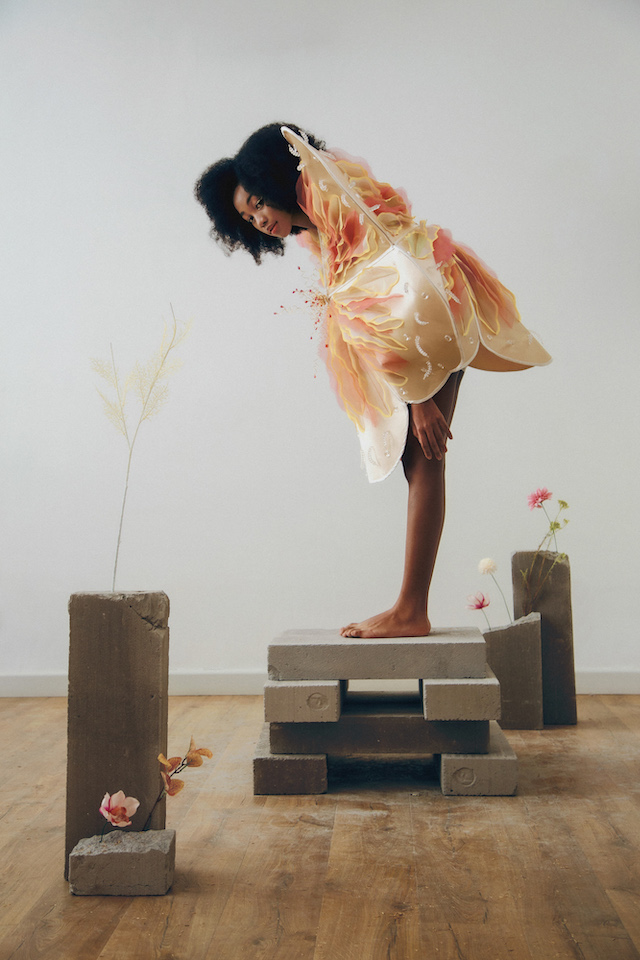
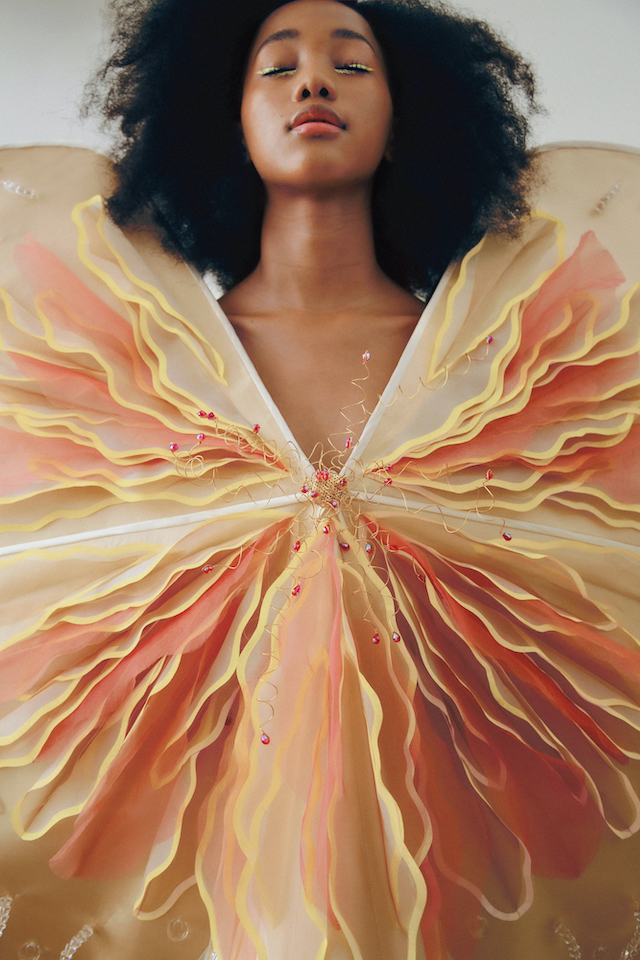
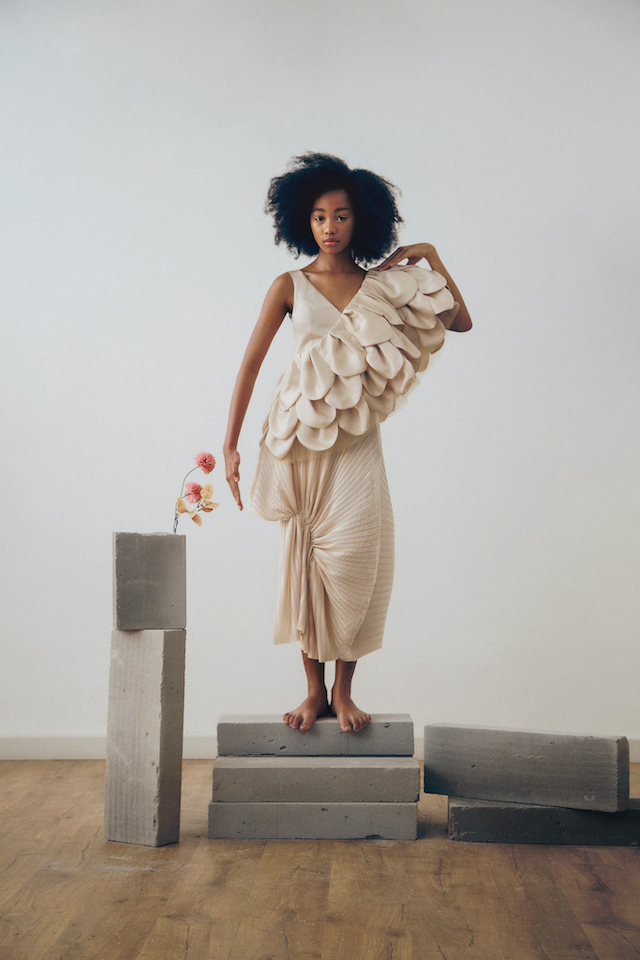
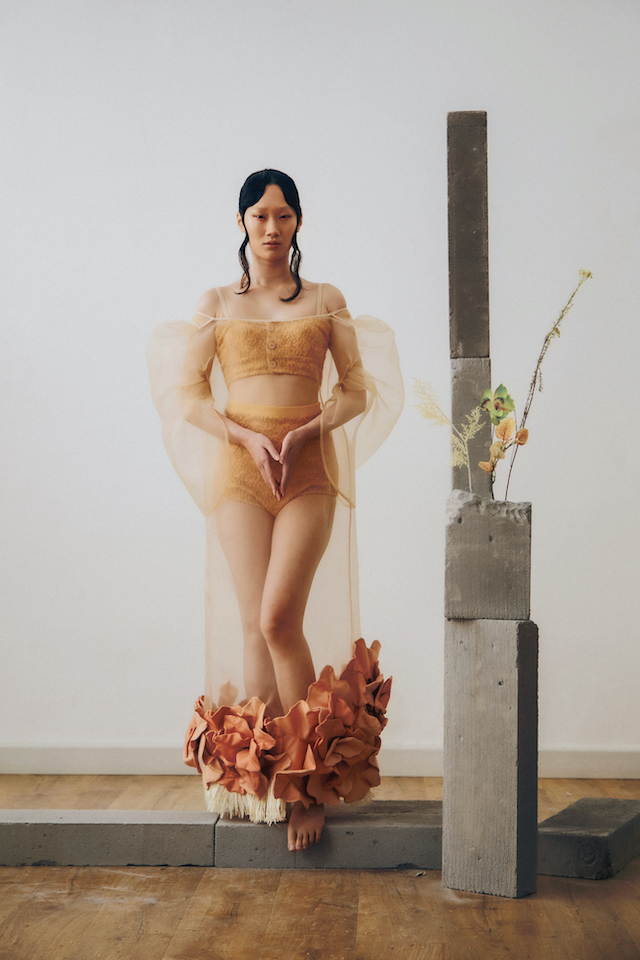
Shrouded in soft pastel tones and textual wefts hanging from the shoulder, the artfully delicate compositions found in Bloom are paired with structural elements, like the panels that hang from arm to hip, cinched in corsets, sashes and, most characteristically, the structural – almost sculptural – addition of flowers and petals. Construed from subtle silhouettes and an “explosion” of colours, Melda’s use of materiality is just as important as the meaning attached to it. From sturdy high pressure laminate (HPL) to soft organdy, she toys with different processes and marries them into her own unique vision: using hand-painting, silkscreen, hand-cut petals to form the blooming flowers to achieve her goals.
Not just a beautiful foray into nature and form, the collection also turns a sharp eye onto the concept of femininity and how this is perceived throughout daily life. “Growing up, I realised that society has all these gender boxes and its own definition of what it means to be a woman or a man,” she says. “Since we were little, we have grown accustomed to suppressing our feminine sides: ‘stop crying like a little girl’. That is what they would say to us women when we show the slightest emotion, or to men when they express themselves outside the box of gender we are all put in. But we often forget that, regardless of our gender, we all have a feminine side inside us.”
The symbol of the flower, then, has great importance in Bloom as well as in the wider context of gender and identity. By merging the natural form with a floral petal, for instance, the collection sings as a reminder that “no matter what gender we identify with, or how we look, there is that feminine side that lies within ourselves and there is no right or wrong way to express it,” says Melda. The flower is widely interpreted as a feminine form, varying between cultures, place and time. “Throughout our lives, flowers have always been the symbol of femininity. Even as a kid, it was one of the first few things we came across that’s immediately associated with femininity – no matter the colour and form.” Rich in context and history, it makes for the ideal symbol to spread her messaging within this collection.
“But,” she continues, “this collection is also about the journey of discovering out feminine sides, embracing them and letting them bloom. I want every piece to embody that journey as well, and the process of growth is very much similar to how flowers come to bloom.”
So who can we envision wearing these pieces, which are artistic and bold to the typical fashion barer? “There are some pieces that you can definitely wear on a day out, but there are also some pieces where I just went all out and let my creative freedom flow,” she says. “But they’re all very personal pieces, not just to me, but it can also be for whoever is wearing them. There is no one single person that I’ve made these pieces for. I feel like everyone has their own story, so I want these pieces to give whoever wears them the freedom to tell their personal story and experience it too.”
The Nairobi-based multidisciplinary artist creates worlds of inexplicable beauty
Presence and absence – Joel 2021

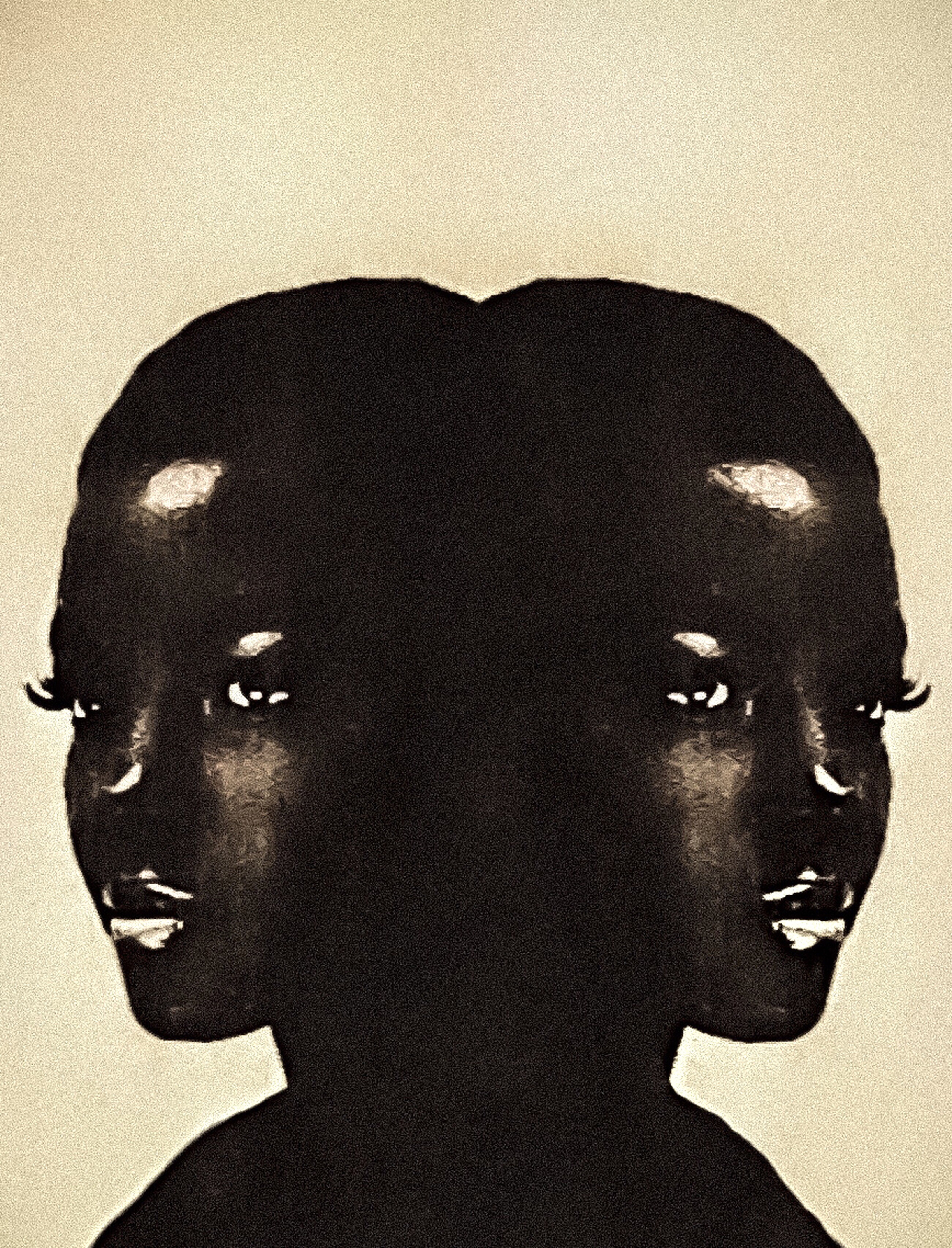
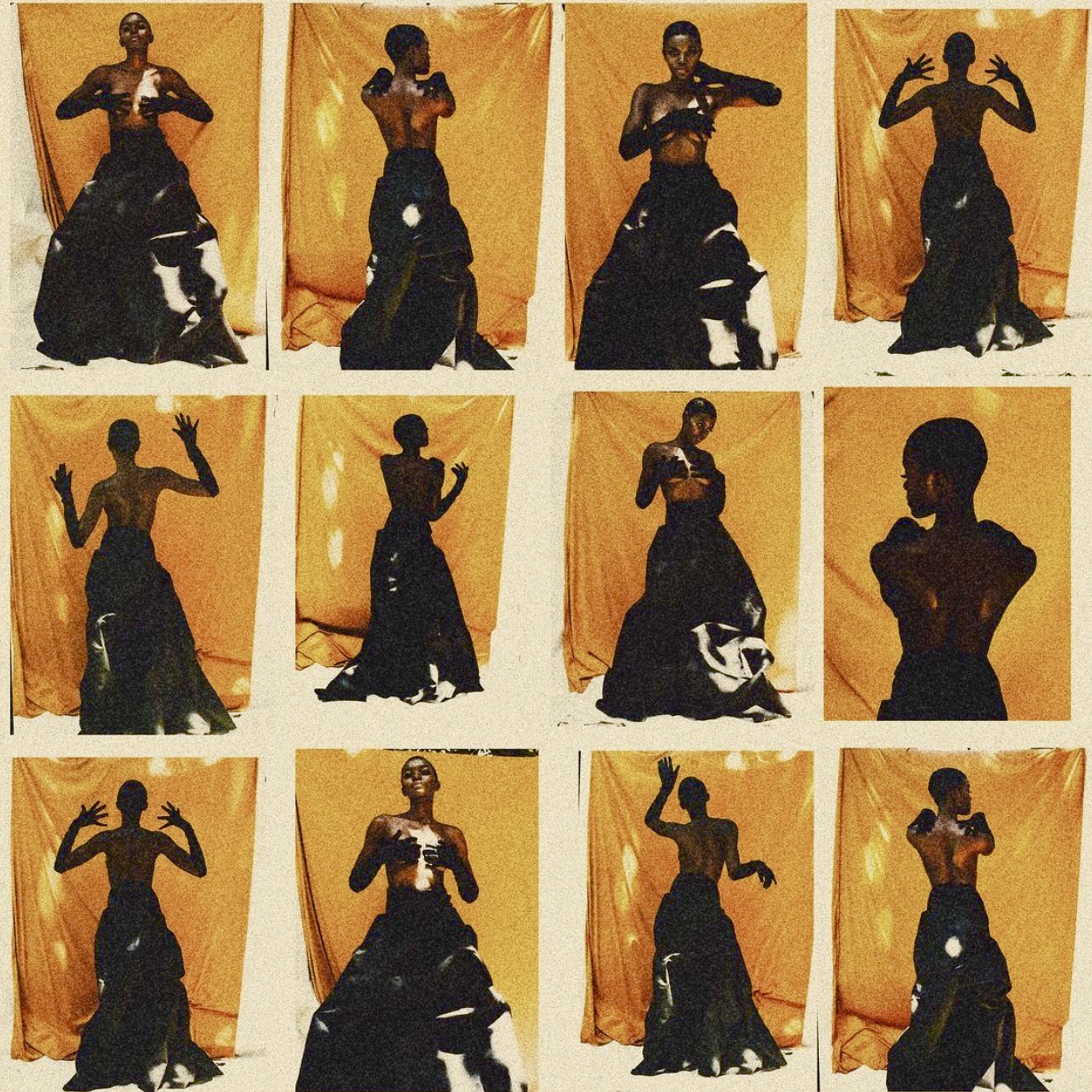
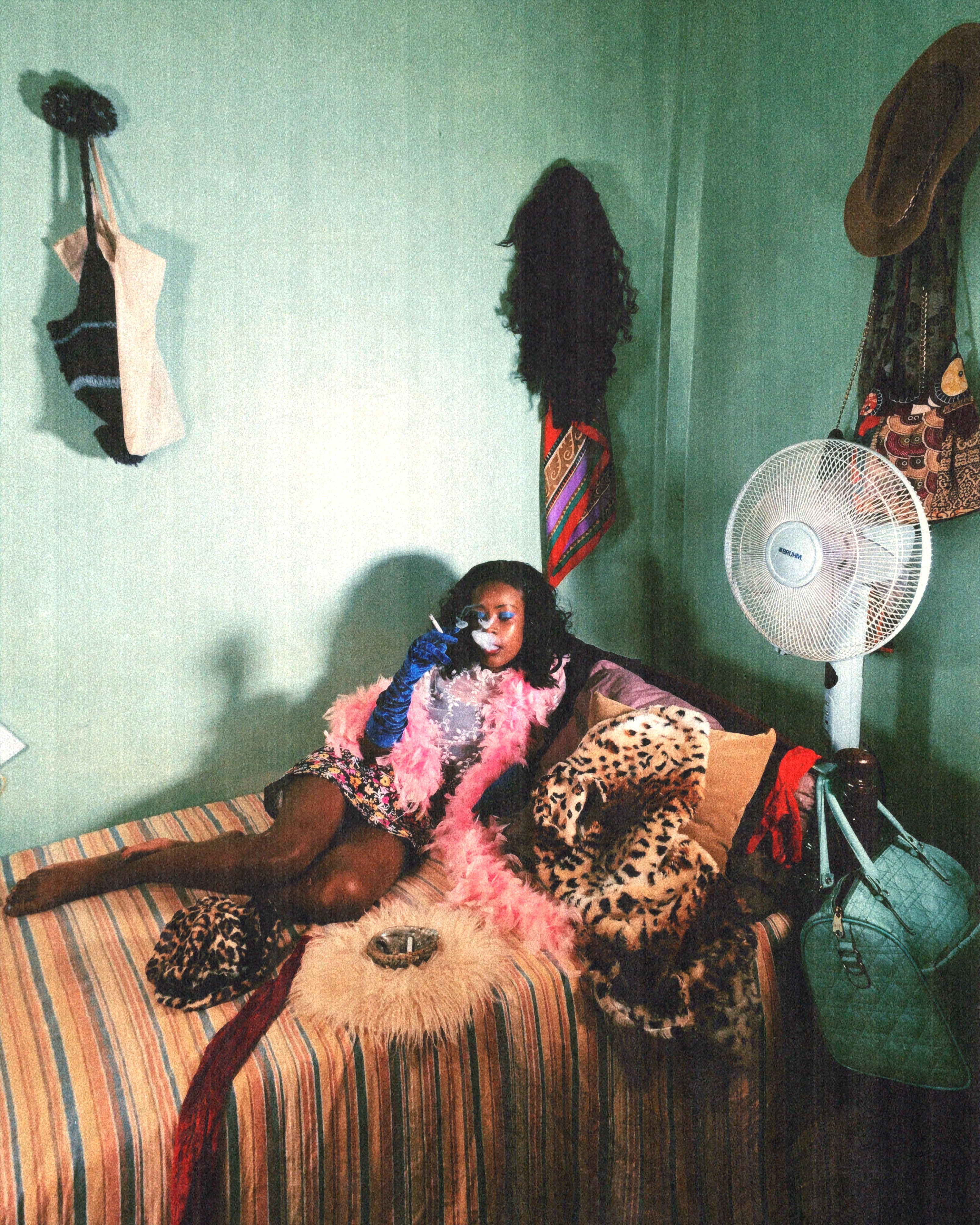
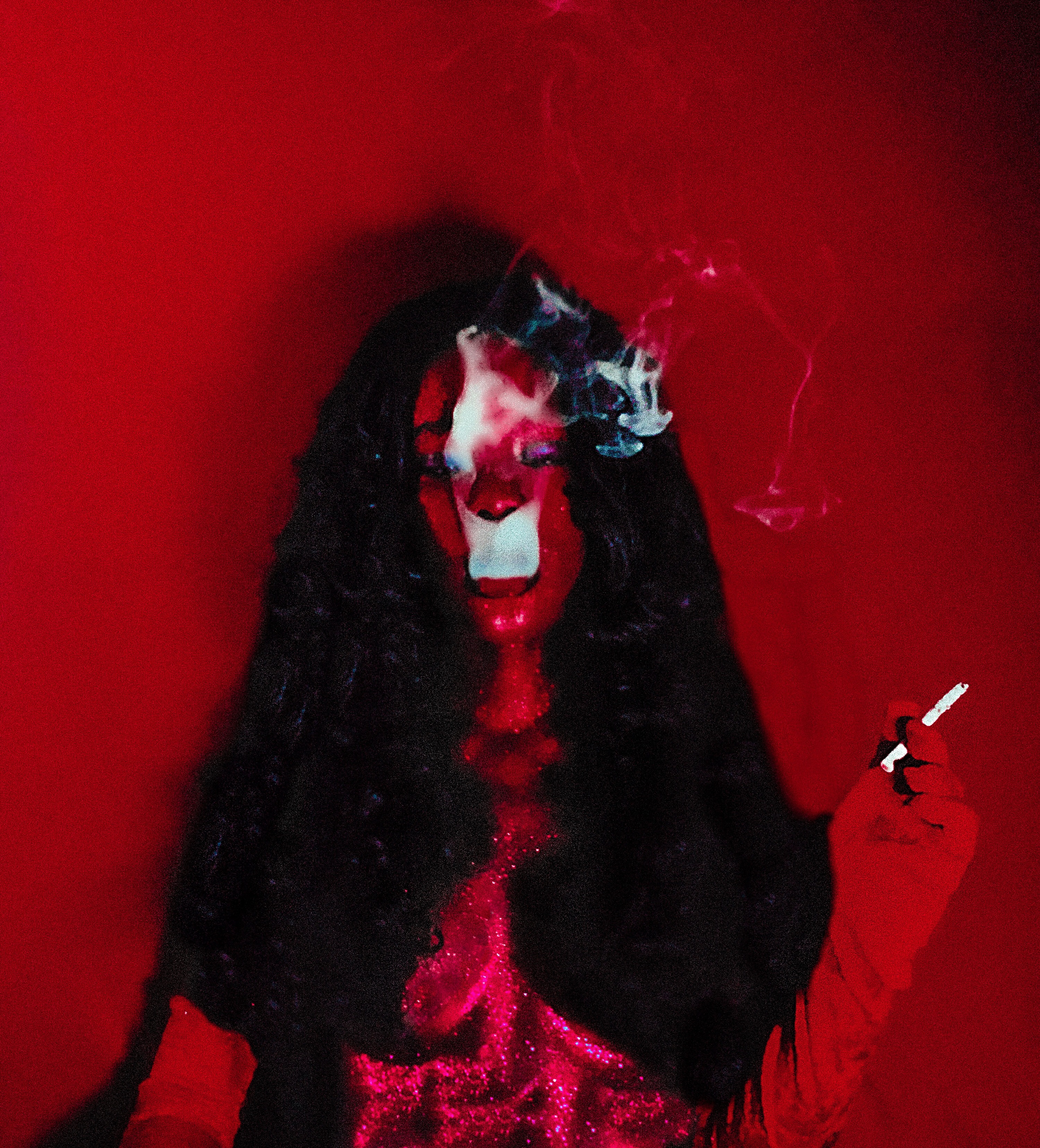
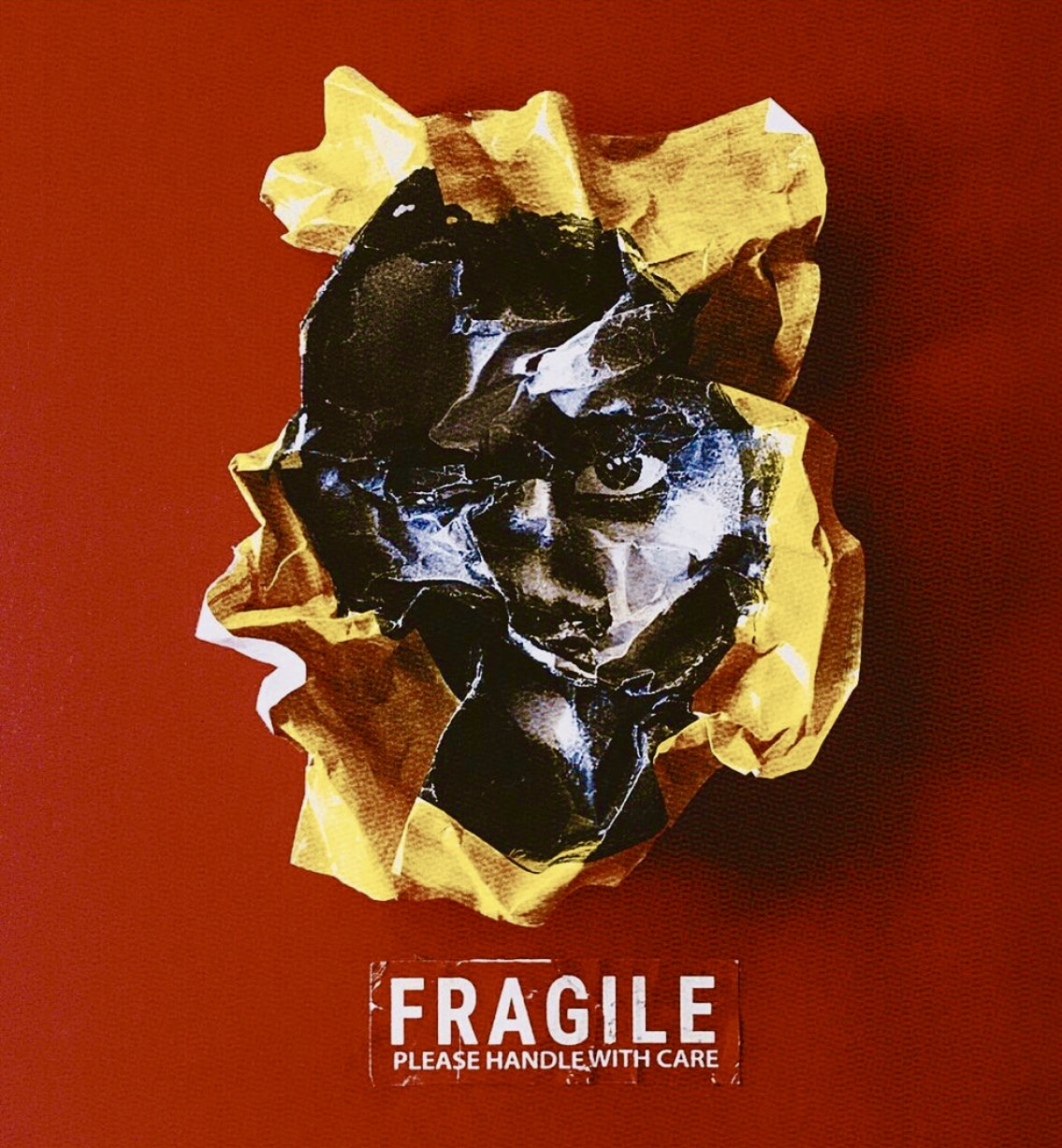
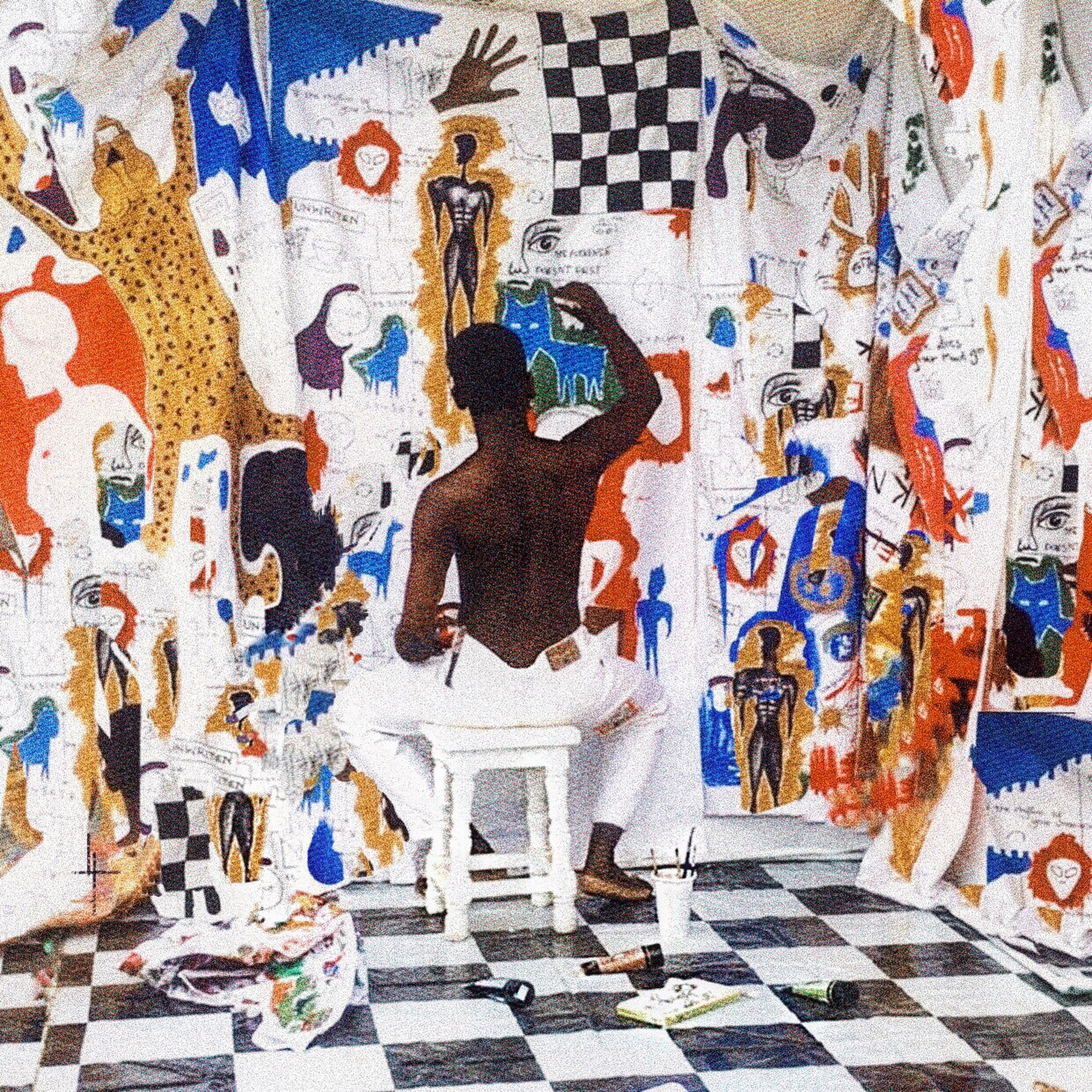
There’s something rather exponential about the work of Shitanda, a multidisciplinary artist from Nairobi, Kenya. Open to interpretation and riddled with passion for craft, each image resonates with power, storytelling and a careful consideration of tactility. You’re not quite sure how or where these images are made, or what they’re suggesting in their complex form and visuals. But that’s exactly what Shitanda strives to achieve in his work; an allusive feeling that sings to a distance memory, time and place.
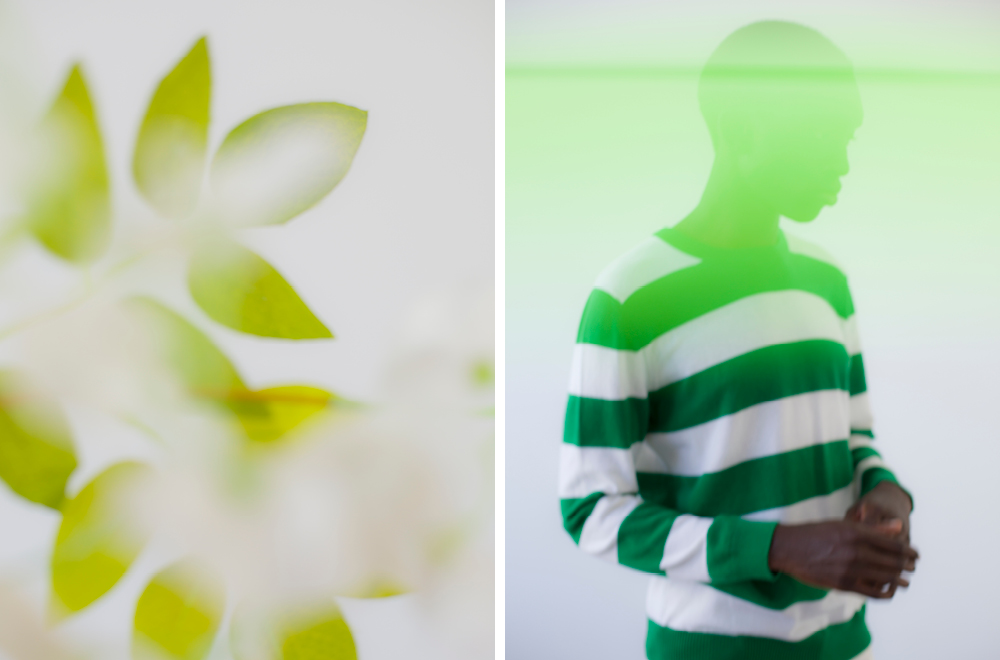
From grainy textures to experimental shadow play, Shitanda’s painterly pieces are produced with a vintage-like quality. He lenses subjects adorned in fashion and places them amongst a coloured backdrop or setting, each littered with intrigue and an artistic language that’s “unexplainably beautiful”. Here, I chat to Shitanda to find out more about his evocative practice.
Mind and body -Juma 2021
What drew you towards photography over other creative media?
Well I can’t really say I chose photography over other media. It’s been a journey of constantly exploring different channels that allow me to visually translate my thoughts and mental experiences. At first, I was particularly drawn to photography because it allowed me to visually experience and relive moments that I was physically present or absent from. I’ve always been fascinated by the thought that I can’t rewind time, but photographs allow me to do so mentally. It’s thrilling to experience that soft nostalgia.
Overtime, photography gave me the chance to present my world to people and, in turn, I also get to experience the minds of those I photograph. A moment when we’re blind to any constraints that reality creates. It’s absolutely beautiful to watch someone reach out to cross that unseen line that separates their fantasies from reality. The honesty, the rawness, the vulnerability, the freedom to touch your dreams and the shared goal of creating something beautiful by our own terms is simply breathtaking.
Mind and body – Phoebe 2020
You’ve developed this immensely cinematic and nostalgic quality throughout your work. What’s influenced you to work this way?
The images are a visual representation of what I think my perception of life would look like if it was an object. Unclear, rough, uncertain, textured but sometimes difficult to feel, yet still so unexplainably beautiful. It’s like a silent noise that evokes a sense of nostalgia for a time and place I’m yet to experience.
How do you go about creating one of your photographs – what tools or methods do you use?
I don’t really have a particular way of making my pieces. I allow my mind to wander and settle where it feels most at home. Every image will carry its own emotion. Sometimes I’ll take photographs and think ‘I need to destroy these’, sometimes I’ll keep them for months without doing anything to them. And other times, I’ll take some and think ‘this story is complete’. I see them as paintings or poems, not to be rushed or overly controlled.
La femme noire – Phoebe 2020
Can you talk me through a favourite piece?
The face of anxiety is an unwritten love letter to the minds that were never meant to be understood. Those that present their own kind of beauty that can’t be explained in words.
Is there a particular message you’re trying to convey?
The poem Risk by Anaïs Nin: ‘And then the day came when the risk to remain tight in a bud was more painful than the risk it took to blossom.’
What’s next for you?
A design space that’s yet to be named, home to the dreamers and an experience for the minds that wander.
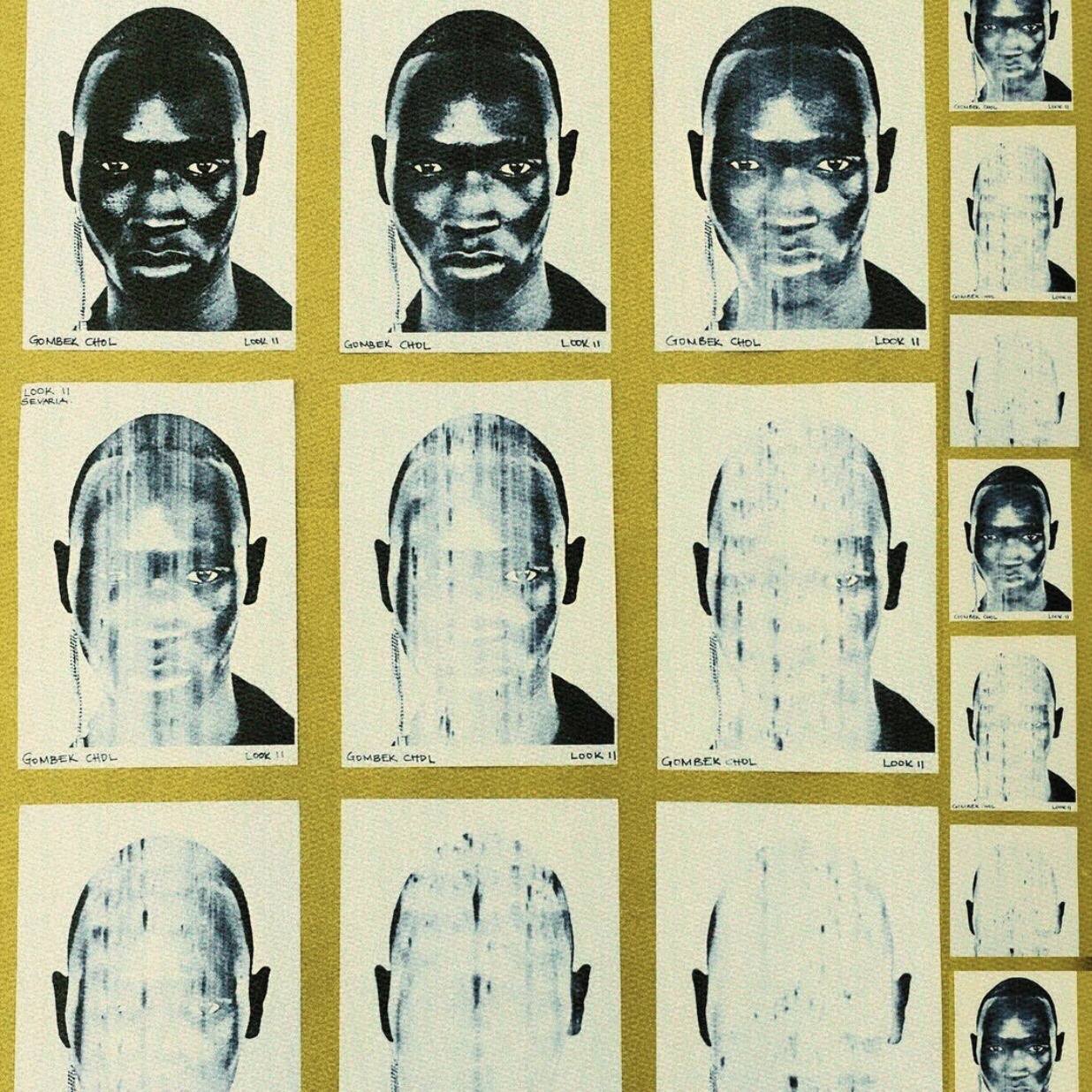
Presence and absence (la femme noire) – Viaana 2019Rest and the repossession of self – memories of non existent times, Didi 2021Rest and the repossession of self (Didi unwinds)The blank pageThe singer and the red rosePresence and absence – Gombek 2021
Fashion is a mirror of society, often reflecting the shifts in attitudes, ideas, tastes and preferences that evolve throughout the years; it’s a Zeitgeist. An early example harks back to the hemline, with skirt lengths shortening along with the fight for women’s rights and equality. While in more recent times, the influx of globalisation and the internet – and thus the immediacy of information and access to goods – has also altered our perceptions and ideals of identity, meaning that, on the one hand, fashion choices have become more liberal, conscious and sustainable, while the other is quite the opposite (taking fast fashion into account). Then there’s health crises, a pandemic, economic inequality and social movements like Black Lives Matter and #MeToo signalling to a change in a global society. But what is fashion’s role amongst it all, and where does it sit in the recent world?
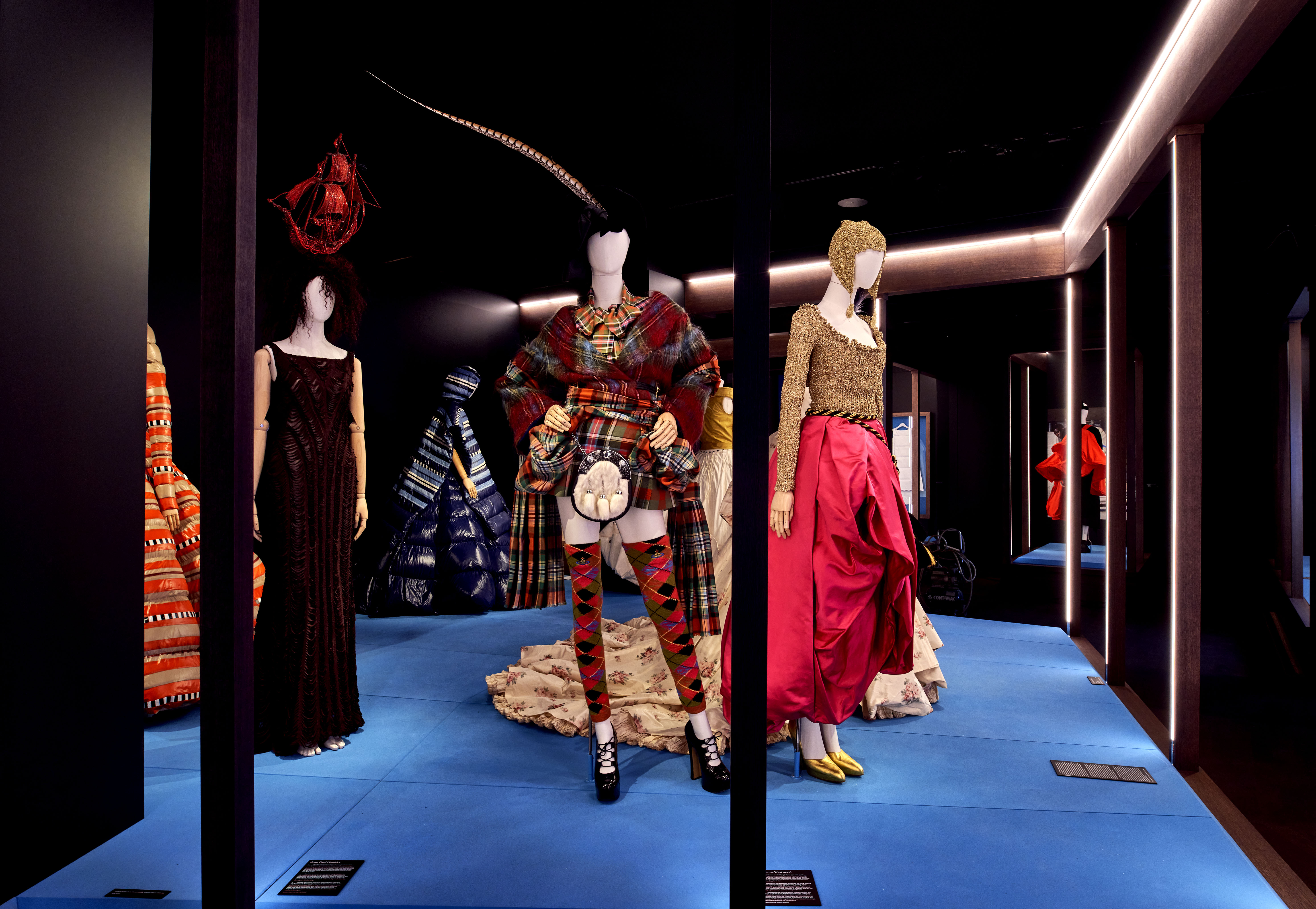
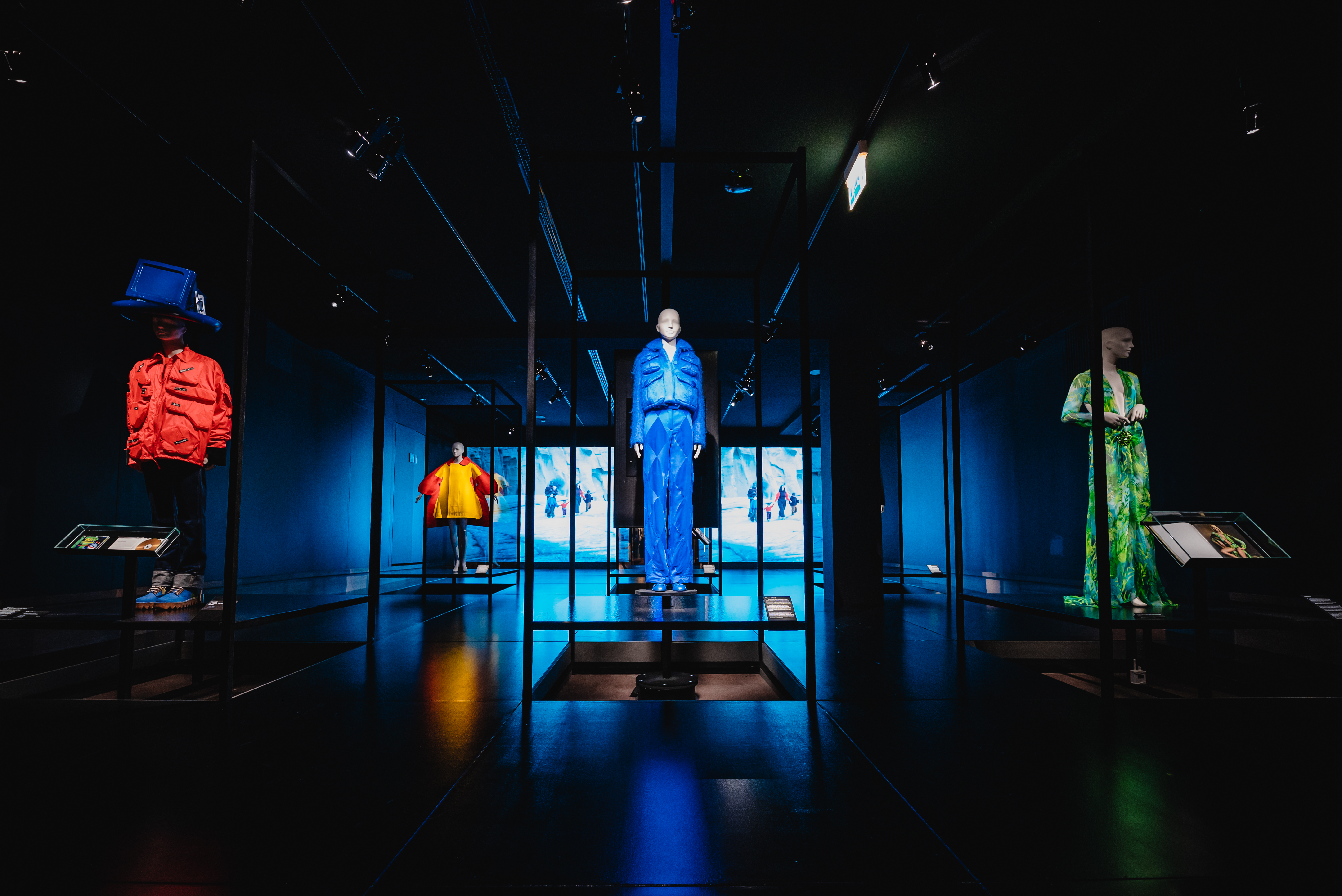
Posing this very question is a new exhibition titled E/MOTION. Fashion in Transition. Presented as part of the reopening of ModeMuseum (MoMu) in Antwerp – which opened its doors on 4 September – the exhibition is curated by Elisa De Wyngaert and features works from Helmut Lang, Walter Van Bierendonck, Alexander McQueen, Martin Margiela, Hussein Chalayan, John Galliano, Raf Simons, Versace and more. A time capsule of sorts, E/MOTION. Fashion in Transition, looks at how fashion has “served as a visual signifier of contemporary instabilities, concerns and emotions since the 1990s,” explains Kaat Debo, MoMu’s director and chief curator. Below, I chat to Kaat about the role of fashion and how it can evoke real change.
What does emotion mean in the context of this exhibition and in the wider sense of fashion?
The choice for the title E/MOTION was motivated by a need for genuine emotion. Over the past 18 months, we’ve all had to work, live and create from home and a large part of our lives took place online. Also, designers have been forced to work digitally because of the pandemic. We wanted to research whether there’s place for genuine emotion in a digital world. We felt the need for real human interaction and the wish to integrate a live aspect in the exhibition, which is difficult within the static context of a (fashion) exhibition. We invited director, performer and countertenor Benjamin Abel Meirhaeghe, in collaboration with the opera house in Antwerp (Opera/Ballet Vlaanderen) and the exhibition designers (Jan Versweyveld & HuismanVanmerode) to create a live performance for the exhibition. A challenging but also very exciting experiment.
In order to reflect on the future of fashion, as well as on the recent past, we conducted numerous interviews with fashion students and established designers during the pandemic. The designers gave their personal views on a wide range of subjects: what impact does the digital (r)evolution have on their creativity? Are fashion shows important? Can fashion evoke genuine emotions? What is the importance of craftsmanship, local production and sustainability? And what do you hope for the future? Fragments of these interviews formed the basis for this performance, that will be the closing installation in the exhibition. The performance will be brought 20 times during the entire exhibition period (September – January).
Fashion has long mirrored certain shifts in society. Can you tell me a bit more about this, and how fashion responds to particular events?
Over the last three decades, we have borne witness to unprecedented globalisation, which has had its impact on the creation, production, dissemination, communication and consumption of fashion. More than ever before, it has pushed fashion into the barriers of its own complex system and made it a stage for international political crises, from the Gulf War in the 1990s to terrorist attacks at the start of the new millennium, as well as for financial crises and recessions, the ecological crisis, and such health crises as the AIDS or the current Covid-19 pandemic. Fashion always reflects the prevailing zeitgeist, from social and economic inequality to global social movements, including Black Lives Matter and #MeToo. How have these evolutions impacted the way we see and perceive emotion, success, beauty, creativity, authorship and collaboration? And how has the role of the fashion designer changed in all this upheaval? Some examples…
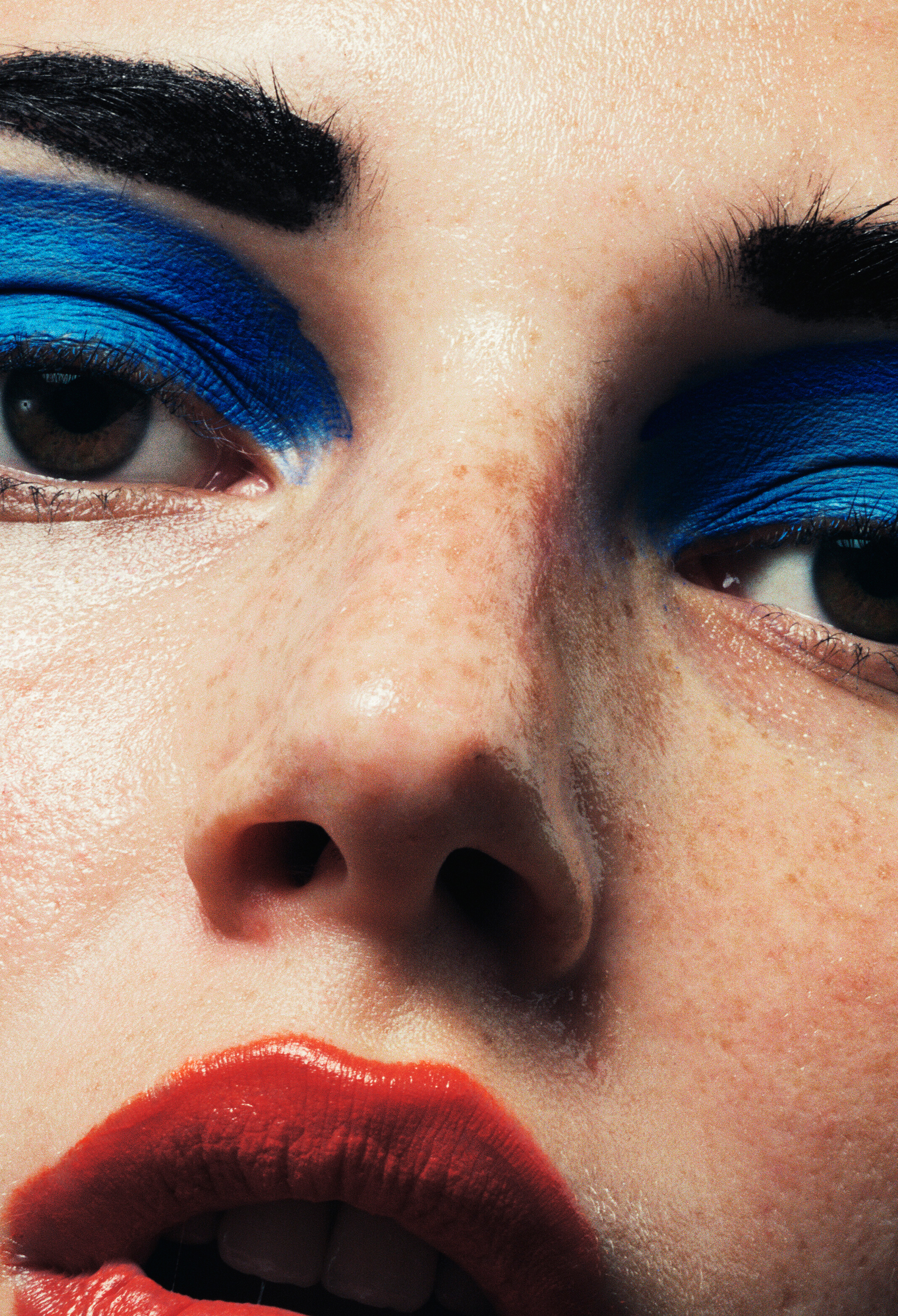
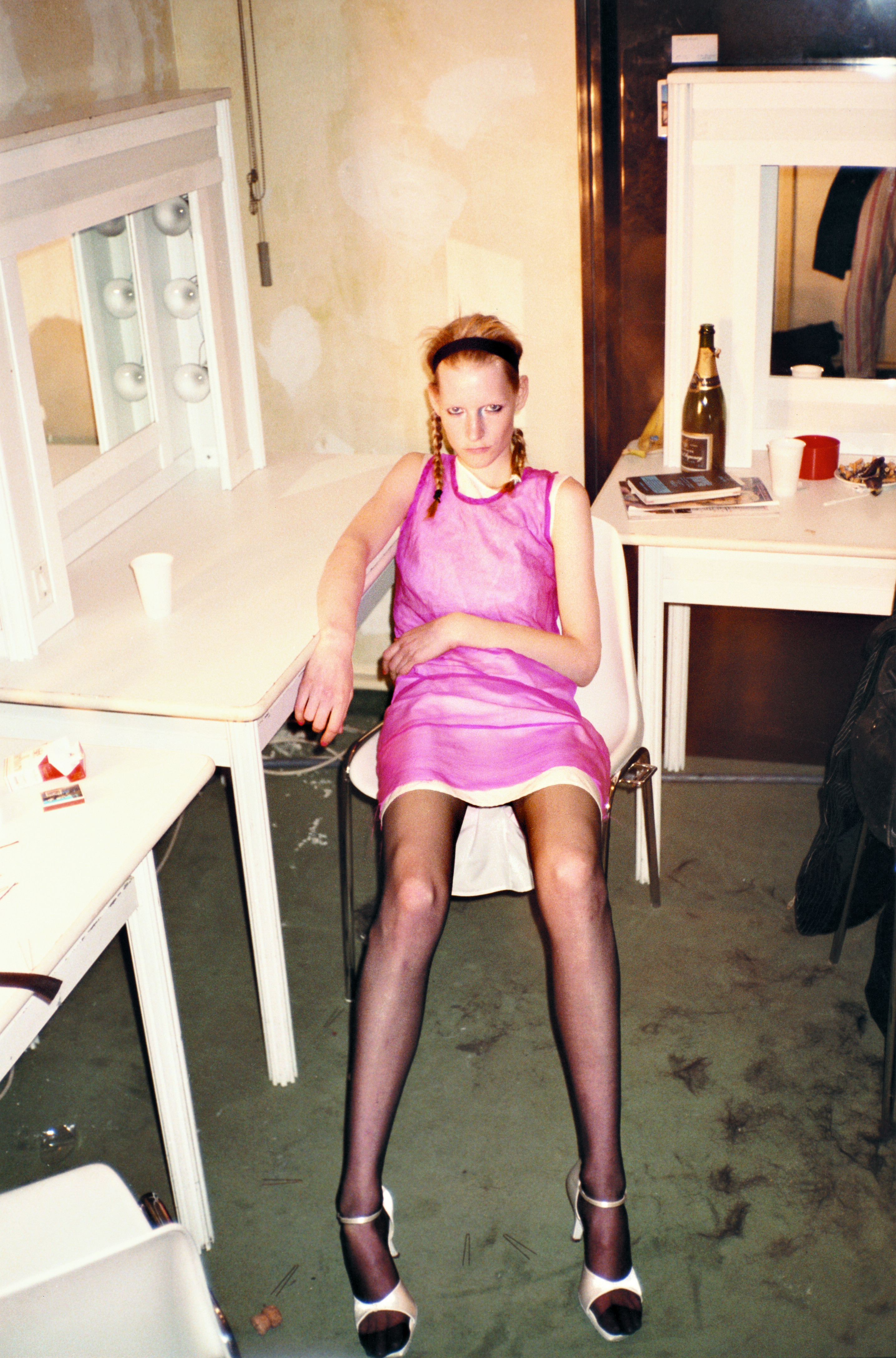
90s recession: Against a backdrop of recession, a deflated job market and pessimism about the future among the younger generation in the 1990s, the Heroin Chic look became popular in fashion imagery. Fragile-looking models with messy make-up and drugged expressions appeared not only in photography, but also in fashion shows. The emergence of the look was linked to the Junk Culture of contemporary movies about addiction, such as Trainspotting (1996). The embrace of heroin and unhealthy body images in fashion drew vitriol. After the turn of the millennium, the Heroin Chic look was replaced by a tanned, toned and – in contrast to its predecessor – ‘healthy’ looking body.
Health crises: Our fear of death and disease during the past three decades has been further fuelled by various epidemics and pandemics, including HIV, swine flu and Covid-19. These health crises also affected the fashion industry. In the early 1990s, Benetton, the Italian fashion brand, ran controversial advertising campaigns referring to the AIDS crisis; while Martin Margiela created t-shirts for charity to encourage open conversations about AIDS; and Walter Van Beirendonck included rubber pieces as protective shields and printed messages about safe sex in his activist collections. During the Covid-19 pandemic, the face mask has emerged as a symbol of the crisis.
Terrorist attacks: The euphoria of entering the new millennium ended abruptly in September 2001. The repercussions of the terrorist attacks in the USA were complex, violent and disruptive, changing the course of world politics. The attacks occurred on the fourth day of New York Fashion Week, making fashion journalists the first to report them. Though incomparable to the tragic loss of life, the financial impact of 9/11 forced many independent designers to file for bankruptcy or to look for outside investment. Another challenge occurred when, against the sudden trauma of 9/11, some of the Spring-Summer 2002 collections were reinterpreted by the press and buyers as inappropriate and insensitive. Some fashion photographers faced the same issues when a few editorials had to be cut at the last minute. In these, models were depicted falling from buildings or looked like survivors covered in dirt; they suddenly seemed too close to reality.
Military references in fashion were often in direct response to pervasive images in the news about war and terror. In the last two decades, a series of terrorist attacks in European cities led to increased military presence. The surreal experience of encountering soldiers in camouflage uniforms – previously out of context in cities – heightened a sense of unease and fear. Directly or indirectly, these ongoing emotions of anxiety and terror prompted fashion designers to investigate the dichotomies between feeling protected and feeling threatened, between soldiers and female warriors.
Can you give an example of what’s involved in the exhibition and how this relates to the theme?
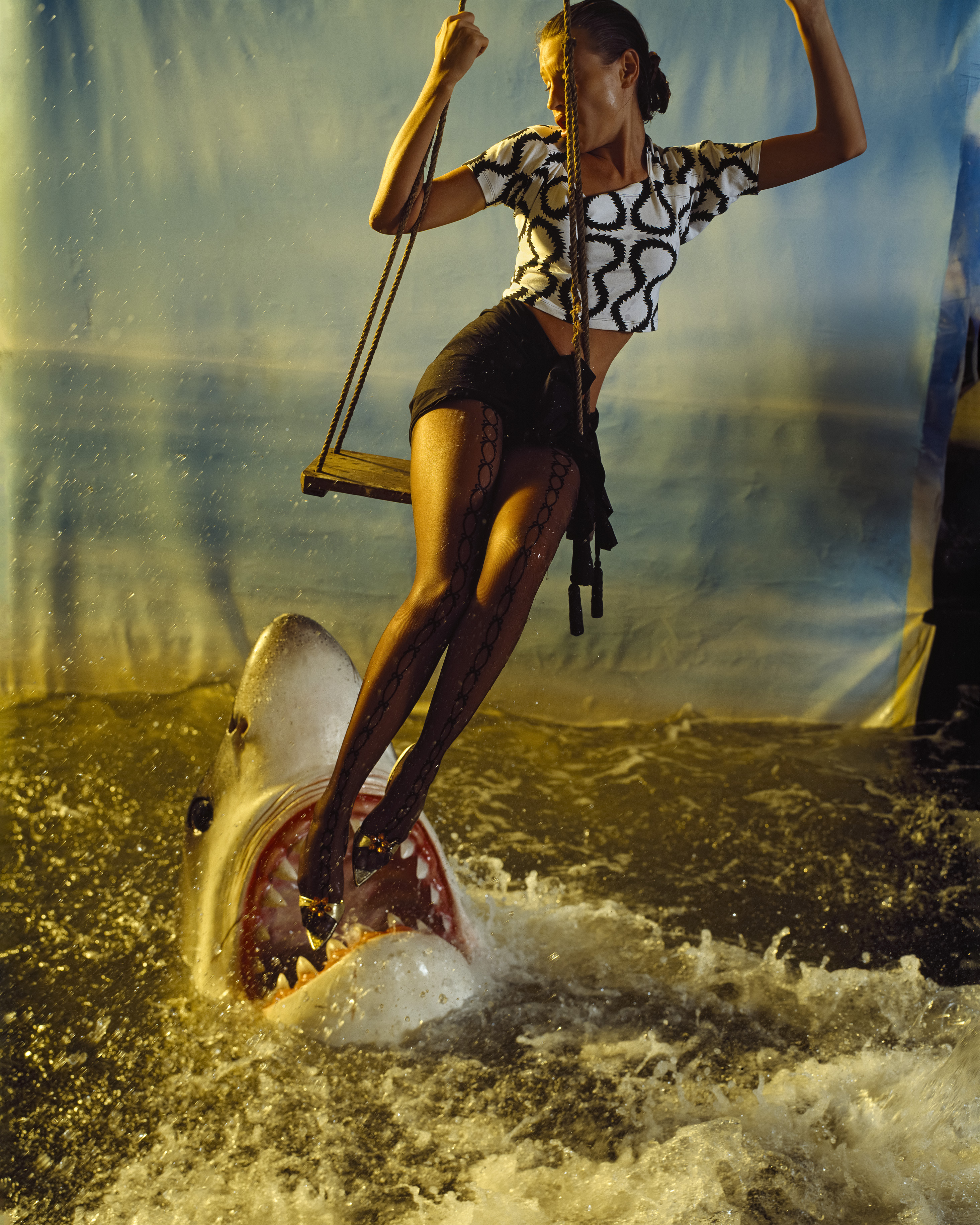
One of the exhibition themes is dedicated to the digital evolution and the internet. In this theme, we present a chiffon Versace dress, that was worn by Jennifer Lopez in 2000 during the Grammy Awards. People all around the world Googled her photo. This sudden peak in the search for a specific image was the reason Google Images was invented. The look became a metaphor of the ever more powerful symbiosis between fashion and celebrity culture. Twenty years later, Jennifer Lopez appeared on the Versace runway in this very dress.
What can the audience learn from this exhibition?
I hope the exhibition will inspire and move our visitors, as well as provoke conversation about fashion culture and its impact on society.
E/MOTION. Fashion in Transition is on show at MoMu from 4 September 2021 – 23 January 2022
Kemka Ajoku’s new series captures migration and settlement of Black people in the UK after the Windrush era
The After Party
A photographer of fashion and portraiture, Kemka Ajoku – who’s born and raised in London – strives to rewrite the stories of Black British culture. Done so through a mix of personal projects and commissions, Kemka has documented all sorts of meaningful tales from the locals of Lagos, busy in the tasks of their everyday jobs, and the beauty of brotherhood in the post-adolescent stage of life. Each picture he takes reverberates with purpose and passion; he’s a storyteller of truth, and someone who employs visual art as a tool for spreading his messages.
Over the last year, which has been a difficult one for many, if not all, Kemka has managed to find a sense of fulfilment. Not only did he graduate at the end of 2020 form a degree in Mechanical Engineering, he also arrived back home and broke away from the educational system for the first time in his life. “I felt free to creatively understand more about who I am,” he tells me, “looking back at my lineage as a guide to learning more about myself, having never given myself the space or time to truly be introspective.”
Gestural Greetings
A period of self-awareness and contemplation, Kemka’s ventures out into the ‘real world’ arose alongside the arrival of the pandemic. Coupled with the increase in racist hate crimes and injustice the globe, he began to question his role as a photographer, “a Black British photographer for that matter.” A sense of responsibility emerged: “a need to document the life of my people both in Nigeria and the diaspora,” he says. “To me, this was more important than taking a pretty photo. And so, a paradigm shift took place within me, a shift which led to me working with more intentionality, giving more meaning to the work with the hopes of lasting the test of time.”
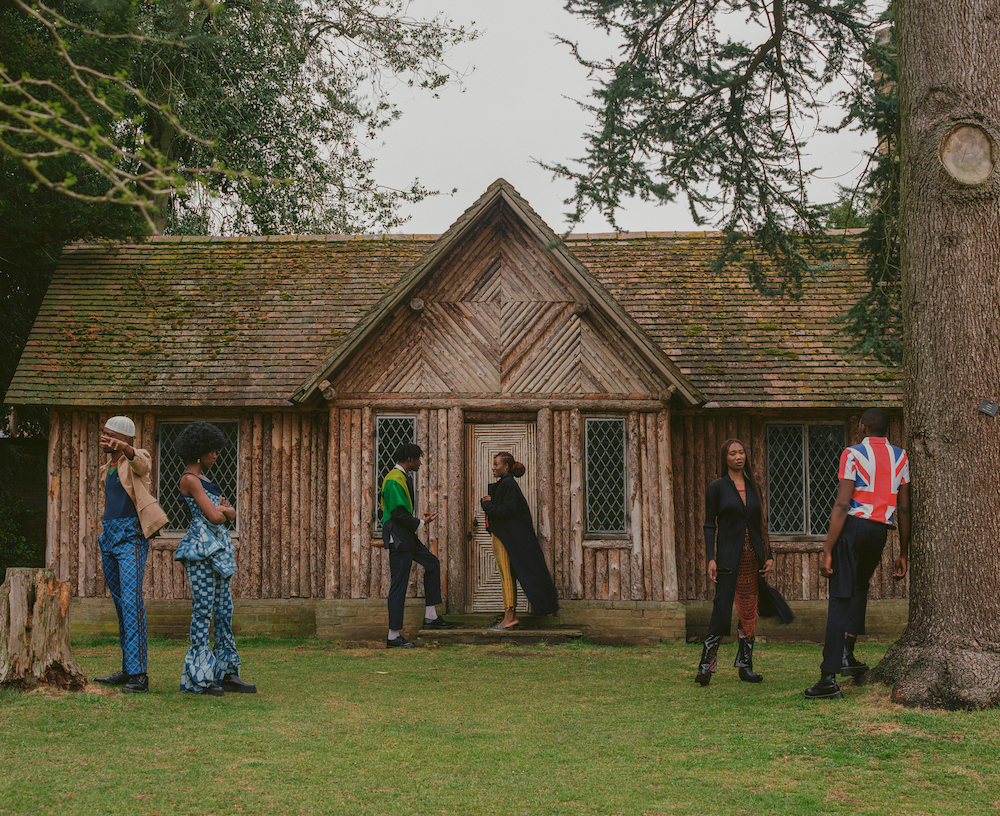
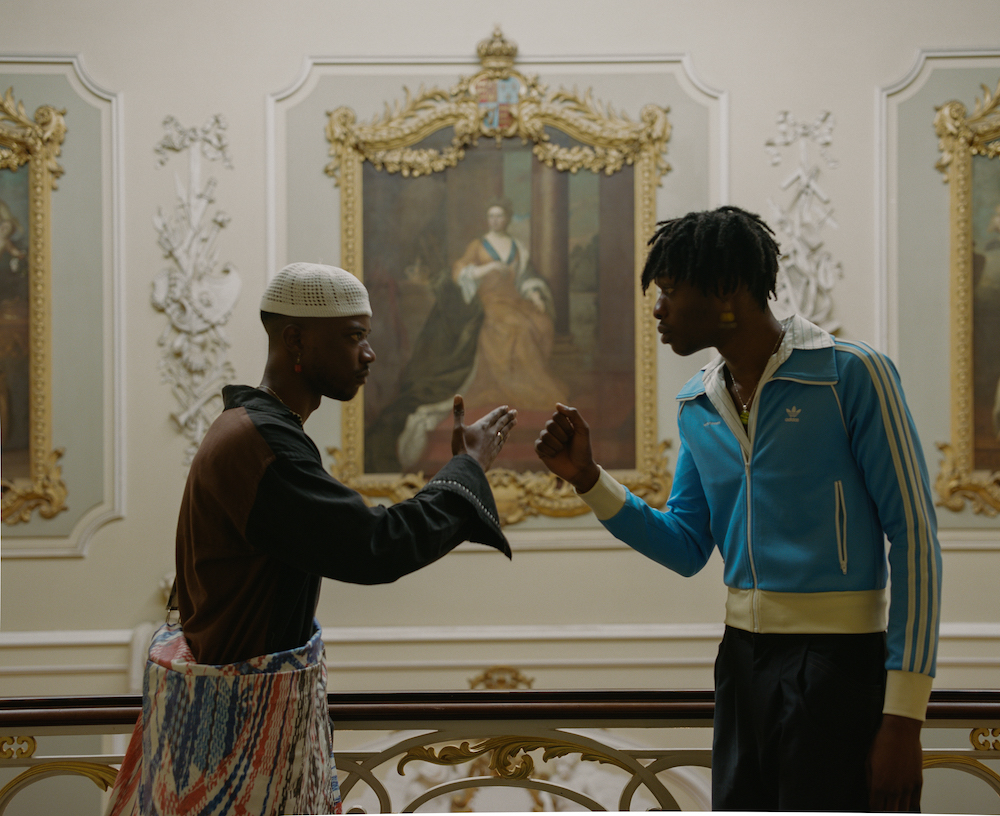
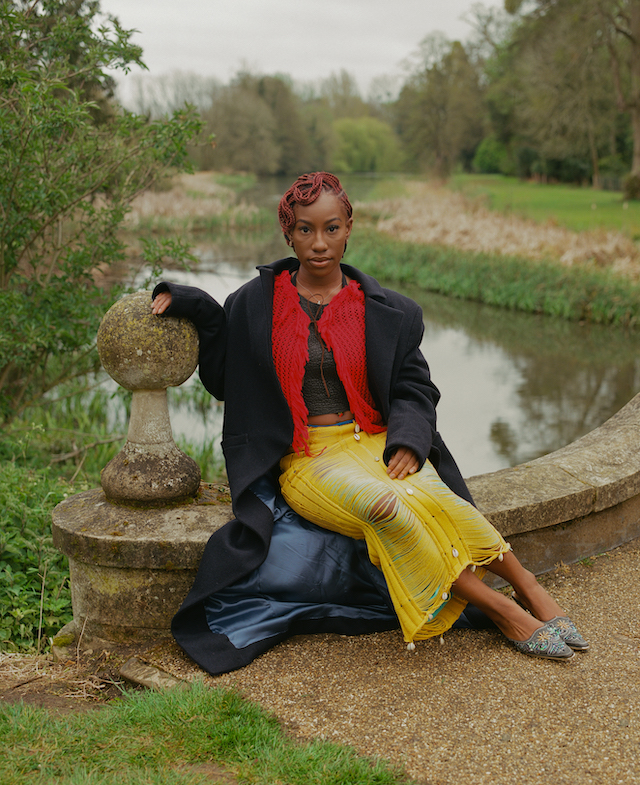
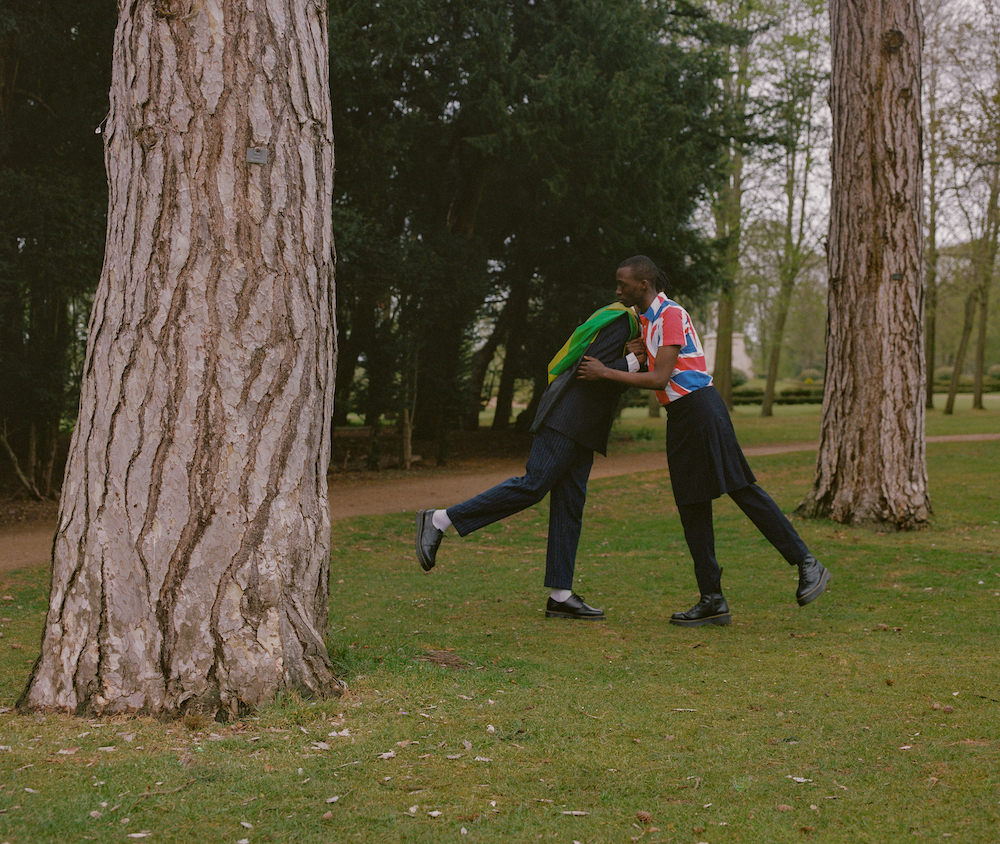
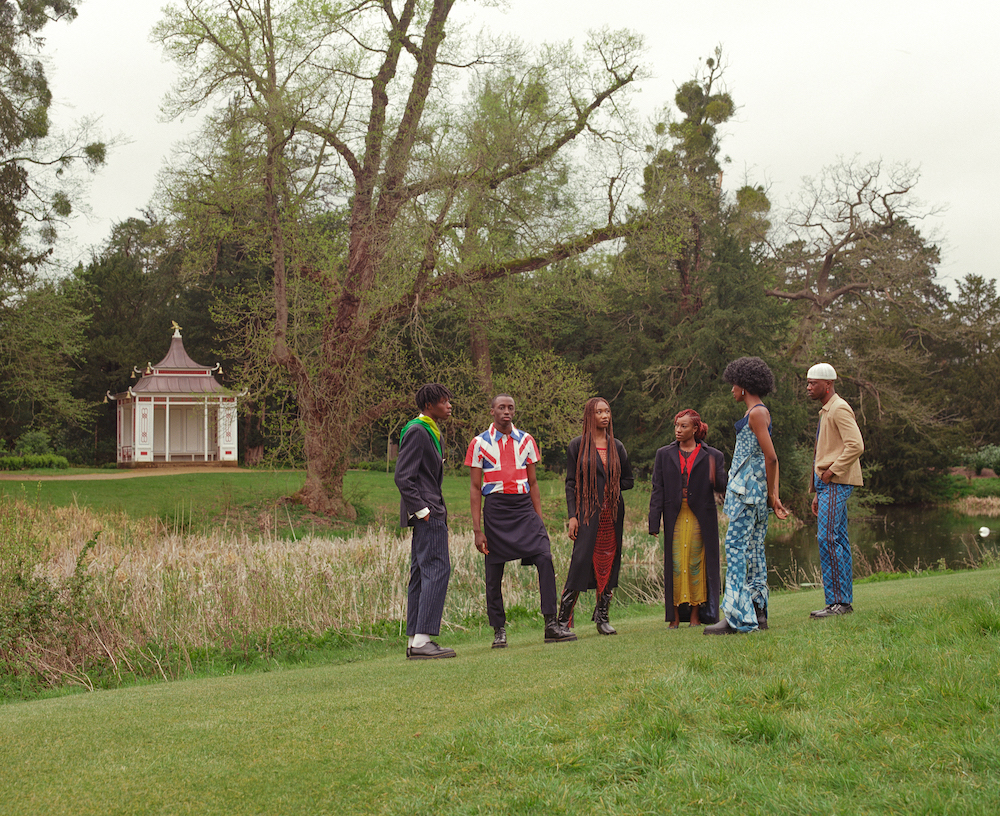
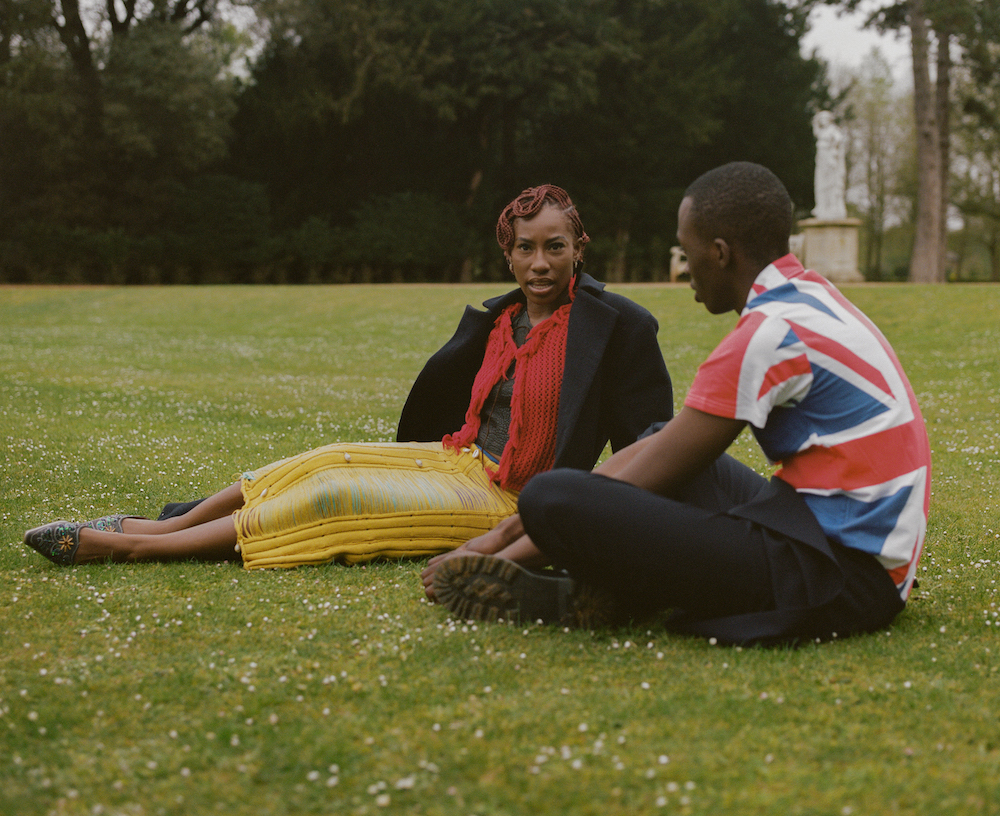
This matured sensibility has manifested into his latest photo series, titled Finding Common Ground. Months in the making, the body of work is currently exhibiting at Wrest Park as part of the England’s New Lenses project with Photoworks, in partnership with English Heritage’s Shout Out Loud programme. In comparison to his previous series – although motivated in their own right – Kemka has never worked with such drive and ethos. “I sat down and really articulated what I wanted to achieve before picking up my camera.” A lengthy bout of research and exploration later, he came to learn more about the migration and settlement of Black people in the UK after the Windrush era, “a story that me, my parents, and their parents are part of.”
Tami’s Portrait
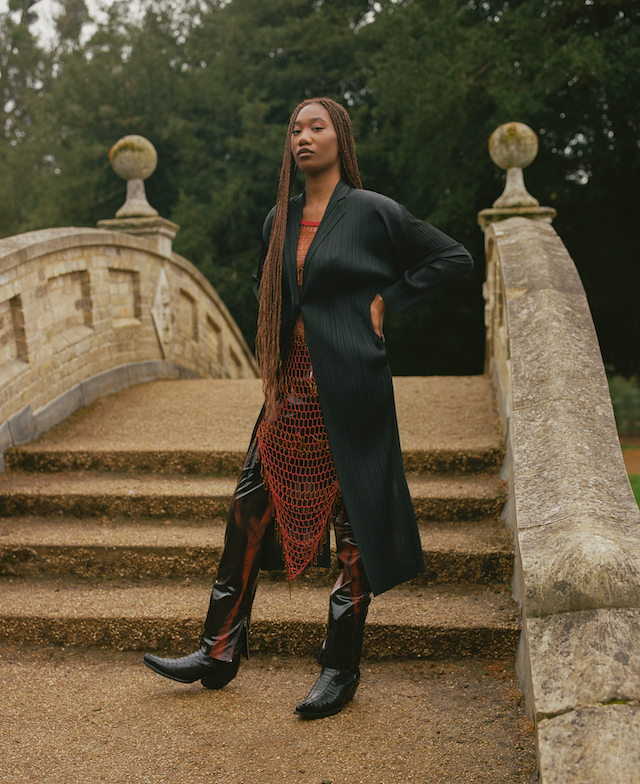
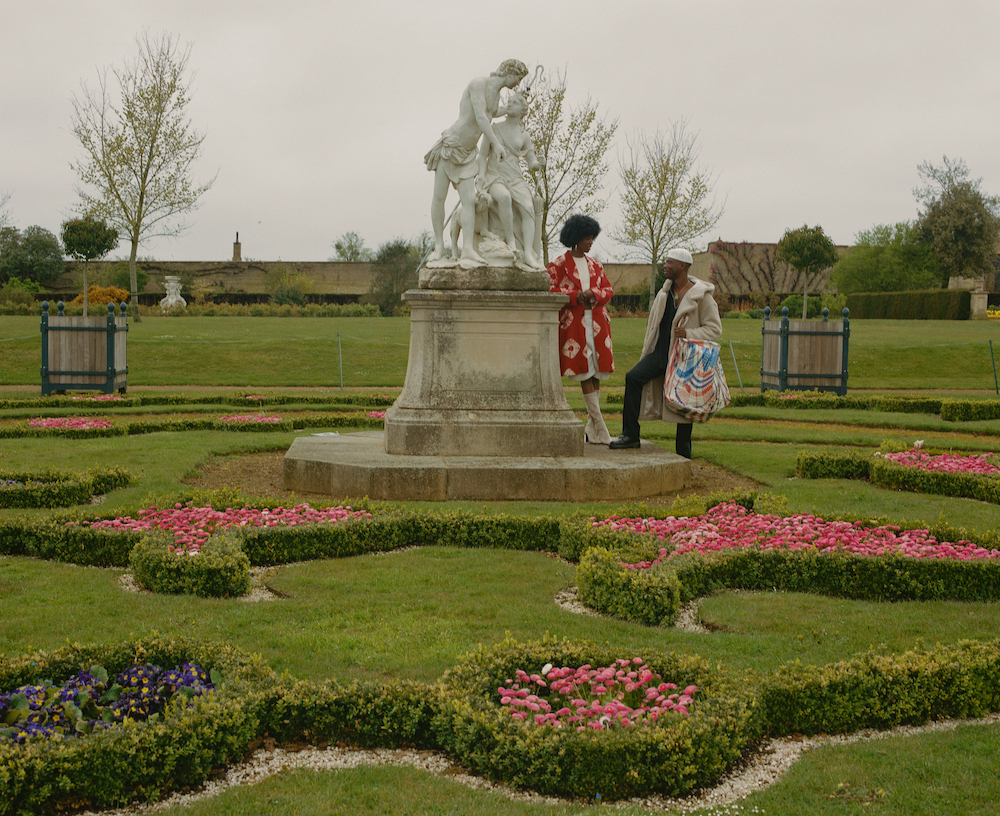
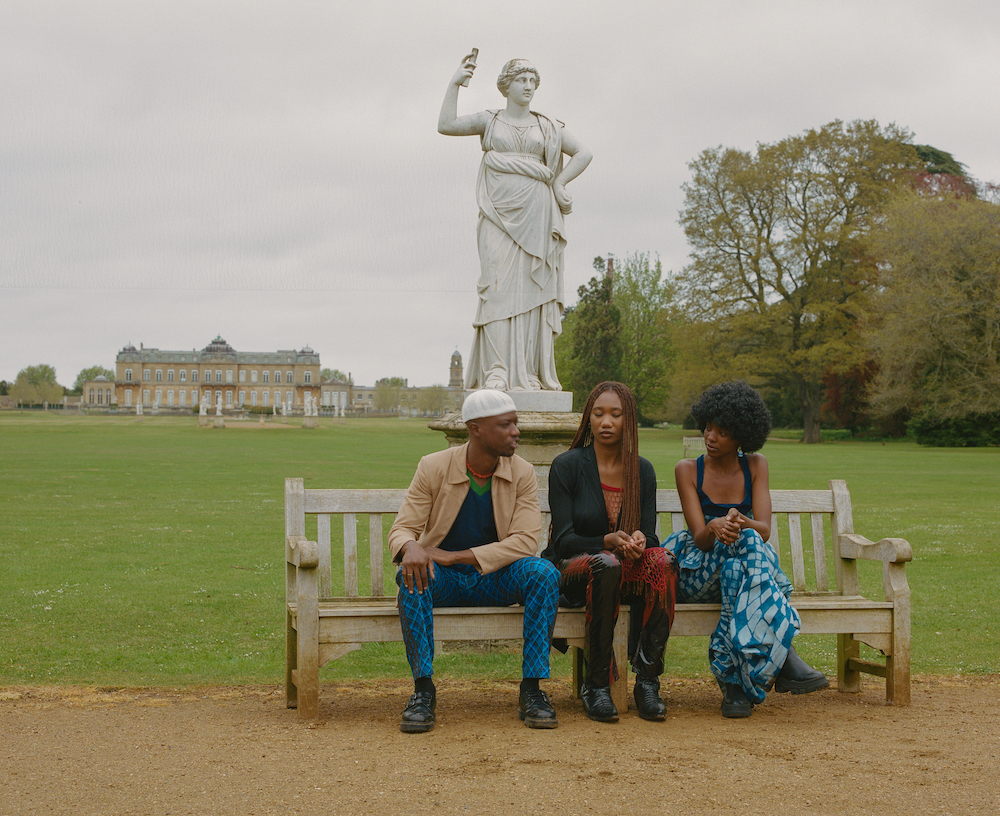
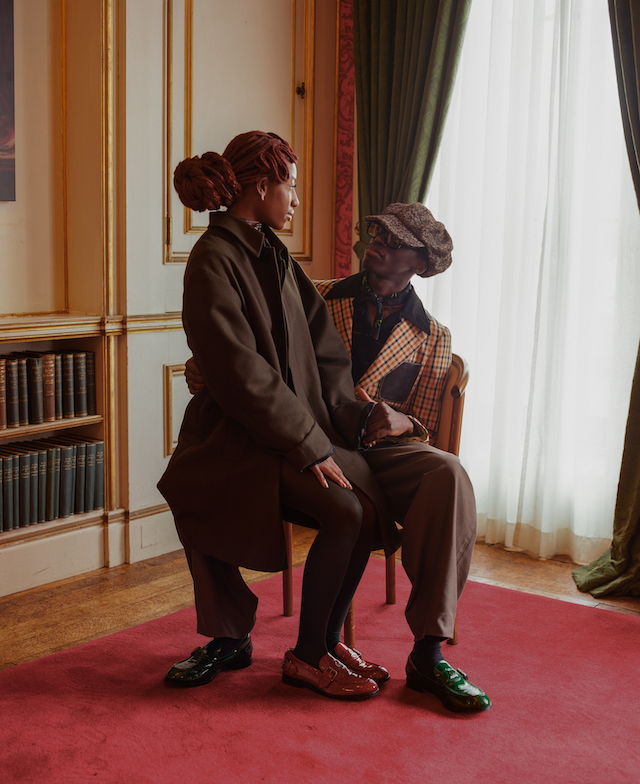
The photos involved are therefore contemplative, powerful and historical. Shot in Wrest Park, Bedfordshire, the location protrudes with British heritage as it’s built atop the style of an 18th Century French Chateau. He cast a selection of his friends to sit for him, each representing a specific demographic within the Black British community. Referred to as “characters”, Kemka explains how each of his models’ personas have been developed from “watching British Blaxploitation films from the 70s and 80s; films such as Black Joy, Babylon Burning an Illusion and Pressure to name a few.” To accentuate this, Kemka worked with stylists Daniel Obaweya, Charles Ndoimu and Lingani Noah who assisted with adorning the models in Black British clothing lines from both young and more established labels.
Western Union
“The styling for this project was broken into two parts, highlighting two generations of Black British citizens,” adds Kemka, “from the tailored style of the late 40s and early 50s, to the more relaxed and youthful looks of the 70s and 80s. Fashion is an important part of British culture, used in a way to express identity with the community one associates themselves with. Many fashion nuances migrated from foreign land have interwoven with British styling over recent years, and this integration of style was a focal point in styling the models.”
Observing the completed works and you’ll notice how the poses or gestures appear to have been caught in a freeze frame – recording not only that moment in time,but also an experience and learning exuded from the photographer who’s captured them. “The intention with this work is to artistically depict an important era in Black British history (not in a common documentary photography fashion) that will have longevity long after I’m around,” he concludes. “Thinking back to my intentions as a photographer, one thing I revert to is the legacy my work will have for other Black British creatives, looking for a reference upon which to build their creative career upon.”
One View of the TempleKozy’s PortraitCouple in Wrest gardenThe ConsultationWrest RiverThe Essence of ChiLover’s Rock
Styling Team: Daniel Obaweya, Charles Ndiomu, Lingani Noah
Special Thanks: Mahtab Hussain, Ingrid Pollard
And special thanks to Photoworks and English Heritage for giving me the opportunity to create this body of work through their ‘England’s New Lenses’ project
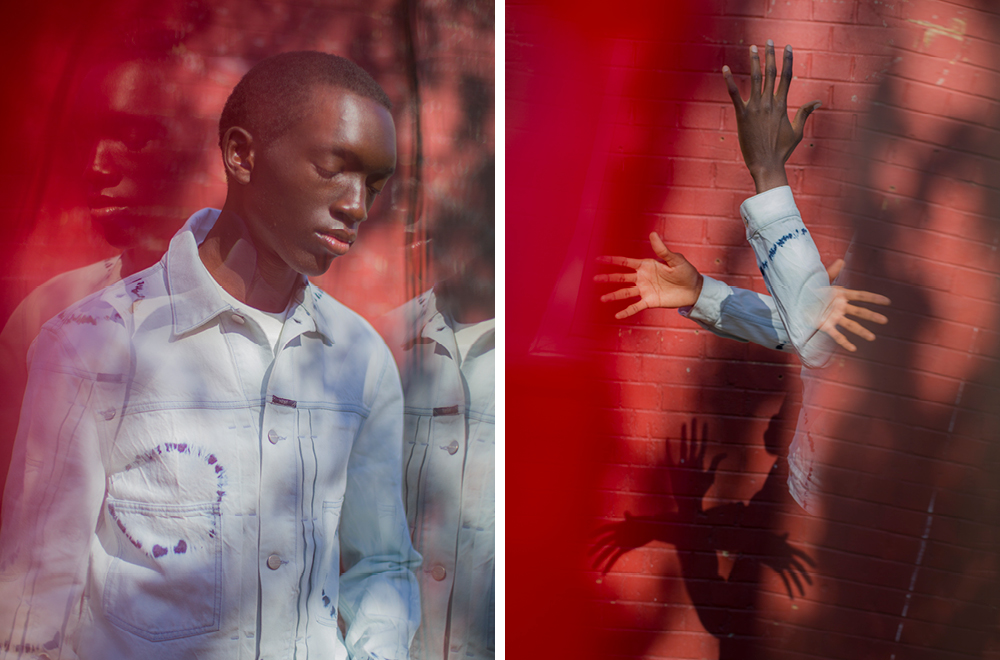
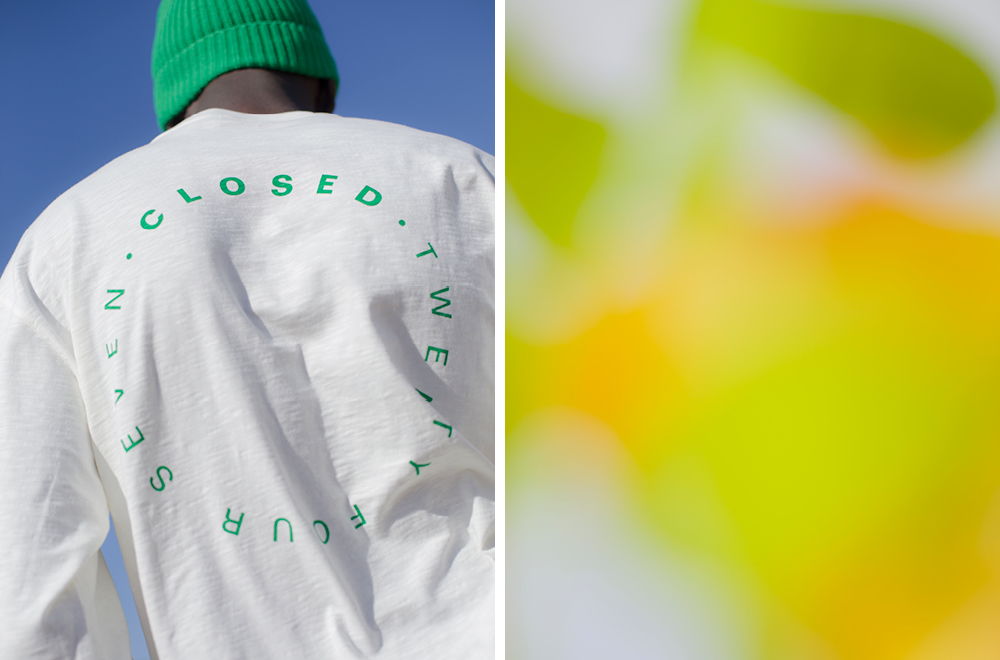
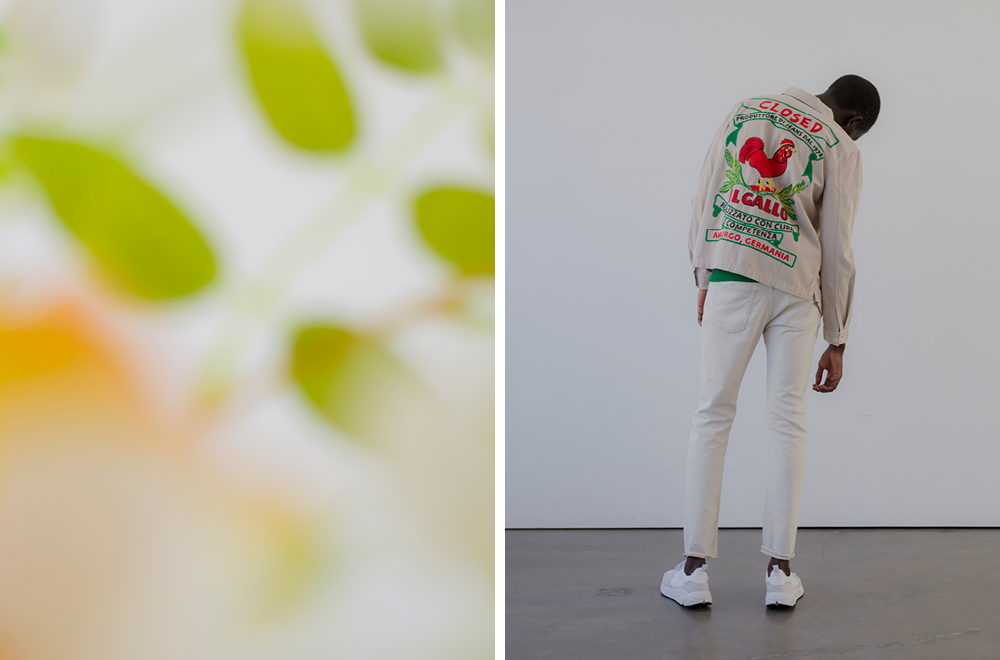
Port has partnered with Closed for a series of stories profiling poets who are encouraging social change through their work. We talkedto Wilson Oryema about language, climate change and making fashion sustainable
“Whether painted or untouched,
an honest depiction, or a bunch of fluff,
all things carry the same value under the blazing sun.”
– Wilson Oryema
Asked what the primary stimulus for his writing is, Wilson Oryema calmly replies, “Life.” The London-based poet, filmmaker, environmental activist and model – a potentially dizzying combination for some, but not him – finds he can only authentically write on subjects he’s personally experienced: “I’ve tried to do various things in my life outside of poetry and they never work out unless I’m putting 100% of myself into it. For it to make sense, emotionally, it has to be honest, understood and lived.”
Oryema’s focus covers capitalism, modern masculinity and most frequently, how we can adopt more sustainable practices for the planet. His recently published collection of poetry, Wait, meditates on the complex web of constant consumption in the 21st Century, urging us to halt before moving onto the next thing held briefly in our hands. “The voice is such a powerful instrument,” he notes, “and poetry is a great medium because it exists between reems of text and nothing at all. It’s punchy. It gets to the point.” I enquire whether poetry’s resurgence in the digital age is in thanks partly due to its brevity? “It definitely taps into the contemporary brain of quick consumption which has gotten used to headlines, advertisements, skimming information. If you look at the Bible – in the beginning was the word. People can’t escape language. The voice is the first medium of communication they come into contact with and it remains the most important means to define ourselves.”
With the UK Prime Minister recently dismissing the danger of inflammatory language – traitor, surrender, betrayal – as “humbug”, how political language is targeted and weaponised is causing a great deal of public anxiety and division. Oryema reflects that this is nothing new: “After WWII, the propaganda writer Edward Bernays introduced a switch in language through his use of public relations and advertising. You can feel that influence in politics now, through the aesthetically pleasing politician, reliance on focus groups, relentless slogans. A faux-science has been built around language manipulation and we’re in a place now where new levels of mastery have been unlocked, but most people are unaware of the control or influence they’re being exposed to. We know how to instil feelings effectively, what buttons to press. There’s a great Drake lyric which comes to mind – ‘Tell me lies, make it sound good.’”
Oryema went from working at a charity to walking the runway at Paris Fashion Week in a matter of weeks. Scouted on his lunch break, he has gone on to work with Edward Enninful, Hugo Boss and extensively with designer Grace Wales Bonner, who he counts as “an older sister”. In a previous interview he knowingly described himself as a “walking contradiction”, both part of the one of the biggest polluting industries in the world, but separate enough to offer a critical perspective. By only choosing to work with brands aligned with his values, it’s clear he feels he can best shape the world of fashion from within, using his work as a platform for change.
His latest documentary examines the toxic chemicals and natural fibres in fashion manufacturing and their unseen effects on the human body. “In the production process, there’s about 8,000 different types of chemicals that clothes are exposed to through their entire manufacturing, from farm to store,” he explains. “We have millions of pores, composed of billions of trillions of cells, so we’re constantly absorbing fibres around us. We’ll think about the environmental cost of the fashion industry, but don’t typically think about the dangers of petrochemicals directly on our body. How do we reconcile that? Are there any effects? The documentary delves into this and looks at some of the chemicals used, as well as alternatives that can reduce your risk. We have to take care take care of our surrounding environment, but also not lose sight of self-care, protecting the human body.”
Having just joined the Global Fashion Agenda, a forum arguing for a change in how clothing is produced, marketed and consumed, Oryema has publicly stated that the future of fashion will be rooted in accountability. Expanding on this, he rationalises that, “with the advent of the information age, the internet, connected devices, the brightness of our screens has reduced the amount of darkness in the world. There’s nothing that isn’t being captured or tracked in some way, whether that’s the end user or back end. Traceability is now becoming a big trend and we’re coming to a point where we’ll be able to track everything, with new companies like EON creating digital identities for clothes. Once these things become totally visible, when parties have to take ownership of their production – how much waste you’re producing, how many physical stores you own, how you treat your workers – there’s going to be no dark spaces to hide secrets. This transparency will lead to much more accountability.”
Originally born in Clapham, Oryema grew up in Brixton surrounded by British Red Cross research and pamphlets from the Salvation Army due to his mother working for both, in addition to a number of other charities. Did this emphasis on care – for others, for the world at large – subconsciously shape him? “Naturally we are the sum of our environment and our surroundings. I’ve somehow strolled into a space where I’m considered an activist or environmentalist. Whatever I’m doing, though, I don’t see any way forward for myself that isn’t improving my surroundings. Whether it’s my writing or photography or film, I want to play a role in creating social change. Art has this ability to reach people who wouldn’t necessarily come into contact with or care about issues like climate change. I want to contribute new perspectives.”
Last year saw six million citizens the world over join in a mass global climate strike. I ask whether this is an encouraging sign, and just how optimistic he is about stemming the damages brought by climate change? “This may come as a shock, but I am supremely hopeful,” he replies. “Lots is already being done and I can see so much promise in people right now. There was a recent news story about a schoolchild committing suicide because they were so scared of climate change. If people are bullied or scared into thinking they’re the cause, if you back people into a corner, you’ll naturally evoke feelings of paralysis and apathy. Problems are never solved through fear. Long term thinking relies on hope – we have to stay calm.”
The latest podcast from Port, featuring fashion designer Kaushik Velendra and CSM course leader David Kappo
In the third starter episode of The Path to Positive Change, we are joined by Kaushik Velendra, the founder of the London-based luxury menswear label which carries him name. Established in 2019, his collections have already won praise during London Fashion Week and led to him being shortlisted for the LVMH Prize, in 2020. Our second guest, meanwhile, is David Kappo, a London-based fashion designer, regular broadcaster, and course leader of Central Saint Martins’ world renown Graduate Diploma in fashion. Together, we discuss fostering diversity and inclusion, creativity in education, and more holistic, human definitions of sustainability.
Our next episode will be released next month via Spotify, so stay tuned.