Trout with Leeks and Wild Garlic

Merlin Labron-Johnson, the Michelin-starred chef behind Osip, shares a recipe for issue 28
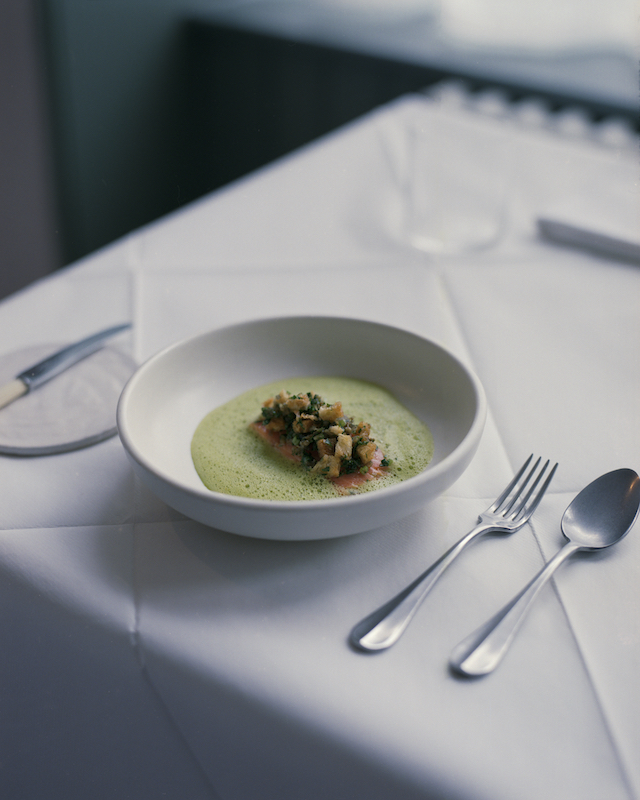
Ingredients

500g trout fillet, scaled and pin boned
50g rock salt
10g caster sugar
1 shallot, finely sliced

400ml water
1 glass of dry white wine
100ml cream
1 handful parsley leaves
1 handful wild garlic
1 lemon
3 large leeks
75g butter
1 slice of old bread, crusts removed
Olive oil

Method

Place the trout flesh side up in a dish large enough to sit in the fridge. Mix the rock salt with the caster sugar and smear over the flesh of the trout. Grate over the zest of one lemon. Leave for four hours before rinsing the fish, making sure to remove all the salt and sugar. Use a clean towel to dry the fish fillet and return to the fridge uncovered for another few hours to allow the fish to dry out a little.

Wash the leeks well and separate the green part from the white part. Roughly chop the green part and place in a saucepan with the water. Bring to a boil and cook for 30 minutes on a gentle simmer before straining through a sieve. You will use this leek broth for your sauce. Slice the white part of the leeks as thinly as possible and sweat very gently in 25 grams of butter for 30 minutes without any colour. Season with salt and set aside.

Preheat the oven to 150 degrees.

Put the shallots and white wine in a saucepan and bring to the boil. Cook until almost evaporated and then add the leek broth and cream. Cook for a further 10 minutes then transfer to a blender. Separate the leaves from the stems of the wild garlic. Add the leaves and half the parsley to the blender and blitz until smooth and bright green. Return to the saucepan and add the remaining butter. Season with salt and keep hot.

Cut the trout fillet into four even-sized pieces and place in an ovenproof dish. Drizzle a liberal amount of olive oil over each piece, cover the dish with foil or a lid and place in the oven for 15 minutes. Dice the bread into tiny cubes and fry in a little olive oil. Chop the wild garlic stems and the remaining parsley as finely as you can. Reheat the leeks.

After 15 minutes, the trout should be lightly cooked, flaky and a little bit raw in the middle. Remove from the oven and top with the chopped parsley, wild-garlic stems and fried bread.

Divide the hot leeks between four bowls. Place a piece of trout in each bowl. Give the wild-garlic broth a good whisk and pour a little onto each plate, serving the rest in a jug on the side.

This article is taken from Port issue 28. To continue reading, buy the issue or subscribe here

Nature and Nurture

Award-winning chef Merlin Labron-Johnson reflects on the joy of growing his own produce

Photography Izzy de Wattripont

You can’t cut corners gardening. No shortcuts, no rushing. Like cooking, every single process must be respected because each dictates the end result. When you are creating a dish, you are nurturing those ingredients in much the same way you love, care and pay attention to what you’re growing. Both practices are unforgiving, and in the beginning I made plenty of mistakes – the trick is not to make them twice.

I grew up in South Devon, and the countryside is where I feel most comfortable. How I cook and approach food is very much connected to agriculture, landscapes, the wilderness. What I previously lacked in London was inspiration; I was on autopilot. Yesterday, I walked through a beautiful pine forest and was transported to the Swiss Alps, where I cooked for many years. I think most creatively when I am outside, watching the plants grow, feeling the seasons change.

Launching a restaurant is often traumatic and chaotic, never mind on the eve of a pandemic, and having to close Osip’s doors after only five months was hard. The first lockdown gave me time to reflect on what I’d created and what I did and didn’t like about it, what I would change in an ideal world. After a brief respite from the day-to-day madness, I could actually see the wood for the trees. The restaurant I reopened that summer was 10 times better than the one I’d closed, and the most important factor behind this was teaching myself how to grow.

We now have two sites, essentially next door to the restaurant, to cultivate vegetables – Spargrove and Dreamers Farm – and this direct relationship inspires what we cook. I intend to be entirely self-sufficient all year round, and will be busy during the hunger gap – the January to May period in the UK where little grows – clearing and ploughing the ground, building polytunnels and greenhouses. I have overwintering things like kales, cabbages, chards, onions, garlic, and purple sprouting broccoli currently working their magic underground, and I’m planting strawberries, gooseberries, raspberries, as well as black, white and red currants in time for summer.

I am guided by and at the mercy of the land. It’s rare to be in an environment where a chef can pick something that morning and serve it for lunch. The difference in flavour is enormous because every day that a vegetable is out of the ground, it deteriorates in quality. My cooking has never had a clearer identity, or felt more emotionally rooted, because I’m only working with ingredients I’ve grown myself. Osip is an expression of who I am.

Ethical and ecological opinions aside, I’m bored of protein. I love a steak as much as the next person, but I find vegetables to be infinitely more versatile in the ways they can be prepared and presented. In the past, this country has been particularly unimaginative with vegetables. In France, they have different ways to describe national methods; carrots à l’Anglaise means to boil in water with no salt. That says it all really. If you look at the way Italians prepare produce, there’s real thought and care poured into every step. Perhaps we’re still on that journey of discovery here in the UK.

In recent years, some of the greatest meals of my life have revolved around the humble vegetable. I felt sated, satisfied, enthused but not heavy. There’s a distinction to be made between being full and fulfilled.

As told to Tom Bolger

Photography Izzy de Wattripont

Merlin Labron-Johnson became the UK’s youngest Michelin-starred chef in 2015. His latest project is the farm-to-table restaurant Osip – and the accompanying wine bar and épicerie, The Old Pharmacy – in Bruton, Somerset. Having only been open for seven months, Osip was recently awarded a Michelin star.

This article is taken from Port issue 28. To continue reading, buy the issue or subscribe here