Rolex has launched a new collection, but that’s not the only remarkable thing about it
Photography Adam Goodison. Land Dweller, 40mm, Oystersteel with white gold bezel. Rolex at David M Robinson, £13,050 davidmrobinson.co.uk
Rolex is a brand that likes to do things slowly. Small changes, little shifts, it doesn’t deal in revolutions. You just have to look at the furore when it moved a crown from the right to the left on the GMT-Master II a few years ago – a sure sign that incremental changes at the Crown pack a rather large punch. So, you can imagine the levels of excitement in the halls of Palexpo – the space in Geneva where Watches & Wonders is annually held – when rumours rippled through that Rolex was not only announcing a brand-new collection, but one that contained a brand-new movement housing Rolex’s new escapement.
This is the first new watch from Rolex for 13 years. As its name – Land-Dweller – indicates, it joins the ‘Dweller’ family, following on from 2012’s Sky and 1967’s Sea. However, it is not a combination of these two nor does it really share much of their DNA, apart from a fluted bezel, looking good in steel, and a crown on its dial. This is an entirely new beast with its own unique heartbeat.
Reportedly the brief was first handed down from management five years ago. The team was tasked to design a timepiece that was modern, but which took inspiration from the integrated bracelet style of two specific timepieces. The first was the ref. 5100, a Datejust Quartz from 1969, the other the rare ref.1630 from 1974 – a two-tone Oyster Perpetual Datejust that looks like the famed Oysterquartz but preceded it by three years and is, in fact, automatic. The new addition also had to have a movement that ran at 5Hz (or 36,000 oscillations per hour), as opposed to the usual 4Hz (28,800p/h) speed that is typical at Rolex. There is a logic to raising the oscillating rate – the number of times the balance wheel swings back and forth. A higher frequency means a watch that is less sensitive to shock and accelerations. To do this however, Rolex had to redesign its regulating system.
What Rolex has done with its new escapement, which it calls Dynapulse, is completely overhaul the Swiss lever escapement. This method, by which the release of power from the mainspring is regulated, was invented in 1754 by Thomas Mudge and uses a small fork attached to the mainspring that, in turn, through a back-and-forth rocking motion, moves the escape wheel around as the prongs alternately come into contact with its teeth. Most of the watchmaking world uses this system. And now Rolex has come up with an alternative.
With the Dynapulse, two interconnected wheels that look like sci-fi flowers enmeshed together, take turns in flicking a two-pronged fork between each other as the balance wheel swings. The wheels are made from silicon using the DRIE (deep reactive-ion etching) process, which means that the tooth tips are polished, and their surface is curved not flat, so there is no sliding friction as the wheels connect and pass, but more of a rolling motion. This means that there is little need for oil, which is used but dispensed using a curved precision needle and on a nanolitre scale. Add in an extremely strong white ceramic balance staff that has been polished smooth on a nanometric scale, an ‘optimised brass’ balance and a hairspring in Rolex’s proprietary silicon, Syloxi, and you have a movement that is upgraded to the max.
That alone would have been enough newness for anyone, let alone Rolex, for whom a tiny adjustment is newsworthy. However, the Land Dweller also comes with a brand new bracelet design. The last time Rolex put a watch on some new links was the President – a three-link design with semi-circular components created especially for the launch of the Day-Date in 1956. Before that there was 1945’s Jubilee and prior to that the Oyster, which had been in the collection since the 1930s. For the Land-Dweller, we now have the Flat Jubilee – so named because it is basically the flattened underside of the Jubilee, with its same construction of two larger outer pieces and three internal links – except here, instead of being beaded, they are flat. As an added extra, Rolex has reinforced it using ceramic inserts at the first articulated link, limiting stretch over time.
The result is a bolder and more geometric Rolex than people are maybe used to. It isn’t a ‘professional’ watch but sits in Rolex’s ‘classic’ category sartorially somewhere between the DateJust and Day-Date; a refined design with a sporty vibe that feels destined to spend time on the deck of a yacht or in a bar with a night-time view of a cinematic skyline. The finishing on the case is unusual for Rolex, given that it has gone for a satin finish on the flat surfaces, polished sides and chamfers on the case. The honeycomb dial is a new pattern as well, for which Rolex has used a femtosecond laser – an ultrafast precise beam – to etch the pattern, which gives it its texture.
All of which adds up to Rolex’s decision to enter the integrated bracelet club; something it has not been a part of for many years. And it has certainly entered it with aplomb. This is a 10-strong collection in 36 or 40mm, with everything from steel with white-gold bezel to full platinum with a diamond-set dial and bezel. Obviously, it’s been a hit. This is Rolex’s world; everyone just lives in it.
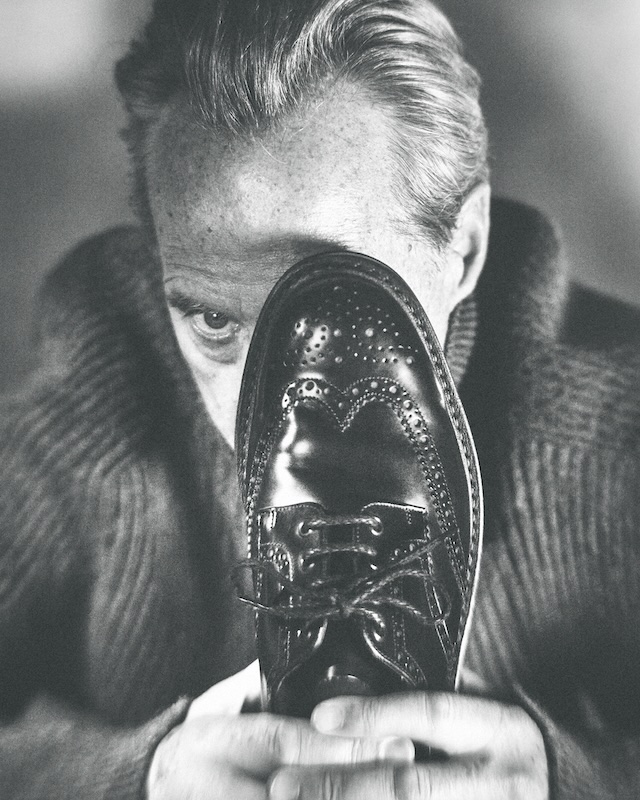
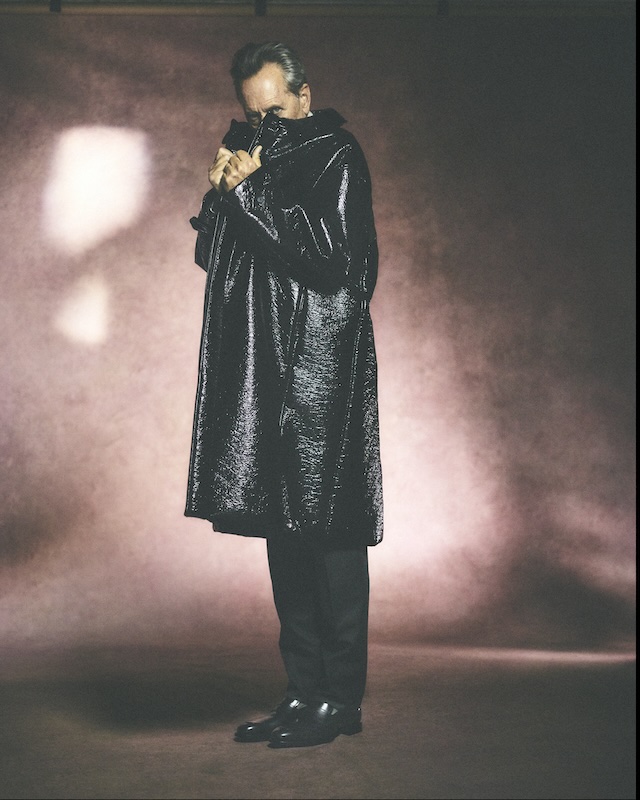
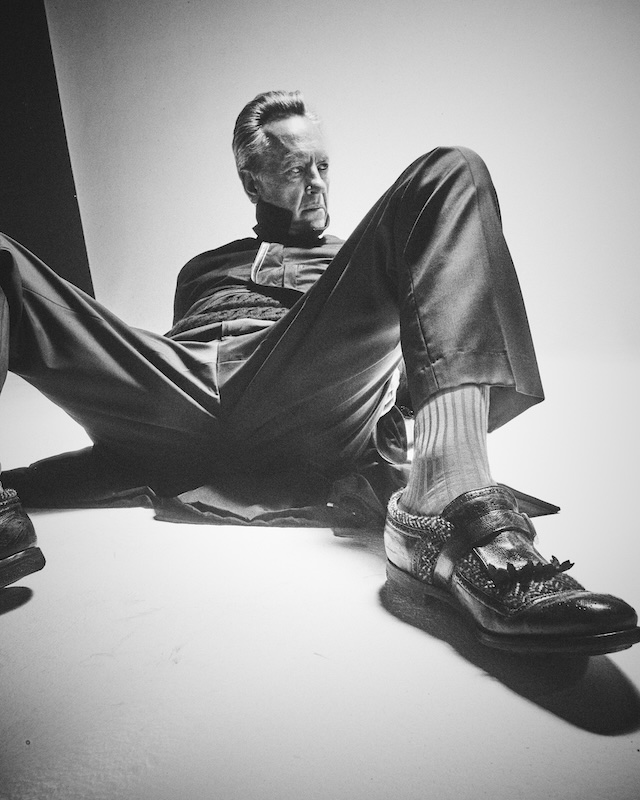
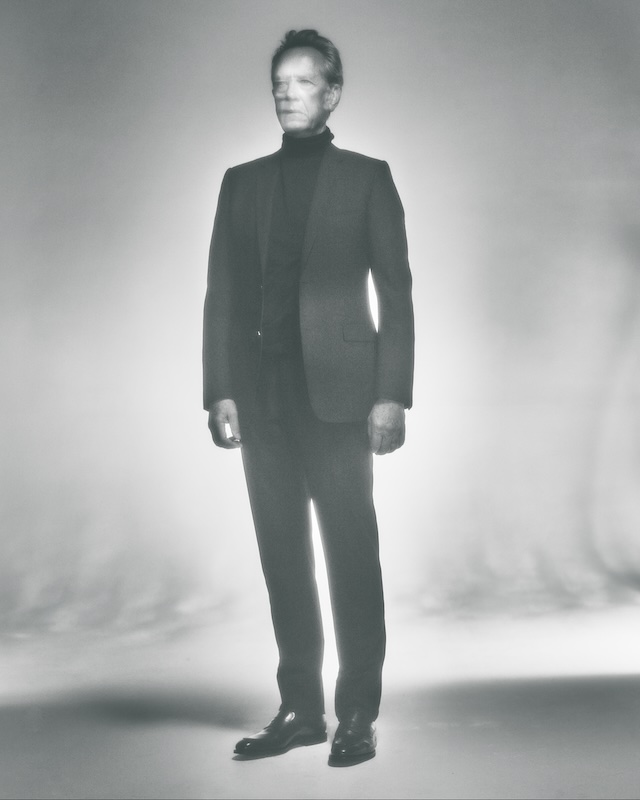
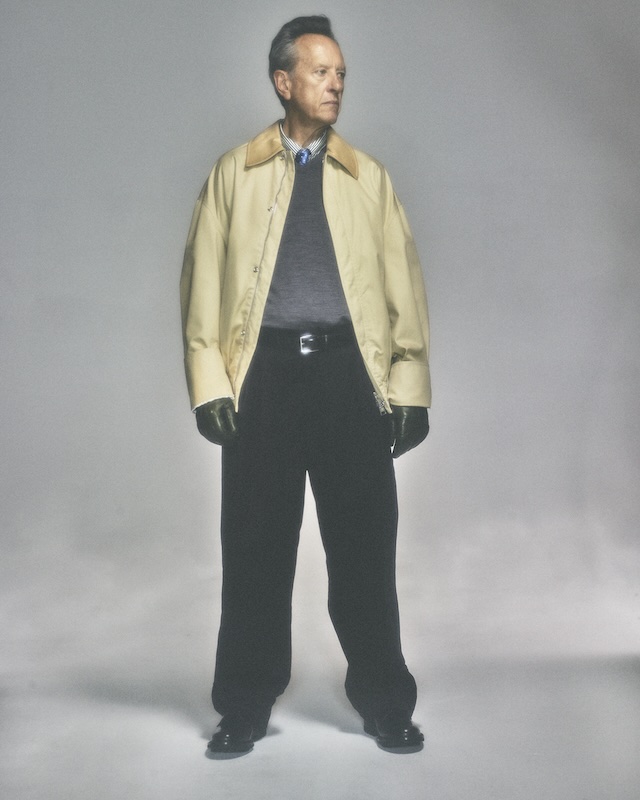
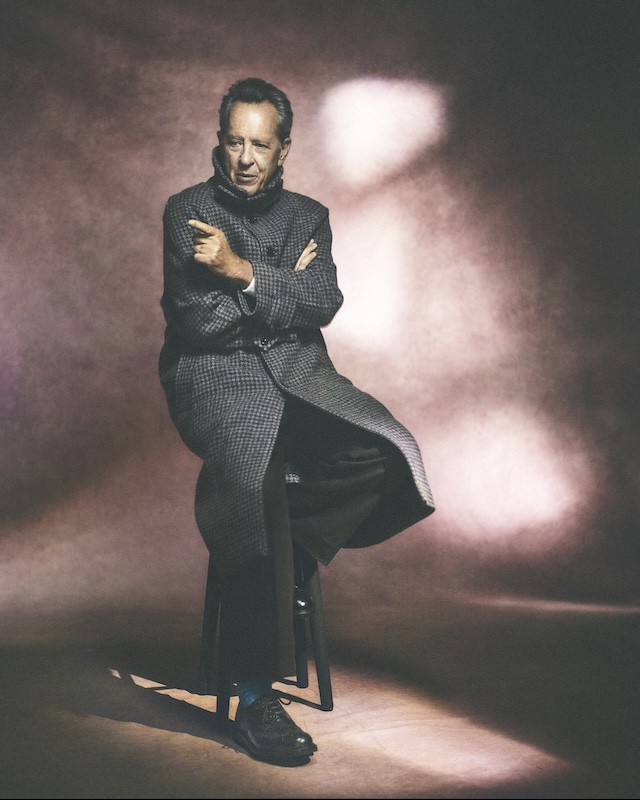
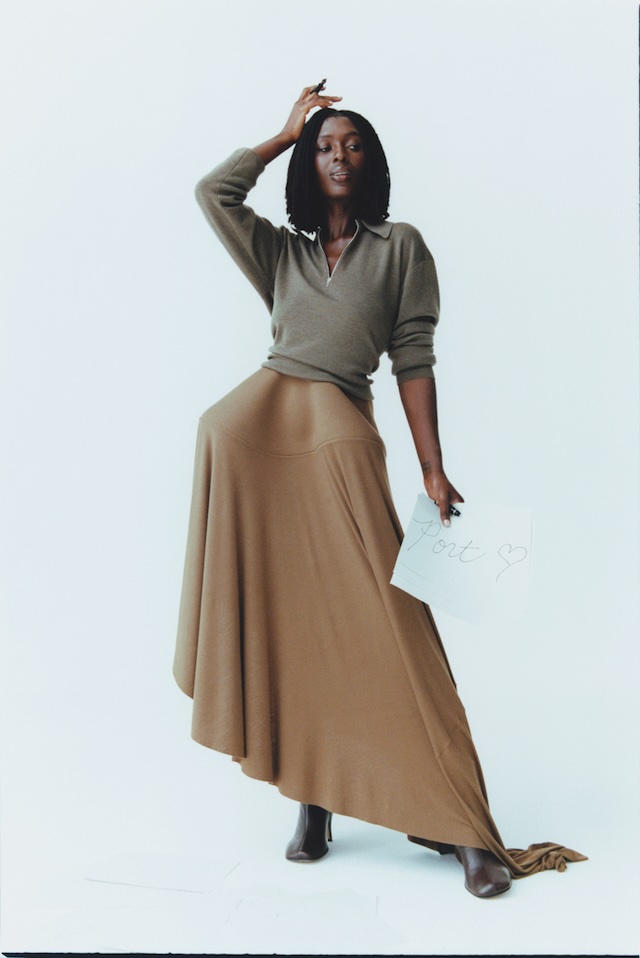
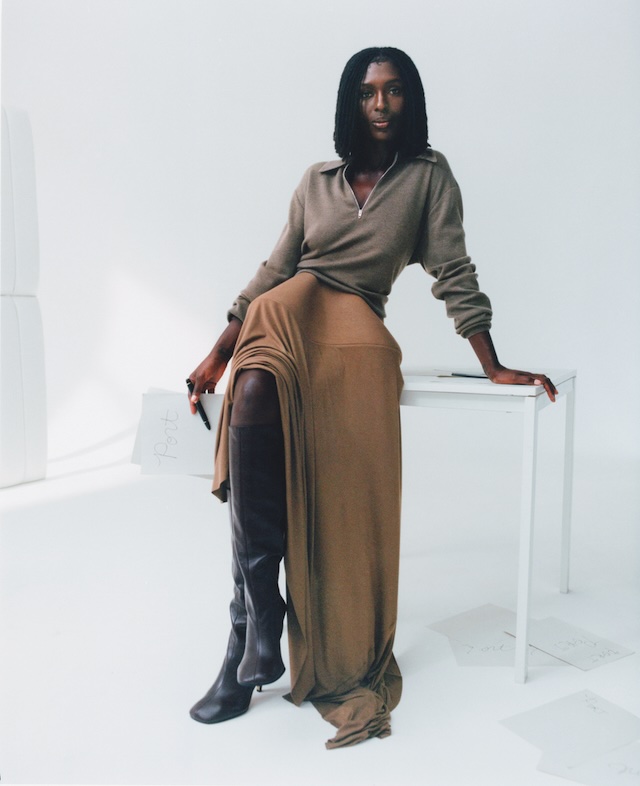
GUCCIShirt HERMÈS Rollneck HERMÈS Trousers LOUIS VUITTON Belt HERMÈS
Shirt LARDINI Trousers LARDINI Sweater CELINE Tie LARDINI Shoes LORO PIANAShirt FENDI Trousers FENDI Boots SAINT LAURENT BY ANTHONY VACCARELLOShirt PAUL SMITH Tie PAUL SMITHCoat DUNHILL Shirt EMPORIO ARMANIWaistcoat LORO PIANA Trousers LORO PIANA Shoes CANALIShirt HERMÈS Rollneck HERMÈS Trousers LOUIS VUITTON Boots HERMÈS Belt HERMÈS
Richard E Grant likes to think of himself as a sharp flavour added at just the right moment. It’s a modest description for an actor whose career spans Withnail and I, an Academy Award nomination for Can You Ever Forgive Me?, and collaborations with the likes of Scorsese, Campion and Altman. Now, in his “condiment years”, Grant looks back on the friendships, films and insatiable curiosity that continue to define his life and work
“My wife said that I was in the condiment years of my career,” Richard E Grant recalls fondly, sitting in his study on a bright September morning. “I’m brought into a film like vinegar or mustard or a spice. I feel that is a very accurate description of what I’m doing at this age.” Grant, with a long and storied career under his belt and the likes of Martin Scorsese, Jane Campion and Robert Altman among his previous directors, is in his element. This year alone he appears in no fewer than four feature films, while a quick glance at Grant’s IMDB profile confirms a further 10 upcoming projects across genres and formats, from a voice performance in Wildwood, the much-anticipated animated film from Laika, to playing the father of magazine icon Isabella Blow in The Queen of Fashion. The “condiment years” are being kind to Grant, who is fitting in our conversation before an afternoon of ADR voice work in central London. He’s busy – but that’s very much the way he likes it.
“I write every day, I collect stuff, I work in my garden,” he explains. “I’m like an ant, I suppose, I don’t sit still for very long.” Even when he’s not at work, Grant is at the theatre, the opera, a museum or the cinema, or (more often than not) reading. “I think that’s partly to do with where I grew up,” he suggests. “There wasn’t television, there was only the BBC World Service on the radio, so reading was a way into the outside world.” When I ask, offhandedly, what he’s been reading lately (Parallel Lines by Edward St Aubyn, by the way), Grant mentions he has “five or six” titles on the go at any given moment. “I’m a voracious reader, I get through about three or four books a week,” he explains. I suddenly feel both woefully unambitious about my timekeeping and impressed by his boundless energy. “When I was a little boy, my father used to say I was hypercurious, and that hasn’t changed,” Grant muses. “I like to squeeze as much out of my life as possible, because you only get one go at it.”
This inherent excitement about the world and everything in it has shaped Grant’s career, leading him in 1982 from Eswatini to seek his fortune as an actor in London, where he would break out in bombastic fashion a few years later as the eponymous flamboyant alcoholic in Bruce Robinson’s wine-soaked dramedy Withnail and I. “When I worked with Daniel Day-Lewis on The Age of InnocenceI prostrated myself and thanked him for turning down Withnail, because without that I wouldn’t be sitting here talking to you today,” Grant says. Perhaps it’s kismet as much as curiosity. The two forces have also brought Grant to James Vanderbilt’s Nuremberg, in which he plays Sir David Maxwell Fyfe, part of the prosecution team tasked with trying and sentencing the surviving members of Adolf Hitler’s inner circle at the end of the Second World War. His small but pivotal role – a condiment part – comes years after Grant found himself studying the rise of Hitler for his History A-Level. “It felt like familiar territory from a very formative age,” Grant explains. “And the beauty of it was – as well as all the reading I’d done, including the biography of Maxwell – the footage of the real trials are readily available to watch on YouTube, so I could really see the man I was playing in exactly the moment I would be playing him. I’ve never had that opportunity before, and it was incredibly exciting to me.”
The film, some 13 years in the making, is based on the experiences of psychiatrist Dr Douglas Kelley, who assessed the defendants’ mental capacity to stand trial – chief among them Hermann Göring, known as the “right hand of Hitler”, who remained unrepentant for his part in the Holocaust until the day he died by suicide, swallowing a cyanide capsule the night before he was to be executed for war crimes. In Nuremberg, Grant is part of a starry ensemble: Russell Crowe plays Göring, with Rami Malek opposite as Douglas Kelley, and Michael Shannon cast as US lead prosecutor Robert H Jackson. They’re joined by Leo Woodall, Colin Hanks and John Slattery. For Grant, it was an intimidating but electrifying experience. “The day on set that we shot the climactic courthouse scene where Jackson finally confronts Göring, I knew that Michael and Russell obviously had a lot to say, because the scene on paper was about 25 pages,” Grant recalls. “I only had a small part of dialogue, so I thought, ‘Great, I can relax today and be ready to shoot my part tomorrow.’” But then, just before lunch, Vanderbilt informed him that Crowe and Shannon wanted to shoot the entire scene in one take. Without a rehearsal. Grant smiles as he recalls the memory. “I couldn’t let James see me panic obviously, so we went ahead and did it. And not a single person flubbed a line. At the end, when I said my final line, and we see Göring realise he’s been defeated… it felt like there was a minute of silence. Then the entire crew of 600 Hungarian extras stood up and applauded.” He thinks for a moment, then elaborates: “I have only experienced that once before, when I shotThe Iron Lady, and Meryl Streep delivered her first Falklands speech to parliament as Margaret Thatcher. A roomful of men in pin-drop silence, just awe-struck.”
Grant speaks about his experience on Nurembergwith demonstrable passion. He recalls the way that the cast, despite the incredible weight and darkness of the subject material, found camaraderie and kinship during the shoot. “We were all staying together in the same hotel, so we’d go out for dinner and drink together, staying up late,” he grins. “It was a real friendship-forming time, and we’re all still in contact.” I mention that I’m a great admirer of Michael Shannon, and saw his excellent performance in Eugene O’Neill’s A Moon for the Misbegotten at London’s Almeida Theatre (which, naturally, Grant also caught before the run ended). “I’d never dared dream I would be calling Michael a friend before this,” he says, “but he has the most lethal, dry wit,” Grant remarks fondly. “And a face that looks like it could have been carved into Mount Rushmore.”
Nurembergis the final film of Grant’s spectacularly busy year, but there’s another I have to ask him about: Julia Jackman’s delightful genre-defying 100 Nights of Hero, in which he briefly appears as the villainous omnipotent deity Birdman. How did he end up having a tiny role in a queer indie fantasy film that counts Emma Corrin, Maika Monroe, Charli XCX and Nicholas Galitzine among its achingly chic cast? “I had an in,” Grant laughs. “My daughter was the casting agent, and she – without my knowledge, I must say – put me up for the role. I was very happy to be involved, because it’s based on such an unusual graphic novel, and Julia was a director I admired. But it was a nepotism hire,” he jokes. Grant’s daughter, Olivia (who did an excellent job casting Jackman’s film), also had a say in one of her father’s most iconic roles. “When my daughter was about eight years old, she was totally possessed by the Spice Girls,” Grant says. “So when she found out I was being offered the role of their manager in Spice World, she was absolutely ecstatic.”
“I was berated by some people in my profession for taking that part,” Grant continues. “But Adele, with whom I share a birthday but not a bank balance, is a huge Spice Worldfan, and she kindly sent me some tickets to her sold-out tour at the O2… so it paid off in the end.” It was that very performance as Clifford the Spice Girls’ manager which brought Grant to the attention of a young Lena Dunham, who would later ask Grant to guest star on her smash-hit series Girlsas Jasper, who has a brief dalliance with Jemima Kirke’s Jessa after they meet in rehab. Recently Dunham came calling again, offering him a role in her London-set Netflix sitcom Too Much as adman Jonno. “I never thought that Spice Worldwould have that sort of legacy, and it comes with its own sort of cult following,” Grant says. “But then again, I never thought that I would be BAFTA and Oscar-nominated for a role at 62, for a film where I had replaced another actor last minute.” He’s referring to his turn as the charming rogue Jack Hock in Marielle Heller’s sublime crime drama Can You Ever Forgive Me?, for which Grant received critical acclaim and a nomination for Best Supporting Actor at the 2018 Academy Awards. (Chris O’Dowd had been slated to play the role before the part ended up with Grant.)
Considering the garlands that Can You Ever Forgive Me?received at that point in his career, I ask Grant if there are any films from his past that he looks back on and thinks deserved more attention than they got. “I don’t tend to think about things like that unless I’m forced to, like you’re doing now.” He gamely considers my question all the same. “I had a great time working on The Portrait of a Ladyand I don’t know if that film ever found its audience,” he says. “Nicole Kidman and Viggo Mortensen were delightful, but Jane Campion is so specific as a director, and at that time I don’t think I’d worked for a female director on a movie before, and I will never forget the atmosphere she created on set, because she was surrounded by this incredible team of women working on this adaptation of a book written by Henry James and giving so much to the female gaze and interpretation of that text,” Grant explains. “It made for a very different atmosphere, and it made a deep impression on me.”
Grant has continued to work with many female filmmakers since, now counting Dunham, Heller and Jackman among them, as well as Emerald Fennell, Phyllida Lloyd and Thea Sharrock. “You can’t generalise, but I will,” he says mischievously. “When I work with a female filmmaker, it always feels more collaborative, and that people’s opinions matter. Working with Emerald Fennell was extraordinary because she sounds so posh, and she is, but this crew of 200 were ready to jump off a cliff for her, because she has this gift of making everyone feel their opinion counts, and that it informs what everyone’s doing. You feel valued as somebody on her set, and included, and if she offered me work for the rest of my career I’d be very delighted.”
Then again, he’d have to make more time for Fennell’s films. A scan of his thriving Instagram account this month shows Richard has been to see the V&A’s new Marie Antoinette exhibition; cuddled some puppies at the Toronto International Film Festival with his Nuremberg co-stars, and even popped down to see Ralph Fiennes directing As You Like Itin Bath, starring Charlie Rowe, whom Grant acted alongside in 2010’s The Nutcracker in 3D. If these are, as his wife once told him, the condiment years, it seems Richard has developed an incredibly refined palate.
The Oscar-winning actress, known for Eternal Sunshine of the Spotless Mind, Steve Jobs and The Reader, is stepping behind the camera for the first time. Her directorial debut, Goodbye June – a stirring family drama, written by her son – marks a new chapter. Kate Winslet speaks about the surprising strength of midlife, the freedom of turning 50, and how, as a longtime Longines ambassador, she’s begun to think of time not just in hours, but in stories told
Anticipating the arrival of Kate Winslet – actress, producer, now director, and all-round leading light of the film world – in a busy central London hotel bar, I am enjoying the knowledge that at any moment a frisson of excitement may descend on the crowd as a bona fide Hollywood A-lister sweeps through their midst. While lost in this thought, a petite woman wearing thick-rimmed glasses and a backpack bustles over, thrusting her outstretched hand toward mine. I quickly try to place her. Behind the huge specs, her skin glows and she has a beautiful cupid’s bow. It is, I realise with a start, Winslet. The bar-goers remain oblivious.
“Whenever I put my glasses on, I just seem to disappear,” she says a little later as we settle down on her balcony, drinks poured. “I’m much shorter than people think I’m going to be. I am this, sort of, little person with my backpack on, and I just barrel on through like everybody else.” She has been riding the underground regularly, undisturbed: “I take the tube every day of my life at the moment. Everyone’s just on their phone; no one’s looking up.”
Winslet has long had the kind of megawatt silver screen presence that can be turned up – in Revolutionary Road, Titanic and on the red carpet – or dialled right down, as in Dominic Savage’s bracing 2022 tale of teenage mental illness, I Am Ruth, in which she plays a weary single mother to Freya, played by her real-life daughter, Mia Threapleton. In person, she sits somewhere in the middle – a pretty, healthy woman, embracing midlife – “I’m feeling very good, solid, you know. I feel strong” – and is every bit as warm and disarming as one might expect (“Shall we sit outside?” “Do you want a glass of wine?” “I just love the architecture around here…”)
Big topics – mortality, loss, motherhood – hang in the air at our meeting, as Winslet makes her directorial debut this winter with Goodbye June, a deeply moving tale of four adult siblings coming together as their mother is diagnosed with terminal cancer at Christmas time. The film is inspired by her family’s loss of their matriarch in 2017, reworked into an extraordinarily capable script by Winslet’s own son, Joe Anders – still only 21 years old. (It is not, however, she stresses, autobiographical: “No, no, no, definitely not.”) She explains that it came about because Anders won a place at screenwriting school where he was encouraged by “a brilliant teacher” to write about what he knows. “He, of course, had remembered when his grandmother, my mum, had died – he was a teenager at the time – and his clearest memory of it all was how everyone came together, and how we were able to give her a passing that she deserved. It struck him how, for so few families, can that possibly be the case, based on how difficult those interconnected relationships might be.” As she mentions her mum, she inhales quickly and her eyes mist with tears. We sit quietly for a moment. It’s a remarkably sage observation for someone so young, I say. “I know…” she breathes.
Anders’ work clearly signals (A-list pedigree aside) the arrival of an exciting new talent. His writing is purposeful and mature, light and shade employed as carefully as by anyone twice his age. And Winslet brings his words to life with a dream-team cast – “How lucky, for fuck’s sake!” Timothy Spall and Helen Mirren are father and mother Bernie and June: he, seemingly emotionally devoid, later hinting masterfully at oceans of unexpressed feeling, and she almost unrecognisable – physically ailing but internally steadfast, guiding the family ship home in the night. Winslet plays daughter Julia, alongside Andrea Riseborough, Toni Collette and Johnny Flynn, all bringing their A-game. “It’s magical when you have actors at that level, and they bring things to a story that just utterly floor you,” she enthuses. “But when you have a cast like that, such phenomenal performers, the key thing was to make them all disappear into the parts that they were playing. That mattered to me a great deal, you know – keeping it really… feeling very grounded, and very British, and keeping it in the world of a family people could relate to. That was critical.” The spectrum of relatable familial life is there: humour, frustration, resentment, joy, pain. (“Some of the most complicated relationships we have in our lives are with the people we love the most in the whole wide world,” Winslet observes.)
It’s tempting to declare that the resulting intimate, vulnerable performances could only have been drawn out by an actor-cum-director. “I’ve always had a dream as an actor to just act in a room with the cameras locked off and no crew, and we were able to do that a few times on this film. Not always, because often the camera needs to move, and you need to feel as though there’s a looseness to what you’re experiencing – but in some of the quieter, more still scenes, the cameras were set and locked off, the focus was set, everyone would walk away, and the actors would be left entirely alone in those spaces.” She also wanted to do away with the conventional overhead boom mics. “So, we had a lot of hidden microphones, as well as radio mics on actors. This is not a particularly unusual thing, but we were really religious about it.”
I ask her which veterans of the profession influenced her own directorial approach: “I have always been a huge Mike Leigh fan – I feel like most actors say that, and if they don’t, they probably should – because of the way in which he is able to capture pieces of life and is unafraid to just stand back and observe from the corners of rooms.
“For me, it was about trying to find something that I could offer , that might give them a framework to feel free in, that perhaps was unusual enough that it would do something to the quality of what they felt, the quality of those performances… how quiet it can sometimes be. Just making them feel alone and unobserved. That was something I’d thought about a lot before we started.” Clearly, trusting and ceding control to the performers was incredibly important to her. “The most rewarding experiences I’ve ever had as an actor are when I have really been absolutely given the reins.”
Later I will speak to Spall, who brims with affection for this production, calling it one of his best professional experiences. “There was this sense that she really had our backs, you know,” he tells me. “She created an esprit de corps that was totally natural – this purely infectious, positive energy and also this confidence in being delighted that you were doing it with her, and for her.”
Unsurprisingly, Winslet’s conversation crackles with love of the craft: “Actors are just so different and wonderful and free and eccentric and curious. There’s nothing more exciting than being in a room full of extraordinary actors. I remember Richard Eyre saying that to me – when I did Iris with him, and I was only 25 and I’d just had Mia – and it’s absolutely true.”
With Goodbye June, the viewer feels they are pulling back the curtain and seeing the nucleus of a regular, unassuming family – its beating heart. (Spall, rather beautifully, describes the movie as depicting “a kind of broken-down true love.”) “It mattered to me a lot that as they emotionally start to creep closer to one another, I wanted to do that with the camera. I wanted to feel that that’s when you go in closer, and you see literally every single wrinkle and every pore and every mark, and you see the closeness of the backs of hands and the beautiful translucency of Helen’s extraordinary skin.”
Anyone who has been through the kind of loss depicted will identify with the film’s close observation. I tell Winslet that I found it incredibly moving, having lost my dad to cancer last year and recognising so much of my own experience in the film: “Oh, my God, I’m sorry. I’m so sorry.” She tells me that some of the cast had been through similar bereavements, and some hadn’t: “So there was a huge amount of sharing that went on in rehearsal and consistently throughout. It was a very private, special bond that we all formed, largely because of sharing all those kinds of stories, really, which happens with actors all the time, but it especially happens with actors who are prepared to really give it everything.” That’s not to say that this is a gloomy work – far from it. Winslet notes that much of the feedback has been that people have laughed and cried and laughed again, throughout. The lasting effect is utterly uplifting, a potent reminder to count one’s blessings.
The Kate Winslet filmography is difficult to pin down. Her roles are complex – increasingly so, as she ages – powerful, often likeable. Even her Oscar-winning performance in 2008’s The Reader, as an SS guard in Auschwitz – almost certainly her most ignominious character – is a reservoir of wide-eyed emotion, goading us to feel for her in her moral malignance. “I’ve never wanted to do anything that was predictable or that anyone would anticipate I might do. I’m quite sort of… not ‘out of the box’, but I like to just keep ducking and diving.” For many younger adults, Winslet is first and foremost Clementine Kruczynski, in Michel Gondry’s Eternal Sunshine of the Spotless Mind – a phenomenon bordering on a cult classic. “There’s that brilliant line that Charlie wrote,” she smiles, adopting the character’s soft New York accent: “‘I’m just a fucked-up girl, who’s looking for her own piece of mind. Don’t assign me yours.’ Oh, my God, it’s such a good line. I still can’t believe I got to say it!”
Now, over 20 years on, what are Winslet’s memories of that period? “Well, I mean, the experience itself of making the film was that it was extremely cold. It was a particularly cold New York winter, and I had little tiny Mia, so I remember the phenomenal juggle of it.” Did she find it particularly stretching when working with a director known for such unpredictability? “Those scenes in the street with the elephant – that was extraordinary. I’d finished work for the night and Michel Gondry called me at 2am. He said , ‘I ’ave thees wonderful ideea… There is a carnival! The circus is coming into town, and they bring all the elephants down Fifth Avenue. We’re going to shoot!’ I was like, ‘Amazing. When is it? Tomorrow?’ He said, ‘No. It’s now!’ I thought, ‘Are you fucking mad?’ I jumped out of bed; I think I got in a taxi, and we just improvised this wonderful scene in the middle of the night.
“A lot of that experience with Michel was very spontaneous,” Winslet continues. “We went out to Montauk to shoot the sequence in the bed on the beach. We woke up that morning and it was, like, three and a half feet of snow… and I thought, ‘Oh, well shit, what are we going to do? We can’t shoot in the snow’. I found Michel and said, ‘So, what are we gonna do?’ And he said, ‘Ees so fantastique! We’re gonna shoot in that!’ So off we went, put the bed on the beach, woke up in the snow,” she hoots with laughter. “It was a real adventure.”
At the time of our meeting, Winslet is a few days from her 50th birthday, and she reflects on this milestone. “I definitely find myself thinking, God, where did I think I’d be at 50? I didn’t think I would feel as strong or capable and resilient. I feel quite surprised by how comfortable I am with myself. It’s fucking great. I’ve been one of those people who would look in the mirror and really have to not look again because I would hate what I see,” she admits. “I see so many young people now who scrutinise themselves, and it makes me sad. That part of my life has absolutely evaporated; it just doesn’t exist for me anymore, and that’s a nice feeling.”
She attributes her self-belief to several factors, including a small group of close friends, mainly outside of the industry; her husband, Ned; and the joy she takes in her profession. “I love what I do; I really do, and I love it more all the time… The overwhelming feeling I have right now is of being very fortunate, and I feel extremely lucky that I am married to somebody who literally, I mean, not just supports, but encourages me to do these things and to fill that cup.”
Winslet is an invigorating person to be around. Her intelligence is immediately obvious, but so too is her desire to pull everyone around, particularly women, up with her. “I really do care about championing other women. We have to lift each other up, otherwise we are literally fucked; both on set and off, in the world, in life, as mothers, partners – all of it – sisters, friends. We have to lift each other up.” She’s acutely aware of structural inequality in her own industry and puts her money where her mouth is, insisting that the 2024 film, Lee – about war photographer Lee Miller – which Winslet co-produced and starred in, had a female director – Ellen Kuras: “Because I felt that it was right that a woman should be telling that story, but also because we do still have such a shortage of female directors being offered those opportunities and stepping into that creative space.” Of her own move to director, Winslet is justifiably cautious about how press scrutiny might differ were she a man: “It’s so exciting for young male actors who are becoming directors; it’s wonderful, it really is. But they can just get on and do it. Whereas for women, there’s a whole bunch of, ‘Okay, so, what’s this… your vanityproject?!’”
A mother-son director-scriptwriter combination is a unique thing. (“The pride that I feel is absolutely enormous, but you can’t keep telling a colleague you’re so proud of them all the time!” she laughs.) “I hope that the film creates conversation amongst families, either about a family dynamic or about a loss that they have had, or that might be coming, and what they can do to… lean on each other, because it’s fucking tough out there. Now more than ever.
“I hope that we’ve made a film that feels real and tender around this subject,” she says warmly, “and that ultimately feels loving, because that was what Joe wrote. He didn’t write a film about a death; he wrote a film about a family.”
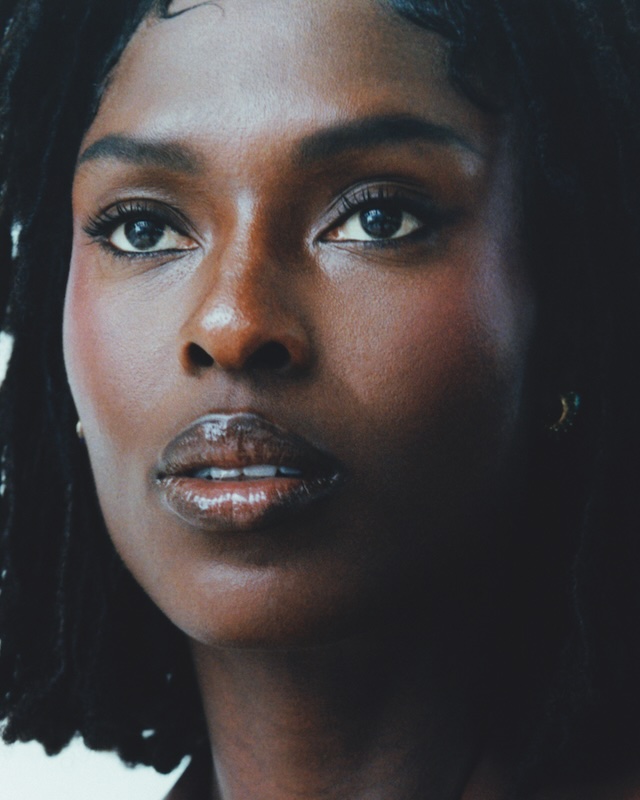
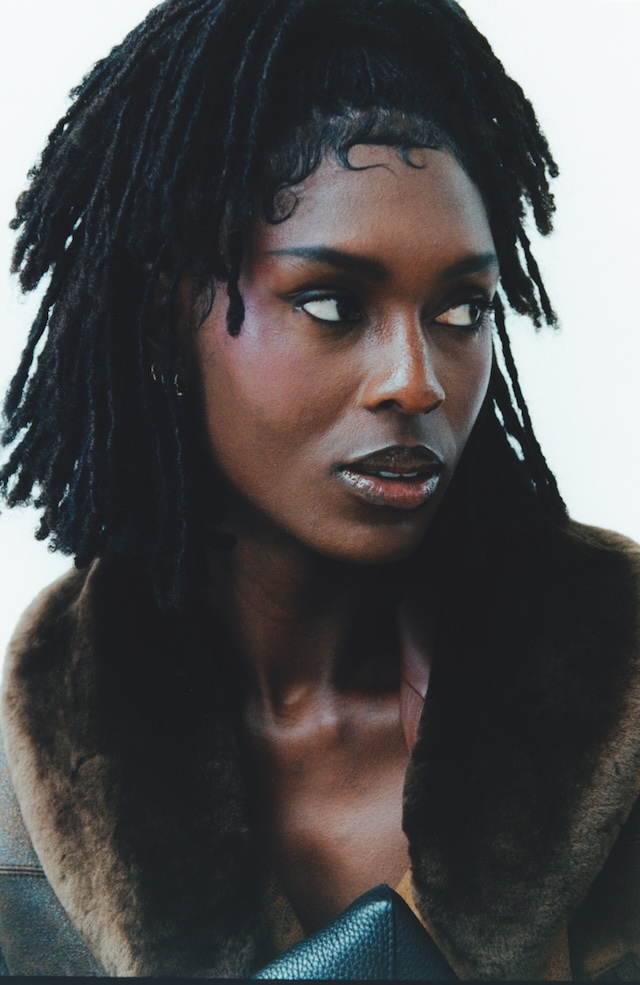
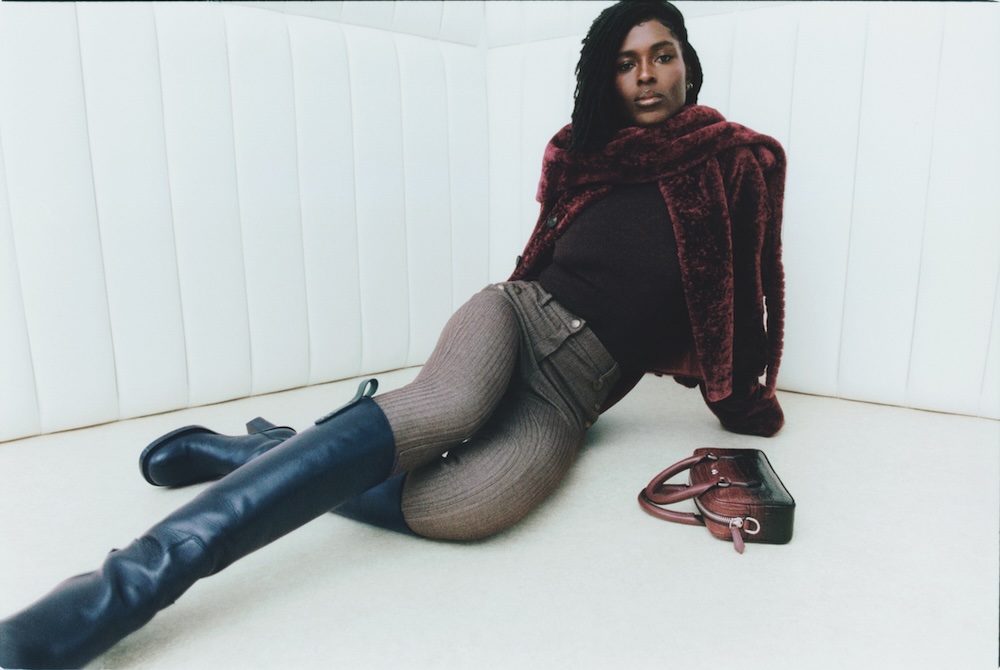
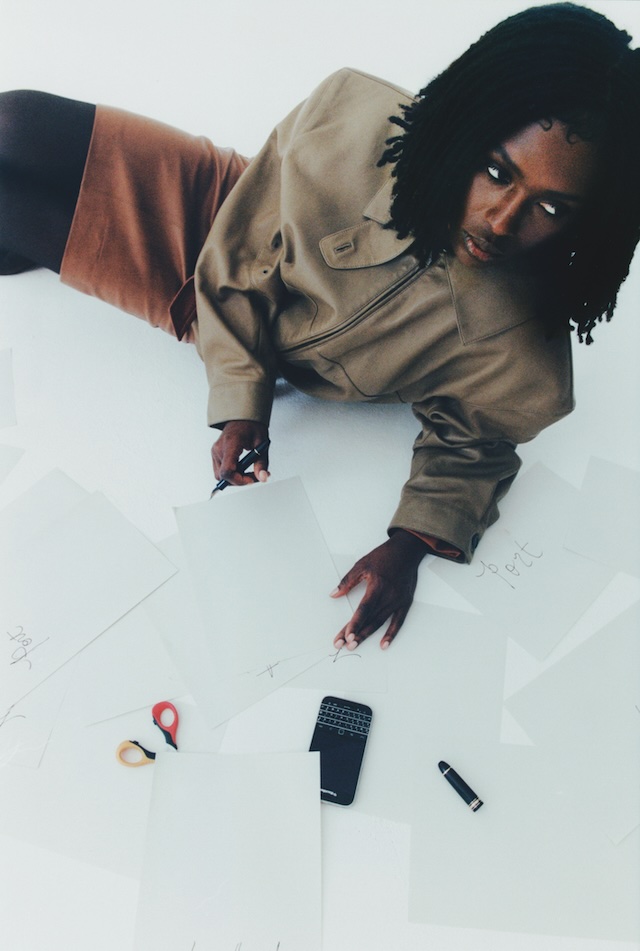
From her breakout in Queen & Slim to portraying Anne Boleyn, Jodie Turner-Smith has never shied away from roles that test boundaries and spark conversation. In the years since, she’s moved with ease between imagined galaxies in Star Wars: The Acolyte, Kogonada’s meditative sci-fi After Yang, and Bahamian folklore in Apple TV’s Bad Monkey. She joins Disney’s Tron: Ares as Athena, an antagonistic AI program, in the latest chapter of the cult sci-fi franchise. Next, she’ll return to the screen in series 2 of the high-stakes spy thriller The Agency, playing an anthropologist drawn into webs of deception opposite Michael Fassbender. Across worlds both real and imagined, Turner-Smith continues to expand her universe – exploring womanhood, power and resilience with a voice that feels wholly her own
When Jodie Turner-Smith answers the question of what she misses from the US when she’s in the UK, it’s at lightning speed. “I definitely miss Erewhon ”, she declares. Immediately after that, she laughs and apologises for sounding “so LA”. Right now, she’s here in London for the next month or so shooting series 2 of The Agency, an action-packed labyrinthian spy thriller about the perils of untangling the webs we weave. A remake of renowned French series The Bureau, the show is produced by George Clooney and Grant Heslov and stars Michael Fassbender. In it Turner-Smith plays Samia Zahir, a Sudanese professor of anthropology, with Turner-Smith learning and speaking Arabic for the role. The show is shot partially in the UK, where Turner-Smith spent the first 10 years of her life, and while her tastebuds might have surrendered to the ‘health nut’ culture of the West Coast, to the ear she still sounds distinctly British.
After a brief corporate stint and years split between modelling and acting, the actress rose to fame in 2019 with her breakout performance in runaway tragedy Queen & Slim. Since then, she’s embodied roles across a whole host of imagined worlds, periods, geographies and galaxies: the leader of a witch coven from the Planet Brendok in Star Wars: The Acolyte, an adoptive mother in Kogonada’s sci-fi study After Yang, an Obeah-practicing Bahamian in Bad Monkeyor the infamously wronged Anne Boleyn. From the set of The Agency, she’ll be off to do international press for upcoming Disney blockbuster Tron: Ares, in which she plays an antagonistic AI program called Athena.
Back here in present-day London, however, she breaks down her hack for concocting her own version of Erewhon’s Green Goddess ice cream at home (the real stuff retails for $20 at the superfood mecca). “Really, I just go [to Erewhon] to look at the menu,” she laughs. Every question, big or small, she dives into with a fervour, theorising in tangents on everything from smoothies to gratitude to Agnès Varda, with her British accent impressively intact. In fast-paced moments she almost sounds transatlantic, the edges of her received pronunciation only slightly softened by an American lilt, like the leading lady in a 1940s Hollywood picture.
“I didn’t go to drama school but I studied films through watching them. And before the streaming wars truly kicked off, my first subscription was to the Criterion Channel,” she says. At the intersection of her identities as both a cinephile and a Francophile, what naturally followed was a love of the French New Wave and the classic simplicity with which its films approached life’s complexities. “They weren’t doing super fancy things, they were just looking at life in really interesting ways. I think that Agnèsis probably the first person who really made me want to be a filmmaker.” Her favourite film of Varda’s is Cléo from 5 to 7, a classic about a woman awaiting news about her health. In it we see a sliver of her life, as the title promises, between the hours of 5-7pm, as her fears and worries intensify. “The movie has messages about life, death, beauty, what it means to be a woman; the whole thing just feels like a bit of a prose poem sometimes. It’s just so magical,” says Turner-Smith. “And the themes are still so relevant for a woman today. Honestly I even felt that way when I did Anne Boleyn, that’s why I wanted to do it.”
She continues, “So much of Anne’s power and her work was tied to the capabilities of her womb. Tell me that’s not still a modern conversation.” There’s a sharp edge to her tone as she deadpans, “I dare you to tell me that’s not still relevant.”
After her marriage to fellow actor Joshua Jackson ended in a public divorce in 2023, Turner-Smith is no stranger to the experience of having your womanhood dissected on the stage. Still, she excitedly finds every opportunity to weave in stories about their daughter, Juno, and credits motherhood for bringing her closer to her own mother again as well as transforming her perspective on the world. “What’s next after is being a ‘Valley mum’ in Studio City,” she laughs at one point. “I’m really excited about pick-ups and drop-offs and circle time and popcorn Fridays.”
In the next breath, she peppers in frequent mentions of the patriarchy, the ‘Herculean task’ of motherhood and the ways in which the former often minimises the latter. “ involves so much invisible labour, which is why I believe it’s been discounted so much – people often discount things that they cannot quantify,” Turner-Smith says. “Women are owed so much reverence but… if we truly acknowledged their power then we’d have to do a lot of things differently, wouldn’t we?”
Unfortunately, her talent for finding the universal threads in the human experience isn’t something that’s always been shared by her potential audiences. The colourblind casting of Turner-Smith in the historical role of Anne Boleyn ended up opening her up to significant backlash for its ‘inaccuracy’, and it wasn’t the last time she’d encounter that kind of discourse. When starring alongside Amandla Stenberg in the Disney+ seriesThe Acolyte, which is, crucially, set in a fictional universe, both came under fire from racist pockets of the Star Warsfandom who were unhappy with its diverse cast. Turner-Smith remains vocal about failures of the studio to protect actors and condemn the extreme harassment. “The issues of race, and the limitations that people put on that are not unique to my industry, but my industry has a unique opportunity to – by setting the image of what the social mores are dictating – either move the conversation forward or just affirm the same bullshit,” Turner-Smith says bluntly.
Despite multiple run-ins with the hard edge of visibility, she remains optimistic about the state of things in Hollywood, still viewing her career as a proof of a changing tide, not an exception to the rule. “As with many things, there’s still further to go but I do think that I’ve seen progress. The fact that I’m here doing the work I’m doing is evidence of that,” she says. “It’s also just an opportunity for me to continue to keep that door open, the way that the dark-skinned women before me did, you know? When they were truly trailblazing, playing roles of helpers and nurses and mammies, they were opening the door for me to be able to do what I’m doing right now… to be playing a woman with a PhD who is fighting for the rights of her people. It’s a big deal, I don’t take that for granted.”
And if you consider her origin story, it’s no surprise that Turner-Smith feels fortune-favoured. The story of the making of her first on-screen credit flows like the plot of a farfetched coming-of-age film. In fact, it takes almost 10 minutes to recount. It starts with Turner-Smith as a college student with tickets to see one of her favourite artists, Common, in concert. When he pulled out of the tour with Kanye West, she almost didn’t make it to the show, she tells me. But ultimately she went, somehow ending up in the front row – even though her tickets were in the nosebleeds – and then naturally got invited backstage after her striking presence grabbed the attention of someone in the band. That night sparked the start of a friendship with West’s cousin, Tony Williams, and a number of concert-fuelled adventures post-graduation. At the same time, Turner-Smith was on track to become a corporate banker after landing a graduate job from an internship. But as her eyes opened up to the possibilities of the creative industries, that future began to look shaky. “I just thought, I do not want to go and be a corporate banker, I don’t think that’s what I’m meant to do with my life,” she laughs. She went and gave it a go anyway. But when she met Pharrell Williams backstage at a NERD show in Miami in 2009, he confirmed her bubbling suspicions. “He was like, ‘you need to be in front of the camera,’” Turner-Smith recalls. “Then he calls Hype Williams on my phone that night and tells him, ‘you’ve gotta meet this girl, she’s so beautiful. You need to put her in one of your videos.’”
Nothing came of it immediately, but on her next trip to LA the friend she was visiting encouraged her to reach out again. The award-winning director, Hype Williams, responded and told her to swing by his office straight off the plane. When she got there she found herself on the set of a huge production. He took one look at her and brought her back into the studio: “There’s this white convertible and two guys are standing behind it: Kanye West and The-Dream.” Without explanation, Williams gives her an outfit to try on, another crew member ushers her through to hair and makeup, and before she knows it, she’s starring in their music video. “And that was my first time being on camera,” she says. Trawl backwards through the YouTube archives to The-Dream’s ‘Walkin’ On The Moon’ single and there she is: channelling an aptly dazed and confused supernatural being, wrapped in a white Hervé Léger swimsuit and draped on the arm of who was soon to become one of our generation’s most influential artists.
From that first appearance as an extraterrestrial beauty to her subsequent career in film and TV, there’s a consistent thread of otherworldly charm to many of the roles Turner-Smith inhabits. At a first glance you might attribute that to her statuesque appearance alone, but speaking with her and hearing how her life has unfolded, you get the sense that the true source of that ethereality actually comes from within. “I think we see things, not as they are, but as we are,” Turner-Smith offers. “If you’re looking for magic, you’re gonna find it everywhere. I believe the same with love and I believe the same with God.” She seems to hold whatever’s in her hands at any given moment as sacred, and so far it’s served her well. As our conversation sprawls, she gushes with the same refreshing enthusiasm about her motherland of Jamaica, the divine feminine, the beauty and commonalities of the Black experience worldwide – “you know when you see a tree bursting through concrete, people have paved over it but nature finds a way,” she marvels – and all the lessons she gets to learn through the worlds of the characters she plays. “I do believe that magic is present in my own life,” Turner-Smith smiles, “and I like to affirm it, because I don’t want it to stop.”
Actor, director and writer Ethan Hawke – known for films such as Boyhood, Before Sunrise and Training Day – talks to longtime friend and collaborator Hamilton Leithauser, frontman of The Walkmen and acclaimed solo artist whose scoring credits include Hawke’s documentary The Last Movie Stars. The pair discuss Hawke’s new show, The Lowdown, his role in Blue Moon, the politics of truth-telling and the power of art to cut through the noise
Hamilton Leithauser: It’s been a minute since we last saw each other. I think I saw your wife the other night, but you’ve been away filming your new show. Tell me about it – I saw the preview on the plane and laughed out loud.
Ethan Hawke: I appreciated that text. You may not know this, but you’re a huge inspiration to the show. Usually, I get to read a script before I say yes, but with this, it was just, ‘Do you want to do a show with Sterlin Harjo?’ and I said yes before even seeing a script. I told Sterlin, “I want this show to feel like a Hamilton Leithauser performance – when it’s over, you feel like someone gave you a piece of their heart.” I wanted to be sweaty and bloody at the end of this show.
HL: My wife was at your premiere and said the show is fantastic.
EH: Your wife is clearly very intelligent.
HL: She has very good taste – in men and television.
EH: I’m not sold on the man part.
HL: I just saw the preview – I think I saw it on your Instagram. I want to hear all about that.
EH: Well, I’m playing one of the greatest songwriters of the 20th century . I know a lot of his songs: ‘My Funny Valentine’, ‘Blue Moon’, ‘Bewitched, Bothered and Bewildered’ – so many classics. What’s so interesting about the movie is you’re basically watching a human being die of heartbreak in real time. He was part of Rodgers and Hart for 25 years – they were the Lennon and McCartney of their generation. Then Hart, the character I play, his drinking got so incorrigible that Rodgers decided to move on and did a new show with a young fellow named Oscar Hammerstein. They went on to have a 17-year collaboration. So it’s kind of like Lennon and McCartney break up, and then McCartney starts a new band that’s bigger than the Beatles ever were. That’s what happened to Larry Hart. He loved Richard Rodgers – they were best friends for 25 years. He goes to this opening night party to try to convince his old friend that he’s ready to work again, that he’s sobering up and ready to put in the real effort. But it’s too late. The ship already sailed, and his friend has already moved on. He has to sit there at the opening night party for Oklahoma! and try to be a good sport.
HL: And how long did he live, does the movie go into that?
EH: It’s a classic Linklater movie. It’s 90 minutes of real time. You watch him walk into the party, meet everybody, and 90 minutes later, you realise he’s going to drink himself to death and he’ll be dead in five months.
HL: Your hair looks fantastic in the preview by the way, I gotta say.
EH: Dude, that combover killed my soul. My vanity took such a hit. I had to grow the edges of my hair long, and then I had to shave the middle of my hair so I could do this combover. But if you didn’t do the combover, you looked like Bozo the Clown. Luckily, it was the hardest I ever worked in my life with that part, so I didn’t even go out.
HL: So you did that after you did the Oklahoma trip?
EH: No, I didBlue Moon first, and then I went to Tulsa. What about you? Are you on the road with Pulp?
HL: I’m on the road with Pulp, yeah.
EH: I love Pulp. There was a time in my life where I wanted to be Jarvis , he just seemed like the coolest guy in the world.
HL: He is cool. He still is.
EH: How’s their music?
HL: It’s great. They put on a really big show every night. And I think people enjoy my show also. Right now I’m in Milwaukee, doing a headline show with my band tonight. Pulp’s taking two days off, so I was like, fuck it, I’ll just do a show here, and then we’re going to play in Minneapolis with them.
EH: I love Milwaukee.
HL: Milwaukee is awesome. There’s always something cool to find here. You can still find a huge, really cool bookstore that actually has reasonable prices, which you don’t see anymore these days. I just bought a huge stack of books and art which was totally affordable. And it’s right downtown. There’s nobody on the sidewalk, which is probably not a great sign for the city’s economics, but it’s a pleasure to walk around on a beautiful sunny day.
EH: I love it. I was there last summer. We screened Wildcat in this old movie theatre, the kind of place that looks like Gone With the Wind premiered out. They have an organ and a balcony, and it’s awesome. 1,000 seats, and the place was sold out, and it rocked and rolled. I just got such a good feeling from that whole city.
HL: We’ve had some good times here over the years.
EH: What’s it feel like as you ride around the country right now?
HL: With the media stuff?
EH: In the Lowdown show, I’m playing a journalist – a guy who’s hellbent on showing the benefits of telling the truth. It doesn’t matter if it’s within a family: if there’s a problem and you’re not honest about it, you’ll never heal. The same goes for society – if you’re not facing the truth, you won’t grow or heal; you’ll just stay stuck with the same issues.
Sterlin used to work for a free press in Tulsa and saw the benefits of honest reporting firsthand. In the 1990s, they were covering stories about the Tulsa race massacre, and witnessed the healing that happened in the community when people shared a reality based on truth, instead of covering things up. My character in the show is inspired by a friend and mentor Sterlin had when he was young, a journalist named Lee Roy Chapman. So, my character is based on him. A kind of Don Quixote, going after big money.
HL: Are you still a journalist in the show?
EH: In the show, I run a used bookstore but still write for local magazines, trying to expose how the affluent take advantage of the underclass. I keep getting knocked down for it. I was even on Good Morning America this morning, saying to George Stephanopoulos that if you tell the truth, sometimes you get punched in the nose.
My grandfather’s generation understood democracy and the value of a middle class. Now, with the internet, it’s like the Tower of Babel – so much confusion, and people are afraid to speak honestly. Even in this interview, I’m aware of how I’m speaking, and that fear isn’t good. It’s easy to get distracted by things that don’t matter while ignoring what really does.
HL: And journalists now face real threats – some need 24/7 security because of the backlash, just for asking tough questions.
EH: Exactly. Sometimes it feels like, ‘what country am I living in?’ Until people feel the loss of their freedoms, nothing will change. The powers that be profit from compliance, and no one feels motivated to take a stand.
HL: I want to hear some funny stories from your show – were you having a ball the whole time?
EH: The sad truth is, I never had so much fun in my life. There’s a punk rock spirit happening in Tulsa. That part of the country has been dealing with all the problems that we’re citing right now for a long time. The state has all of the major issues, from the Native populations, the issue of race, the oil money land barons. They’ve got a history of corruption. The community is very awake to all these issues. They’re very present. The art has a present tense-ness to it, and the music history is great, from the Gap Band and Leon Russell to Bob Wills, Cain’s Ballroom, the Woody Guthrie Center and the Bob Dylan Center. You’ve got Larry Clark . It’s a place that has a high regard for creativity. Apartments are cheap, so our students can find a place to live, create and be wild. You feel that in the film community. We did have fun – we had Killer Mike in the show.
HL: Oh yeah, Killer Mike. You got so many people in that show.
EH: [My character] writes for two newspapers. One is a longform magazine and it aspires to be like The Paris Review of Oklahoma. The other one I write for is theTulsa Beat, which is booty and bad guys, and Killer Mike’s newspaper. I have these two different duelling editors, where if one won’t publish, maybe the other one will. It’s been so fun to watch somebody as smart as Mike is, who has achieved so much success at one artistic medium, but he’s still got a beginner’s mind about acting. He’s so excited by it and so turned on.
HL: Is it like tongue-in-cheek, or is he fully in character?
EH: He’s fully in character. I’m not into the tongue-in-cheek thing. We’re trying to create a real world that you can smell. Sterlin likes the same thing. You’re going to love it. And there’s so much JJ Cale and Leon Russell – it’s awesome. The music of the street is very much a part of the show. Then we have Tim Blake Nelson and Jeanne Tripplehorn, who are like Oklahoma royalty. That was pretty fun.
HL: That’s awesome, I can’t wait to see this thing. When does it come out?
EH: September 23. My job right now is to tell people the first thing you’re gonna do is you’re gonna get your beautiful wife and watch this. You’re gonna sit down with her and stream the first two episodes, and then you’re gonna text your friend Ethan and say –
HL: Yeah, dude, nothing but praise.
EH: Are you hitting the studio anytime soon?
HL: I got a movie coming out that I scored that I’m really proud of. I don’t know how they’re debuting. I don’t know how stuff works. You know more than me.
EH: Well, I have this theory that I’m going to put here in print. I hope that you are going to have this whole other act of your career like Randy Newman, who I think is a genius rock and roller, and happens to be one of the best people to score a movie in the history of the world. With your sense of melody and musicianship, you’re ready to take that torch.
HL: I’m ready. My hand is open and I’m running.
EH: For those that don’t know, we have been friends for a long time through mutual friends, but we really got to know each other because Ham scoredThe Last Movie Stars, which was a six-hour documentary about Paul Newman and Joanne Woodward. Ham made the whole thing sparkle and shine. His music is all over it.
One of the best nights of my life is the night we became friends. It was a New Year’s Eve party where we did an old fashioned guitar pull all night long, and we stayed up way too late. But that’s where I had the idea. Do you remember when Ben Dickey started playing a Blaze Foley song, and I had the idea that he should play Blaze Foley in a movie?
HL: Oh, that’s where you came up with that. I had been friends with this guy since long before I even knew you. He was not an actor, and then I went and saw Blaze, and he’s up there crying, delivering this crying speech. I couldn’t believe it.
EH: He’s amazing in the movie. But that gets to my theory about you and a lot of other people – Killer Mike for example – that if you have access to creativity, it can manifest in a lot of different fields, especially if you do it with humility and discipline, which Ben did. He took the idea of acting in that part incredibly seriously. He worried about it morning, noon and night. In Philly, he would be playing with his band, the Blood Feathers, and they were so much fun. I could watch him hold an audience in his hand, and the charisma I knew would translate into his work as an actor.
HL: You balance big projects with smaller, more personal ones. Do you find yourself turning to those to stay grounded?
EH: There’s a direct inverse correlation between how much you get paid and how substantive the job is. The more meaningful the work, the less you get paid. But those projects keep me growing and connected to the art. The trick is to focus on what you can give to the profession, not what it can give to you. I had a really great 20s, met a lot of amazing people, and was really idealistic about the power of storytelling and the arts. The arts really represent the collective mental health of a culture. When it’s vibrant, ideas are flowing, and light is shining in all the dark places – you have a healthy culture. When it’s dark, and all anybody’s trying to do is sell cheeseburgers, the whole thing atrophies. My goal was never to be a big shot.
HL: Sometimes you get lucky and a passion project breaks through.
EH: Exactly. Every now and then, you thread the needle – like Boyhood, which we worked on for 12 years. Sometimes the crazy, avant-garde projects find their place, and it’s important to keep doing them for the sake of our collective mental health. Every now and then you get absurdly lucky, and it works, and it finds a place in the marketplace, and people really appreciate it. But I think it’s so important that we do those things because sometimes they break through.
After working together on the new adaptation of Max Porter’s novel Grief Is the Thing with Feathers, Benedict Cumberbatch, known for acclaimed turns in Sherlock, The Power of the Dog and the Doctor Strange films, sits down with the writer to talk about grief, fatherhood, the circus of publicity, Olivia Colman and a quickfire round of ‘would you rather’. What follows is an intimate, searching and at times funny exchange between friends and collaborators, probing how to live, feel and create in chaotic times
Benedict Cumberbatch: Oh, look. We got the same haircut and everything.
Max Porter: Yeah, I did that deliberately. Talk to me. How are you? How’s it going?
BC: Tube strikes in London are not much fun, and everything’s all right. It’s just that thing of transitioning back into a full schedule after a summer of ‘this life’s nice,’ and not getting my head into acting. I take full responsibility for it. But other than that, I’m good. Am I going to see you next week at Together for Palestine [a fundraising event for aid in Palestine?
MP: No, we’ve got a screening that night.
BC: Oh yes, [I’ll be at Together for Palestine] which is why I can’t come.
MP: Glad it’s happening, glad it’s big, glad you got all the names. Are you filming?
BC: No, I’m doing bits and pieces for and that’s kind of it work-wise. It’s just this and developing stuff, writing, going through the slate, getting stuff together with Sophie, and making sure the tennis racquets are in the right place, piano lessons are made on time, the bike’s serviced. It’s the endless domestic list, which leaves little bandwidth for work. How did the go in Toronto?
MP: I already had love for you, but now I have a great deal of sympathy, having seen how those things work – the drum kit, the red carpet. I don’t know how you do it.
BC: Everyone keeps saying that necessary. I don’t think it is. There’s another model out there no one’s bothering to deal with, because there are a lot of careers that benefit from this relationship between the press and hysteria around films. One thing it does is celebrate the collective, within the room, within the festival atmosphere. That community around what we do for a living is great.But half the people who want your signature aren’t going to watch your film. They’ll sell it for £300-£900. They’re not fans; they’re making money. I don’t begrudge them that, it’s a bleak world, but it exists alongside this endless need to answer the same questions.
We had a golden moment during COVID to rethink things. For about five minutes we did. Then we went back to the old normal. You have to get through it, treat it like fun and find something amusing about it. But then you shed so much afterwards.We’ve got a beautiful, neurotic whippet dog. When she goes on a walk, she starts out okay, then starts seeing dogs and everything becomes terrifying. When she comes back, she rubs her body to get rid of the adrenaline and the cortisol of the fight-or-flight reflex that kicked off. The best way is to immerse yourself in nature, or spend five minutes being at the mercy of a six-year-old. Or with the dog. But really, nature is what you need – and isolation.
MP: I want to sprinkle in quick-fire questions in and amongst the general chat. What’s your favourite tree?
BC: My favourite tree is the oak. The majesty and the prehistoric might of sequoias is humbling. Both trees, in our land and in lands abroad, for me, are sentinels in the way that whales are. They are slow-growing reminders of life being more important than a political cycle or the profit margin in a quarter. And they humble us. They give us life, both above and below the ground. Those two trees, in their longevity, I find are extraordinary totems of time and our insignificance, but also what we actually need to focus on in our lives, which is our brief moment here, in this incarnation, and leaving it in a better state than when we found it. Not much of that going on at the moment.
MP: Segueing to our film, The Thing with Features, one of the things that struck me when we met was that you don’t take the easy route. You don’t take this work lightly and your engagement with it is both professional and serious and, in this instance, and most instances for you, profoundly rigorous in terms of the craft. But this was also an intellectual and emotional engagement for you. You didn’t just get the script, you knew the book, and understood the toll it would probably take on you as a human being. But you also dive quite deeply into the questions of paternal care, literary influence, art, art-making as a parent, and the profound intersection of you as a dad, and you as an actor, playing dad with young actors on set. Can you talk about how you jumped in and whether you regret that now? Did it take its toll?
BC: I don’t think I was aware of the cost until I did it. I knew it’d be costly, but you don’t know until you’re doing it. That’s part of the joy – the perversity, even. It’s a gift – the unknown in our industry and in art in general. It’s about discovery, and that comes at an uncalculated cost.
The book is so cinematic, the psychological depth of it is naked and profound and alluring to an actor. You feel a lot when you’re reading it, not just because of the universal theme of grief, but this very specific lens. Some association too, not having been through that, but other forms of grief in my life. Also the milieu, the north London middle-class feel of it. It’s a world and a time, a retrospective unreliable narration from the kids’ point of view. Spoiler alert, but as that evolves it’s very specific. All of that resonated with me – our generation, the richness of the imagery, the imagination of it immediately flickered with the light of cinema.
MP: You know I have this obsession with juxtapositions. Grief Is the Thing with Feathers is entirely that. It’s what the reader brings to the gap between things, the hinge of a metaphor. So I wanted to ask you, how was it to go from being spun by eight-foot-tall Crow in semi-screaming, semi-jayhawking, semi-wailing, semi-orgasming craziness to working with one of your close friends on a whip-smart comedy. How’s the juxtaposition of energy for you in that?
BC: That’s the Benedict buffet. You need it. I remember James McAvoy saying, ‘God, you’re having a lot of fun.’ I said, ‘Yeah. Try playing George Tesman for four months and watching your wife blow her brains out every night.’ I went big on the comedy for that.
MP: Is there a form of self-care in curating your career?
BC:Work should never be therapy, otherwise you leave your personal development in the hands of characters that are over once the film’s gone. That’s not a very safe place to be.
MP: Can I be nosy, was working together enriching for your friendship with Olivia?
BC: Massively so. It’s a working relationship too, so you get far more insight. You spend a lot of time with someone you’ve only seen fleetingly before. Half my life is family, then work, so friendships suffer unless you’re lucky to be friends with kids’ parents. My New Year’s resolutions are simple: simplicity and friendship.
Olivia is remarkable. It seems very easy for her. Not just because she grew up with Peep Showand comedy classics and knows that world, but she’s innately and supremely talented. She can do anything. It’s a very safe dancing partner, especially when it’s a friend. You risk more, it’s a bit faster and you can be very honest. She’s a great sounding board – never dismissive, properly on it.
MP: There is this sort of appetite that this world creates in emotionally intelligent people to latch on to. Like when we met, you could have just shook my hand and said, ‘That was nice, thank you very much, and see you next time.’ But you were curious about me, you asked me questions about my life. We got quite deep quite quickly.
BC: You’re not just part of an opening in my calendar. It’s a rarity to meet people that you feel very strong kinship with immediately. I over-romanticise our friendship, but it’s true. I look at some of my best friendships and how instantaneous they were. In a way, Adam ’s one of them. We did one job together, now we have a production company .
MP: Have I told you my story about my middle son when I got back from the West Bank? He’s 13, and he’s completely in charge of his own life. He’s someone that gets his own clothes out, makes his own breakfast. Develops his own tastes. It’s amazing; he’s running the show. But I can’t milk him for emotional content. Anyway, I was malfunctioning, heartbroken, traumatised by what I’d seen on a trip to Palestine – apartheid, machine guns.
BC: I can only imagine. It’s only now coming through in detail, away from social media, what’s been going on.
MP: One night I was robotically stirring risotto and I didn’t hear him come in. I had been crying a lot, but I wasn’t crying at that moment. My son wrapped his arms around me, held me for about three minutes, then left the room. It was exactly what Feathers is about. A non-verbal, instinctual benevolence. He recognised I needed it. My ability to grieve for that faraway child I’ve never met is connected to my ability to love this one. There is no empathy gap to be crossed. It’s all in me. It’s the pain that is thrust upon me. As he says in the book, ‘let no man cease to fix it.’ It is how I love. May we hurtle back into our family units, covered in the scars and thickets and bristles of the work, and let them see it. Let them soak it up. Let them know that we’re weird.
BC: It’s been amongst many fears of raising children, the fact we both have three boys. This is a story of male grief – what men feel or don’t allow themselves to feel, and the damage done. We are living through a culture of that. One of the most important things to teach boys is that it’s fine to feel. You are strong in vulnerability.
MP: We’re running out of time, so here’s a couple of quickfire questions. Favourite bird?
BC: White-tailed sea eagle.
MP: Wrong. Crow. Favourite spread?
BC: Honey.
MP: Nope, Marmite. Favourite car game?
BC: Yellow Car.
MP: I love Yellow Car. Our new game is making sentences out of number plates. It doesn’t work. Would you rather suffer the loneliness of being misunderstood or the unease of having caused offence?
BC: Fucking hell. Constantly ill at ease at causing offence. Both, really.
MP: Swimming or fishing?
BC: Swimming, definitely.
MP: Would you rather squeeze a pimple or pluck a hair?
BC: Squeeze a nipple?
MC: Pimple.
BC: Squeeze a spot. It’s painful isn’t it, but satisfying.
MP: This is a really disgusting story to remember but when you’re really tired in the car and everyone else is asleep and you’ve got three more hours to go, I pluck nose hairs to keep myself awake.
BC: Then I start sneezing and wake people up. Same with ear hairs. I’m getting rogue ones because I’m getting old.
MP: But you’ve got people to look after you.
BC: I get regularly plucked, I’m like a prepped chicken underneath this T-shirt.
MP: Listen, I love you, and I’m looking forward to seeing you.
BC: Are you coming to Zurich?
MP: What’s in Zurich? No, I’m not.
BC: All these film festivals…
MP: No, but I’m seeing you in London, and we’re doing a day of press together where we can do ‘shacket’ club again.
BC: Oh yeah, that’d be good. What shackets are you gonna turn up in this time?
MP: I have two looks at the moment. My T shirt game is entirely either ‘Free Palestine’ or I’ve got this incredible new T shirt that says, ‘Listen to Sade’. And I am therefore having abnormally rich conversations everywhere I go about why Sade is the best. People are sharing their favourite albums – security guards in Toronto were like, ‘My brother – come here. Which record?’
BC: Amazing. I mean, she’s great. All I’ve got in my head is when she sings, ‘This is no ordinary love…’
MP: Well, she’s a goddess. I have a theory that the world suffers in the gaps between Sade records, and then when there’s a new Sade record we have a moment of hope and optimism. I think Sade’s in the studio working away right now, so hopefully we will have a new era.
Grudova is the author of Children of Paradise and The Doll’s Alphabet, known for her surreal and unsettling fiction. In this original story for Port, we follow Milda, a woman released from prison to marry a stranger as part of a state effort to boost the birth rate. But her new husband has his own agenda – he wants her to join his underground political cell, offering to help find the child she lost when she was imprisoned for murder. Together, they must navigate a society where family is both a performance and a form of control
Milda was put in prison for killing her sweetheart, a foreign diplomat, after seeing him take another woman to the ballet. She met him working at a restaurant popular with diplomats and bureaucrats which served tiny fish sandwiches, thin chicken broths and champagne. It also sold French and Cuban cigarettes, electronic plug converters and thin mittens from behind a counter.
Milda had a baby while in prison, which was taken away and put in a nursery she did not know the name of. The state, realising the population was dramatically falling, put Milda in a scheme where men of the public could write romantic letters to her and other healthy young women, and if they proposed marriage, the women would be released early in order to have children.
Benji had various part-time jobs. He worked in a grocery store specialising in dented and damaged goods, and in a local museum which had a small-scale model of a volcano and a vast collection of human brains kept in glass, once belonging to famous intellectuals, revolutionaries and scientists from the local area. He wrote to Milda that someone broke into the museum when it was closed, and – along with the small selection of dry biscuits in the shop advertised as food eaten by astronauts in space – stole all the brains. There were bits of brain among slobber and broken glass on the floor. Whoever stole them had taken bites on the spot.
Where were the brains now? He asked Milda. Perhaps in stews, casseroles, puddings she replied. The prison food was plain buckwheat porridge, soy sausages, pale juice.
Milda wrote him descriptions of her daily prison life: how they made men’s shoes for a foreign market – hideous long ones in red and purple snakeskin – and some older women there were so lonely they hid love letters in the toes of the shoes. Though Milda thought only cads would wear snakeskin shoes and wouldn’t care for love letters at all.
She didn’t tell him about her son, which she had named Teo before he was taken away, or how she stole an enamelled vase from the restaurant where she had worked. The diplomat was furious at seeing it in her bedroom and said she ought to be sacked, and that he would write to the restaurant. It resembled a tattooed chicken: squat with little wings and legs, embossed illustrations of trees and people on it. She didn’t know why she stole it, perhaps to feel a little power or impress the diplomat – which it didn’t at all.
She had also stolen tepid champagne, putting the dregs of glasses into a big old plastic water bottle, and drank it at home to relax before the diplomat came over to make love to her. He made fun of her for wanting to attend Swan Lake, performed by a small touring provincial ballet company which didn’t have a live orchestra but a gramophone only. A gramophone looks like a golden swan said Milda, but he was not convinced. He took another woman, who was also a foreign diplomat from a different country than himself, to see a ballet based off a Tennessee Williams play. It had all the dialogue removed, Milda read in the paper reviews. It was just music and dance. Milda made herself angrier and angrier watching a bootlegged copy of A Streetcar Named Desire with Marlon Brando on silent with no subtitles, until she killed the diplomat. She went into the diplomat’s apartment uninvited because the doorman knew her already, and the diplomat hadn’t told the doorman he had a new woman now. She used a mallet she had bought to fix her bed because it was old and the metal was bent out of shape. It was only in prison Milda discovered the pregnancy and she supposed the rages of bodily change must have caused her to become a murderess because she had never thought of becoming one before.
Benji proposed to her, sending a cheap ring with a ladybird on it in the post, which secured her release.
Benji picked her up from the prison and gave her a large jumper to wear because it was cold. He was unpleasantly thin, and wore a belted grey coat and a ushanka, which he put on her head. His hair was blonde, cropped and full of dandruff. His ears were enormous, with blackheads along the lobe, and in one a tiny gold safety pin.
Milda was given a bag of her things when exiting the prison: the vase, a large stuffed toy shaped like a cricket she had spent a lot of money on – and had meant to give to the diplomat because he had once mentioned finding insects fascinating, but thought now, she could give it to her son – a translated P. G. Wodehouse book and a few flimsy floral dresses missing buttons or with holes in them. The restaurant had taken back her uniform, someone else was wearing it now.
When they were out of sight of the prison, Benji said, I apologise those love letters didn’t mean anything, it just had to look convincing to get you out. I admire what you did enormously, killing that diplomat involved in our government’s corruption and the foreign arms trade.
I killed him for romantic reasons, not political reasons, Milda replied.
I admire it all the same, he said, and I think you will be useful to my underground political movement, Alpha.
I have a son in a state nursery and that’s all I care about, said Milda.
Benji lived in a rundown apartment building called Cecil Court. He made her dumplings from a big frozen bag when they arrived. They ate them with spicy red pepper sauce and sliced-up radishes while he told her about Alpha.
Milda agreed to help with the activities of Alpha if Benji helped her find her child.
The other two members of Alpha lived in a hole off a metro tunnel because they were wanted by the state and Benji didn’t have time enough to bring them supplies.
Milda brought them roasted barley tea in large metal containers, tinned fish in sunflower oil, tinned apricots in syrup and chopped raw beef sandwiches on rye bread, along with all the newspapers she could, which she found abandoned on metro seats. They gave Milda articles they wrote in the dark, to be published in underground anarchist magazines. Both of the Alpha members in the metro wore spectacles, though they had no light in their tunnel besides a child’s flashlight.
Milda had to jump onto the tracks between trains and run into the tunnel where the hole was. She could never get back up on the platform herself and was aided by passengers who thought she was suicidal. She went at a different hour every day so she wouldn’t be seen by the same commuters again and again, which annoyed the two bored and hungry Alpha members who said routine, rather than spontaneity, suited them better in their distressed condition.
Milda and Benji were married with the ladybug ring and drank a bottle of Georgian wine to celebrate. They slept together when they were drunk, and Milda examined his thin, blue body in comparison with the diplomat’s who had been like a comfortable and hairy slug, well fed on ham and milk in his home country. This gave her a sensation she thought might be somewhat political.
Milda and Benji attended cultural events to spy on bureaucrats and politicians. Benji bought her theatre-going clothes from a by-the-pound second-hand shop – a pair of black loafers with gold braid on them, a fur coat, a white lace dress, stockings that went up to her knees but always fell down. When they did, Benji crouched down and quickly pulled them up, gently patting her ankle.
They went to see a theatrical adaptation of Anna Karenina. Benji brought them tiny opera binoculars to spy on the audience. Milda kept thinking she saw her diplomat, but he was dead. There were many diplomats like him drinking glasses of red wine, and kissing younger women in booths in a disgusting, lustful and shameless manner.
The actors wore thick plastic glasses out of place with cheap-looking 19th-century costumes made mainly of satin. Still, she was captivated and refused to look at the diplomats any longer as it made her too irate.
Milda asked Benji to take her out to dinner after, but he said he couldn’t because of his political reputation and going to the theatre was strictly work, a cover for spying. He hadn’t caught a line of Anna Karenina.
Through his political connections, Benji found the name of the nursery where children of bureaucrats and diplomats were kept. It was called Ducklings Nursery. Milda went and stood across the street and watched when the children were taken outside. Her son wore the sailor outfit of the nursery, and a long old fashioned-looking coat with a flared bottom that was too big for him and dragged in the dirt. He had longish black curls from his father, that’s how she could tell it was her son, though she found she could peel off these repulsive resemblances to the diplomat and throw them away, laying bare a hard sweet love. When she rang the bell of the nursery it played a strange tune for a very long time, but no one answered.
She wrote the nursery a letter to try and reclaim her son and they told her she would have to apply via the state family board. Milda wondered if she had any more children if they would take them away at the hospital and ask her to reclaim them too. She bought all sorts of birth control on the black market, jellies, diaphragms and pills, but her and Benji did not sleep together again, though they shyly fondled each other at night.
She sent presents to the nursery, and comforted herself with the mental image of the little children enjoying them: the stuffed cricket, Chinese white rabbit candies, paper doll kits, plastic bags of chunky costume jewellery.
She and Benji had to fill out many forms multiple times and take them to the state family board, detailing Benji’s employment. They recommended Milda find a job too. They also had to move to relocate the two Alpha members in the train tunnel with them. Benji found an old warehouse on the edge of the city, with big windows which let in plenty of bright light the other Alpha members were not used to. They had to wear sunglasses all day. They told Milda they couldn’t tell her their names, even though they trusted her. One’s face was covered in prominent, pale brown moles, like nipples, and the other had a pimple on his nostril which he prodded and examined but didn’t squeeze. They smelled from living in a hole and Milda bought them carbolic soap, but they wouldn’t bathe as they said they were too busy.
Milda wasn’t allowed to work anywhere with too many foreigners or the public because of her jail time but got a job feeding monkeys in a lab. The monkeys had microchips in their heads or were going to be put into orbit, and Milda cried to and from the lab every day thinking of their frightened red faces and how here she could hear their screams, but there was no one in orbit who would. She gave them candy and radishes to cheer them up but it only gave them diarrhoea. Once she had a few payslips she took them to the state family board and they added them to the file. They told her they would have to do a home visit. The spectacled Alphas agreed to leave the warehouse for the day. They packed a frugal picnic to take with them. Milda and Benji cleaned, and tore pictures from a children’s book and taped them all over the walls – tigers and bears in scout hats – and bought a cheap space heater so they wouldn’t think it too miserable or cold for a child. As Milda was showing the social workers from the state family board around the warehouse, she noticed her vase was gone, she had thought it might impress the social workers, an old, possibly expensive thing it was. They drank barley tea with relief after the social workers left. It had gone well. Benji made dinner just for them – radishes, soy meat and a spicy broth. He said the other alpha members would not return, and that they would be leaving the country that night, in fact, after carrying out something they had been planning for a while. It would be easier, just her Benji and the child, said Milda, but did they take my vase?
Yes, he said, it was the perfect container for a bomb, I’m sorry I didn’t ask beforehand. Milda replied, it was ugly anyway.
It was the only thing she had left that had been in the same room as her and the diplomat at the same time. It had that mystical power and now it was shattered somewhere among ruins, but she supposed that was a good thing for her to move on.
She didn’t hear from the state family about the results of the visit, and tried calling the nursery over and over again but the phone had the same annoying piece of music as the nursery doorbell. She told Benji she couldn’t get through to them, and he said, No, I shouldn’t expect you would.
In the first film of Port and Sage’s series, The Art of Duality, fashion designer Rejina Pyo and chef Jordan Bourke reveal how their home becomes both studio and kitchen. Across sketching, painting and recipe development, we uncover how they move between moments of intensity and reflection – with coffee as an anchor in their day-to-day. At the centre of these rituals is the Oracle™ Dual Boiler espresso machine by Sage, offering the ease of automation when the pace quickens, and the satisfaction of hands-on craftsmanship when there’s time to linger
Rejina Pyo launched her eponymous label in 2014, shortly after earning an MA at Central Saint Martins. Known for her sculptural yet playful silhouettes, she’s built a reputation for designs that balance bold form with comfort and ease. Her Soho store embodies that same sensibility – with clean lines, natural materials and warm lighting, it acts as both retail space and creative hub, a place where she connects with her team and the people who wear her clothes. Her husband, Jordan Bourke, is a chef, food stylist, author and broadcaster. He’s a recognised authority on Korean cuisine, co-author of Our Korean Kitchen, and has trained both in Ireland and in Korea.
Their home doubles as both a studio and a kitchen – a creative crucible where garment samples, recipe tests, painting tools and ingredients live side by side. It’s also a place to slow down, to cook, sketch and gather their thoughts between projects. With two children, school drop-offs and a lively household, calm comes only in small pockets before the day intensifies.
“Some days are filled with work events and deadlines, and then some days are quieter,” Pyo says. Her mornings often begin with journaling through what she calls her “morning pages” – a moment to process what’s “bubbling in her mind” before the day begins. She notes of her business journey, “I say it was very high risk as an independent designer in London, but I just love the connection with people.” Her days in the studio can be full – fittings, store visits, meetings with her team – but she finds calm when she turns to painting in the evening, a slower and more instinctive process. “Painting can be relaxing,” she says, “but it can also be a crazy process – you build this energy, and then you have to let it out.”
For Bourke, the pace of his day is equally dynamic. “If I’m developing recipes for a client or for a book, it’s usually to a deadline […] picking up ingredients, testing, writing. I’ll have quick coffees throughout. It’s just a case of moving as fast as I can,” he says. But when he gets the chance, he seeks to counterbalance that intensity – slowing down to cook for the family, to plate food carefully, or to enjoy the sensory process of grinding beans and brewing coffee by hand.
In their household, coffee mirrors this duality of efficiency and routine. Bourke adds, “I love having the time to make a more manual coffee. It’s a bit more of a labour of love – such a ritual.” Meanwhile, Pyo begins her day with a cup before stepping into Soho’s bustling streets: “You don’t always know where you can stop for a coffee, so I like to make it at home, then you’re out the door, walking to the station to the store in Soho.” The Sage Oracle™ Dual Boiler sits in the centre of their kitchen, allowing them to switch between auto and manual modes – automatic workflow for when the morning rush demands it, and hands-on espresso crafting for when time slows down. The new Auto Dial-in system monitors each extraction and automatically adjusts the grind size, helping to achieve the perfect cup. “It kind of just brings all of those elements into one … perfect. It just sits beside the oven,” Bourke says.
This film marks the beginning of Port x Sage’s The Art of Duality, exploring the rhythm and balance of modern creative lives. Stay tuned for the next film in the series, featuring chef Thomas Straker, releasing on 23rd October.
Production Studio Union
Exec producer Dan Pickard
Director & DoP Theo Tennant
Lighting & camera assistant Matt Bramston
Hair & makeup / groomer Margherita Lascala
Port producer Jack Stacey
Port editor Ayla Angelos
Production assistant Annabelle Brown
Barista / drinks stylist Luke Lane
Edit Ned Donohoe
Edit David Tse
Colourist Lucrezia Pollice
Dub Tom Guest
EMEA PR & Partnerships manager Kira Schacht
Breville Group General manager, global communications Lucy Martyn
Concept agency John Doe
Since its founding in 1985, SCP has nurtured generations of talent, from Jasper Morrison to Andu Masebo. As it marks 40 years with an exhibition tracing its legacy, its influence on contemporary design remains undeniable
Chair by Jasper Morrison for SCP 1986
While London is still a city in which many of the world’s most successful designers live and work, if they want to make furniture on an industrial scale, they have to travel. The influential manufacturers for the upmarket home are mostly Italian or Danish, with some of the best-known names, such as Cassina or Hay, being American-owned. Vitra is Swiss, though its biggest factory is in Germany.
There are a few exceptions: foremost, Sheridan Coakley, who started making furniture in 1985 when he set up SCP with a showroom in Shoreditch. As a brand name, it showed a certain degree of self-awareness. Coakley had begun his career with a shop located off London’s Portobello Road selling vintage tubular steel chairs made before World War II by Practical Equipment Ltd, known by its initials as PEL.
Topside stool by Andu Masebo, designed for the SCP Boxed Collection
But Coakley has never been about nostalgia; he wanted to sell new designs, and to make things on his own account. He had seen Café Costes in Paris the previous year, the bar that made Philippe Starck into a design world celebrity, and he opened his own showroom with an exhibition of Starck’s playful furniture designs. Forty years later, SCP is one of the few British brands that is still making innovative design. It is celebrating with an exhibition in its Shoreditch base titled An Imperfect Archive, that includes prototypes and pieces by a remarkable collection of designers, architects and artists, from Jasper Morrison to Rachel Whiteread. At the same time, Coakley has commissioned a range of new work that SCP launched in Milan in April.
Coakley’s imperfect archive, one which was built up almost absent-mindedly, serves to illuminate 40 years of contemporary culture in Britain, a period during which SCP has served as a crossover point between design, art, music and politics.
Now that the 1980s have receded far enough into history’s rear-view mirror to take on a certain period charm, it’s easy to forget that 1985 was a lot less fun than it might look from today’s distance. Margaret Thatcher was halfway through her 11 years as prime minister. The British had gone through a war in the Falklands, 3.4 million unemployed, a confrontation with the miners, riots in Brixton and Katharine Hamnett’s trip to Downing Street wearing a T shirt emblazoned with the message “58% don’t want Pershing”.
Hoop Daybed by Tom Dixon for SCP 1998
Factories were closing, manufacturing was moving to Asia. Students trained as ‘industrial’ designers had no industry to work for, creating a phenomenon documented in a prescient exhibition at the Crafts Council titled Industry of One: Designer Makers in Britain 1981-2001. Jasper Morrison, Ron Arad, Tom Dixon and others tried to unlock the potential of mass production by initiating the manufacturing process themselves, using found objects and technology as best as they could to produce what were essentially one-offs.
Against this background, SCP was almost on its own in being prepared to manufacture the work of a talented generation of young designers. Coakley was the only person in Britain interested in turning Morrison’s ideas into commercial products, or those of Matthew Hilton, or Konstantin Grcic. Thirty years later he was one of the first manufacturers to work with the Canadian designer Philippe Malouin.
In the early 1980s Jasper Morrison was still a student at the Royal College of Art, and started coming to SCP to see what interesting new things Coakley had in stock. The graphic designer Peter Saville had just moved to London from Manchester and was ready to barter a logo design for the pieces he needed to furnish his flat.
Side Tables by Jasper Morrison for SCP 1986
Coakley had the ambition to look beyond the sometimes parochial nature of the London design scene. He took SCP to Milan’s Salone del Mobile. In the 1990s, he made possible a pioneering project (Please Touch) involving artists, including Rachel Whiteread and Michael Craig-Martin, in design.
The endless years of the Conservative government finally came to an end when Tony Blair came to power. Peter Mandelson had already been photographed for Vogue by Tony Snowdon seated in his leather Balzac club chair that Matthew Hilton designed for SCP. When Mandelson became a government minister his department bought another one for his office. Contemporary design became a signifier for Britain and SCP was an essential part of its vocabulary.
In 2003, SCP acquired upholstery works in Suffolk. It was the start of the company’s commitment to manufacturing, and also to phasing out the use of foam, which is both unsustainable, and (because of UK regulations) treated with potentially harmful chemicals. In recent years SCP has made all its own designs foam-free.
Stool by Andu Masebo The Boxed Collection SCP
SCP has been shaped by Coakley’s particular sensibility. He has always been ready to work with a wide variety of voices: Nigel Coates’ anthropomorphism; the reduced-to-the-essentials work of Jasper Morrison, Terence Woodgate and James Irvine. He has worked on textiles with Donna Wilson, and with Reiko Kaneko to make ceramics and fine bone china in Staffordshire. He is open to new ideas wherever they come from. SCP works with graduates of Design Academy Eindhoven, as well as Brooklyn start-ups, such as Piet Hein Eek and Rich Brilliant Willing, Fort Standard and Pearson Lloyd.
Coakley has continually set out to find new things, or new ways of doing old things, that interest him. It is perfectly true that we have worked through many conceivable approaches to designing a chair. But that does not mean that we should stop trying, any more than we will stop designing new shirts. Furniture, seen through the lens of 40 years of SCP, is a reflection of the wider sensibility. An interior in 2025 is not the same as an interior in 1985. SCP, and Coakley, have done more than most people to shape both.
This article is taken from Port issue 36. To continue reading, buy the issue or subscribe head here