Port Horizons: Savannah

Port Horizons is a new travel series, with each edition focusing on a single location to explore how its architecture, makers and communities shape its cultural identity. For the first edition, we explore how Spanish moss, historic squares and a university called SCAD transformed America’s most beguiling Southern city

All photography Phil Dunlop

When you arrive in Savannah, Georgia, the first thing that slows your step is the Spanish moss, laced like silver tinsel through the branches of ancient oaks. It hangs low enough to brush your shoulder as you pass – and, as the locals warn, it often gets stuck in your hair. By late summer it sways in the humid air, softening the geometry of America’s first planned city. Savannah was laid out in 1733 by British general James Oglethorpe, its grid of 22 squares punctuating the streets with fountains, statues and benches, each framed by a patchwork of Colonial, Federal, Gothic Revival and Victorian buildings. Cast-iron balconies curl with vines, verandas sag in the heat, façades wear their history in layers of paint and weather.

Yet perhaps most noticeable are the large-scale Savannah College of Art and Design signs peppered throughout town. Painted on old brick warehouses, lit in neon above façades and stencilled onto doorways are four letters: SCAD. The Savannah College of Art and Design is everywhere, stitched into the city’s fabric like a watermark.

Founded in 1978, the university was the brainchild of Paula Wallace, president of SCAD, who envisioned a new type of art school – one that bridged creativity and professional practice. At a time when most creative colleges left careers to chance, SCAD was deliberately structured as an “art and design university where students are educated as creative professionals from day one – much like a medical school or law school, so that they might be propelled towards lifelong careers”, says Wallace. From its first cohort of 71 students, the school has grown into a global institution of more than 18,500 across Savannah, Atlanta, Lacoste in Provence and an online campus, offering over 100 degree programmes spanning film, fashion, photography, design, architecture, game development and more. Its “unofficial” motto, says Wallace, became “No starving artists”. Today that ethos manifests in infrastructure like SCADpro – an in-house design studio developing briefs for NASA, Gucci and Google – and resources ranging from a casting office to industry-standard production facilities. “Our philosophy is simple,” adds Wallace. “Reimagine with reverence.”

Wallace grew up in Atlanta, the daughter of May and Paul Poetter, a curriculum designer and a Bureau of Labor Statistics employee. By the age of 12 she was giving piano lessons to neighbourhood children, discovering early both her independence and her love for teaching. While working later as an elementary school teacher in Atlanta Public Schools, she became frustrated by what came next for her pupils: “I recognised a chasmic gap in higher education, which was too heavy on abstraction, too light on application,” she recalls. In the 1970s, art schools didn’t speak about careers. “You were left to fend for yourself. Whatever happened after university, that was a black box,” she says. “Not at SCAD. Every course would be designed to meet a professional need, a client’s need.”

Her parents backed the vision, selling their belongings and retirement savings to purchase SCAD’s first building, a derelict 19th-century armoury on Bull Street that became the university’s first classroom. Wallace describes Savannah at the time as “on her deathbed”, with historic structures crumbling, downtown hollowed out and young people leaving. SCAD has since restored more than 70 historic buildings, from depots and schools to warehouses and churches, giving them new life as classrooms, studios and galleries. Walk down Broughton Street, Savannah’s main commercial artery, and the logo can be seen on buildings such as SCAD Trustees Theater and Jen Library – located a few blocks down from Paris Market: an airy, Parisian-inspired concept store that has become a destination for design-minded visitors. Forsyth Park, over 30 acres of lawn and shaded pathways in the Victorian District, hosts Saturday markets, art festivals, and is an ideal place for student projects to spill out under its oaks. The Starland District, once semi-abandoned, now hums with converted dairies, galleries and cafes, many of them run by graduates.

That initial building – Poetter Hall – became the benchmark of it all, and today it houses SCADstory – an immersive, Disney-esque biography of the institution. “So many SCAD buildings have lived many lives,” Wallace says. “Former churches, schoolhouses, private residences, Savannah’s first hospital, first power station and others all transformed by the university through adaptive rehabilitation and upcycled into new purpose.” Vice president of SCAD Savannah, Darrell Naylor-Johnson, frames it as inseparable from the city’s rebirth: “What were once uninspired or abandoned spaces have been turned into vibrant, living models of design and artistry.”

The SCAD Museum of Art, housed in the 1856 Central of Georgia Railway depot, is a contemporary art museum and teaching space. Its 65,000-square-foot expansion added galleries, conservation labs, event space and a 250-seat theatre. Winter exhibitions include shows by contemporary international artists Rana Begum, Tomokazu Matsuyama, Davina Semo and Michi Meko

The SCAD Museum of Art epitomises this approach. Sitting on the city’s west side, just a short walk from the riverfront’s Plant Riverside District, the museum is housed in the 1856 Central of Georgia Railway Company depot – once worked by enslaved African Americans. In 2011, it was rescued from ruin and reimagined with alumnus and professor Christian Sottile. More than 70,000 original Savannah grey bricks were paired with an 86-foot glass tower, a soaring modern addition nicknamed the ‘Lantern’. SCAD’s choice to preserve and showcase the bricks is a way of acknowledging the past while embedding it into a space of dialogue and creativity. “This National Historic Landmark is the only surviving antebellum railroad complex in the US,” explains chief curator Daniel S Palmer. “The building’s precious salvaged Savannah grey brick and original heart pine timbers give the museum a vital sense of place and root us to the historic site, yet the brilliant adaptive reuse renovation allows for a state-of-the-art display and experience of art.”

Davina Semo’s exhibition A Gathering of Bells at the SCAD Museum of Art

Inside, as many as 20 exhibitions a year bring international artists into conversation with SCAD alumni. In recent months, shows have ranged from a solo show of Rana Begum called Reflection to Davina Semo’s A Gathering of Bells, alumna Summer Wheat’s Fruits of Labor and a group exhibition exploring myths and legends. The museum has just unveiled the world’s first exhibition of garments and other belongings from the late André Leon Talley’s personal collection – a project Talley himself had asked Wallace to oversee.

SCAD’s restoration work extends beyond the museum. The Beach Institute, founded in 1867 as the first school for African Americans in Savannah, was rehabilitated and donated by SCAD to the King-Tisdell Cottage Foundation, a landmark that “thrives as a vital centre for African American arts, culture and history”, says Naylor-Johnson. He adds, “As a Black Southerner, my return to the South – and to Savannah specifically – was influenced by SCAD’s presence. Savannah is a city with a layered and often difficult history, but SCAD has helped reframe that history by restoring neglected spaces, fostering inclusivity, and creating opportunities for global dialogue through art and design. SCAD’s presence demonstrates that the South can be both a guardian of its heritage and a leader in innovation. In doing so, the university has helped position Savannah as a cultural and creative capital, while also challenging historical narratives that excluded voices like mine.”

Spanning over 300,000 square feet, SCAD’s Savannah Film Studios includes the largest university backlot in the U.S., complete with an LED volume and Hollywood-scale sets – giving students a true-to-life film production experience

Savannah’s identity today is inseparable from the university’s cultural footprint. Each autumn, the SCAD Savannah Film Festival draws around 75,000 visitors, regularly attended by Barry Jenkins, Olivia Wilde and Jeremy Irons. Jenkins hired dozens of SCAD students for The Underground Railroad, while Todd Haynes shifted production of May December to Savannah after attending the festival. The city is also home to the Savannah Film Studios, the largest university film studio complex in the country. Spanning 300,000 square feet, it includes an LED volume, a Hollywood-style backlot, and a 17,000-square-foot production design facility. “SCAD has it all. In the School of Film and Acting we have an unwavering commitment to transform every class and student project into a ‘just like Hollywood’ or ‘just like Broadway’ experience,” says Andra Reeve-Rabb, dean of the School of Film and Acting. “At SCAD, students don’t just learn film, they live it.”

The fashion programme is no less visible. Alumnus Christopher John Rogers, winner of the CFDA/Vogue Fashion Fund and an LVMH Prize finalist, cut his teeth here; other graduates have gone on to LVMH and Nike. Former Style.com editor Dirk Standen, now SCAD’s dean for the School of Fashion, puts it bluntly: “We bring Paris and London and New York here.” The university recently launched a tailoring course in partnership with Savile Row stalwart Huntsman, embedding professional expertise directly into the curriculum. John Rogers remains closely engaged with SCAD students, while Flora Medina was hired by i-D’s Steff Yotka straight from campus. “It’s literally hand in hand – not only in terms of placing our students or partnering on conferences, but in embedding professional expertise into our curriculum,” says Standen.

Perhaps the clearest sign of SCAD’s embedded nature within Savannah is the number of graduates who stay and build their futures in the city. Leather goods brand Satchel, founded by Elizabeth Seeger, has become a fixture on Liberty Street. “At SCAD we were encouraged to use any and all resources at our fingertips and to think outside of the box to solve problems. Isn’t that entrepreneurship in a nutshell?” she says. 

In the Starland District – now one of Savannah’s trendiest neighbourhoods – alumni have opened cafes, studios and galleries, helping anchor a creative community. Provisions, a hybrid cafe and pantry founded by graduate Nikki Krecicki, has become a downtown hub. Origin Coffee Roasters, launched by another alum, keeps students and locals alike fuelled. Laney Contemporary, run by a SCAD graduate, has established itself as one of the city’s most forward-thinking galleries. Elsewhere, Asher + Rye merges Scandinavian-inspired interiors with a lifestyle store, while jewellery designer Gillian Trask has built a namesake studio for her sculptural silver pieces.

SCAD also runs Gryphon, a tea room housed in a 1926 pharmacy, where students and alumni – like Aahana Tank, who’s studying themed entertainment design and has worked on two SCADpro projects with Universal – serve grits, quiche and sweet tea beneath stained-glass windows. Next door, shopSCAD acts as a storefront and showcase, selling student and alumni-designed works to visitors from around the world.

For Seeger, the appeal of staying is about more than a business opportunity. “I love that Savannah values quality of life,” she adds. “The city is beautiful, the people are lovely and it’s a laidback lifestyle.”

Tybee Island, about 18 miles east of downtown Savannah, is home to ~3,400 year-round residents, hosts nesting logger- head sea turtles and features one of the oldest operational lighthouses in the U.S

The work of SCAD graduates – whether running cafes, designing jewellery or staging exhibitions – wins awards, pays wages, fills hotel rooms and keeps studios in business. Meanwhile, blockbuster festivals and fashion events translate into production hires, tourist nights and local retail spend. A Tripp Umbach study found SCAD generated $1.3 billion in economic impact for Georgia in the 2023 fiscal year – roughly $1 billion of that attributable to the Savannah area. “Our capital projects employ local construction companies and workers, while our day-to-day operations rely heavily on area vendors, service providers and small businesses,” says Naylor-Johnson. Joe Marinelli, president and CEO of Visit Savannah, agrees: “Without what President Wallace and SCAD have done, it’s hard to imagine the community looking better.”

SCAD shows no sign of slowing down. In the past year alone it has launched new degrees in themed entertainment, cinematography and eyewear design. A Bachelor of Design in applied AI – the first of its kind – is beginning this term, empowering students to “shape intelligent systems with empathy, ethics and artistry”, says Wallace. “We launch new degrees that anticipate market demand – immersive reality, sneaker design, the business of beauty and fragrance.”

SCAD Beach is a 16,000-square- foot sand-filled courtyard built upon the former railway depot footprint. It includes sable palms, ambient lighting, cabanas and a lifeguard stand that doubles as an AV booth

Yet for all the scale, her vision remains intimate. She recalls a graduate who returned from India with his wife. “He described Savannah and SCAD as places ‘you want to fold up and put in your pocket, take with you wherever you go’. Our city and university reside in people’s hearts that way, carried with SCAD friends and alumni throughout their lives and careers.”

Nearly five decades after its founding, SCAD has grown into something larger than itself. Its home in Savannah remains unapologetically Southern – “The residents that live in Savannah are some of the most hospitable and welcoming that you’ll find anywhere in the country,” says Marinelli – but now, it’s layered with a new identity. A city of students, makers and dreamers, where the preservation of the past feeds directly into the future.

Photography Phil Dunlop

This article is taken from Port issue 37. To continue reading, buy the issue or subscribe here

Savannah’s marshes are rich in spartina grass and tidal creeks, hosting migratory birds and aquatic species

LaKeith Stanfield

LaKeith Stanfield has built a career on being unpredictable. Since starring in Short Term 12, the Californian actor has featured in Ava DuVernay’s Selma, Boots Riley’s surreal satire Sorry to Bother You, Rian Johnson’s whodunnit Knives Out and Shaka King’s Judas and the Black Messiah, which earned him an Academy Award nomination for Best Supporting Actor. Equally at home in satire, romance or a biblical comedy, Stanfield is now stretching that range further with two new films: Shane Black’s noir-tinged Play Dirty and Lynne Ramsay’s long-awaited Die, My Love. Here, the actor reflects on the stories he wants to tell, and why he’s beginning to look beyond acting to life behind the camera

LaKeith wears Paul Smith throughout, photography Kennedi Carter

When LaKeith Stanfield was a kid, he used to put on puppet shows. He’d do this at his aunt’s house, where he remembers there was a “giant bed” more than twice his size. “Or maybe it wasn’t that big, but I was very short, like two feet tall,” the actor recalls with a grin. Stanfield would hide behind the bed, raising his hands to play the puppets. “I was not seen, and I liked that,” he says. As the puppet master he could “tell the story from a God’s perspective”, he explains. “I’m looking at all the pieces on the board, rather than me being a piece on the board.”  

Stanfield’s ability to see the bigger picture has allowed him to shape his own story. Since his breakthrough as troubled teenager Marcus in 2013’s Short Term 12, Stanfield, now 34, has worked with directors as different in sensibility as studio-favourite sleuth enthusiast Rian Johnson (Knives Out), anti-capitalist rabble-rouser Boots Riley (Sorry to Bother You) and Ava DuVernay (Selma). His idiosyncratic portfolio spans satire, romantic comedy, one revisionist Western and a very funny biblical epic. In 2021, Stanfield received an Academy Award nomination for Best Supporting Actor for his performance in Shaka King’s Judas and the Black Messiah. He played the antagonist, an FBI informant who infiltrates the Black Panther Party. On screen, Stanfield is magnetic and a little unsettling. His soulful, expressive eyes and bone-dry sense of humour are an asset, and easy to spot. 

“How are you doing? I’m sorry, I’m in the middle of an interview, but nice to meet you,” I hear him tell a fan who stops him to say hello. He is video calling from Los Angeles, where he has literally just stepped off a plane. “I’m quite distracted,” he admits, apologetically. “But I just got to this airport and I’m trying to find my way out of the slammer.” Flustered, he struggles to locate the arrivals area where a car is coming to pick him up. A stranger with long hair who “kinda looked like Jesus… or the white conception of Jesus” eventually points him in the right direction. “One of the perks of this Hollywood thing is that people will randomly help you because they recognise you,” he says. “They’ll be like, ‘Alright, what do you need man?’” 

Friendliness goes a long way in Stanfield’s world. “I don’t really like impersonal relations,” he explains. It’s why he’s not a big fan of New York City, where he’s just flown in from. “When there are a lot of people around, we might as well say hello to one another,” he says. I can picture it now: Stanfield in the middle of a crowded Times Square, waving affably, jostled by unimpressed passers-by. “When I go to New York, I’m pretty much the only person with that thought,” he jokes. When asked if that impulse comes from his family, he pauses. “I don’t think so. They weren’t particularly polite,” he says, laughing. “I think it’s just me.” 

Stanfield emits ‘West Coast chill’, coming from “San Bernardino, Riverside, Victorville, the Inland Empire” in California. He says there wasn’t a lot of money growing up. “We ate the same thing every day – a lot of hot dogs, a lot of oatmeal. But hey! We were eating.” One luxury he did have was a big extended family, whom he loved to entertain. The living room was his stage, and as a kid he got used to their applause. Once, however, “I was doing a performance and nobody clapped at the end,” he says. He remembers commanding the whole room to clap as everyone’s eyes widened. “I was like, ‘I said CLAP!’ And then everybody started clapping, and laughing.” He chuckles. “They probably thought it was the cutest thing.” 

As a child, Stanfield was a dreamer who spent a lot of time in his head. He was “always thinking about how things could be, or playing in the mind”, he says. “I still do that now.” And when he wasn’t creating characters, he was watching them. His aunt had an old television, the kind where you had to manually tune the knobs. “I remember lying in front of it and playing with the broken knob while the TV broadcasted from the VHS that was hooked up to it.” It was the 1990s and he was allowed to watch “pretty much anything, whether it was child-appropriate or not”. One of the VHS tapes the family had laying around was Lethal Weapon, the 1987 buddy cop film written by Shane Black, starring Mel Gibson and Danny Glover. “It left an impression,” he says. It was a film Stanfield would watch on repeat. 

It was partly why he jumped at the opportunity to work with Black on his new heist film Play Dirty. A dark comedy set at Christmas, it takes inspiration from hard-boiled crime novelist Donald E Westlake and his Parker series. Stanfield plays Grofield, a debonair theatre proprietor and professional thief with a selection of fabulous hats. Grofield is the accomplice to Mark Wahlberg’s Parker, and comic foil to the character too. “Everything from those noir times was fun, funny and witty,” says Stanfield about the script. After a slew of more serious parts, the prospect of doing something light and easy-going appealed to him. 

It’s in stark contrast to the role he plays in another upcoming film, Lynne Ramsay’s Die, My Love. The psychological thriller marks the long-awaited return of Scottish director Ramsay, and features Jennifer Lawrence as a new mother experiencing postpartum psychosis. As Grace, Lawrence channels ambivalence and horniness simultaneously, emotions that are rarely associated with early motherhood, let alone seen on screen. Stanfield plays Karl, a handsome stranger who becomes the locus of her fantasies.  

In the real world, Stanfield’s wife Kasmere Trice gave birth to their child in 2023. Witnessing both her pregnancy and her childbirth was a visceral and sometimes affirming glimpse into early motherhood. “Something that don’t really get that much of an insight into, in that category of discussion about being a mother, is how your body feels, how you feel, hormonal changes and things,” he says. “You don’t really see too much stuff about that, so I thought this was really valuable.” He found the experience of fatherhood useful while preparing to work with Ramsay on Die My Love. When they first met, at a bungalow at the Chateau Marmont in LA, he was taken aback by how “a tiny body can be such a big presence”. He describes her as a playful genius: “a child in an adult’s body”. At times, he says, he sees himself as a big kid too. 

For his first paid acting job, Stanfield received a $500 cheque. There’s something childlike about the way he can still recall the feeling. “I thought that was a lot of money, and I was very happy to have that,” he remembers. The cheque was stamped with the words ‘Entertainment Partners’. For a while he kept it in a glass case, unable to believe it was real. 

At the time, he was so eager to be on set that “you didn’t even have to pay me”, he says. He was desperate to be working, and impatient to arrive on the scene. In 2014 he received an Independent Spirit nomination for Best Supporting Actor, for his debut film role in Short Term 12. It was at this point he sensed something had shifted. “I felt like I was beginning an initiation into a different chapter of life,” he says, “I was like ‘What does this mean? Ok, here goes.’”  

He spent the next decade working with a slew of celebrated auteurs, an experience that has taught him different ways to tell a story. The next thing Stanfield wants to conquer is directing something himself: “I want to give my perspective.” He says he’s inspired by the fearless attitude of filmmakers like Boots Riley and Shaka King. “I love that about Boots, I love that about Shaka – though I shouldn’t necessarily say they’re fearless as much as brazen.” Another lesson he’s picked up on set is good pacing. “I like the rhythm with which Ava DuVernay is able to navigate a scene, and how she’s able to start it off.” 

The boy who put on puppet shows for his aunt had to find a way to get his audience invested, he says, “without it being about me”. For the adult Stanfield, producing and directing films is a way to channel little LaKeith. It’s early days, but he has started to write his own material. “But when I want it to be really good”, he says, “I’ll bring in a real writer.” 

LaKeith wears Paul Smith throughout

Photography Kennedi Carter

Styling Anna Schilling

Photography assistant Khalilah Pianta  

Groomer Tasha Reiko Brown using CHANEL Beauty  

Production Hyperion LA

This article is taken from Port issue 37. To continue reading, buy the issue or subscribe here

Kate Winslet

The Oscar-winning actress, known for Eternal Sunshine of the Spotless Mind, Steve Jobs and The Reader, is stepping behind the camera for the first time. Her directorial debut, Goodbye June – a stirring family drama, written by her son – marks a new chapter. Kate Winslet speaks about the surprising strength of midlife, the freedom of turning 50, and how, as a longtime Longines ambassador, she’s begun to think of time not just in hours, but in stories told

Anticipating the arrival of Kate Winslet – actress, producer, now director, and all-round leading light of the film world – in a busy central London hotel bar, I am enjoying the knowledge that at any moment a frisson of excitement may descend on the crowd as a bona fide Hollywood A-lister sweeps through their midst. While lost in this thought, a petite woman wearing thick-rimmed glasses and a backpack bustles over, thrusting her outstretched hand toward mine. I quickly try to place her. Behind the huge specs, her skin glows and she has a beautiful cupid’s bow. It is, I realise with a start, Winslet. The bar-goers remain oblivious. 

“Whenever I put my glasses on, I just seem to disappear,” she says a little later as we settle down on her balcony, drinks poured. “I’m much shorter than people think I’m going to be. I am this, sort of, little person with my backpack on, and I just barrel on through like everybody else.” She has been riding the underground regularly, undisturbed: “I take the tube every day of my life at the moment. Everyone’s just on their phone; no one’s looking up.”  

Winslet has long had the kind of megawatt silver screen presence that can be turned up – in Revolutionary Road, Titanic and on the red carpet – or dialled right down, as in Dominic Savage’s bracing 2022 tale of teenage mental illness, I Am Ruth, in which she plays a weary single mother to Freya, played by her real-life daughter, Mia Threapleton. In person, she sits somewhere in the middle – a pretty, healthy woman, embracing midlife – “I’m feeling very good, solid, you know. I feel strong” – and is every bit as warm and disarming as one might expect (“Shall we sit outside?” “Do you want a glass of wine?” “I just love the architecture around here…”)  

Big topics – mortality, loss, motherhood – hang in the air at our meeting, as Winslet makes her directorial debut this winter with Goodbye June, a deeply moving tale of four adult siblings coming together as their mother is diagnosed with terminal cancer at Christmas time. The film is inspired by her family’s loss of their matriarch in 2017, reworked into an extraordinarily capable script by Winslet’s own son, Joe Anders – still only 21 years old. (It is not, however, she stresses, autobiographical: “No, no, no, definitely not.”) She explains that it came about because Anders won a place at screenwriting school where he was encouraged by “a brilliant teacher” to write about what he knows. “He, of course, had remembered when his grandmother, my mum, had died – he was a teenager at the time – and his clearest memory of it all was how everyone came together, and how we were able to give her a passing that she deserved. It struck him how, for so few families, can that possibly be the case, based on how difficult those interconnected relationships might be.” As she mentions her mum, she inhales quickly and her eyes mist with tears. We sit quietly for a moment. It’s a remarkably sage observation for someone so young, I say. “I know…” she breathes. 

Anders’ work clearly signals (A-list pedigree aside) the arrival of an exciting new talent. His writing is purposeful and mature, light and shade employed as carefully as by anyone twice his age. And Winslet brings his words to life with a dream-team cast – “How lucky, for fuck’s sake!” Timothy Spall and Helen Mirren are father and mother Bernie and June: he, seemingly emotionally devoid, later hinting masterfully at oceans of unexpressed feeling, and she almost unrecognisable – physically ailing but internally steadfast, guiding the family ship home in the night. Winslet plays daughter Julia, alongside Andrea Riseborough, Toni Collette and Johnny Flynn, all bringing their A-game. “It’s magical when you have actors at that level, and they bring things to a story that just utterly floor you,” she enthuses. “But when you have a cast like that, such phenomenal performers, the key thing was to make them all disappear into the parts that they were playing. That mattered to me a great deal, you know – keeping it really… feeling very grounded, and very British, and keeping it in the world of a family people could relate to. That was critical.” The spectrum of relatable familial life is there: humour, frustration, resentment, joy, pain. (“Some of the most complicated relationships we have in our lives are with the people we love the most in the whole wide world,” Winslet observes.) 

It’s tempting to declare that the resulting intimate, vulnerable performances could only have been drawn out by an actor-cum-director. “I’ve always had a dream as an actor to just act in a room with the cameras locked off and no crew, and we were able to do that a few times on this film. Not always, because often the camera needs to move, and you need to feel as though there’s a looseness to what you’re experiencing – but in some of the quieter, more still scenes, the cameras were set and locked off, the focus was set, everyone would walk away, and the actors would be left entirely alone in those spaces.” She also wanted to do away with the conventional overhead boom mics. “So, we had a lot of hidden microphones, as well as radio mics on actors. This is not a particularly unusual thing, but we were really religious about it.” 

I ask her which veterans of the profession influenced her own directorial approach: “I have always been a huge Mike Leigh fan – I feel like most actors say that, and if they don’t, they probably should – because of the way in which he is able to capture pieces of life and is unafraid to just stand back and observe from the corners of rooms. 

“For me, it was about trying to find something that I could offer , that might give them a framework to feel free in, that perhaps was unusual enough that it would do something to the quality of what they felt, the quality of those performances… how quiet it can sometimes be. Just making them feel alone and unobserved. That was something I’d thought about a lot before we started.” Clearly, trusting and ceding control to the performers was incredibly important to her. “The most rewarding experiences I’ve ever had as an actor are when I have really been absolutely given the reins.”

Later I will speak to Spall, who brims with affection for this production, calling it one of his best professional experiences. “There was this sense that she really had our backs, you know,” he tells me. “She created an esprit de corps that was totally natural – this purely infectious, positive energy and also this confidence in being delighted that you were doing it with her, and for her.”  

Unsurprisingly, Winslet’s conversation crackles with love of the craft: “Actors are just so different and wonderful and free and eccentric and curious. There’s nothing more exciting than being in a room full of extraordinary actors. I remember Richard Eyre saying that to me – when I did Iris with him, and I was only 25 and I’d just had Mia – and it’s absolutely true.” 

With Goodbye June, the viewer feels they are pulling back the curtain and seeing the nucleus of a regular, unassuming family – its beating heart. (Spall, rather beautifully, describes the movie as depicting “a kind of broken-down true love.”) “It mattered to me a lot that as they emotionally start to creep closer to one another, I wanted to do that with the camera. I wanted to feel that that’s when you go in closer, and you see literally every single wrinkle and every pore and every mark, and you see the closeness of the backs of hands and the beautiful translucency of Helen’s extraordinary skin.”  

Anyone who has been through the kind of loss depicted will identify with the film’s close observation. I tell Winslet that I found it incredibly moving, having lost my dad to cancer last year and recognising so much of my own experience in the film: “Oh, my God, I’m sorry. I’m so sorry.” She tells me that some of the cast had been through similar bereavements, and some hadn’t: “So there was a huge amount of sharing that went on in rehearsal and consistently throughout. It was a very private, special bond that we all formed, largely because of sharing all those kinds of stories, really, which happens with actors all the time, but it especially happens with actors who are prepared to really give it everything.” That’s not to say that this is a gloomy work – far from it. Winslet notes that much of the feedback has been that people have laughed and cried and laughed again, throughout. The lasting effect is utterly uplifting, a potent reminder to count one’s blessings.  

The Kate Winslet filmography is difficult to pin down. Her roles are complex – increasingly so, as she ages – powerful, often likeable. Even her Oscar-winning performance in 2008’s The Reader, as an SS guard in Auschwitz – almost certainly her most ignominious character – is a reservoir of wide-eyed emotion, goading us to feel for her in her moral malignance. “I’ve never wanted to do anything that was predictable or that anyone would anticipate I might do. I’m quite sort of… not ‘out of the box’, but I like to just keep ducking and diving.” For many younger adults, Winslet is first and foremost Clementine Kruczynski, in Michel Gondry’s Eternal Sunshine of the Spotless Mind – a phenomenon bordering on a cult classic. “There’s that brilliant line that Charlie wrote,” she smiles, adopting the character’s soft New York accent: “‘I’m just a fucked-up girl, who’s looking for her own piece of mind. Don’t assign me yours.’ Oh, my God, it’s such a good line. I still can’t believe I got to say it!”  

Now, over 20 years on, what are Winslet’s memories of that period? “Well, I mean, the experience itself of making the film was that it was extremely cold. It was a particularly cold New York winter, and I had little tiny Mia, so I remember the phenomenal juggle of it.” Did she find it particularly stretching when working with a director known for such unpredictability? “Those scenes in the street with the elephant – that was extraordinary. I’d finished work for the night and Michel Gondry called me at 2am. He said , ‘I ’ave thees wonderful ideea… There is a carnival! The circus is coming into town, and they bring all the elephants down Fifth Avenue. We’re going to shoot!’ I was like, ‘Amazing. When is it? Tomorrow?’ He said, ‘No. It’s now!’ I thought, ‘Are you fucking mad?’ I jumped out of bed; I think I got in a taxi, and we just improvised this wonderful scene in the middle of the night. 

“A lot of that experience with Michel was very spontaneous,” Winslet continues. “We went out to Montauk to shoot the sequence in the bed on the beach. We woke up that morning and it was, like, three and a half feet of snow… and I thought, ‘Oh, well shit, what are we going to do? We can’t shoot in the snow’. I found Michel and said, ‘So, what are we gonna do?’ And he said, ‘Ees so fantastique! We’re gonna shoot in that!’ So off we went, put the bed on the beach, woke up in the snow,” she hoots with laughter. “It was a real adventure.” 

At the time of our meeting, Winslet is a few days from her 50th birthday, and she reflects on this milestone. “I definitely find myself thinking, God, where did I think I’d be at 50? I didn’t think I would feel as strong or capable and resilient. I feel quite surprised by how comfortable I am with myself. It’s fucking great. I’ve been one of those people who would look in the mirror and really have to not look again because I would hate what I see,” she admits. “I see so many young people now who scrutinise themselves, and it makes me sad. That part of my life has absolutely evaporated; it just doesn’t exist for me anymore, and that’s a nice feeling.”  

She attributes her self-belief to several factors, including a small group of close friends, mainly outside of the industry; her husband, Ned; and the joy she takes in her profession. “I love what I do; I really do, and I love it more all the time… The overwhelming feeling I have right now is of being very fortunate, and I feel extremely lucky that I am married to somebody who literally, I mean, not just supports, but encourages me to do these things and to fill that cup.” 

Winslet is an invigorating person to be around. Her intelligence is immediately obvious, but so too is her desire to pull everyone around, particularly women, up with her. “I really do care about championing other women. We have to lift each other up, otherwise we are literally fucked; both on set and off, in the world, in life, as mothers, partners – all of it – sisters, friends. We have to lift each other up.” She’s acutely aware of structural inequality in her own industry and puts her money where her mouth is, insisting that the 2024 film, Lee – about war photographer Lee Miller – which Winslet co-produced and starred in, had a female director – Ellen Kuras: “Because I felt that it was right that a woman should be telling that story, but also because we do still have such a shortage of female directors being offered those opportunities and stepping into that creative space.” Of her own move to director, Winslet is justifiably cautious about how press scrutiny might differ were she a man: “It’s so exciting for young male actors who are becoming directors; it’s wonderful, it really is. But they can just get on and do it. Whereas for women, there’s a whole bunch of, ‘Okay, so, what’s this… your vanity project?!’”  

A mother-son director-scriptwriter combination is a unique thing. (“The pride that I feel is absolutely enormous, but you can’t keep telling a colleague you’re so proud of them all the time!” she laughs.) “I hope that the film creates conversation amongst families, either about a family dynamic or about a loss that they have had, or that might be coming, and what they can do to… lean on each other, because it’s fucking tough out there. Now more than ever. 

“I hope that we’ve made a film that feels real and tender around this subject,” she says warmly, “and that ultimately feels loving, because that was what Joe wrote. He didn’t write a film about a death; he wrote a film about a family.” 

Kate wears Longines throughout

Photography Liz Collins

Styling Naomi Miller

Make-up Lisa Eldridge using Lisa Eldridge Beauty

Hair Dayaruci @ The Wall Group using Hair by Sam McKnight

Production The Production Factory

Photography assistant Tom Ayerst

Styling assistant Elizabete Pakule

This article is taken from Port issue 37. To continue reading, buy the issue or subscribe here

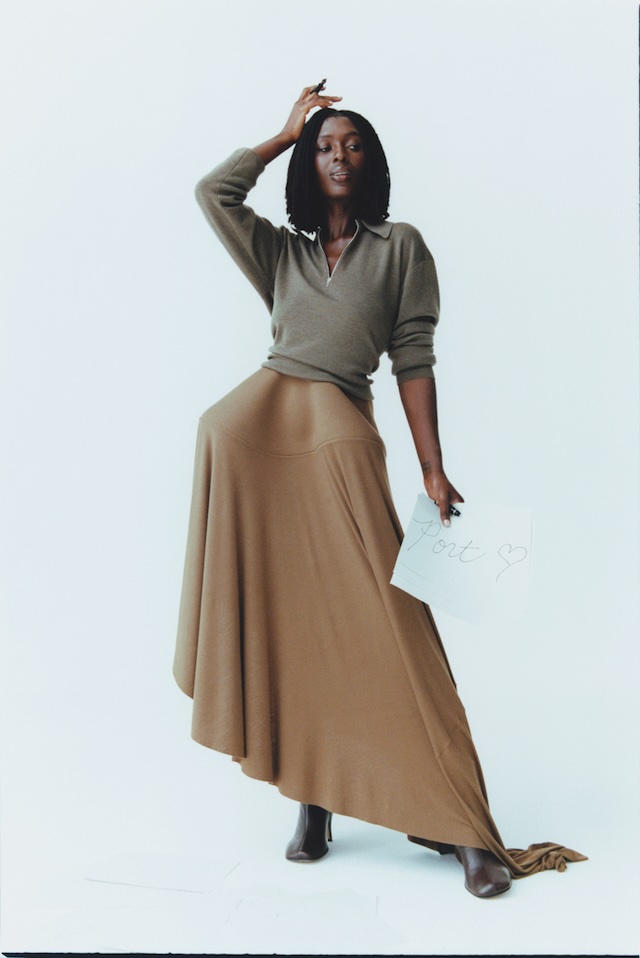
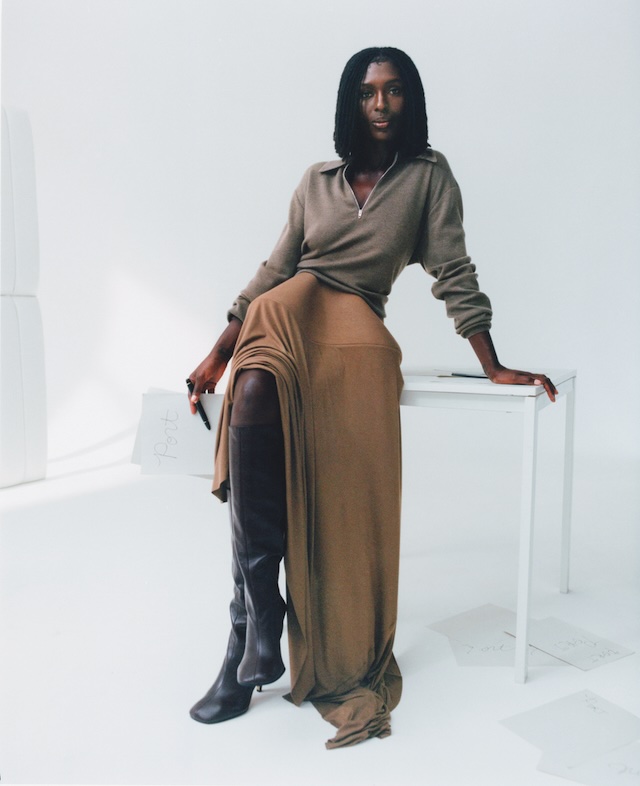
Jodie Turner-Smith

From her breakout in Queen & Slim to portraying Anne Boleyn, Jodie Turner-Smith has never shied away from roles that test boundaries and spark conversation. In the years since, she’s moved with ease between imagined galaxies in Star Wars: The Acolyte, Kogonada’s meditative sci-fi After Yang, and Bahamian folklore in Apple TV’s Bad Monkey. She joins Disney’s Tron: Ares as Athena, an antagonistic AI program, in the latest chapter of the cult sci-fi franchise. Next, she’ll return to the screen in series 2 of the high-stakes spy thriller The Agency, playing an anthropologist drawn into webs of deception opposite Michael Fassbender. Across worlds both real and imagined, Turner-Smith continues to expand her universe – exploring womanhood, power and resilience with a voice that feels wholly her own

Turner-Smith with Montblanc pen, photography Charlie Gates

When Jodie Turner-Smith answers the question of what she misses from the US when she’s in the UK, it’s at lightning speed. “I definitely miss Erewhon ”, she declares. Immediately after that, she laughs and apologises for sounding “so LA”. Right now, she’s here in London for the next month or so shooting series 2 of The Agency, an action-packed labyrinthian spy thriller about the perils of untangling the webs we weave. A remake of renowned French series The Bureau, the show is produced by George Clooney and Grant Heslov and stars Michael Fassbender. In it Turner-Smith plays Samia Zahir, a Sudanese professor of anthropology, with Turner-Smith learning and speaking Arabic for the role. The show is shot partially in the UK, where Turner-Smith spent the first 10 years of her life, and while her tastebuds might have surrendered to the ‘health nut’ culture of the West Coast, to the ear she still sounds distinctly British.  

After a brief corporate stint and years split between modelling and acting, the actress rose to fame in 2019 with her breakout performance in runaway tragedy Queen & Slim. Since then, she’s embodied roles across a whole host of imagined worlds, periods, geographies and galaxies: the leader of a witch coven from the Planet Brendok in Star Wars: The Acolyte, an adoptive mother in Kogonada’s sci-fi study After Yang, an Obeah-practicing Bahamian in Bad Monkey or the infamously wronged Anne Boleyn. From the set of The Agency, she’ll be off to do international press for upcoming Disney blockbuster Tron: Ares, in which she plays an antagonistic AI program called Athena.  

Back here in present-day London, however, she breaks down her hack for concocting her own version of Erewhon’s Green Goddess ice cream at home (the real stuff retails for $20 at the superfood mecca). “Really, I just go [to Erewhon] to look at the menu,” she laughs. Every question, big or small, she dives into with a fervour, theorising in tangents on everything from smoothies to gratitude to Agnès Varda, with her British accent impressively intact. In fast-paced moments she almost sounds transatlantic, the edges of her received pronunciation only slightly softened by an American lilt, like the leading lady in a 1940s Hollywood picture. 

“I didn’t go to drama school but I studied films through watching them. And before the streaming wars truly kicked off, my first subscription was to the Criterion Channel,” she says. At the intersection of her identities as both a cinephile and a Francophile, what naturally followed was a love of the French New Wave and the classic simplicity with which its films approached life’s complexities. “They weren’t doing super fancy things, they were just looking at life in really interesting ways. I think that Agnès is probably the first person who really made me want to be a filmmaker.” Her favourite film of Varda’s is Cléo from 5 to 7, a classic about a woman awaiting news about her health. In it we see a sliver of her life, as the title promises, between the hours of 5-7pm, as her fears and worries intensify. “The movie has messages about life, death, beauty, what it means to be a woman; the whole thing just feels like a bit of a prose poem sometimes. It’s just so magical,” says Turner-Smith. “And the themes are still so relevant for a woman today. Honestly I even felt that way when I did Anne Boleyn, that’s why I wanted to do it.” 

She continues, “So much of Anne’s power and her work was tied to the capabilities of her womb. Tell me that’s not still a modern conversation.” There’s a sharp edge to her tone as she deadpans, “I dare you to tell me that’s not still relevant.” 

After her marriage to fellow actor Joshua Jackson ended in a public divorce in 2023, Turner-Smith is no stranger to the experience of having your womanhood dissected on the stage. Still, she excitedly finds every opportunity to weave in stories about their daughter, Juno, and credits motherhood for bringing her closer to her own mother again as well as transforming her perspective on the world. “What’s next after is being a ‘Valley mum’ in Studio City,” she laughs at one point. “I’m really excited about pick-ups and drop-offs and circle time and popcorn Fridays.” 

In the next breath, she peppers in frequent mentions of the patriarchy, the ‘Herculean task’ of motherhood and the ways in which the former often minimises the latter. “ involves so much invisible labour, which is why I believe it’s been discounted so much – people often discount things that they cannot quantify,” Turner-Smith says. “Women are owed so much reverence but… if we truly acknowledged their power then we’d have to do a lot of things differently, wouldn’t we?”  

Unfortunately, her talent for finding the universal threads in the human experience isn’t something that’s always been shared by her potential audiences. The colourblind casting of Turner-Smith in the historical role of Anne Boleyn ended up opening her up to significant backlash for its ‘inaccuracy’, and it wasn’t the last time she’d encounter that kind of discourse. When starring alongside Amandla Stenberg in the Disney+ series The Acolyte, which is, crucially, set in a fictional universe, both came under fire from racist pockets of the Star Wars fandom who were unhappy with its diverse cast. Turner-Smith remains vocal about failures of the studio to protect actors and condemn the extreme harassment. “The issues of race, and the limitations that people put on that are not unique to my industry, but my industry has a unique opportunity to – by setting the image of what the social mores are dictating – either move the conversation forward or just affirm the same bullshit,” Turner-Smith says bluntly.  

Despite multiple run-ins with the hard edge of visibility, she remains optimistic about the state of things in Hollywood, still viewing her career as a proof of a changing tide, not an exception to the rule. “As with many things, there’s still further to go but I do think that I’ve seen progress. The fact that I’m here doing the work I’m doing is evidence of that,” she says. “It’s also just an opportunity for me to continue to keep that door open, the way that the dark-skinned women before me did, you know? When they were truly trailblazing, playing roles of helpers and nurses and mammies, they were opening the door for me to be able to do what I’m doing right now… to be playing a woman with a PhD who is fighting for the rights of her people. It’s a big deal, I don’t take that for granted.” 

And if you consider her origin story, it’s no surprise that Turner-Smith feels fortune-favoured. The story of the making of her first on-screen credit flows like the plot of a farfetched coming-of-age film. In fact, it takes almost 10 minutes to recount. It starts with Turner-Smith as a college student with tickets to see one of her favourite artists, Common, in concert. When he pulled out of the tour with Kanye West, she almost didn’t make it to the show, she tells me. But ultimately she went, somehow ending up in the front row – even though her tickets were in the nosebleeds – and then naturally got invited backstage after her striking presence grabbed the attention of someone in the band. That night sparked the start of a friendship with West’s cousin, Tony Williams, and a number of concert-fuelled adventures post-graduation. At the same time, Turner-Smith was on track to become a corporate banker after landing a graduate job from an internship. But as her eyes opened up to the possibilities of the creative industries, that future began to look shaky. “I just thought, I do not want to go and be a corporate banker, I don’t think that’s what I’m meant to do with my life,” she laughs. She went and gave it a go anyway. But when she met Pharrell Williams backstage at a NERD show in Miami in 2009, he confirmed her bubbling suspicions. “He was like, ‘you need to be in front of the camera,’” Turner-Smith recalls. “Then he calls Hype Williams on my phone that night and tells him, ‘you’ve gotta meet this girl, she’s so beautiful. You need to put her in one of your videos.’” 

Nothing came of it immediately, but on her next trip to LA the friend she was visiting encouraged her to reach out again. The award-winning director, Hype Williams, responded and told her to swing by his office straight off the plane. When she got there she found herself on the set of a huge production. He took one look at her and brought her back into the studio: “There’s this white convertible and two guys are standing behind it: Kanye West and The-Dream.” Without explanation, Williams gives her an outfit to try on, another crew member ushers her through to hair and makeup, and before she knows it, she’s starring in their music video. “And that was my first time being on camera,” she says. Trawl backwards through the YouTube archives to The-Dream’s ‘Walkin’ On The Moon’ single and there she is: channelling an aptly dazed and confused supernatural being, wrapped in a white Hervé Léger swimsuit and draped on the arm of who was soon to become one of our generation’s most influential artists. 

From that first appearance as an extraterrestrial beauty to her subsequent career in film and TV, there’s a consistent thread of otherworldly charm to many of the roles Turner-Smith inhabits. At a first glance you might attribute that to her statuesque appearance alone, but speaking with her and hearing how her life has unfolded, you get the sense that the true source of that ethereality actually comes from within. “I think we see things, not as they are, but as we are,” Turner-Smith offers. “If you’re looking for magic, you’re gonna find it everywhere. I believe the same with love and I believe the same with God.” She seems to hold whatever’s in her hands at any given moment as sacred, and so far it’s served her well. As our conversation sprawls, she gushes with the same refreshing enthusiasm about her motherland of Jamaica, the divine feminine, the beauty and commonalities of the Black experience worldwide – “you know when you see a tree bursting through concrete, people have paved over it but nature finds a way,” she marvels – and all the lessons she gets to learn through the worlds of the characters she plays. “I do believe that magic is present in my own life,” Turner-Smith smiles, “and I like to affirm it, because I don’t want it to stop.” 

Turner-Smith with Montblanc pen

Photography Charlie Gates  

Styling Georgia Thompson  

Hair Marcia Lee using As I Am  

Make-up Joey Choy @ The Wall Group  

Nails by Megan Cummings using Nailberry  

Set design Po Tsun Lin  

Production The Production Factory  

Post production lamina.studio.london  

Photography assistants Oliver Matich, Alice Abbey-Ryah  

Styling assistant Taylor Ahern

This article is taken from Port issue 37. To continue reading, buy the issue or subscribe here

Ethan Hawke

Actor, director and writer Ethan Hawke – known for films such as Boyhood, Before Sunrise and Training Day – talks to longtime friend and collaborator Hamilton Leithauser, frontman of The Walkmen and acclaimed solo artist whose scoring credits include Hawke’s documentary The Last Movie Stars. The pair discuss Hawke’s new show, The Lowdown, his role in Blue Moon, the politics of truth-telling and the power of art to cut through the noise 

Hawke wears J.Crew, photography Ian Kenneth Bird

Hamilton Leithauser: It’s been a minute since we last saw each other. I think I saw your wife the other night, but you’ve been away filming your new show. Tell me about it – I saw the preview on the plane and laughed out loud. 

Ethan Hawke: I appreciated that text. You may not know this, but you’re a huge inspiration to the show. Usually, I get to read a script before I say yes, but with this, it was just, ‘Do you want to do a show with Sterlin Harjo?’ and I said yes before even seeing a script. I told Sterlin, “I want this show to feel like a Hamilton Leithauser performance – when it’s over, you feel like someone gave you a piece of their heart.” I wanted to be sweaty and bloody at the end of this show.  

HL: My wife was at your premiere and said the show is fantastic. 

EH: Your wife is clearly very intelligent. 

HL: She has very good taste – in men and television. 

EH: I’m not sold on the man part. 

HL: I just saw the preview – I think I saw it on your Instagram. I want to hear all about that. 

EH: Well, I’m playing one of the greatest songwriters of the 20th century . I know a lot of his songs: ‘My Funny Valentine’, ‘Blue Moon’, ‘Bewitched, Bothered and Bewildered’ – so many classics. What’s so interesting about the movie is you’re basically watching a human being die of heartbreak in real time. He was part of Rodgers and Hart for 25 years – they were the Lennon and McCartney of their generation. Then Hart, the character I play, his drinking got so incorrigible that Rodgers decided to move on and did a new show with a young fellow named Oscar Hammerstein. They went on to have a 17-year collaboration. So it’s kind of like Lennon and McCartney break up, and then McCartney starts a new band that’s bigger than the Beatles ever were. That’s what happened to Larry Hart. He loved Richard Rodgers – they were best friends for 25 years. He goes to this opening night party to try to convince his old friend that he’s ready to work again, that he’s sobering up and ready to put in the real effort. But it’s too late. The ship already sailed, and his friend has already moved on. He has to sit there at the opening night party for Oklahoma! and try to be a good sport.  

HL: And how long did he live, does the movie go into that? 

EH: It’s a classic Linklater movie. It’s 90 minutes of real time. You watch him walk into the party, meet everybody, and 90 minutes later, you realise he’s going to drink himself to death and he’ll be dead in five months. 

HL: Your hair looks fantastic in the preview by the way, I gotta say. 

EH: Dude, that combover killed my soul. My vanity took such a hit. I had to grow the edges of my hair long, and then I had to shave the middle of my hair so I could do this combover. But if you didn’t do the combover, you looked like Bozo the Clown. Luckily, it was the hardest I ever worked in my life with that part, so I didn’t even go out. 

HL: So you did that after you did the Oklahoma trip? 

EH: No, I did Blue Moon first, and then I went to Tulsa. What about you? Are you on the road with Pulp? 

HL: I’m on the road with Pulp, yeah. 

EH: I love Pulp. There was a time in my life where I wanted to be Jarvis , he just seemed like the coolest guy in the world. 

HL: He is cool. He still is. 

EH: How’s their music?  

HL: It’s great. They put on a really big show every night. And I think people enjoy my show also. Right now I’m in Milwaukee, doing a headline show with my band tonight. Pulp’s taking two days off, so I was like, fuck it, I’ll just do a show here, and then we’re going to play in Minneapolis with them.  

EH: I love Milwaukee.  

HL: Milwaukee is awesome. There’s always something cool to find here. You can still find a huge, really cool bookstore that actually has reasonable prices, which you don’t see anymore these days. I just bought a huge stack of books and art which was totally affordable. And it’s right downtown. There’s nobody on the sidewalk, which is probably not a great sign for the city’s economics, but it’s a pleasure to walk around on a beautiful sunny day.  

EH: I love it. I was there last summer. We screened Wildcat in this old movie theatre, the kind of place that looks like Gone With the Wind premiered out. They have an organ and a balcony, and it’s awesome. 1,000 seats, and the place was sold out, and it rocked and rolled. I just got such a good feeling from that whole city. 

HL: We’ve had some good times here over the years. 

EH: What’s it feel like as you ride around the country right now? 

HL: With the media stuff? 

EH: In the Lowdown show, I’m playing a journalist – a guy who’s hellbent on showing the benefits of telling the truth. It doesn’t matter if it’s within a family: if there’s a problem and you’re not honest about it, you’ll never heal. The same goes for society – if you’re not facing the truth, you won’t grow or heal; you’ll just stay stuck with the same issues.  

Sterlin used to work for a free press in Tulsa and saw the benefits of honest reporting firsthand. In the 1990s, they were covering stories about the Tulsa race massacre, and witnessed the healing that happened in the community when people shared a reality based on truth, instead of covering things up. My character in the show is inspired by a friend and mentor Sterlin had when he was young, a journalist named Lee Roy Chapman. So, my character is based on him. A kind of Don Quixote, going after big money.  

HL: Are you still a journalist in the show? 

EH: In the show, I run a used bookstore but still write for local magazines, trying to expose how the affluent take advantage of the underclass. I keep getting knocked down for it. I was even on Good Morning America this morning, saying to George Stephanopoulos that if you tell the truth, sometimes you get punched in the nose. 

My grandfather’s generation understood democracy and the value of a middle class. Now, with the internet, it’s like the Tower of Babel – so much confusion, and people are afraid to speak honestly. Even in this interview, I’m aware of how I’m speaking, and that fear isn’t good. It’s easy to get distracted by things that don’t matter while ignoring what really does. 

HL: And journalists now face real threats – some need 24/7 security because of the backlash, just for asking tough questions. 

EH: Exactly. Sometimes it feels like, ‘what country am I living in?’ Until people feel the loss of their freedoms, nothing will change. The powers that be profit from compliance, and no one feels motivated to take a stand.  

HL: I want to hear some funny stories from your show – were you having a ball the whole time? 

EH: The sad truth is, I never had so much fun in my life. There’s a punk rock spirit happening in Tulsa. That part of the country has been dealing with all the problems that we’re citing right now for a long time. The state has all of the major issues, from the Native populations, the issue of race, the oil money land barons. They’ve got a history of corruption. The community is very awake to all these issues. They’re very present. The art has a present tense-ness to it, and the music history is great, from the Gap Band and Leon Russell to Bob Wills, Cain’s Ballroom, the Woody Guthrie Center and the Bob Dylan Center. You’ve got Larry Clark . It’s a place that has a high regard for creativity. Apartments are cheap, so our students can find a place to live, create and be wild. You feel that in the film community. We did have fun – we had Killer Mike in the show. 

HL: Oh yeah, Killer Mike. You got so many people in that show. 

EH: [My character] writes for two newspapers. One is a longform magazine and it aspires to be like The Paris Review of Oklahoma. The other one I write for is the Tulsa Beat, which is booty and bad guys, and Killer Mike’s newspaper. I have these two different duelling editors, where if one won’t publish, maybe the other one will. It’s been so fun to watch somebody as smart as Mike is, who has achieved so much success at one artistic medium, but he’s still got a beginner’s mind about acting. He’s so excited by it and so turned on. 

HL: Is it like tongue-in-cheek, or is he fully in character? 

EH: He’s fully in character. I’m not into the tongue-in-cheek thing. We’re trying to create a real world that you can smell. Sterlin likes the same thing. You’re going to love it. And there’s so much JJ Cale and Leon Russell – it’s awesome. The music of the street is very much a part of the show. Then we have Tim Blake Nelson and Jeanne Tripplehorn, who are like Oklahoma royalty. That was pretty fun. 

HL: That’s awesome, I can’t wait to see this thing. When does it come out? 

EH: September 23. My job right now is to tell people the first thing you’re gonna do is you’re gonna get your beautiful wife and watch this. You’re gonna sit down with her and stream the first two episodes, and then you’re gonna text your friend Ethan and say –  

HL: Yeah, dude, nothing but praise. 

EH: Are you hitting the studio anytime soon? 

HL: I got a movie coming out that I scored that I’m really proud of. I don’t know how they’re debuting. I don’t know how stuff works. You know more than me.  

EH: Well, I have this theory that I’m going to put here in print. I hope that you are going to have this whole other act of your career like Randy Newman, who I think is a genius rock and roller, and happens to be one of the best people to score a movie in the history of the world. With your sense of melody and musicianship, you’re ready to take that torch. 

HL: I’m ready. My hand is open and I’m running. 

EH: For those that don’t know, we have been friends for a long time through mutual friends, but we really got to know each other because Ham scored The Last Movie Stars, which was a six-hour documentary about Paul Newman and Joanne Woodward. Ham made the whole thing sparkle and shine. His music is all over it.   

One of the best nights of my life is the night we became friends. It was a New Year’s Eve party where we did an old fashioned guitar pull all night long, and we stayed up way too late. But that’s where I had the idea. Do you remember when Ben Dickey started playing a Blaze Foley song, and I had the idea that he should play Blaze Foley in a movie? 

HL: Oh, that’s where you came up with that. I had been friends with this guy since long before I even knew you. He was not an actor, and then I went and saw Blaze, and he’s up there crying, delivering this crying speech. I couldn’t believe it. 

EH: He’s amazing in the movie. But that gets to my theory about you and a lot of other people – Killer Mike for example – that if you have access to creativity, it can manifest in a lot of different fields, especially if you do it with humility and discipline, which Ben did. He took the idea of acting in that part incredibly seriously. He worried about it morning, noon and night. In Philly, he would be playing with his band, the Blood Feathers, and they were so much fun. I could watch him hold an audience in his hand, and the charisma I knew would translate into his work as an actor. 

HL: You balance big projects with smaller, more personal ones. Do you find yourself turning to those to stay grounded? 

EH: There’s a direct inverse correlation between how much you get paid and how substantive the job is. The more meaningful the work, the less you get paid. But those projects keep me growing and connected to the art. The trick is to focus on what you can give to the profession, not what it can give to you. I had a really great 20s, met a lot of amazing people, and was really idealistic about the power of storytelling and the arts. The arts really represent the collective mental health of a culture. When it’s vibrant, ideas are flowing, and light is shining in all the dark places – you have a healthy culture. When it’s dark, and all anybody’s trying to do is sell cheeseburgers, the whole thing atrophies. My goal was never to be a big shot. 

HL: Sometimes you get lucky and a passion project breaks through. 

EH: Exactly. Every now and then, you thread the needle – like Boyhood, which we worked on for 12 years. Sometimes the crazy, avant-garde projects find their place, and it’s important to keep doing them for the sake of our collective mental health. Every now and then you get absurdly lucky, and it works, and it finds a place in the marketplace, and people really appreciate it. But I think it’s so important that we do those things because sometimes they break through. 

Hawke wears J.Crew

Photography Ian Kenneth Bird  

Styling Mitchell Belk  

Grooming Jennifer Brent at Forward Artists using 111SKIN and Kiehl’s  

Production Hyperion NY

Photography assistants Fallou Seck and Anthony Lorelli 

This article is taken from Port issue 37. To continue reading, buy the issue or subscribe here

Benedict Cumberbatch

After working together on the new adaptation of Max Porter’s novel Grief Is the Thing with Feathers, Benedict Cumberbatch, known for acclaimed turns in Sherlock, The Power of the Dog and the Doctor Strange films, sits down with the writer to talk about grief, fatherhood, the circus of publicity, Olivia Colman and a quickfire round of ‘would you rather’. What follows is an intimate, searching and at times funny exchange between friends and collaborators, probing how to live, feel and create in chaotic times

Cumberbatch wears Prada throughout, watch Vanguart, photography Matt Healy

Benedict Cumberbatch: Oh, look. We got the same haircut and everything. 

Max Porter: Yeah, I did that deliberately. Talk to me. How are you? How’s it going? 

BC: Tube strikes in London are not much fun, and everything’s all right. It’s just that thing of transitioning back into a full schedule after a summer of ‘this life’s nice,’ and not getting my head into acting. I take full responsibility for it. But other than that, I’m good. Am I going to see you next week at Together for Palestine [a fundraising event for aid in Palestine? 

MP: No, we’ve got a screening that night. 

BC: Oh yes, [I’ll be at Together for Palestine] which is why I can’t come. 

MP: Glad it’s happening, glad it’s big, glad you got all the names. Are you filming? 

BC: No, I’m doing bits and pieces for and that’s kind of it work-wise. It’s just this and developing stuff, writing, going through the slate, getting stuff together with Sophie, and making sure the tennis racquets are in the right place, piano lessons are made on time, the bike’s serviced. It’s the endless domestic list, which leaves little bandwidth for work. How did the go in Toronto? 

MP: I already had love for you, but now I have a great deal of sympathy, having seen how those things work – the drum kit, the red carpet. I don’t know how you do it. 

BC: Everyone keeps saying that necessary. I don’t think it is. There’s another model out there no one’s bothering to deal with, because there are a lot of careers that benefit from this relationship between the press and hysteria around films. One thing it does is celebrate the collective, within the room, within the festival atmosphere. That community around what we do for a living is great. But half the people who want your signature aren’t going to watch your film. They’ll sell it for £300-£900. They’re not fans; they’re making money. I don’t begrudge them that, it’s a bleak world, but it exists alongside this endless need to answer the same questions. 

We had a golden moment during COVID to rethink things. For about five minutes we did. Then we went back to the old normal. You have to get through it, treat it like fun and find something amusing about it. But then you shed so much afterwards. We’ve got a beautiful, neurotic whippet dog. When she goes on a walk, she starts out okay, then starts seeing dogs and everything becomes terrifying. When she comes back, she rubs her body to get rid of the adrenaline and the cortisol of the fight-or-flight reflex that kicked off. The best way is to immerse yourself in nature, or spend five minutes being at the mercy of a six-year-old. Or with the dog. But really, nature is what you need – and isolation. 

MP: I want to sprinkle in quick-fire questions in and amongst the general chat. What’s your favourite tree? 

BC: My favourite tree is the oak. The majesty and the prehistoric might of sequoias is humbling. Both trees, in our land and in lands abroad, for me, are sentinels in the way that whales are. They are slow-growing reminders of life being more important than a political cycle or the profit margin in a quarter. And they humble us. They give us life, both above and below the ground. Those two trees, in their longevity, I find are extraordinary totems of time and our insignificance, but also what we actually need to focus on in our lives, which is our brief moment here, in this incarnation, and leaving it in a better state than when we found it. Not much of that going on at the moment.  

MP: Segueing to our film, The Thing with Features, one of the things that struck me when we met was that you don’t take the easy route. You don’t take this work lightly and your engagement with it is both professional and serious and, in this instance, and most instances for you, profoundly rigorous in terms of the craft. But this was also an intellectual and emotional engagement for you. You didn’t just get the script, you knew the book, and understood the toll it would probably take on you as a human being. But you also dive quite deeply into the questions of paternal care, literary influence, art, art-making as a parent, and the profound intersection of you as a dad, and you as an actor, playing dad with young actors on set. Can you talk about how you jumped in and whether you regret that now? Did it take its toll? 

BC: I don’t think I was aware of the cost until I did it. I knew it’d be costly, but you don’t know until you’re doing it. That’s part of the joy – the perversity, even. It’s a gift – the unknown in our industry and in art in general. It’s about discovery, and that comes at an uncalculated cost. 

The book is so cinematic, the psychological depth of it is naked and profound and alluring to an actor. You feel a lot when you’re reading it, not just because of the universal theme of grief, but this very specific lens. Some association too, not having been through that, but other forms of grief in my life. Also the milieu, the north London middle-class feel of it. It’s a world and a time, a retrospective unreliable narration from the kids’ point of view. Spoiler alert, but as that evolves it’s very specific. All of that resonated with me – our generation, the richness of the imagery, the imagination of it immediately flickered with the light of cinema. 

MP: You know I have this obsession with juxtapositions. Grief Is the Thing with Feathers is entirely that. It’s what the reader brings to the gap between things, the hinge of a metaphor. So I wanted to ask you, how was it to go from being spun by eight-foot-tall Crow in semi-screaming, semi-jayhawking, semi-wailing, semi-orgasming craziness to working with one of your close friends on a whip-smart comedy. How’s the juxtaposition of energy for you in that? 

BC: That’s the Benedict buffet. You need it. I remember James McAvoy saying, ‘God, you’re having a lot of fun.’ I said, ‘Yeah. Try playing George Tesman for four months and watching your wife blow her brains out every night.’ I went big on the comedy for that. 

MP: Is there a form of self-care in curating your career? 

BC: Work should never be therapy, otherwise you leave your personal development in the hands of characters that are over once the film’s gone. That’s not a very safe place to be

MP: Can I be nosy, was working together enriching for your friendship with Olivia? 

BC: Massively so. It’s a working relationship too, so you get far more insight. You spend a lot of time with someone you’ve only seen fleetingly before. Half my life is family, then work, so friendships suffer unless you’re lucky to be friends with kids’ parents. My New Year’s resolutions are simple: simplicity and friendship. 

Olivia is remarkable. It seems very easy for her. Not just because she grew up with Peep Show and comedy classics and knows that world, but she’s innately and supremely talented. She can do anything. It’s a very safe dancing partner, especially when it’s a friend. You risk more, it’s a bit faster and you can be very honest. She’s a great sounding board – never dismissive, properly on it. 

MP: There is this sort of appetite that this world creates in emotionally intelligent people to latch on to. Like when we met, you could have just shook my hand and said, ‘That was nice, thank you very much, and see you next time.’ But you were curious about me, you asked me questions about my life. We got quite deep quite quickly. 

BC: You’re not just part of an opening in my calendar. It’s a rarity to meet people that you feel very strong kinship with immediately. I over-romanticise our friendship, but it’s true. I look at some of my best friendships and how instantaneous they were. In a way, Adam ’s one of them. We did one job together, now we have a production company . 

MP: Have I told you my story about my middle son when I got back from the West Bank? He’s 13, and he’s completely in charge of his own life. He’s someone that gets his own clothes out, makes his own breakfast. Develops his own tastes. It’s amazing; he’s running the show. But I can’t milk him for emotional content. Anyway, I was malfunctioning, heartbroken, traumatised by what I’d seen on a trip to Palestine – apartheid, machine guns. 

BC: I can only imagine. It’s only now coming through in detail, away from social media, what’s been going on. 

MP: One night I was robotically stirring risotto and I didn’t hear him come in. I had been crying a lot, but I wasn’t crying at that moment. My son wrapped his arms around me, held me for about three minutes, then left the room. It was exactly what Feathers is about. A non-verbal, instinctual benevolence. He recognised I needed it. My ability to grieve for that faraway child I’ve never met is connected to my ability to love this one. There is no empathy gap to be crossed. It’s all in me. It’s the pain that is thrust upon me. As he says in the book, ‘let no man cease to fix it.’ It is how I love. May we hurtle back into our family units, covered in the scars and thickets and bristles of the work, and let them see it. Let them soak it up. Let them know that we’re weird. 

BC: It’s been amongst many fears of raising children, the fact we both have three boys. This is a story of male grief – what men feel or don’t allow themselves to feel, and the damage done. We are living through a culture of that. One of the most important things to teach boys is that it’s fine to feel. You are strong in vulnerability. 

MP: We’re running out of time, so here’s a couple of quickfire questions. Favourite bird? 

BC: White-tailed sea eagle. 

MP: Wrong. Crow. Favourite spread? 

BC: Honey. 

MP: Nope, Marmite. Favourite car game? 

BC: Yellow Car. 

MP: I love Yellow Car. Our new game is making sentences out of number plates. It doesn’t work. Would you rather suffer the loneliness of being misunderstood or the unease of having caused offence? 

BC: Fucking hell. Constantly ill at ease at causing offence. Both, really. 

MP: Swimming or fishing? 

BC: Swimming, definitely. 

MP: Would you rather squeeze a pimple or pluck a hair? 

BC: Squeeze a nipple? 

MC: Pimple. 

BC: Squeeze a spot. It’s painful isn’t it, but satisfying. 

MP: This is a really disgusting story to remember but when you’re really tired in the car and everyone else is asleep and you’ve got three more hours to go, I pluck nose hairs to keep myself awake. 

BC: Then I start sneezing and wake people up. Same with ear hairs. I’m getting rogue ones because I’m getting old. 

MP: But you’ve got people to look after you. 

BC: I get regularly plucked, I’m like a prepped chicken underneath this T-shirt. 

MP: Listen, I love you, and I’m looking forward to seeing you. 

BC: Are you coming to Zurich? 

MP: What’s in Zurich? No, I’m not. 

BC: All these film festivals… 

MP: No, but I’m seeing you in London, and we’re doing a day of press together where we can do ‘shacket’ club again. 

BC: Oh yeah, that’d be good. What shackets are you gonna turn up in this time? 

MP: I have two looks at the moment. My T shirt game is entirely either ‘Free Palestine’ or I’ve got this incredible new T shirt that says, ‘Listen to Sade’. And I am therefore having abnormally rich conversations everywhere I go about why Sade is the best. People are sharing their favourite albums – security guards in Toronto were like, ‘My brother – come here. Which record?’ 

BC: Amazing. I mean, she’s great. All I’ve got in my head is when she sings, ‘This is no ordinary love…’ 

MP: Well, she’s a goddess. I have a theory that the world suffers in the gaps between Sade records, and then when there’s a new Sade record we have a moment of hope and optimism. I think Sade’s in the studio working away right now, so hopefully we will have a new era. 

Cumberbatch wears Prada throughout. Watch Vanguart

Photography Matt Healy  

Styling Reuben Esser

Grooming Wakana Yoshihara using Pelegrims, 111SKIN, Naturabisse, Ouai and Oxygenetix

Production The Production Factory

Photography assistants Cameron Jack and Leigh Skinner

Styling assistant Mayu Fukuda


This article is taken from Port issue 37. To continue reading, buy the issue or subscribe here

The Art of Duality: Max Radford

The final film in PORT and Sage’s The Art of Duality series follows designer and gallerist Max Radford in his South London home and gallery. Between sketching, research and curating what he calls “radical design”, Radford’s day moves between fast-paced projects and slower, reflective moments – with the Oracle™ Dual Boiler coffee machine threading through both

Max Radford is an interior designer, gallerist and curator of emerging British furniture talent. His eponymous gallery showcases both contemporary innovators and iconic design pieces, reflecting his philosophy that objects should hold value through presence and engagement rather than transaction alone. Radford’s journey spans fine art studies, early experience with an antique dealer and years of cultivating a nuanced eye for materiality and form. He has collaborated with brands such as Ercol, Aram Gallery and LS Gomma, and archives his work and insights via his interiors Substack.

A typical day for Radford involves balancing his dual roles at his gallery and studio. “My weeks are very varied, having two different businesses as a gallerist and also as an interior designer, you have to balance those things,” he says. At home, he switches between focused creative work – like drawing, research and sketching – and domestic tasks, moving between desk, dining table and a small cubby by the kitchen. His home doubles as both sanctuary and studio, a space that allows calm reflection alongside bursts of high-focus activity, whether planning exhibitions, conceptualising furniture layouts or organising objects for the gallery. He spends time reading, scanning magazines, listening to records and lighting incense, crafting moments of quiet within a busy schedule.

Coffee is what drives these different modes. “I always have to start the day with a coffee. Nice and easy flat white on auto mode in the morning,” he says. In the afternoon, he opts for a “nice, slow” pour-over Americano. The Sage Oracle™ Dual Boiler mirrors this flexibility with its auto and manual modes, enabling Radford to switch between automated efficiency for morning routines and manual precision for when he has time to explore his craft. By using the new Auto Dial-in system, which monitors each extraction and adjusts the grind size automatically, Radford is able to achieve the perfect brew every time. “The duality of the machine is something that is certainly great for our lives. We’re easily able to just make a coffee in the morning, pressing a button, or you can fiddle around and learn how to make coffee on the weekends,” Radford adds. 

Looking ahead, Radford plans to expand the gallery internationally while continuing to platform London’s emerging design talent. His home and daily practices remain a laboratory for ideas, where coffee and creativity live in harmony. “The pieces of furniture that we work with within the gallery are regarded as something called collectible design, but we like to call it radical design,” he notes.

This is the closing film in the PORT x Sage The Art of Duality series. Relive the earlier stories with Rejina Pyo and Jordan Bourke here, and Thomas Straker here.

Production Studio Union
Exec producer Dan Pickard
Director & DoP Theo Tennant
Lighting & camera assistant Matt Bramston
Hair & makeup / groomer Margherita Lascala
Port producer Jack Stacey
Port editor Ayla Angelos
Production assistant Annabelle Brown
Barista / drinks stylist Luke Lane
Edit Ned Donohoe
Edit David Tse
Colourist Lucrezia Pollice
Dub Tom Guest
EMEA PR & Partnerships manager Kira Schacht
Breville Group General manager, global communications Lucy Martyn
Concept agency John Doe


The Art of Duality: Thomas Straker

In the second film from Port and Sage’s The Art of Duality series, chef Thomas Straker opens his kitchen and home life to show how discipline, intuition and the Oracle™ Dual Boiler guide his daily creative flow. From high-energy service to content creation and team briefings, we hear about how Straker’s work is shaped by balance

Thomas Straker, the chef and entrepreneur behind Straker’s in Notting Hill, is best known for his playful ‘All About the Butter’ videos. These short-form clips showcase Straker crafting a variety of compound butters – from classic garlic and herb to inventive flavours like miso and Biscoff – demonstrating how a simple ingredient can be transformed into something extraordinary. He trained under culinary legends at Dinner by Heston and Elystan Street before opening Straker’s in 2022, where he blends technical rigour with a sense of spontaneity, a philosophy reflected in every dish he produces. Over 18 years in kitchens, he has developed a reputation for creativity and leadership – running multiple ventures while mentoring a growing team. Coffee is part of that rhythm, a moment at the start of the day that gives him space to think and prepare for what’s ahead.

Straker’s days are usually “jam packed”, juggling work, creativity and family. “The first thing I would do in the morning is have a coffee,” he says. “Today, I had a cortado, and I had a bit of time. So I made it on this manual setting, and you have a bit more of that creative freedom… where I’m just like, ‘this is the key to life today’.” The manual side of the Oracle™ Dual Boiler lets Straker take full control of every element of extraction – from pre-infusion pressure and flow rate to milk texture – so he can make a cup that’s entirely his own. The dual boiler system keeps the temperature perfectly stable, giving each espresso or cortado the same precision and care as a dish he’s crafting in the kitchen. Then, after a run or a session at the gym, he takes his children to school before cycling across London – a moment of clarity and a chance to prepare before the chaos of service begins. Once he arrives at work, he spends 10 minutes jotting down ideas or having a coffee before diving into back-to-back meetings. From there, his day unfolds at pace: a team briefing, menu testing – perhaps a new langoustine dish on the barbecue – then reviewing service flow and restaurant design. “My creative process is very simple – like, what’s good? How can I do the least amount to make it exceptional? And then we’re away,” he explains.

He balances these daily demands with creative projects beyond the kitchen – meetings, brand collaborations and filming for his social channels. “I plug into a design meeting, thinking about materials and how the space looks and feels, and then it’s suddenly, ‘oh, you’ve got to go and make pasta for Instagram’,” he says. “Turn the brain off, then back on again.” Despite the constant shifts in pace, Straker thrives on the variety, learning to find calm in small rituals. “Half my life was spent working,” he reflects. “My first ever job at the Dorchester was also difficult, because you don’t know where you’re going. Now I have such a clear direction of where I want to take my brand. You’ve got to work out what it is in your life that you need to put in there to make you hungry, driven and feel good.” 

For Straker, making coffee with the Sage Oracle™ Dual Boiler becomes a moment to ground himself, before diving back into the day’s creative demands. The machine’s ability to switch between automatic and manual modes means he can opt for a quick, effortless espresso when time is tight, or slow down for a more tactile, hands-on ritual. Its new Auto Dial-in system monitors each extraction and automatically adjusts the grind for the next cup – ensuring every shot is perfect.

This is the second film in Port x Sage’s The Art of Duality. Relive Rejina Pyo and Jordan Bourke’s story here, and keep an eye out for the final film in the series, featuring Max Radford, releasing on 30th October.

Production Studio Union
Exec producer Dan Pickard
Director & DoP Theo Tennant
Lighting & camera assistant Matt Bramston
Hair & makeup / groomer Margherita Lascala
Port producer Jack Stacey
Port editor Ayla Angelos
Production assistant Annabelle Brown
Barista / drinks stylist Luke Lane
Edit Ned Donohoe
Edit David Tse
Colourist Lucrezia Pollice
Dub Tom Guest
EMEA PR & Partnerships manager Kira Schacht
Breville Group General manager, global communications Lucy Martyn
Concept agency John Doe


The Virgin Suicides

Twenty-five years on, Sofia Coppola’s debut film continues to shape how we see girlhood

In depicting Cecilia Lisbon’s first attempt to end her life, Sofia Coppola created a timeless image. Her seminal adaptation of The Virgin Suicides is filled with these, but this frame of a 14-year-old Hanna R. Hall always stayed with me: lying in the still pink water of a bathtub with her tawny hair splayed out, expression serene. Bathed in the dim blue of summer twilight, the scene is a conscious echo of John Everett Millais’s Ophelia, whose fictional subject is also clothed in a pale gown, part-submerged and in the throes of madness. Evoking enduring images like Pre-Raphaelite portraits and religious motifs, Coppola situates her depictions within a long tradition of art history, staging contemporary scenes that feel both familiar and eternal.

Like many others who first encountered the film as a teenager, the Lisbons’ sticker-lined bathroom ledge was instantly recognisable to me as an altar to girlhood by way of consumption – powder brushes, perfume bottles, nail polish, lipstick, bangles and candles – and through the strategic draping of a crystal bead and crucifix necklace, implicit of a life constrained by Catholic upbringing. Kitschy compelling details like these are a hallmark of Coppola’s cinematic work, which critics today recognise as having a profound influence on the iconography of female melancholy.

When the filmmaker, then 27 years old, began shooting the suburban malaise of her debut feature, she had already dipped a toe in several industries – having appeared in multiple music videos, produced four episodes of an ill-fated Comedy Central series and interned at Chanel as a high schooler. In this respect, Coppola is arguably as much a part of the pop culture infrastructure as a formative influence upon it, and her multidisciplinary approach has become second nature for style-adjacent brands anxious to keep evolving their offering.

In aestheticising the Lisbon girls’ suffering, she made a non-physical illness legible to audiences who might struggle to grasp its invisibility. By doing this, Coppola also iconised the ‘sad girl’, positioning her as a disruptor rather than a victim and turning her into a vaguely aspirational figure. She’s effortlessly beautiful, stoic in her abjection, and with a sympathetic rage in her heart; she is given agency, and therefore dignity, in the deaths she dies.

In a recent retrospective for The New York Times, Emily Yoshida writes that Coppola’s films comprise a “stylistic manual for how to be sad, or at least disaffected” in today’s world. But Coppola’s filmography isn’t instructive as much as it is unabashedly expressive and unfailingly allied to the visual, experiential and imaginative – a Magic Eye book more than a manual. However, this hasn’t stopped players in fashion, film and music from taking extensive notes, or adopting concepts wholesale.

The most high-profile designer in this regard is Marc Jacobs, with whom Coppola has an artist-muse relationship described as one of fashion’s “great platonic love stories”: she’s modelled in his campaigns, sat front-row at his fashion shows and worn his clothes to her premieres. In 2014, Coppola directed a short for Daisy Dream, the then-latest instalment in Jacobs’ cult-favourite perfume line. The video uses the dissolve transitions employed in the dream sequences of The Virgin Suicides, which also feature fading palimpsests of blue sky and grassy fields. Campaign face Antonia Wesseloh is styled in accordance with the naturalistic Lisbon girl look, wearing a flowy prairie-style dress and imperceptible makeup, her long hair lank and loose around her shoulders.

While Coppola didn’t install lithe young white girls as the aesthetic ideal, her films further glorified and romanticised their appearance, reinforcing a narrow scope of desirable femininity and unfortunately contributing to an ever-expanding repository of imagery weaponised online to inspire anorexia. Thus, Coppola’s heroines live a second life on social media as “nostalgia effigies”, a term used by cultural critic Safy-Hallan Farah, who also invokes Tavi Gevinson’s Rookie magazine, the photography of Petra Collins, and “Lana Del Rey’s fully-realised visual and sonic identity” as associated totems.

What each of these touchstones present is a highly-stylised facsimile of unattainable girlhood, burned on a stake but remembered forever. A quarter century after the premiere of a film set another quarter century before that, The Virgin Suicides endures in its portrayal of adolescent desire and terror. An art object whose central critique is of the implicit violence wrought on the female body, its visuals were perhaps always going to exist apart from their far pricklier context. As it continues to age, find new audiences and accrue acclaim, the film only appreciates as a time capsule full of anachronism: a wholly uncondescending coming-of-age tale that asks us to believe what we see rather than what we’ve been told.

This article is taken from Port issue 36. To continue reading, buy the issue or subscribe head here

Cannes 2025: Brutal Realism

Polemics, female trouble and dreams of slow cinema at the festival’s 78th edition 

Magellan, Lav Diaz

There are two ways you can read the computer-generated pre-roll that plays before every official Competition screening at Cannes, according to Filmmaker Magazine’s Vadim Rizov. The clip – which depicts a watery ascent up a series of red-carpeted stairs, to a star-studded night sky – was originally made for the 44th edition of the festival. On the occasion of certain anniversaries, the names of directors are added to each stair; most years they remain blank, and the graphic regularly plays to applause regardless. “If you’re feeling uncharitable, this can serve as a damning metaphor for the festival itself: an image created in 1991 synecdochally standing for a selection of bedrock auteurs that remain stuck in the same time period,” Rizov writes. “If you’re feeling charitable, the metaphor is more positive: the future of Cannes is unwritten, and the best is yet to come.”

Two things can be true at once. But in 2025, the festival’s programming tendencies come across a little haphazard. In trying to strike a precise balance between auteur loyalty, arthouse prestige, commercial viability and starpower, the lineup ends up optimised for Western celebrity more than anything else – movies that might spawn memes, lead to clout on Letterboxd or, perhaps most pertinently, result in lots of boutique merchandise sales. 

That doesn’t mean that’s all there is. If Cannes is good for one thing, it’s pulse-checking the health of arthouse collaborations around the world. Admittedly, the mood is a little low, and the market a little soft: the prospect of a nonsensical tariff on ‘foreign-made’ productions connected to American filmmakers and studios is not only “outright ridiculous”, as Leonardo Goi explains in Notebook, it’s “hopelessly out of touch with the way the industry actually functions,” because many contemporary titles result from pooling different countries’ resources and incentives.

Óliver Laxe’s Jury Prize-winning Sirât is one such co-production: the result of a €1.2 million Spanish production grant to a French-born Galician director, who has made a muse of the arid Moroccan setting he’s now shot three films in. Also meaning ‘path’ or ‘way’ in Arabic, the Sîrat of the title refers to a concept in Islamic eschatology: a bridge to heaven whose length spans the chasm of hell. I won’t spoil much of this transcendental road movie – which begins in the desert with a missing person and a freewheeling techno rave – but I will say that it is a divisive drama that I was surprised to love. I never felt betrayed by its excruciating plot machinations, but sympathise if you do. 

It’s a brutal movie about a brutal world – a thematic conceit seemingly applicable to much of this year’s programme. For Spike Magazine, Nolan Kelly summarises an emergent “globalised pessimism” through a few repeating motifs. Calling to mind instances in Wes Anderson’s Phoenician Scheme (a darker, arguably weaker outing in the context of the director’s oeuvre, but an amusing enough showcase, especially for fans of Michael Cera), Julia Ducournau’s Alpha (an unrelentingly bleak pandemic narrative that’s strongest when it sticks with its adolescent protagonist) and others, Kelly notes “family members plotting to kill one another; children living through the death knell of authoritarian states […] an obsession with AIDS and other forms of blood purity.” 

If I can make an addition to this list, it would be the films of a category dedicated to various shades of female pain – one which I have dubbed the woman-spinning-out subgenre. The trauma plot is most apparent (and least bearable) in Kristen Stewart’s directorial debut, an imagistically poetic adaptation of a memoir by Oregonian writer Lidia Yuknavitch that ultimately comes across too on-the-nose to be successful. On an episode of the Film Comment podcast, Devika Girish discusses how Yuknavitch’s somatic writing reflects an earlier era of feminist discourse, and why its impulses come across as dated in Stewart’s film. “There’ll be a scene where she’s trying to come to terms with her body, and the narration is: I’m staring at my wide, wet cunt.”

The Phoenician Scheme, Wes Anderson

Lynne Ramsay’s Die My Love, also adapted from a book of the same name, faces similar charges. (Girish: “I thought to myself, hysteria is so back.”) But I found a lot to admire in this wild, weird swing with Jennifer Lawrence and Robert Pattinson doing career-best work as Grace and Jackson, a young couple who move into a ramshackle country home together and have their first child. Ramsay’s frightfully alive film has a decidedly vintage sonic identity, with needle drops by Bowie, Billie Holiday, Cream, Liz Brady, Jean Sablon; the director herself taking a curtain call to sing the sombre Joy Division cover that plays over the credits. You’ll never listen to Toni Basil’s “Mickey” the same way again.

A less hysterical but still enjoyable entry into the woman-spinning-out pantheon is Anna Cazenave Cambet’s Love Me Tender. Yet another literary adaptation from a book of the same name, the film stars Vicky Krieps as Clémence, the protagonist of an autofictional novel by celebrated lesbian author Constance Debré. The book chronicles Debré’s fight to maintain joint custody of her son, but it is as much about the writer embracing the alternative joys of her life as a creative, queer person as the abusive hurdles she faces at the hands of her vindictive ex-husband, who weaponises his homophobia through the French legal system.

Between an opening ceremony where Robert DeNiro denounced “America’s philistine president”, the new internal guidelines sent to staffers to help them maintain “political neutrality” in both private and public interactions, and the region-wide power cut that turned out to be anarchist sabotage, it felt like an especially political year for the festival. As presaged by this auspicious Mark Asch tweet, Juliette Binoche’s jury gave the top prize to Jafar Panahi’s It Was Just an Accident, a well-deserved win for a bracing, humorous film that had to be shot in secret. Following a man who believes he might have identified his former torturer, the film comes as a kind of catharsis following a period in the Iranian director’s life marked by imprisonment and legal struggles following his conviction by the regime for propaganda against the Islamic Republic, including bans that prohibited him making films or travelling overseas. 

Put Your Soul on Your Hand and Walk, Fatma Hassouna and Sepideh Farsi

As with every global-facing cultural event this year, the ongoing humanitarian crisis in Gaza loomed large over the proceedings. An open letter addressing the relative silence and complicity of the entertainment industry – that has, by and large, resisted condemning the war waged by Israel and its enabling allies – was signed by over 350 film workers, and published in Libération on the first day of the festival. The letter (available in English here) is a tribute to Fatma Hassouna, a 25-year-old Palestinian photojournalist. Along with six members of her family, Hassouna was killed by airstrike shortly after Put Your Soul on Your Hand and Walk – the documentary she starred in and helped director Sepideh Farsi make, about the mundane atrocities of life under siege – was announced to premiere in Cannes ACID, the most fledgling of the festival’s sidebar sections.

Hassouna’s own photography of Gazans provides some of the most affecting images in the film, which primarily takes place as a series of patchy FaceTime calls between her and Farsi. Pietro Bianchi locates these frustrating scenes in Laura Marks’ definition of the glitch, which serves as a reminder that the digital stems from the analogue roots of electrons, presenting “a surge of the disorderly world into the orderly transmission of electronic signals”.

The losing side in a conflict like this can only really be communicated in these periphrastic terms. “Gaza’s images are destined to remain hors-champ,” Bianchi writes, “because their erasure – whether through forced invisibility or manipulation – is itself part of the war strategy.” In the wake of Hassouna’s assassination, Farsi’s film feels vital as a document of the journalist’s legacy, but it ultimately tells us little more than one learns watching the news. I think Sophie Monks Kaufman is right to ask whether making this film and sending it to the festival was worth its fatal cost: “The dramatic irony feels tasteless and cruel. We know that she will only come to Cannes as a still image behind the dates 1999-2025.” Despite the film’s merits, it feels so deeply wrong to have it and not the subject who animated it, who gave it a soul. 

Documentaries tend to get short shrift at Cannes, where festival chief Thierry Frémaux recently admitted they are “a minority”. Only two non-fiction films have ever won the Palme D’Or since documentaries are rarely, if ever programmed in the Competition section. But the l’Oeil d’Or award – introduced just ten years ago – is dedicated to the festival’s top documentary. For its decennial, a Special Jury Prize was awarded to Eugene Jarecki’s The Six Billion Dollar Man, an account of the WikiLeaks movement and the destructive surveillance Julian Assange was subjected to as its founding publisher. The film is a persuasive overview of Assange’s political woes, but avoids probing the complexities of his character, skimming over sexual assault allegations and ethical questions that arise when publishing sensitive information.

Resurrection, Bi Gan

For me, the strongest films at Cannes this year luxuriated in taking their time. There was The Mastermind, Kelly Reichardt’s slow implosion of an art heist in a Massachusetts suburb. Bi Gan’s 160-minute Resurrection was a late addition to the Competition lineup that premiered to press close to midnight on a Thursday, repelling and enthralling viewers at roughly the same rate. Perhaps the most compelling feature I had the pleasure of taking in this year was Lav Diaz’s Magellan, an exceptionally-crafted period epic that deconstructs the mythos and colonial sensationalism of the conquistador’s exploits. Led by Gael García Bernal, Diaz’s deeply evocative film runs for 156 minutes, making it one of the auteur’s shortest, as well as being the first he shot in colour in over a decade. You can see why – unfolding at the pace of a blossom on a lake, Magellan is as rigorous in its aesthetic dedication to the humid beauty of the Philippines as it is in the perspectives of its Indigenous people, eschewing the dramatics of battle for something graver and more mercurial.

As the industry moves further towards privileging content over form and classifiable genre over artistic complexity, the market niche representing the festival film stands to lose some legitimacy. Don’t expect to read all about it, though – with platform capitalism and proprietary distribution controlling a system like Cannes’, media sycophancy is a heightened and encouraged aspect of the architecture. Journalists should really just be grateful to be present and accredited, lest they want to risk having their exclusive invite revoked. It is also measurably harder (both physically and morally) to slate a film while hungover from its afterparty open bar. In this vein, Jordan Cronk observes “a series of self-fulfilling events” in which “critics are so invested in seeing that they can’t boo the film when it ends because they already applauded A24’s logo when it began.”

In the haze of habitual movie-watching, I sometimes find myself on autopilot, half-awake and clapping along too. But when a film really reaches out and grabs you, it’s an undeniable feeling – a subgenre, at the very least, of falling in love. It’s this romance that keeps critics coming back, year after year, to the Côte d’Azur: a gaudy, resplendent mirage of a place that always seems to prove it can still touch and surprise.