Erik Spiekermann: a master class in type

Madeleine Morley visits the Berlin studio of revered typographer Erik Spiekermann for a master class in letterpress printing
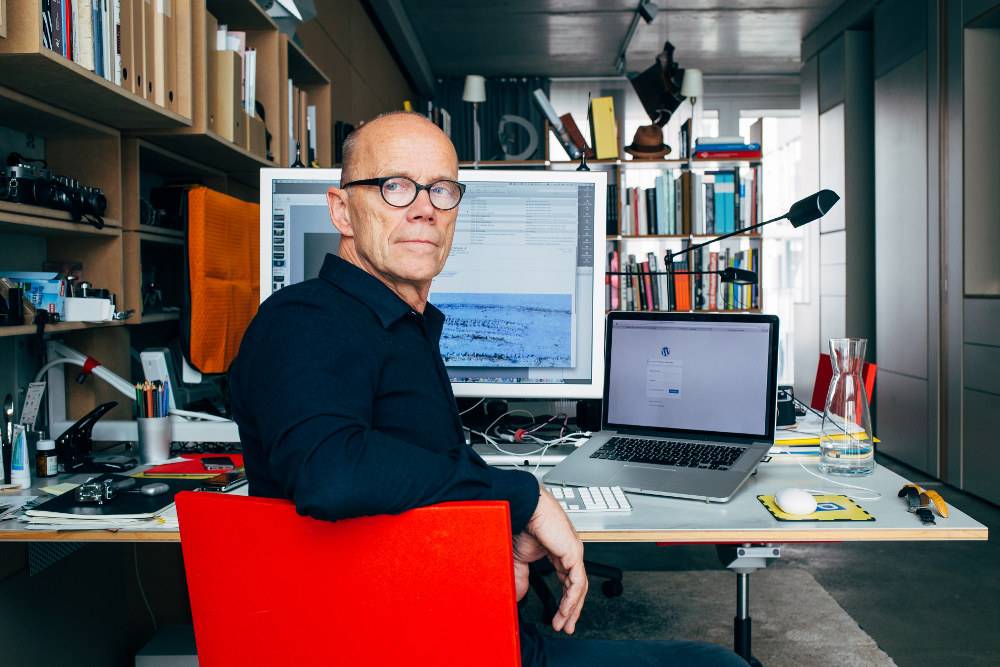
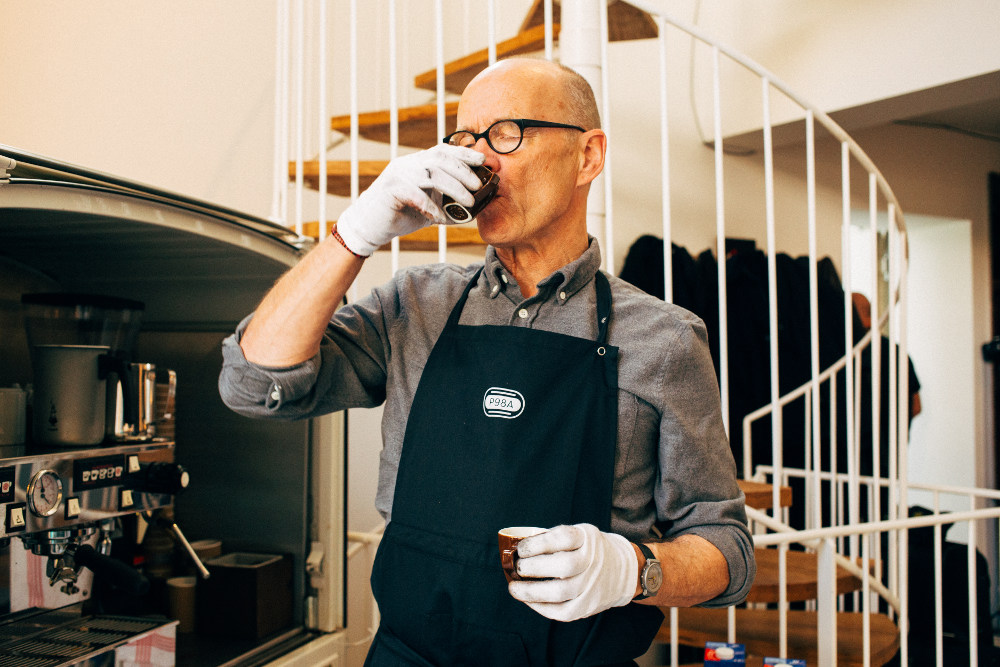
Erik Spiekermann in his Berlin home

Last week, I spent the day with Erik Spiekermann, who invited a small group into his Berlin-based print workshop, p98a, for an introduction to the letterpress. Organised by London branding agency Construct, the session brought together designers, writers and project managers who, like me, spend most of the working day in front of the computer, fixed to their screens or typing away on light, plastic keyboards.
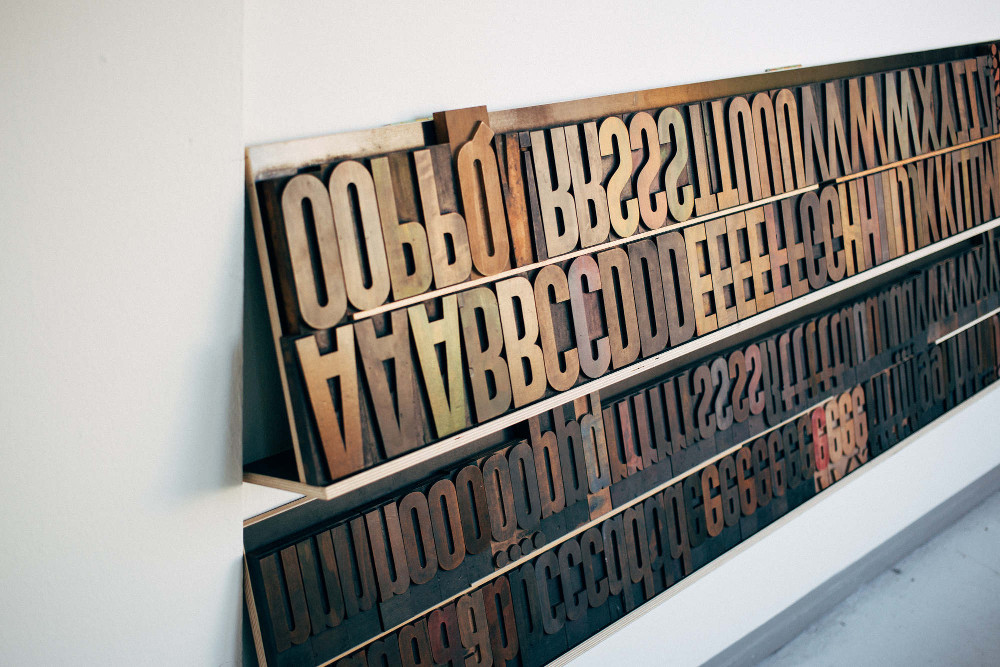
Wood type resting against the wall at p98a

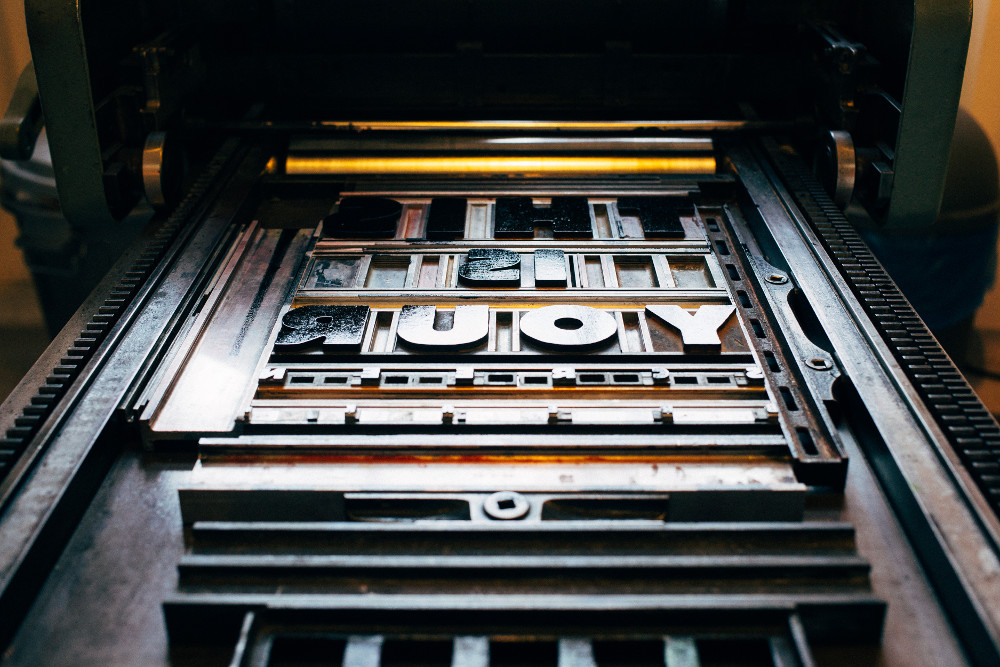
Today, however, we were due to be fixated on another rectangular surface: the bed of a letterpress, crafting words from wood not pixels. The workshop was an opportunity for us to break from the daily monotony, experience the heaviness and precision of typography before it all went digital, and return to a time when rotating a sentence diagonally wasn’t as easy as using the ‘spin’ tool, but required a hand cut wooden wedge instead.
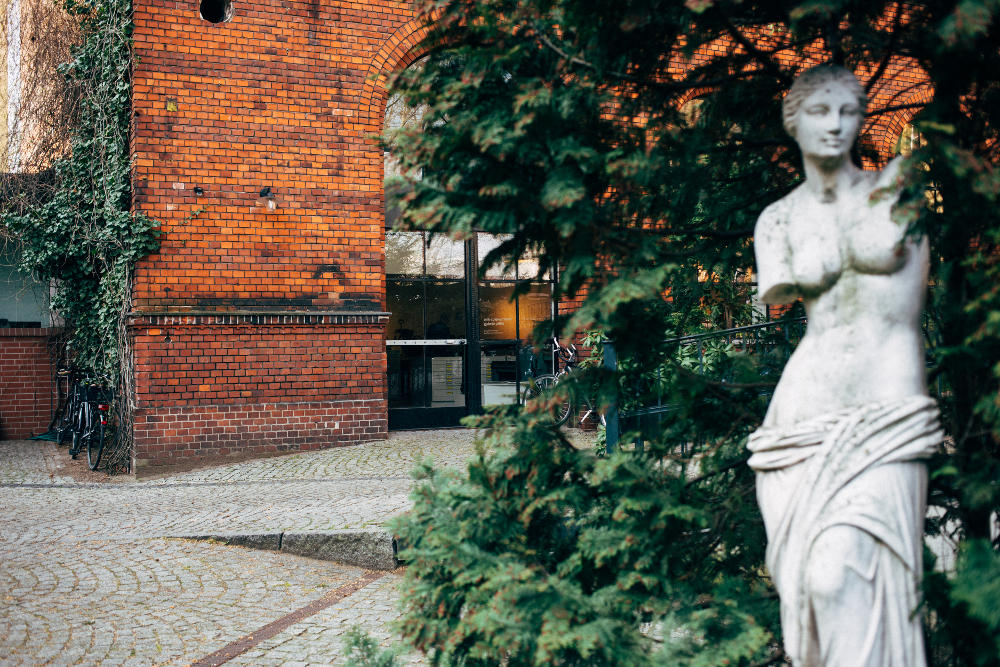
Entrance to p98a, Potsdamer Straße, Berlin

Along a silent yet immense street in Berlin, I found Spiekermann’s workshop nestled in a small green courtyard emerging from the greying road. In the 60s Spiekermann studied nearby, funding himself by running a letterpress in the basement of his house. His studio is now located just a few streets away on a strip of Potsdamer Straße – an empty stretch containing nothing else apart from a hat maker, who designs for the likes of Alexander McQueen, and a few rustic German eateries that sell p98a favourites like spätzel and small beers that arrive in ceramic mugs.
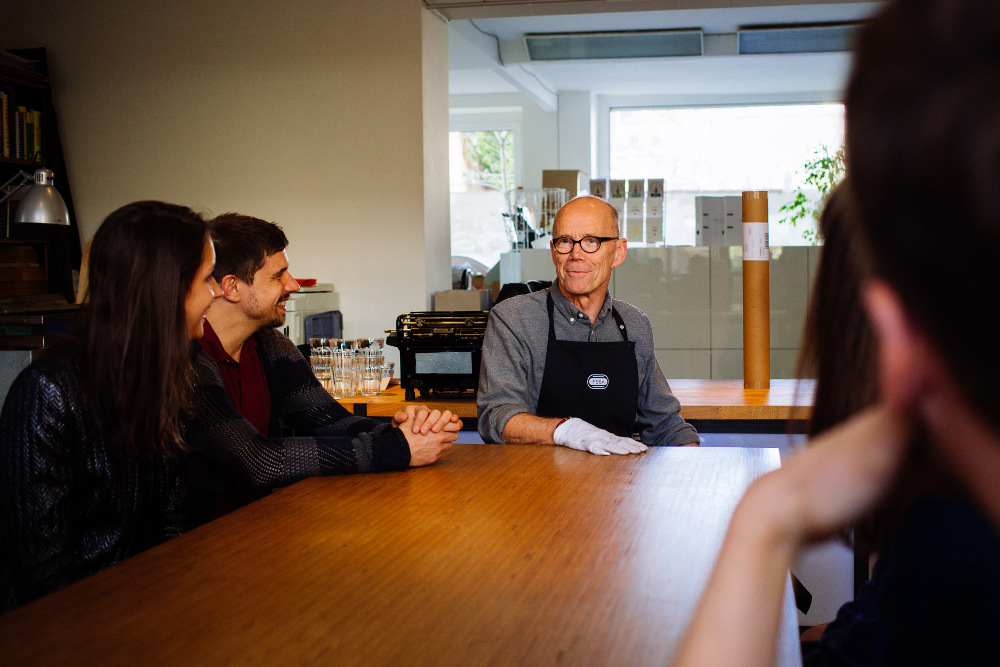
Spiekermann briefs the group on the workshop

Spiekermann greets us at the door, brimming with energy and good humour, wearing a craftsman’s apron and signature circular spectacles. He is a constant source of jokes, anecdotes and ideas, and moves around the solid machinery quickly like a dancer, bouncing from one idea to the next.
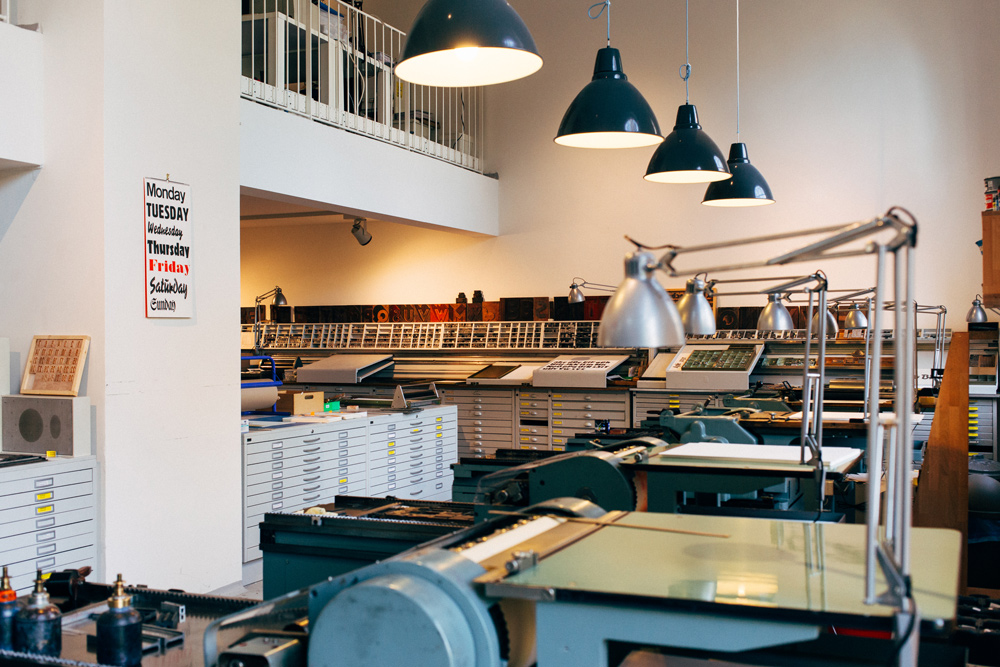
The p98a workshop
The p98a workshop

“This is hard work,” he says whenever he sees me struggling to keep up. “You’re not used to standing up all day, but when you’re here, you’re on your feet the whole time – this is manual labour.”
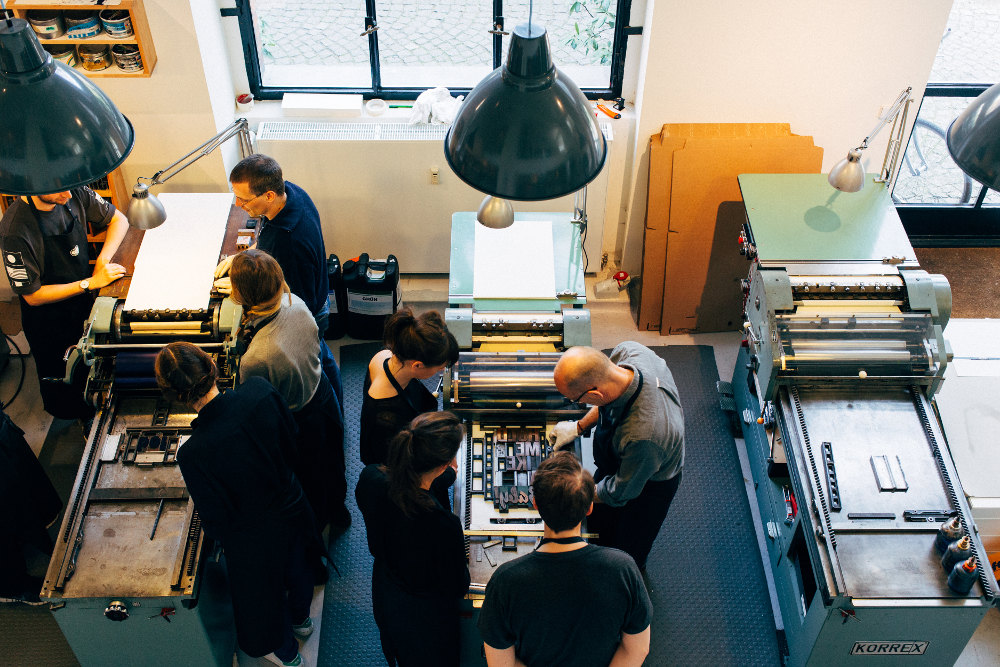
As he explains how the equipment works, his team weave in and out of him like parts of a mechanic clock – they obviously know the dance well. Alexander Nagel, a photosetting expert, hammers letter types into place on the press to keep them from moving around. Meanwhile, fellow p98a director Jan Gassel rolls black paint onto each letter with quick, forward strokes; Spiekermann’s assistant, Ferdinand Ulrich, reaches up to the highest drawers of font sets that no one else can quite stretch to.
The group divides into teams and I work with Tom Wittlin and Dan Jones from Poole creative agency Folk. We’re drawn to a strong typeface called Block, from one of the many drawers and decide on it for our poster. The typeface is bulging, with rounded, assertive sides and ragged edges; it feels solid, like all the machinery around us. Recently, p98a has been experimenting with 3D printing and laser cutting to produce their types. Spiekermann’s new wood type HWT Art, which he designed for the Hamilton Wood Type Museum, Wisconsin, US, is a slicker, more direct and less bumpy version of Block.
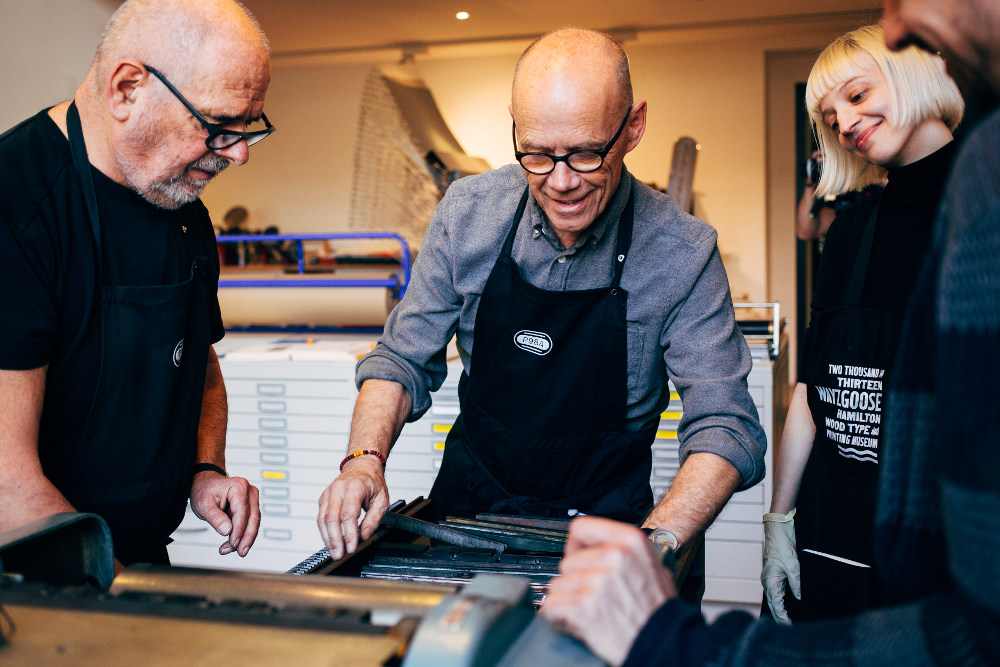
Madeleine Morley with Erik Spiekermann and Alexander Nagel

It’s like a modular puzzle where every piece is rectangular and grey

Axel helps me load a tray of the Block type for our print, putting in tiny slits of metal to make the space between each letter, using tweezers to insert and remove the pieces. We have to measure in cicero (a unit of measurement equivalent to 4.5 mm) and then find corresponding blocks to fit into the gaps – it’s like a modular puzzle where every piece is rectangular and grey.
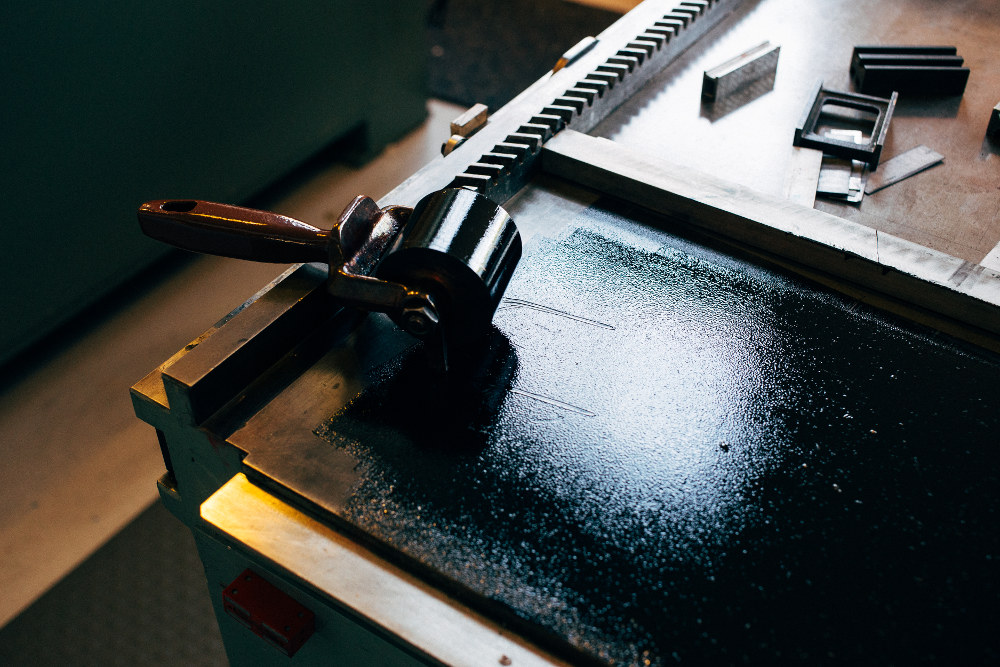
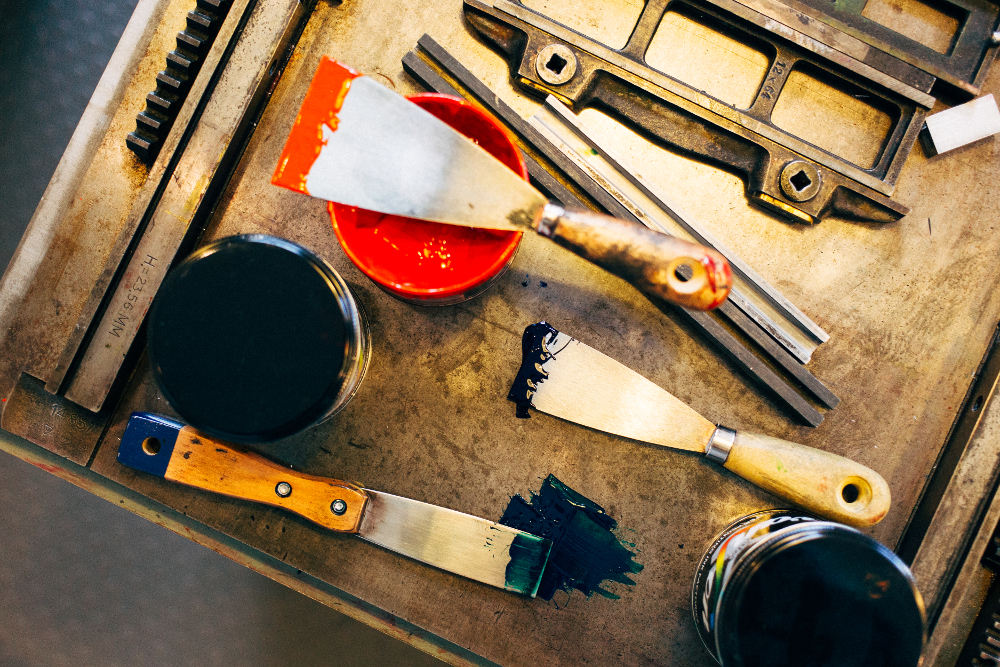
After a sheet has gone through the press, I roll paint on the type again, making sure the colour is thick and evenly distributed . The ‘H’ of our print keeps coming out faded, so we have to raise the type slightly by cutting out a piece of paper and placing it underneath. Once everything is set, we start the process of producing a stack of posters. “You can make around 200 of these an hour… if you’re fast,” Spiekermann says with a wink.
The process of printing is repetitive, slow, and surgical, but also very peaceful and contemplative – like knitting or carpentry. We insert pieces of paper into the letterpress, rotate the handle, stack the print on a drying rack, re-ink the font, then start again. By this point, we begin to develop a consistent and robot-like rhythm, but we’re a clunky, less graceful team in comparison to Spiekermann’s guild of typographers.
I ask Nagel why he prefers this method of design: “It has more… sinne,” he replies, using a German word that is difficult to translate. The term means ‘touch’ or ‘sense’. It refers to the haptic, but also means ‘significance’. This is something people say a lot about the printed page and its physical tangibility, but it’s something you don’t quite appreciate until you’re actually building one of these templates from metal, wood and paint.
From 10am and 6pm, my team and I have only just about finished printing one sentence and it’s in no way perfect or balanced. Hands are bruised, blackened with oil and grease and black paint, and my own are even cut slightly by the paper. My shoulders ache and my eyes are tired, not from being hunched over a laptop all day, but from stretching across the letterpress and putting my eyes up close to the smallest letters and punctuation marks.
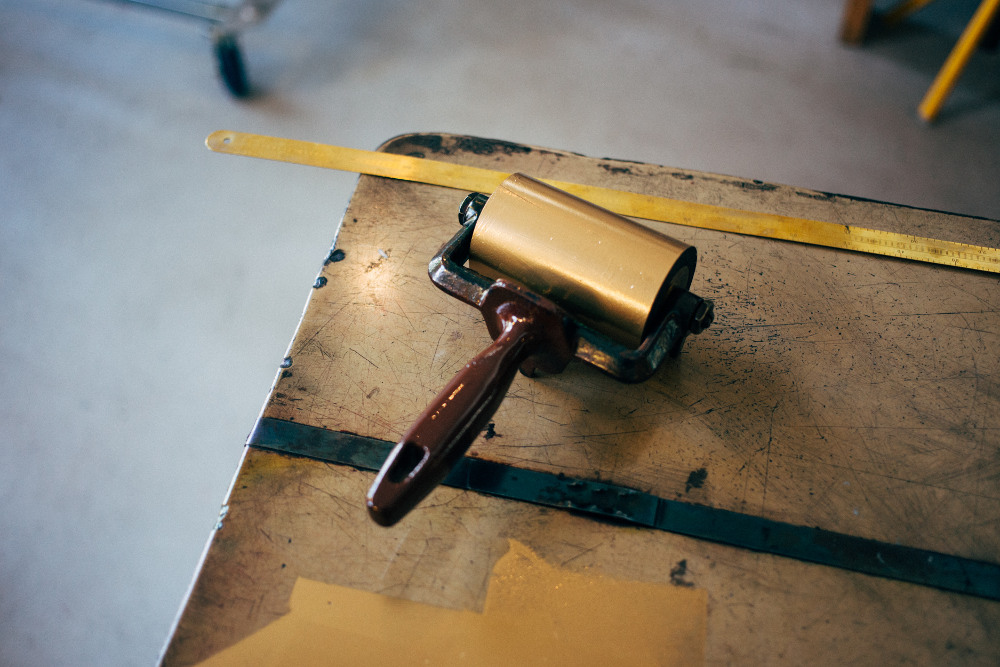
We clean the machine with blackened rags, determined to get one more colour on our design. I prime the press with gold paint and then we put a print that we’ve already made through the press again, moved slightly to the right, so that the gold prints on top of the black. Once it’s done, I hold it up to show Spiekermann, who has been our teacher for the day. “A drop shadow!” he energetically shouts across the room. “Yes! Experiment, try different things – that is what this place is about!”
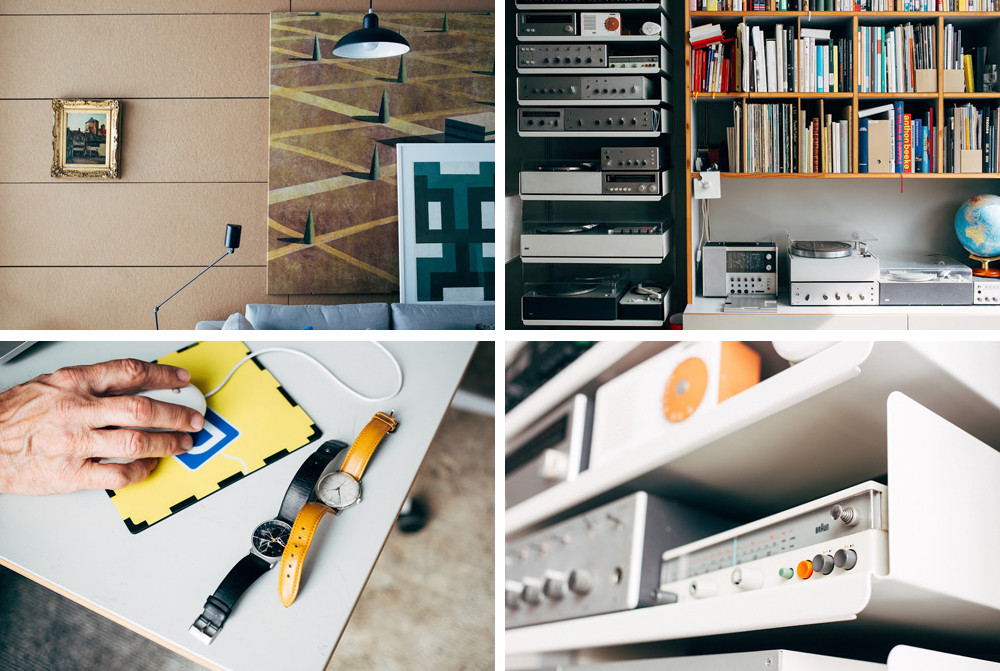
Inside Spiekermann's Berlin home, where he keeps a large collection of products created by industrial designer Dieter Rams
Inside Spiekermann’s Berlin home, where he keeps a large collection of products created by industrial designer Dieter Rams

The word ‘text’ shares its root word with ‘textile’ – a nod towards the shapely, woven and handcrafted nature of words. A day spent at p98a reminds you of the physicality of text, how materials shape an idea. As the workshop comes to a close, I find myself appreciating the complexity of creating a single word in a time when words can be typed and formatted so quickly.
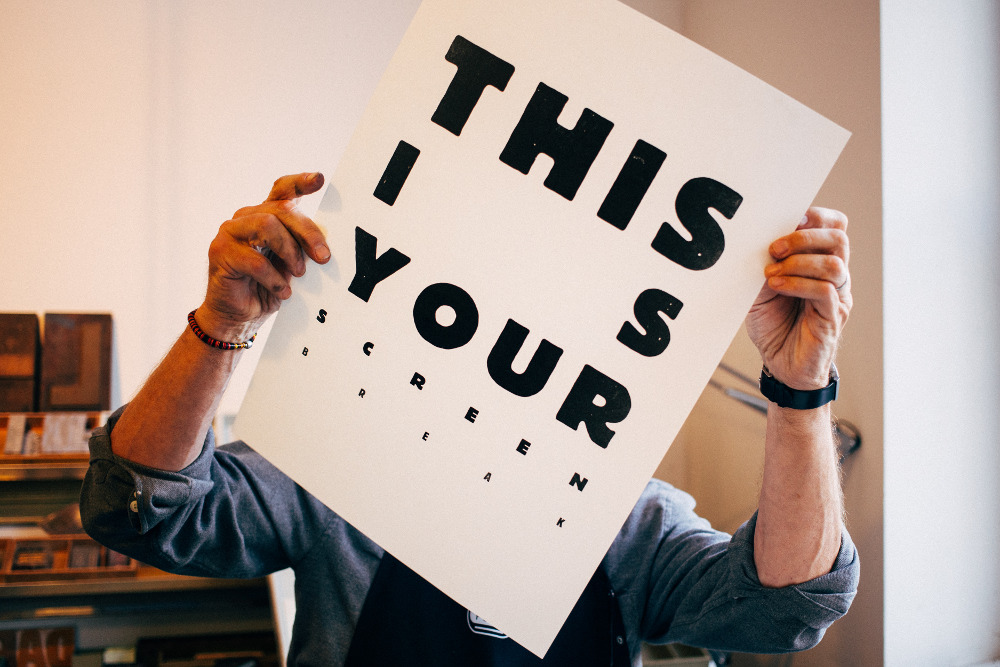
The finished print
The finished print

These days, rewriting a sentence is as simple as hitting the backspace, and colour can be altered with a simple click. At p98a, words aren’t something you simply churn out, and a single world is pleasurable when it fits just right – both in terms of its meaning and its alignment on the page. Returning home to my glaring laptop screen, the quickness of the computer allows me to experiment with sentence structure and rhythm, but the day at the workshop has reminded me to always choose my words carefully.
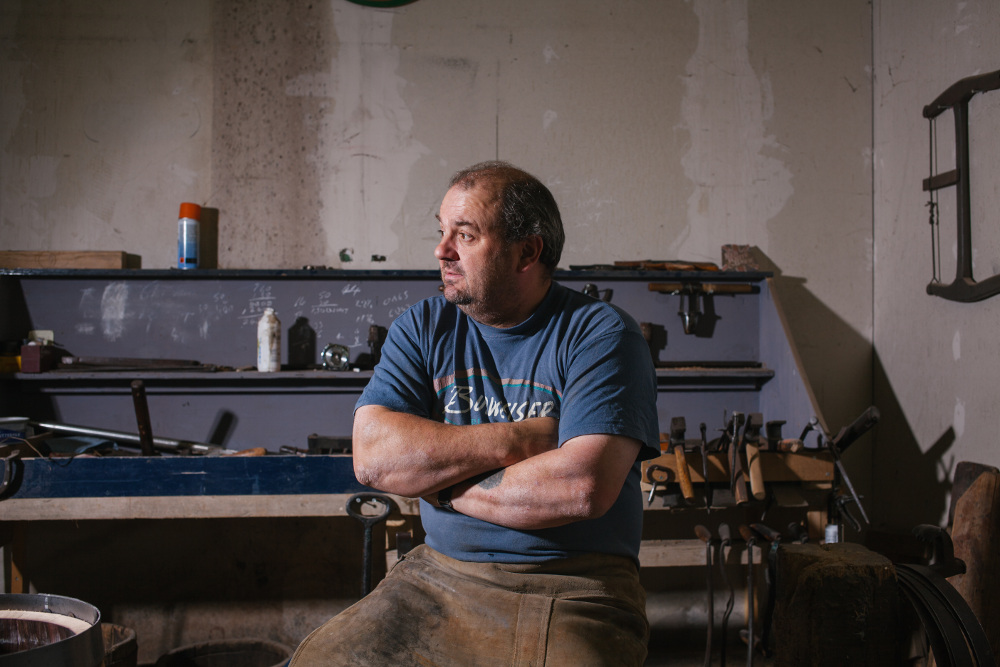
Photography Nikita Teryoshin

The Last Master Cooper

Master barrel maker Alastair Simms speaks with Clare Finney about the history, skill and significance of his craft at his Yorkshire-based cooperage

The Last Master Cooper

In November 1983, a young Alastair Simms was placed in the barrel he had just made, doused in water, and covered in a ‘muck’ of soot, feathers, shavings, beer and treacle. The outside of his barrel was then hammered by a dozen strong-armed coopers and rolled around and around. They lifted him out, tossed him in the air three times while singing, then dumped him back in again, only for him to emerge a few seconds later to be christened a fully-fledged journeyman cooper. In otherwards, a practitioner of the ancient craft of barrel making.

Thirty-two years on, a framed black and white photograph captures that moment: a teenage lad, face masked in filth, beaming as he crawls out of a beer barrel. It was, Simms confirms, a momentous day. “The initiation ceremony’s called ‘Trussing the Cooper’,” he says proudly, standing in his own cooperage White Rose in North Yorkshire, England. “It’s not changed since the 14th century.” Needless to say, it makes the rugby initiations at British universities look tame.

If becoming a cooper is a feat in itself, remaining one in the 21st century is a triumph. Last time Alastair Simms approached the media, it was to sound the alarm bells for the death of the coopering trade. “There are only four breweries left who employ coopers in the country and I’m the only master,” he announced back in 2009. He’d trained an apprentice while working with Weston’s Brewery in the 1990s – hence the ‘master’ title – yet he was struggling to find a new protégé. “Coopering is a proper historic, old-fashioned trade and if you don’t have a skill with your hands from a very young age then you can’t learn it,” he continued. Without a 16-year-old apprentice prepared to stick with him for five years, the art of coopering would follow him to the grave.

Barrels Last Master Cooper

If becoming a cooper is a feat in itself, remaining one in the 21st century is a triumph.

Coopering in England has in fact been in decline since the 1960s, when brewers realised metal casks would be cheaper and less troublesome than using coopers. “We have always had this strained relationship with them,” says Simms, “ever since the Worshipful Coopers Company won the right to be independent from breweries in the 1500s.” Back in the day, a head cooper had more clout than a head brewer and “he got better paid, too,“ Simms claims. Converting from wood to metal, therefore, proved tempting for breweries even if it did rather compromise the flavour of the ale.

In 2009, the nation heard Simms’ call to arms and within two months he found himself besieged with applications. Alas, the then-government’s myopic stipulation that a trainee attend university as well scuppered the apprenticeship plan. “There’s no university for coopering,” Simms growls. “It gets in the way and teaches them the wrong things.” On the plus side, the situation gave Simms the publicity he needed to survive.

As English winemakers bloomed and the craft beer revolution continued, demand for wooden casks grew apace. “Really what we are seeing now is Victorian brewing all over again – I’ve got an agent in Northern Ireland and in the States,” he says, happily. “What matters to microbreweries these days is the beer’s taste, rather than producing huge quantities”. And, according to Simms, when it comes taste, wood wins every time.

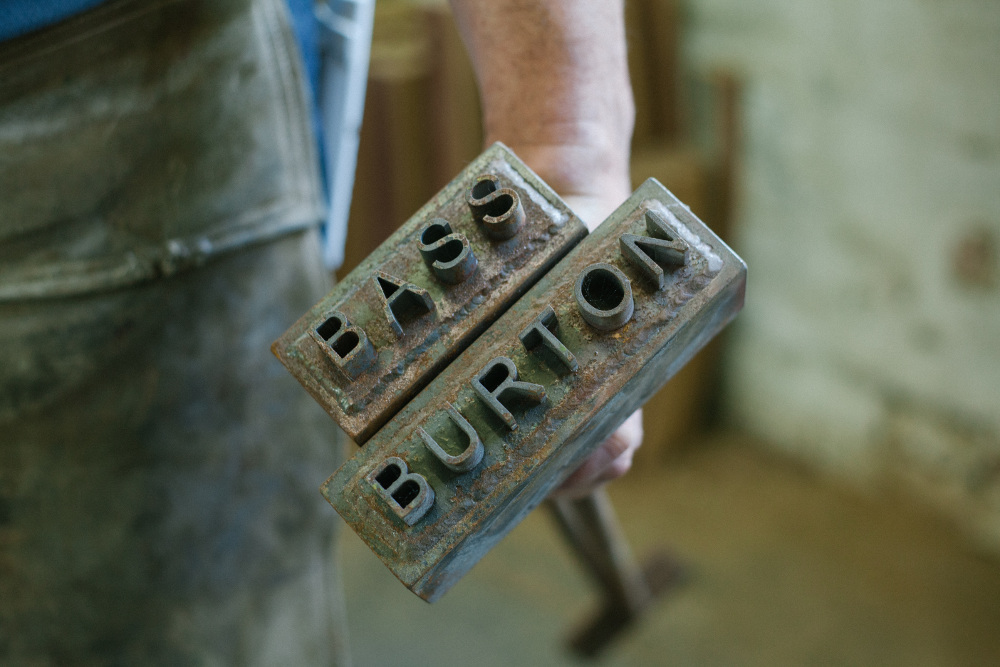
Bass Burton Last Master Cooper

I ask if Simms can really taste the difference between ale from wooden casks versus ale from metal ones. “It’s night and day,” he says. “Wood takes the sharpness off and enhances the flavour of the ale.” Of course this, while by no means irrelevant, is not all that interests microbrewers these days.

“I’m being asked to do things now that as an apprentice I was told I could never, ever do,” he tells me, “like this for example.” He rolls a large wine barrel – or, to use the technical term for this size, ahogshead – over towards me. “If we take this apart, there’s enough timber to make a 36-gallon cask, and the brewers like that it will flavour the beer too.”

Beer into old wine casks, beer into old whisky casks, beer into old rum casks – if it once held alcohol, microbrewers will experiment with it. “I ask these chaps what they want, and I give it to them,” Simms shrugs, looking the faintest bit sceptical. Ten years ago such ventures were unplumbed depths for him as a cooper. These days, they’re his stock-in-trade, together with regular ale casks, churns and water butts for film sets, and English wine barrels – a small, yet potentially lucrative market, once our winemakers realise there’s an alternative to the French barrels closer to home.

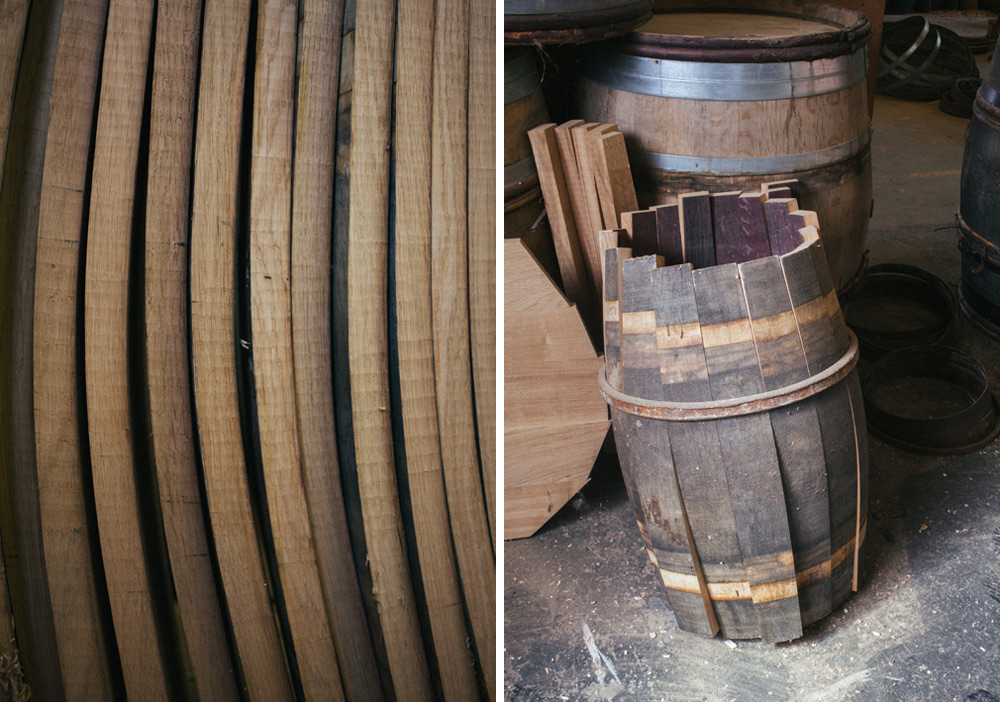
The wine cask Simms is currently leaning on is not his own, but hails from France. From there, it was transported to New Zealand to be filled with the Kiwi’s finest Sauvignon Blanc. “The brewers are hoping that by using wood once used for white wine, it will enhance the flavour of the hops,” says Simms, rolling the empty barrel back into his workshop. Inside, there’s one he unmade earlier: its stripped, spare-looking wooden slats (called staves) are ready and waiting to be cut and resurrected into a ‘new’ ale cask.

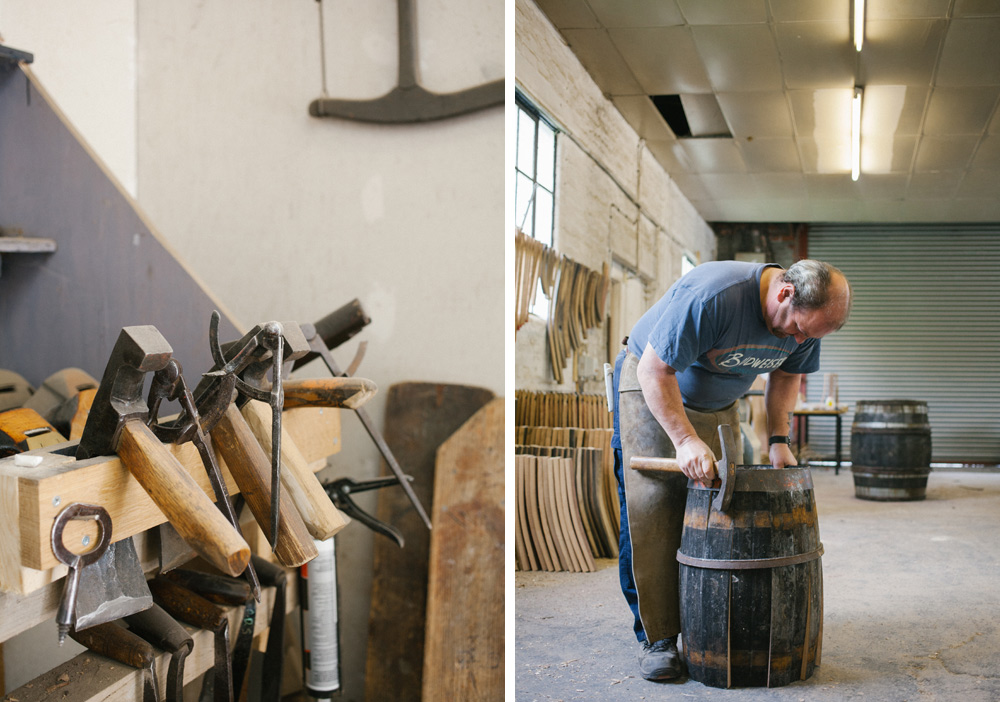
Tools Last Master Cooper

“Recycling is what we’ve always done. There’s nothing new here,” Simms explains, tossing a large stave effortlessly up into his hand to inspect it. A hogshead is converted into a barrel and a barrel is recycled into a kilderkin, which in turn becomes a firkin – the most common container for an ale cask.

“By the time it finishes its life it could be a 4.5 litre gallon, and the timber would be between 115 and 180 years old,” he says. ‘Barrel’ is a common misnomer, I’m told. “It’s actually a unit of measurement. The generic term is a ‘cask’, though there are plenty of landlords make that mistake,” Simms laughs.

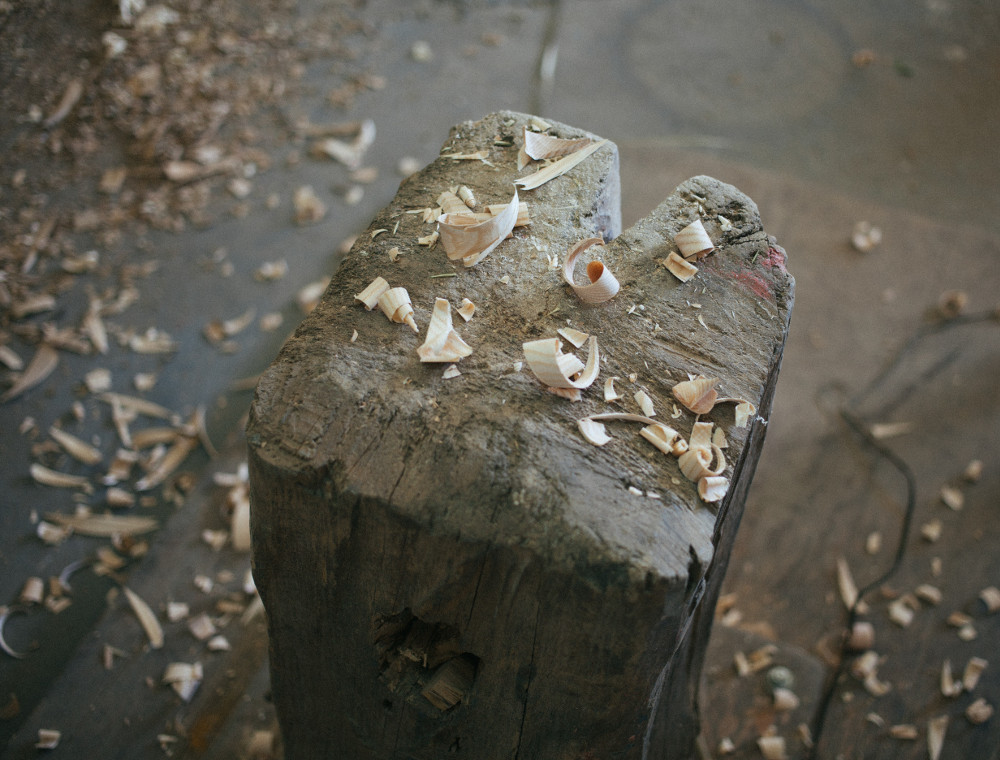
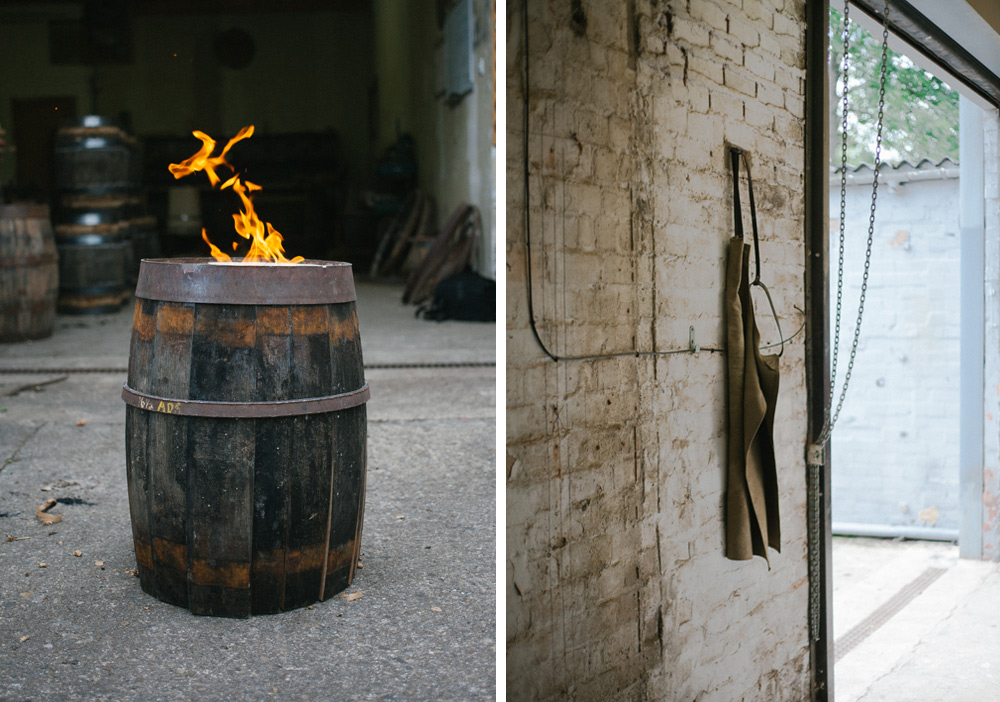
Tools unchanged in centuries send buttery curls of oak shavings flying from beneath Simms’ experienced hands as he reshapes the staves. No measuring is needed, as, after three decades, Simms judges by eye. “I normally play Black Sabbath at this point,” he shouts over the harsh barks of scraping wood, “or Sex Pistols if I’m feeling angry.” That done, he slots them into a metal ring at one end, and takes the half-made cask outside for the next stage: “New cuts need steaming, older cuts like this will bend after gentle heat.”

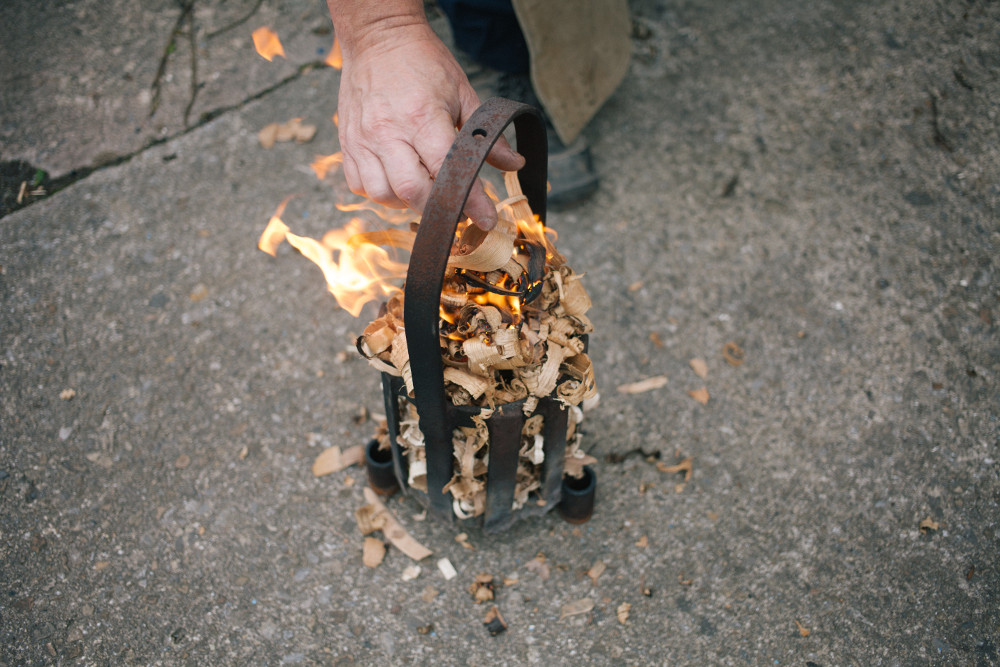
Flame Last Master Cooper

A fire is lit inside the cask without touching it, and a rich, sweet smell starts to seep out, creating white wine infused fumes. “The worst is whisky when you’ve a hangover – it makes your head spin.” When the staves are soft and warm to touch they can be bent into a second ring and left to cool. The finished cask needs no sealant or glue to bind it. “How do you test if the final cask water-tight?” I ask. “I don’t test it,” he replies with a smile and a shrug. “If it’s done right, it just is.”

Simms’ skill is self-evident, yet it’s not just his handiwork that has led him to spearhead this revival of coopering. After all, there are still four other coopers working in England today. What makes Simms special is that, aside from being the only master cooper in the country and a liveryman of the Worshipful Company of Coopers (now largely a charitable arm), he possesses an encyclopedic knowledge of the history of his trade. Indeed, he’s frequently found himself advising the historians.

His most recent commission saw him help with the filming of the Moby Dick adaptation, The Heart of the Sea. “Everything in those days on board a ship was stored in casks. The set directors and historians came to my workshop, saw some old, dirty barrels and said ‘those are perfect.’ I said, ‘they’re not, they’d be newly made in those days.’” In the end, Simms himself made nearly 200 casks for use in the film.

Shavings Last Master Cooper

Still, working on the set of Moby Dick must have been fun, I ask. “It was alright. Pretty boring,” he says. “Chris Hemsworth was alright, though.” The film, due out in December 2015, actually shows Simms working the ‘cooperage’ aboard the Peqod. “Naval coopers had two names: jolly jack tars, or groggers, because when a rum barrel was empty they’d fill it with boiling water, roll them around the cooperage, then serve up the contents. That was called grog,” he says. “You’d have to be careful with that though. If it had wood alcohol mixed in it too, you could go blind.”

At this point, Simms stops talking, gnaws aggressively at his hand, then spits vehemently. “Splinter,” he says, “occupational hazard.”

He enjoys working for himself. He’s had his own cooperage for two years now, having been freelance at Wadworth’s Brewery before, but he’s looking forward to having an apprentice next year. “The Worshipful Company are trying to get me one,” he says. “They’re just waiting for funding now. My mate Camilla says to ask Charles about it.” Charles and Camilla as in the Charles and Camilla? I ask, taken aback. “The very same,” he replies. “She thinks he’ll be interested,” Simms adds, in the manner of a man who’s no stranger to the Royal Family. Sure enough, it transpires he’s met a lot of royalty on his mission to save coopering. “I’ve had a pint with Prince Philip,” Simms says. “He loves to hear about the craft – as does Her Majesty, in fact.”

Maybe it’s the whiskey odour, maybe it’s the Cooper’s Trussing, but Simms is not a man afraid to assert himself. The ‘wine-flavoured’ cask completed, we retreat back to his office for a pint of ale. It tastes… complex: malty, woody and warmly rich, having come from his personal cask.

Fire Last Master Cooper

“When I was made a Freeman of the City of London they took me to the Lord Chamberlain court and gave me a drink of malmsey,” he says after a long, deep draught. “It’s part of the ceremony – and when I’d finished it I said, ‘I’ll have another of them, please’, he tells me. “The assistant said, ‘you can only have one’, but the Chamberlain knew better. ‘He knows his history,’ he said to us. I said to him, ‘Yes, I certainly do’. You see, the coopers bribed the court with half a butt of malmsey to secure their independence from brewers in the 1533. ‘We bought you malmsey,’ I said, ‘and I’ll have another please.’”

Simms raises his pint glass and I meet his with a cheers. The future of coopering might rest with this man, but if it does, it’s in safe hands.

Photography by Joseph Fox

Charles Mackintosh: An Architect For An Art Lover

The new display of drawings by Charles Rennie Mackintosh at London’s RIBA Architecture Gallery offers an opportunity to experience the evolution, influence and legacy of the great Scottish architect

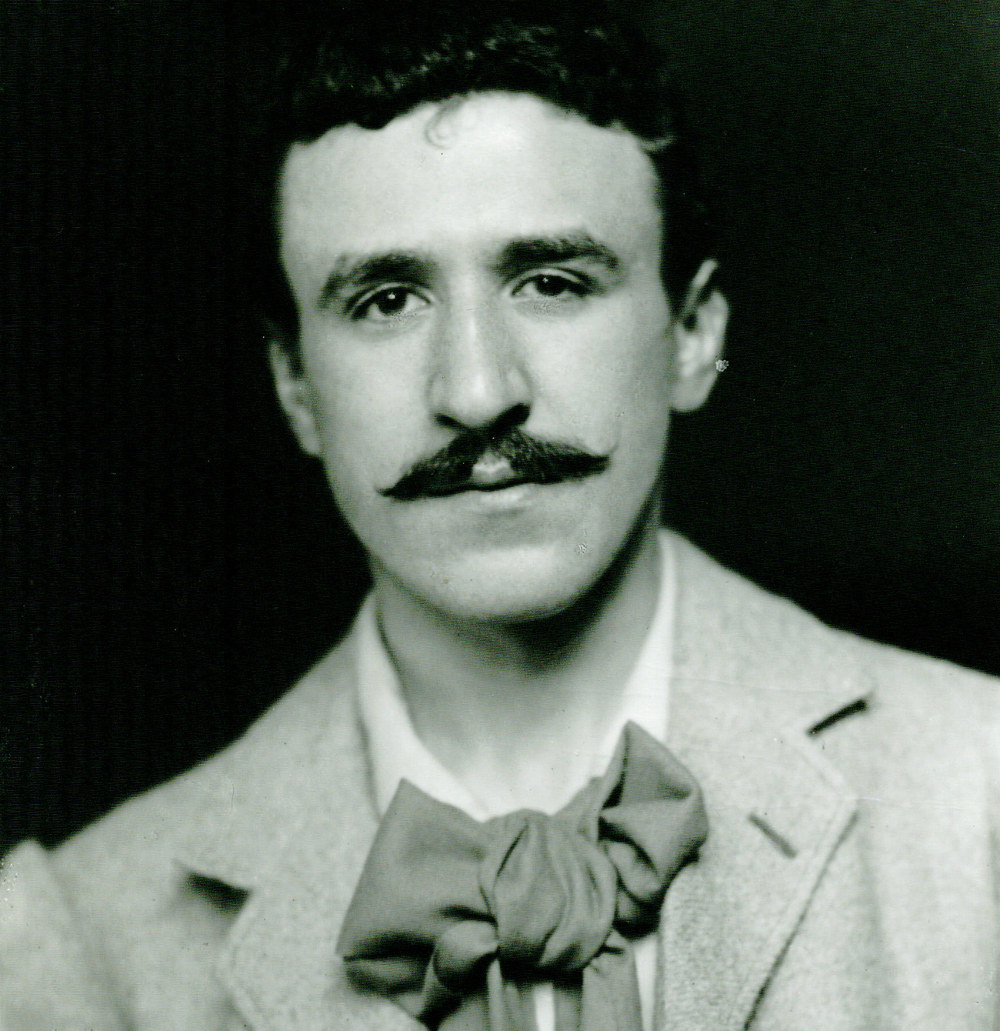
Photograph of Mackintosh, 1893 by James Craig Annan

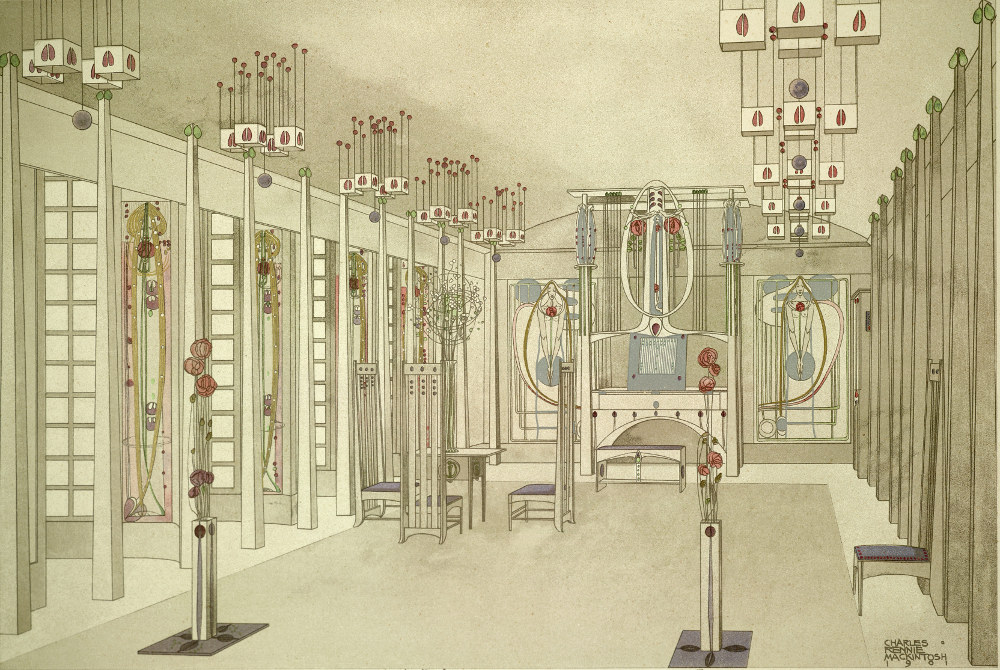
During the nine decades since the death of Scottish architect Charles Rennie Mackintosh, a continuous revival in public interest around his work has been in motion. Glasgow’s year as the European city of culture in 1990 saw a celebration of Mackintosh’s achievements whilst in 1996 his ‘House for an Art Lover’ was posthumously realised in Glasgow’s Bellahouston Park. The buildings designed by Mackintosh are often cited by architectural critics as amongst the finest in the UK, yet during his lifetime his career was marked as much by its difficulties as by its successes, with many of his designs never making it past the drawing board.

Mackintosh Architecture at London’s RIBA Architecture Gallery is the first exhibition to be devoted to his architecture and showcases 60 original drawings, watercolours and perspectives to reveal the evolution of the master’s style from early apprenticeship to later projects as an individual architect and designer. Conor Mahon spoke to the exhibition’s curator Susan Pugh about presenting the fascinating life and career of Charles Rennie Mackintosh.

Design for Scotland Street SchoolMackintoshUniveristy of Glasgow

Why is this an important time to exhibit Mackintosh’s work?

The exhibition marks the completion of a four-year research project undertaken at The Hunterian, University of Glasgow, which has resulted in the first full catalogue raisonné of Mackintosh’s architectural work. This is an amazing online resource which is now available online for all to see. It is also a critical time to focus upon Mackintosh in light of the tragic fire at the Glasgow School of Art last May.

“Mackintosh had an intense passion for art and exquisite skills as a draughtsman”

What insight into Mackintosh’s personality does this exhibit offer?

We learn about Mackintosh’s role within the architectural practice of Honeyman & Keppie, and also something of the difference between his personality and that of his partner John Keppie. Keppie was an adept committee man, amenable and flexible, qualities which Mackintosh may not have been known for.

How do the four contemporary artworks that accompany the exhibit interact with the Mackintosh’s legacy?

Our contemporary section to the exhibition, Beyond Mackintosh, celebrates the thriving artistic community of present-day Glasgow by presenting selected works from alumni of the Glasgow School of Art. These works respond to Mackintosh as an artist and the experience of studying within his iconic building.

Design for a house for an art lover, 1901 (c) RIBA Library

The School has generated impressive numbers of renowned architects, Turner Prize-winning artists and designers within a city that continues to prosper as Scotland’s preeminent cultural capital, despite periodic economic and political difficulties. There are two animations by Katy Dove, a sound piece by Lucy Reynolds and a poem by the National Poet for Scotland, Liz Lochhead, which are played daily in our restaurant.

In terms of the arrangement of these works, what do you hope to convey to the viewer?

Mackintosh had an intense passion for art and exquisite skills as a draughtsman. His personal development within the practice of Honeyman & Keppie (later called Honeyman, Keppie & Mackintosh) and the evolution of his very distinctive style of draughtsmanship, as well as his unique, stripped-down architectural style, all come through in the show.

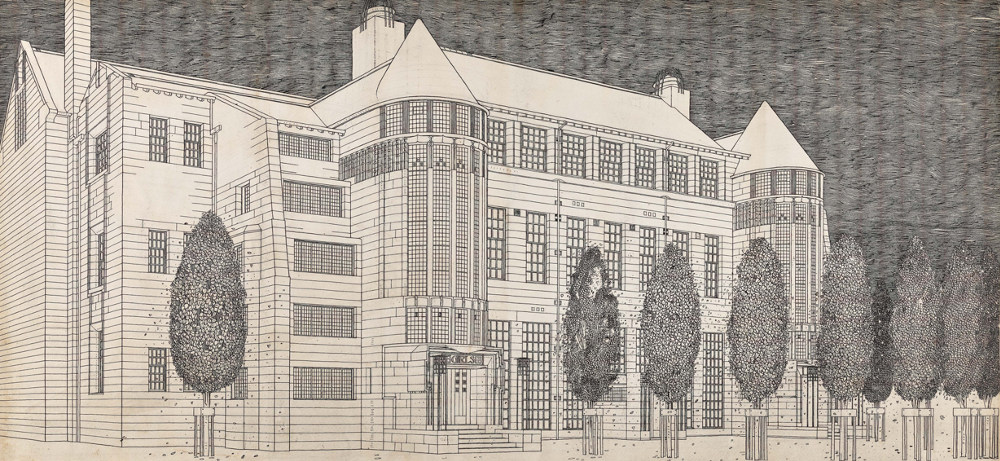
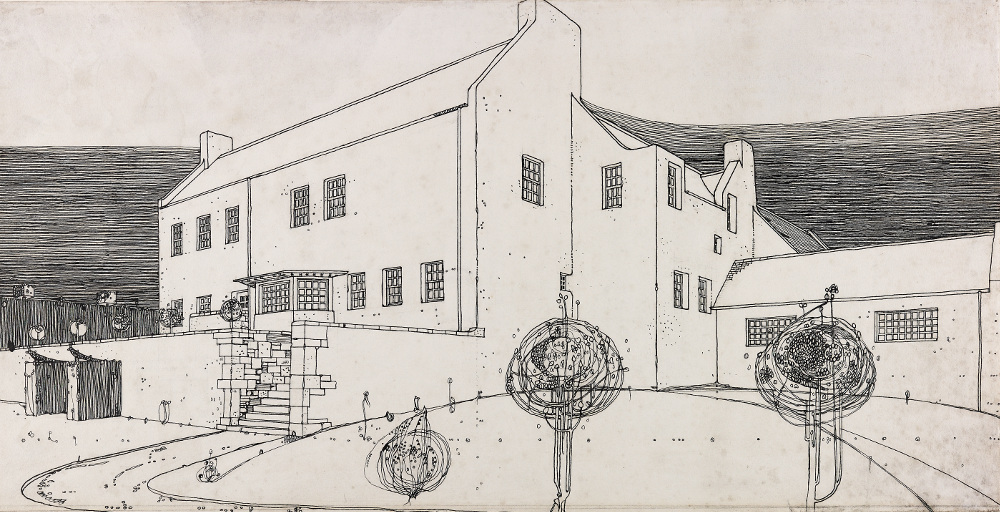
Windy Hill, perspective drawing in ink, 1900,Glasgow School of Art

Many consider Mackintosh’s building at the Glasgow School of Art to be his greatest work. Are there any other overlooked contenders?

I would also put forward Windyhill, the house he designed for his good friend and patron William Davidson. This was the first building to be carried out in Mackintosh’s stripped down, vernacular, roughcast manner and it acted as a model for both The Hill House and his House for an Art Lover design. Windyhill isn’t as well known as it remains a private residence, whereas The Hill House is open to the public as a property of the National Trust for Scotland.

Were there any notable challenges during the production of this exhibition?

The temptation is always to include more. As with all architectural shows, there was also the challenge of how to help the public understand and appreciate the featured buildings within a gallery space, which we addressed with the addition of models, films and photographs.

Mackintosh Architecture runs at the Royal Institute of British Architects until 23 May 2015

On the Fly

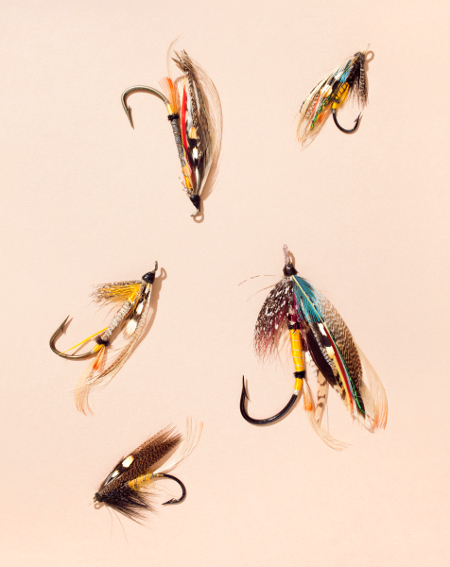
Non-fiction author Charles Rangeley-Wilson inspects the artistry and skill surrounding the fisherman’s flyFlies togetherIt is said that Tenkara, a Japanese form of fly-fishing in which the angler dances up the stream, caressing the water with his line and lure, was developed by Samurai warriors: that swordsmanship and art came together in pursuit of the Cherry salmon. There were, no doubt, easier ways to catch these pretty fish. But, the world over, something in the gratuitous beauty of fish that belong in the salmonid family seems to demand correspondingly ornate methods of capturing them. In British waters we have Atlantic salmon not Cherry, but these bright fish draw a similar response from the men who chase them. Nets are used by those earning a living. But when it comes to rod and line angling what matters is the art of it and the art is built around the fly.

The first was used 2000 years ago in Macedonia and was literally a fly, or a feathery representation of one: red wool and two feathers from under a cock’s wattles. The salmon flies here must look, if anything, more like small fish than insects but the line of evolution is clear, from the Macedonian bee to these baroque creations. They are late Victorian, and as filigreed therefore as salmon flies ever were before or ever have been since. Even their names have a sort of Highland romanticism: The Silver Spectre, Taite’s Fancy. For the fly called Jock Scott (middle right) George Kelson, author of the The Salmon Fly, 1895, reserved special praise: it was ‘the utmost triumph of harmony and proportion’. Of the Akroyd (bottom left) Kelson advised that Spey anglers should trial it with Mallard wing ‘for ordinary occasions’, that men of the Usk should use Black Turkey, whilst on the Earn, he noted, Mandarin Drake had been known to secure more than one tight line.

Did it make any difference to the salmon of the Spey, Usk or Earn even on ‘ordinary occasions’? Who knows? A taking salmon will, maddeningly, sometimes snap at anything, and sometimes only at one thing. Such intricate detail and artistic qualities, one suspects, were more about catching men than fish.

Words Charles Rangeley-Wilson

Photography Sam Harris

B&B Italia: Breaking the Mould

Port’s design editor Alyn Griffiths reflects on the life and legacy of B&B Italia founder, Piero Ambrogio Busnelli

Grande Papilio chair by B&B Italia

In January of last year, one of the design industry’s true pioneers, Piero Ambrogio Busnelli, died at the age of 87. In 1966, the Italian entrepreneur was responsible for introducing the new technology of cold polyurethane foam moulding, which helped improve the comfort and design of the seats and sofas many of us sit on every day.

The process enables designers far greater freedom to create expressive seating shapes that support the curves of the body, and was key to the success of B&B Italia, the label Busnelli founded to explore the industrial potential of his technological breakthrough.

B&B Italia’s furniture is produced by first constructing a metal load-bearing frame, which is fitted with straps, springs and additional structural components. Every product has its own frame and a dedicated mould. The frame is then placed into the mould, where a chemical reaction causes the injected chemical components to gradually expand and solidify to take the final shape of the chair or sofa. The process is capable of achieving complex curving seats, such as Japanese designer Naoto Fukasawa’s bestselling Grande Papilio chair (pictured) and has been used throughout the decades to create products that helped confirm B&B Italia as one of the world’s most innovate furniture brands.

Collaborations with leading designers, from Gaetano Pesce to Edward Barber and Jay Osgerby, have also been crucial in establishing the company’s reputation for developing cutting
edge products.

The second generation of the Busnelli family is now overseeing B&B Italia’s growth into new international markets and areas such as outdoor products and contract furnishings. The company also continues to invest in new materials, processes and technologies, with over three percent of the firm’s annual turnover dedicated to research; a fact that would make its forward-thinking founder proud.

Illustrations by Tim McDonagh

Grande Papilio chair by B&B Italia

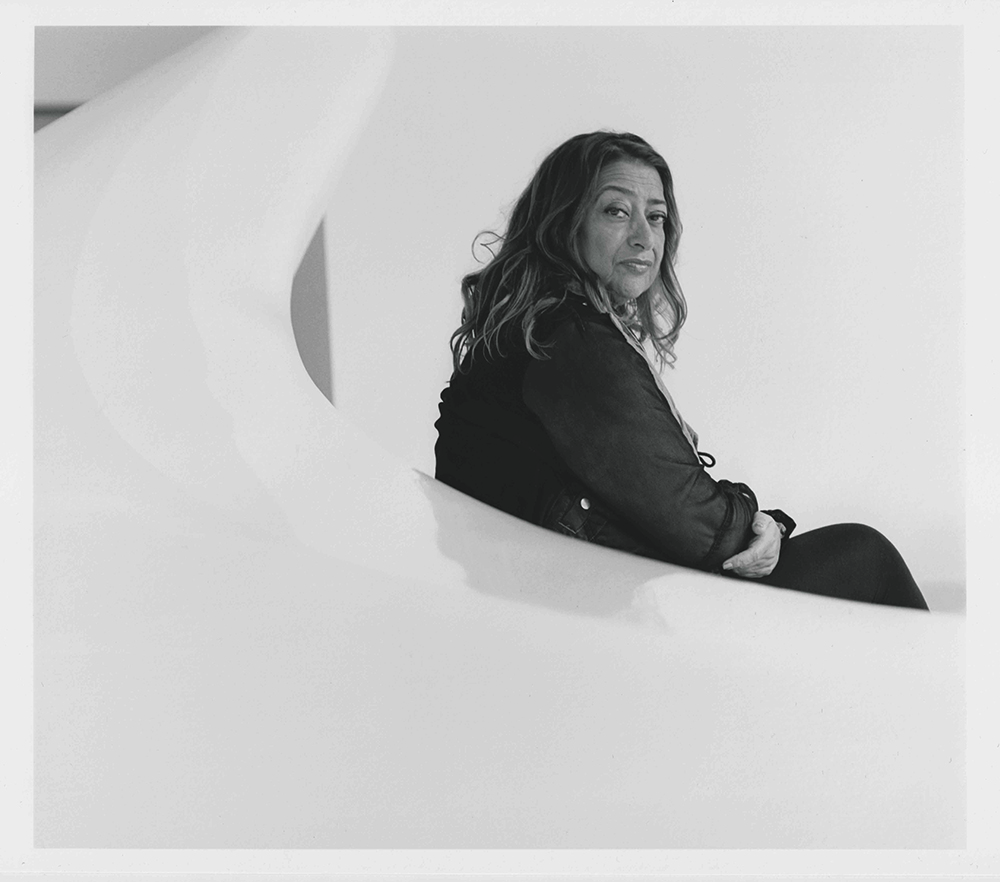
In Conversation: Zaha Hadid

Dame Zaha Hadid tells PORT’s design editor Alyn Griffiths about her inspirations, collaborations and the challenges of being a female Arab architect

Zaha Hadid was the first female recipient of the Pritzker Architecture Prize in 2004 and has since won the Stirling Prize twice, in 2010 and 2011. She is also the first woman to be awarded the RIBA Gold Medal in her own right. Here, in an extended extract from an interview that ran in PORT issue 7, Hadid discusses how she discovered architecture, her greatest challenges and how her designs push the limits of digital technologies.

Why did you choose a career in architecture?

When I was perhaps six or seven years old, my aunt was building a house in Mosul in the north of Iraq. The architect was a close friend of my father and he used to come to our house with the drawings and models. I remember seeing the model in our living room and I think it triggered something in me.

When I was a kid, I travelled to Europe every summer with my parents, and my father made sure I visited every important building in sight! I still remember visiting Cordoba. I was seven years old, and that was the most stunning space. Of course there are lots of other truly great spaces but this mosque left a really tremendous impression on me.

Which architects or personalities have inspired you throughout your career?

The late Alvin Boyarski – the fantastic chairman of the Architectural Association during my student years and years as a teacher – offered me my first platform to test my ideas, and Rem Koolhaas and Elia Zenghelis were crucial as my teachers. Their understanding and enthusiasm really ignited my ambition. There was such a buzz in the school at the time. Everyone was on the brink of doing something new – I will never forget that. The students and the staff at the AA at that time have been seminal to the past 30 years of architecture. It is still influencing current work. That is really amazing.

For an architect, one of the best things about London is the experience and skills of the consultants. This is very important to me. There’s uniqueness to the city; the education, the amount of research and invention. Anything you want, you can get someone to advise you on. In the developing years of my career that was really critical. The seminal figure was Peter Rice. He was the first of that generation; matching innovative engineering with new, untried ideas and concepts. My experience with Peter Rice was extremely fulfilling. I was like a student and he was such an accessible, humble man. He taught me that you have to have a strategy and that even if you’re not an engineer; you have to understand that a building requires common sense.

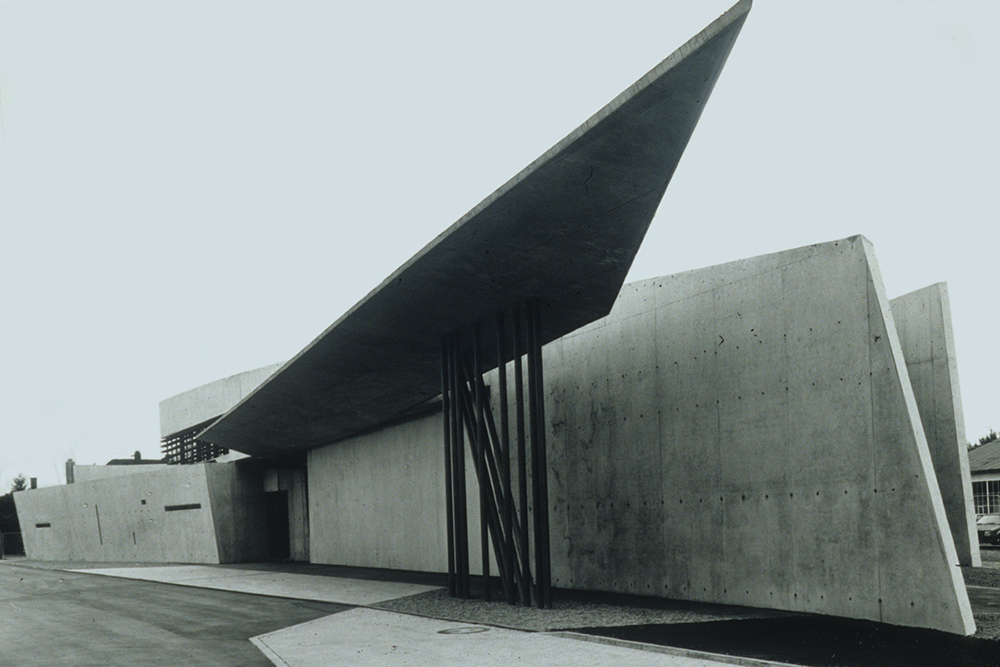
Zaha Hadid Studio, Vitra Fire Station, Weil am Rhien, 1993. Photography Helene Binet

Rolf Fehlbaum, the Chairman of Vitra, where I built my first project, dared to engage me without seeing a prior track record and without the certainty of public success. He was inspired by my ideas and visualisations. Rolf is an incredible client.

The teachers who taught sciences in the nuns’ school I went to when I was growing up in Iraq were all from university and so the levels of the science courses were really incredible. The headmistress, who was a nun, was very interested in the education of women, so in a way she was a kind of pioneer in that part of the world.

What is the greatest challenge you’ve had to overcome in your career?

In 1994 we entered the competition for an opera house in Cardiff. We submitted it, we had a call announcing we’d won it, and then the incredible jubilation in our office turned to great sadness when the project was cancelled. It devastated us, and I had to pick up the pieces. In that period in the mid to late 90s we did one competition after the other – and we didn’t win any. Perhaps there was a stigma against us because they were all great designs. They were all very tough and soft at the same time – elegant and resolved in terms of planning.

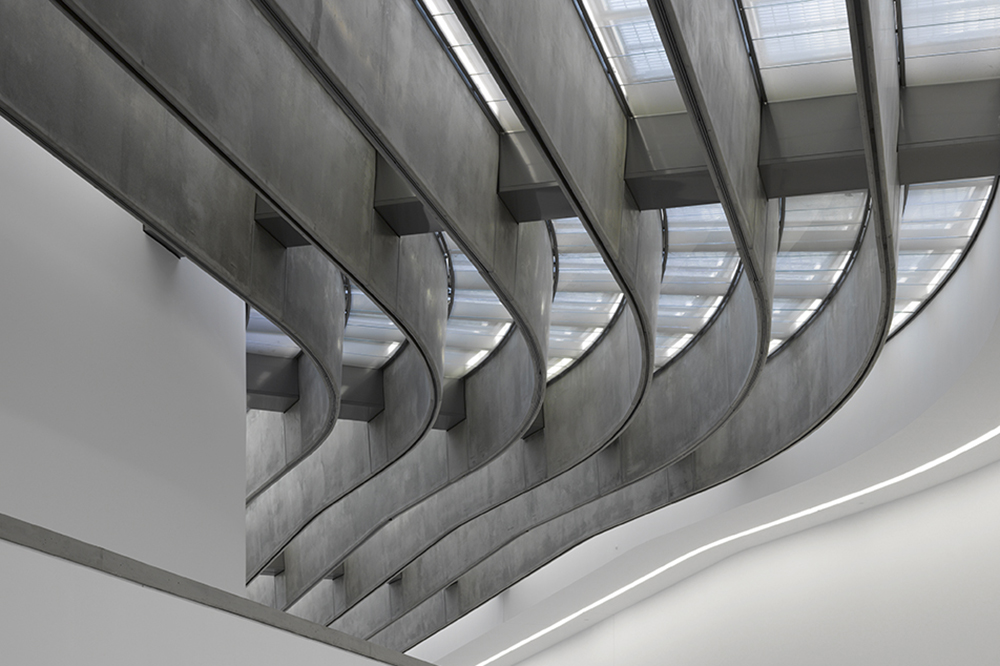
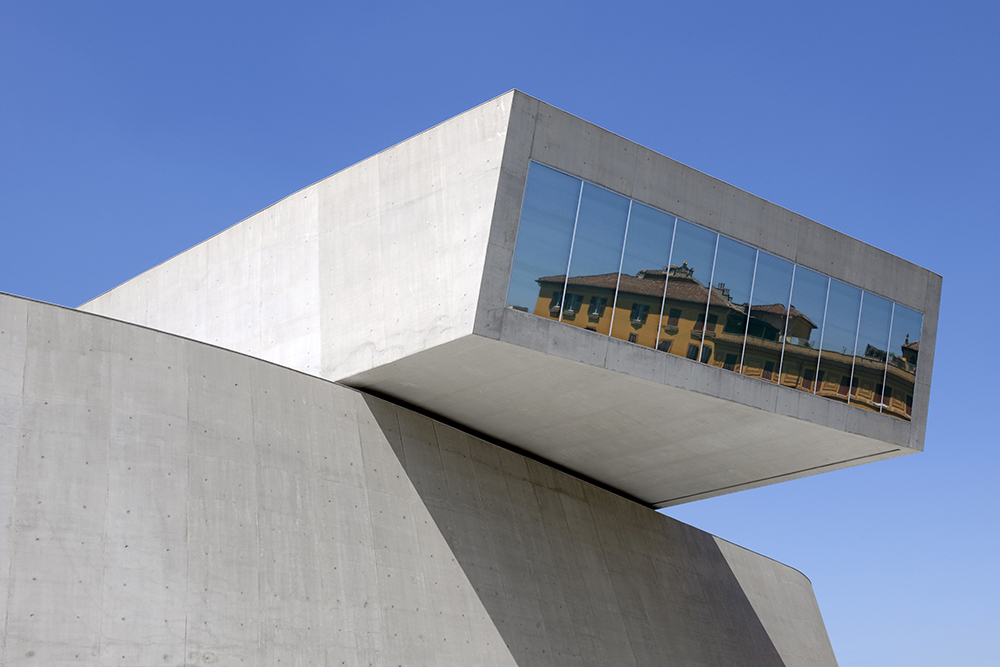
National Museum of the 21st Century Arts, Rome. © Roland Halbe 2009

These unrealised projects were necessary to develop our repertoire of research that allowed us to develop all of our future projects. We learned a lot from them; in fact, we still reference them in our work today.

It is very important to have the commitment to persevere, and to go back to one’s own education in a sense. As a woman you need the confidence that you can carry on and take new steps every time. I believe in hard work; it gives you a layer of confidence. Now we can do a lot of different projects because we have an enormous formal repertoire. The years in isolation, when we were quarantined in a sense, is like research in science. The more research you do, the more and the better the results.

Architecture is a very tough profession. Every architect you talk to, no matter how successful they are – man or woman – has it very difficult. Perhaps it was my flamboyance rather than being a woman that gave me such determination to succeed, but I have always been extremely determined. Now I’ve achieved some success, and I am extremely grateful, but it’s been a long struggle. It’s not as if I just appear somewhere and everybody says ‘yes’ to me – it’s still a struggle, despite having gone through it a hundred times.

National Museum of the 21st Century Arts, Rome. Photography Bernard Touillon

Being a woman and an Arab has definitely presented setbacks. You cannot believe the enormous resistance I have had to face – and sometimes still have to face – just because I’m an Arab. And a woman on top of that! It is like a double-edged sword. With some people, I must work hard to overcome one – and then the other comes up. The moment my woman-ness is accepted, the Arab-ness seems to become up as a problem.

Being an Arab woman and an architect certainly don’t exclude each other. In fact, when I was growing up in Iraq, there were many woman architects. I should say that yes, I am an Arab, but I was not brought up in a traditional Arab way, I have not lived there for thirty years, so in that sense I am maybe not a typical Arab. I’m Iraqi; I live in London; I don’t really have a particular place, and I think in this situation you really have to re-invent yourself, or you invent your world – you have liberation from certain rules. I can say from my personal experience, it is actually a very liberating experience – being totally displaced.

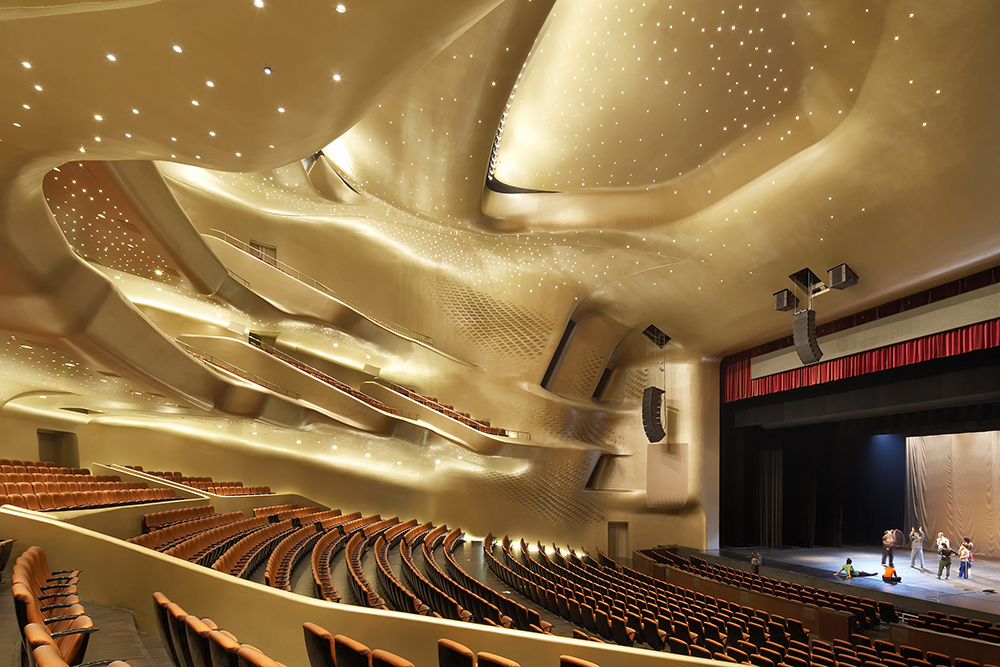
Guangzhou Opera House, Guangdong Province, China. Photography Hufon + Crow

Which companies do you particularly enjoy working with and why?

We greatly enjoy all our collaborations. They provide an opportunity to express our ideas through different scales and in many diverse media. We see it as part of a continuous process of our on-going design investigation. It’s a two-way process – we apply our architectural research and experimentation to these designs – but we also learn a great deal from the process of collaborating with others who lead their own industries. A brilliant design will always benefit from the input of others. Of course there is a lot of fluidity now between art, architecture and fashion – a lot more cross-pollination in the disciplines, but this isn’t about competition, it’s about collaboration and what these practices and processes can contribute to one another.

Our designs demand continual progress in the development of new technologies, and our collaborators continue to respond by providing ever more sophisticated design and fabrication applications. There is a strong reciprocal relationship whereby our more avant-garde designs encourage the development of new digital technologies and fabrication techniques – and those new developments in turn inspire us to push the design envelope ever further. Great things come from this method of working!

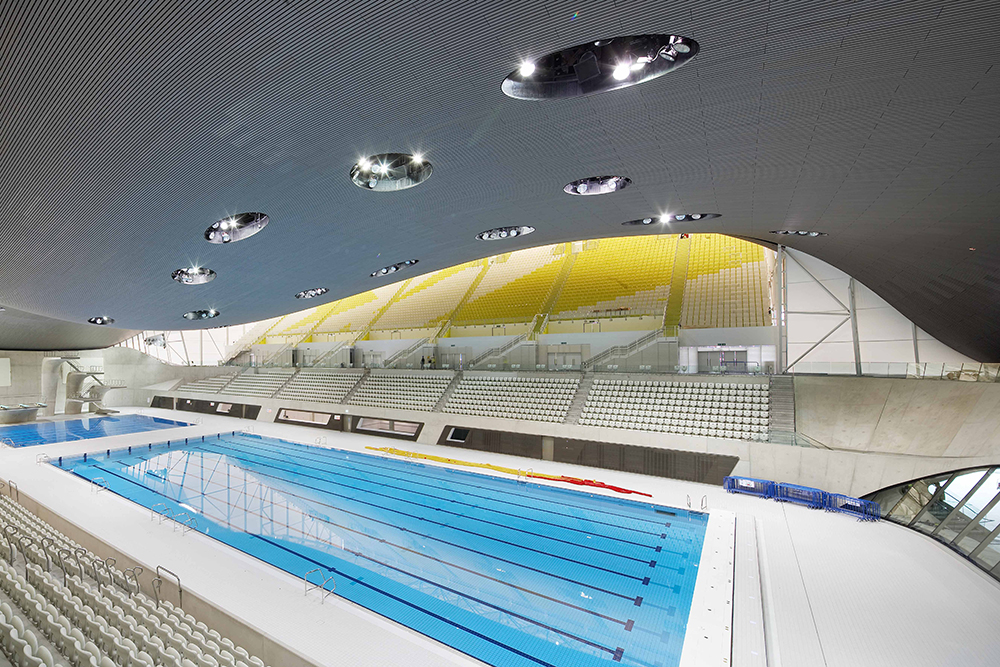
London Aquatic Centre. Photography Hufon + Crow

This interview was conducted for the issue 7 feature, Leaders of Industry, which profiled six world-renowned female figures within the architecture and design industries.

Portraits Michael Hemy

This article was updated in October 2015