At Home with Mark Hix

From his south London home, the celebrated chef, restaurateur and food writer speaks to The Modern House about what modern living means to him

I lived in Shoreditch for 20-odd years, as well as Notting Hill, and I wasn’t considering south London before I bought this place. My friend Richard, who’s a search agent, showed it to me on The Modern House website, and I zipped straight over on my scooter to take a look. I said yes straight away. I didn’t even come for a second viewing because I knew I was going to redo it.

Space was the main consideration, but I’ve found that Bermondsey is a really interesting area. It’s also easy to get to any of my restaurants… I nip over London Bridge to get to the Oyster & Chop House. I’m close to lots of bridges here! I visit at least two of my restaurants every day. I’m not really in the kitchen any more; I’ve got lots of other things to look at, mostly overseeing the creative side.

This place is my home, and I also do some work from here: writing and experimenting. I might start doing some cookery demonstrations, like I do in my Kitchen Library at the Tramshed.

I worked with Tekne on the refurbishment. Originally they’re shop fitters, but they’ve fallen into doing hotels and restaurants. They did my Bankside restaurant, Hixter, and the one in Soho. I recently put them in touch with my friend Robin Hutson, who owns The Pig Hotels, so they’ve done the last two projects for him. When Robin buys old buildings for the hotels he clears them out, and he’s given me a few salvaged things for the flat – a shower and some old Crapper loos.

I designed the space, and then Tekne worked as the contractors and architects. I gave them the ideas, and they put it all on paper. We gutted the whole thing, taking it right back to the bare bricks. We played around with materials: the wine racks are made out of scaffold planks picked up from building sites around here – some we paid for and others we were given for nothing. The same with the bookcase. Because they’re old, they’ve got a bit of character.

The kitchen counter is made from liquid metal. You can pour it over MDF to create curves at the edges, and you don’t get joins. Underneath are pieces of cast concrete from Retrouvius; I think they were originally columns in a mid-century office block. I wanted simple, natural oak units, something that would wear in naturally. Cooker hoods are normally so boring, so we went to a foundry and made a semi-industrial-looking unit that’s wrapped over the top of a normal extractor. We went back to the natural brick on the wall behind, which would have been the end wall of the original factory.

The spoon on the wall is a Michael Craig-Martin – it’s the cover of one of my books, The Collection. The ‘Vacancies’ neon piece is a Peter Saville art piece that he made. The fridge came from an antiques shop in Paris. It was made in the 1800s – originally they would have put a block of ice in the middle compartment to keep the whole thing cold. The refrigeration guy that I use for my restaurants converted it and made the top bit to match the bottom. It’s got different sections: dairy, wine, glasses, negroni cabinet!

I buy a lot of stuff from junk shops and reclamation yards. The kitchen lights are from Trainspotters in Gloucestershire, and I’ve collected midcentury Stilnovo lights over the years.

I bought the cocktail cabinet years ago at the Paul Smith shop. It had a horrible Chinese painting on the front, so I got my artist friend Mat Collishaw to make a replacement. The taxidermy mice in bell jars are by Polly Morgan, and the Bridget Riley is one of the first pieces I ever bought. There’s a shop across the road – a sort of Lithuanian shop – and they were selling what I thought was a mandolin, but I couldn’t work out why it was so big; it turns out it dates from 1903 and was used for slicing white cabbage.

The guitar comes from an event in Lyme Regis called Guitars on the Beach. A friend of mine said: ‘If I get a Fender guitar sponsored, can you ask Tracey Emin to draw on it?’, and she did. I thought it was going to be a silent auction, but it ended up being a raffle at a pound a ticket. So I bought a thousand tickets for £1,000 to narrow the chances down! It’s signed by Paul McCartney as well. I go back to Lyme Regis maybe three weekends a month. I’m part of the local community, I suppose. I get involved in local charity work and I do a food festival, which brings quite a few people to the area.

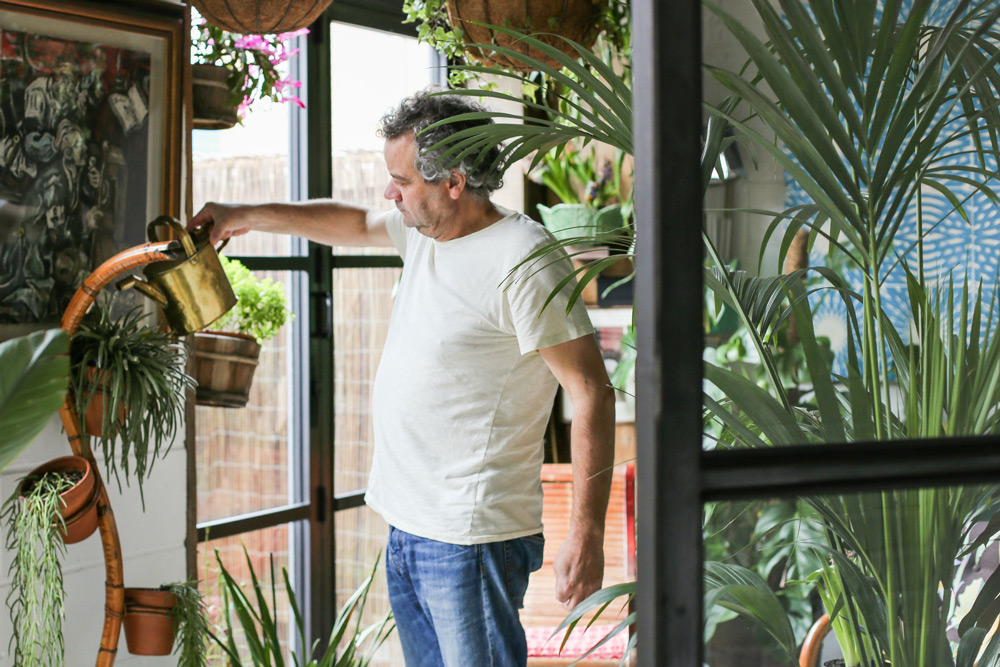
I made the garden room because the little terrace is quite small. In the summer you can open the doors up and feel like you’re inside and outside. I put the bi-fold doors in, and then got lots of crazy plants from Covent Garden. It’s a nice place to have tea in the morning. I found the old plantation chair on eBay. The artwork is by my mate Henry Hudson, who works in plasticine. That’s an Australian Moreton Bay Bug [on the ceiling]: it’s a sort of prehistoric crab. Then this is an old python skin I found rolled up in a box in a junk shop. I guess there’s a touch of the macabre, but really I just thought this room was crazy enough that you could put anything in it.

I’ve got a fishing and shooting cupboard here. The wallpaper is by one of the guys who works in the gallery, Tom Maryniak; he’s done a few different types of wallpaper in the loos at my Bankside restaurant. And then the wallpaper in the main bathroom is by Jake and Dinos Chapman.

The photographs above the bed are by Susannah Horowitz – she was one of the winners of the Hix Award. Every time we do the award I end up buying something. And this one isn’t from the Hix Award: it’s just two fucking flamingos with a little bird watching… I forget what its name is! The rooflight was already here; it was quite a weird space before, with a pool table and not much else.”

This feature is an excerpt from The Modern House, read more here


Nordic Design Wisdom

How the considered design principles of Norway, Denmark, Sweden and Finland reflect thoughtful ways of living 

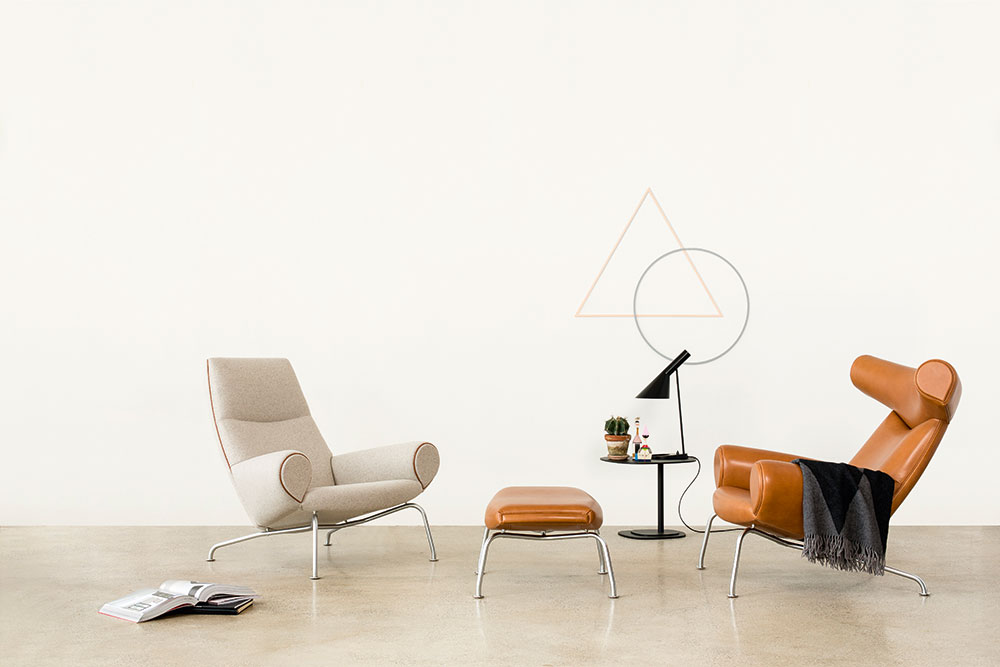
Ox chairs and footstool, Hans Wegner, AP Stolen, 1960 / Currently manufactured by Erik Jørgensen / Insula table, Ernst & Jensen, Erik Jørgensen, 2009; AJ Table lamp, Arne Jacobsen, Louis Poulsen, 1960. Picture credit: Erik Jørgensen

The Swedish have an expression, den röda tråden (the red thread), which they use to describe the essence of something. The ‘red thread’ might run through a particular style, cultural identity or shared experience. In other words, it is a through line; a narrative device and one that speaks to our impulse for storytelling. In a new book that borrows its title from the saying– The Red Thread: Nordic Design – the authors write: “In no other practice is this red thread brighter, tauter and more apparent than in Nordic design.”

Looking at the stellar design legacy of Norway, Denmark, Sweden and Finland, such a claim is hard to deny. Lifestyle is Scandinavia’s greatest export. This is in part because the region’s design is all-encompassing. From furniture to lighting to tableware, design in this part of the world reflects thoughtful ways of living, and is marked by functionality, simplicity and an emphasis on natural materials. Most of us are familiar with some of its prototypes: three-legged stools from Finland, sheepskin rugs from Norway and Denmark’s innumerable armchairs. Each is a studied reminder of the power of design in everyday life.

Taken from the pages of The Red Thread, here are some words of wisdom which highlight the significance of the Nordic approach.

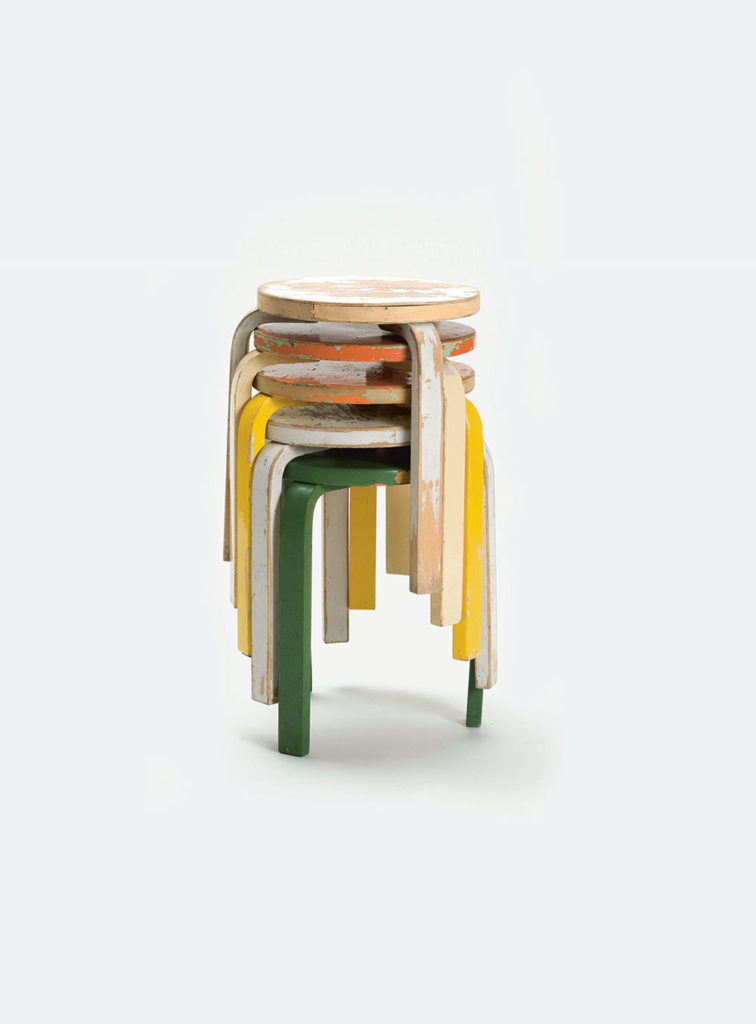
Stool 60, Alvar Aalto, Artek, 1933. Picture credit: © ARTEK

Design to Improve Life

“When Nordic designers sit down to work on a thermos flask, a set of cutlery or a frying pan, they will likely approach the task with the same degree of seriousness as they would bring to designing a motorway overpass. Every single detail is considered and many different solutions are tested; the Nordic designer’s common mission is to investigate how to make an object as streamlined, safe and user-friendly as possible.”

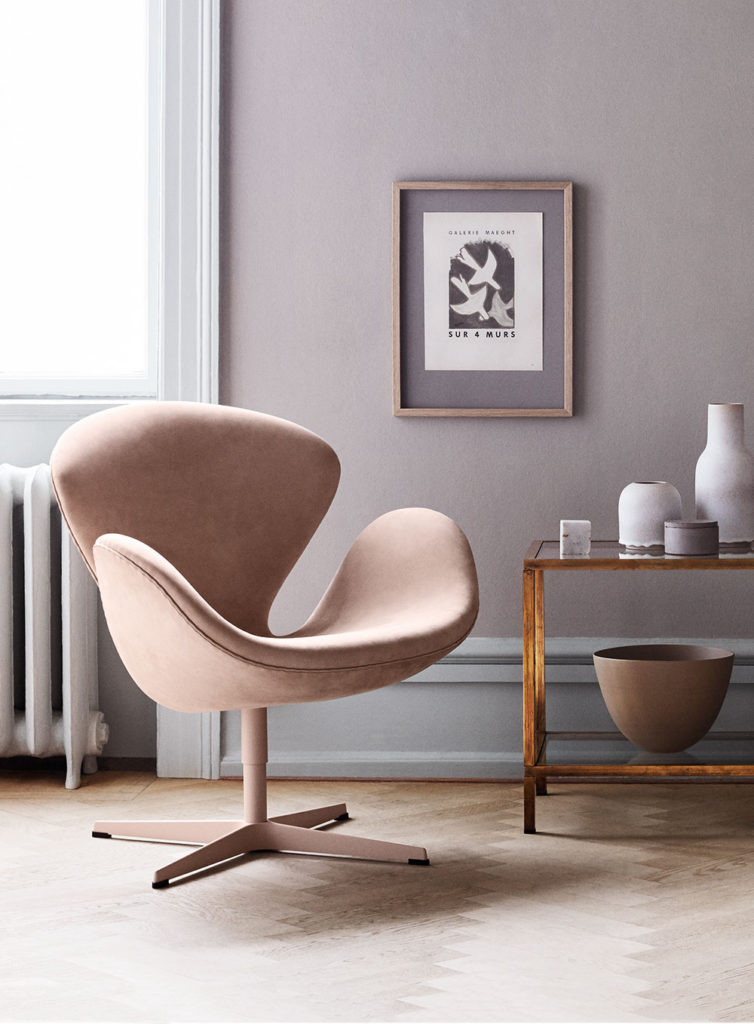
Swan chair, Arne Jacobsen, Fritz Hansen, 1958. Picture credit: Fritz Hansen A/S

Design to Improve Spaces

“The Nordic interest in holding onto good things and passing on heirlooms is explained, in part, by practicality, not necessarily sentimentality. Things are kept because they are useful and, although there are exceptions, the rest is largely jettisoned. A Nordic home must have a sense of clarity; there should be space between furniture as well as underneath it it; walls are often left bare and, even when more furniture could be squeezed in, restraint is practised. Rather a few good pieces than many mediocre ones.”

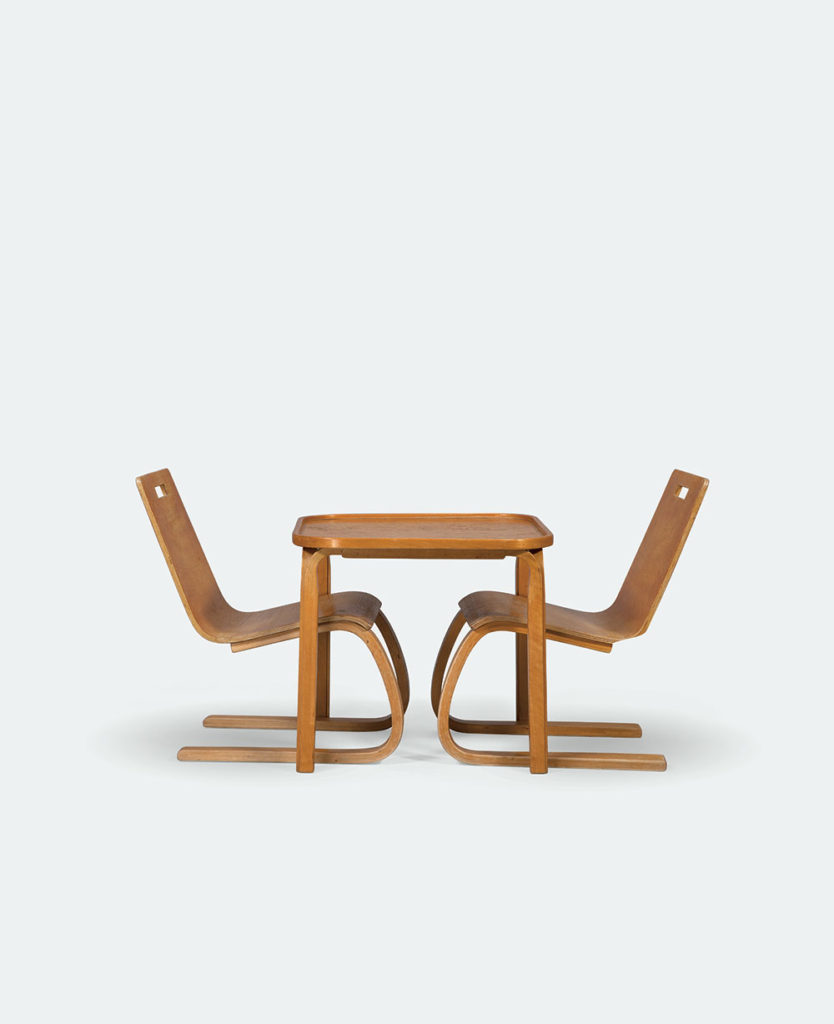
Children’s Furniture, Alvar Aalto, 1940s. Image courtsey Jackson Design

Design to Improve Relationships

“Nordic designers are known for their social commitment. This concern became particularly prominent in the twentieth century, when many were intrinsically involved with forging the region’s welfare states, designing objects to make everyday life easier, more balance and more beautiful. Seeing design as a process of ‘problem solving’ has become commonplace in the industry today; but it was architects, designers and indeed even craftsmen from Norway, Denmark, Sweden and Finland who set the precedent for this, long before think tanks and design labs came along.”

The Red Thread: Nordic Design by Oak Publishing is out on 22 May, published by Phaidon

Port Issue 20: Out Now

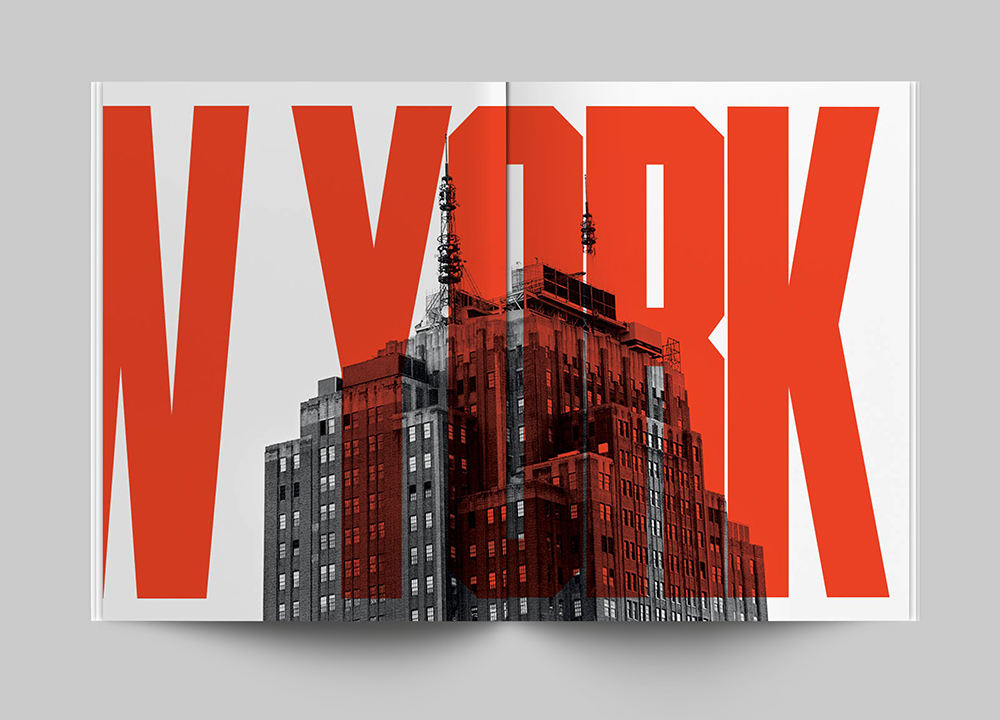
The New York issue is now on sale, featuring artist Julian Schnabel, the New Yorker’s Adam Gopnik, Olympic fencer Peter Westbrook and more

Issue 20 of Port is our tribute to New York – a city that looms large in politics and popular opinion and larger still throughout style, culture and design. In it, we have gathered people and portrayals as big as the Big Apple itself.

Mounting a successful return to New York, our cover star for issue 20 is Brooklyn-born artist Julian Schnabel, who speaks to Kyle Chayka about his reputation as “the carnival man of contemporary art”, his recent exhibition at Pace Gallery and a film in the works. 

In the style section, we include our favourite looks from the Spring Summer 2017 Collections, and an editorial styled by Alex Petsetakis captures the colourful spirit of David Hockney’s poolside paintings with stripes and soft focus. Elsewhere, a design still-life shoot sees New York-native birds from the Wild Bird Fund photographed with organic designs including an Eames mobile for Vitra and a silver branch broach from Louis Vuitton.   

In the feature well, our design editor Will Wiles and photographer Robin Broadbent explore New York’s architectural motifs – from water towers to fire escapes – in a sprawling 38-page photo essay. Next, Adam Gopnik, a staff writer for the New Yorker for over 30 years, invites us into his home and shares an excerpt from his forthcoming memoir, At the Stranger’s Gate. We also meet Peter Westbrook, the first black fencer to win an Olympic medal and founder of the Peter Westbrook Foundation.

Highlights from the Porter include a intimate guide to New York, with recommendations and anecdotes from Port readers and contributors including designer Philippe Starck, writer Will Self and restaurateur Alessandro Borgognone. Also in this section, Studio 54 legend Giorgio Moroder shares his experience producing Donna Summer’s ‘I Feel Love’, Matthew Combs considers the city’s relationship with rats, and architect Daniel Libeskind muses on the drama and energy of the subway. 

Port Issue 20 is available from 12 April. To subscribe, click here

Craft Works – Matteo Fogale & Laetitia de Allegri

Port and Levi’s® Made & Crafted™ meet award-winning designers Matteo Fogale and Laetitia de Allegri to discover how they are using simple techniques and unearthing unique materials to shape the future of their industry

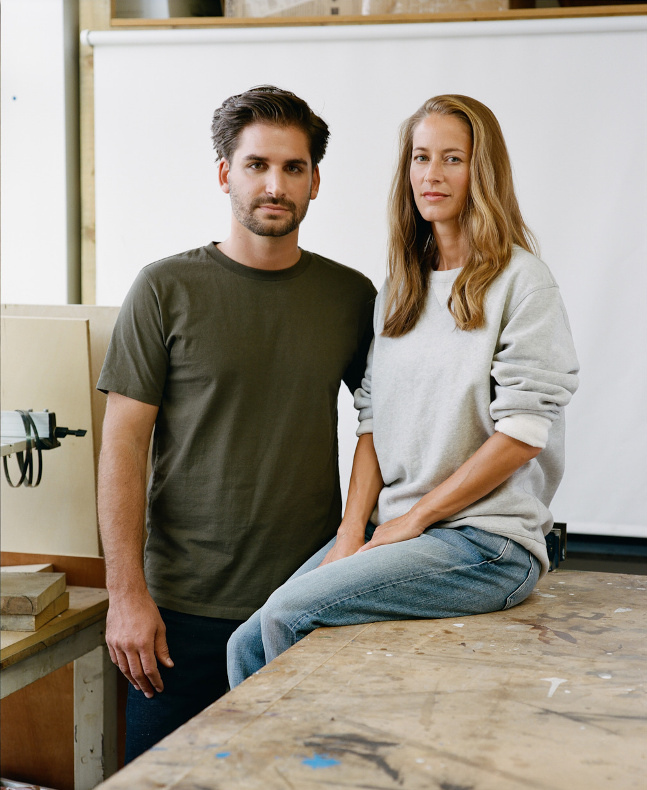
Matteo (left) wears Heavyweight 8oz T-shirt and Tack slim jeans in After Thought, Levi’s® Made & Crafted™ and his own trainers. Laetitia (right) wears Crew sweatshirt and high slim authentic selvedge, Levi’s® Made & Crafted™, and her own trainers

In a technology-obsessed age, where over-designed furniture and deconstructed food dishes snapped from above can command more online coverage and ‘likes’ on social media channels, how do modern-day creatives resist the lure to overcomplicate things, while still continuing to develop? To answer this, we meet award-winning design duo Matteo Fogale and Laetitia de Allegri, all styled in Levi’s® Made & Crafted™. Like Fogale and de Allegri, Levi’s® Made & Crafted™ – the contemporary, sophisticated collection within Levi’s® – is creating tomorrow’s classics by building on a successful reputation for quality product, using meticulously sourced materials (like Italian hand-waxed leathers and proprietary selvedges denim) and state-of-the-art production techniques. Here, we sit down with the design duo and delve into their approaches to innovation.

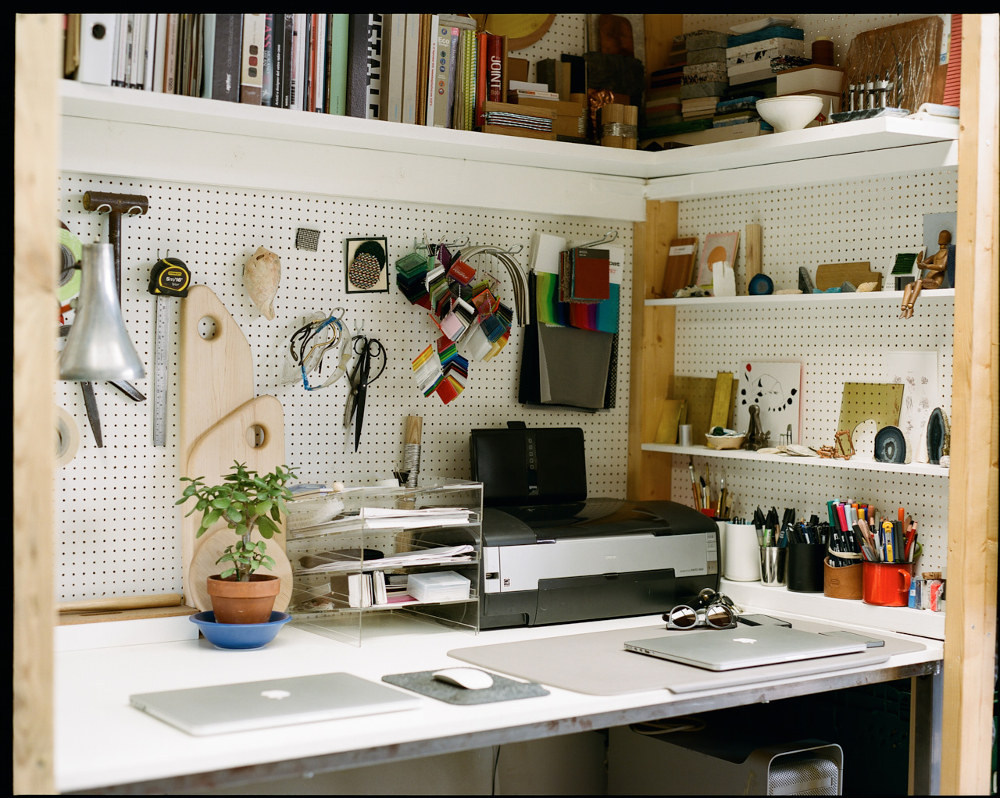
Inside the duo's studio, Blackhorse Workshop – photography Pani Paul
Inside the duo’s studio, Blackhorse Workshop – photography Pani Paul

Uruguayan Matteo Fogale and Swiss-born Laetitia de Allegri met while working at Barber & Osgerby, the leading industrial design studio responsible for creating Vitra’s Tip Ton chair (2011) and the London 2012 Olympic and Paralympic torches. It was here that they came to appreciate the “vision of making something that you really believe in”, and learned some of the simple principles that helped lay the foundations for their own partnership, which began four years later.

“Barber & Osgerby have a really interesting approach to design where they don’t sacrifice, or compromise too much what they want to do, they just stick to what they believe,” Fogale tells me. “I think that’s a really important lesson.”

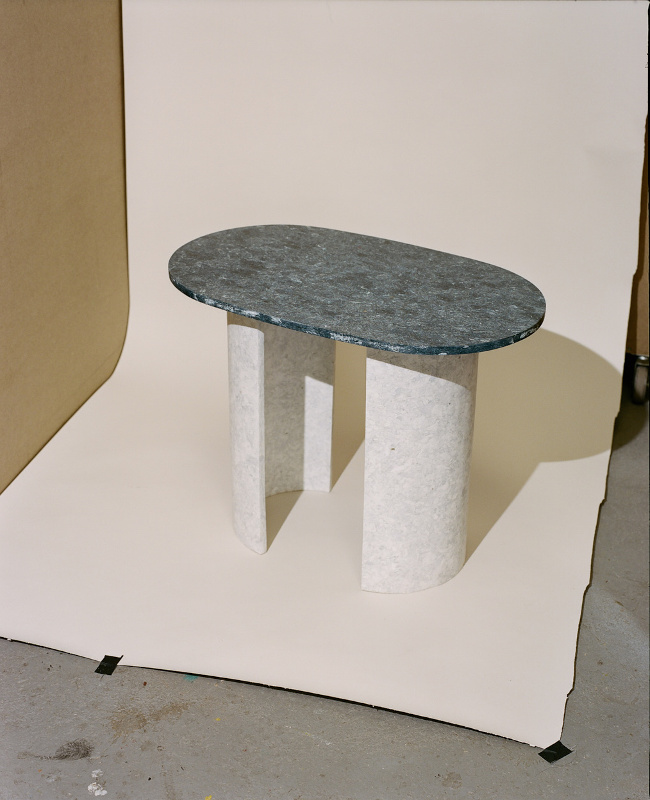
The pair’s first breakthrough project, the -ISH collection (2014), saw them build a beautifully clean line of furniture and tableware using old denim, paper and cotton. As well as winning them recognition from the design community, it gave their practice a focus: recycled and repurposed materials.

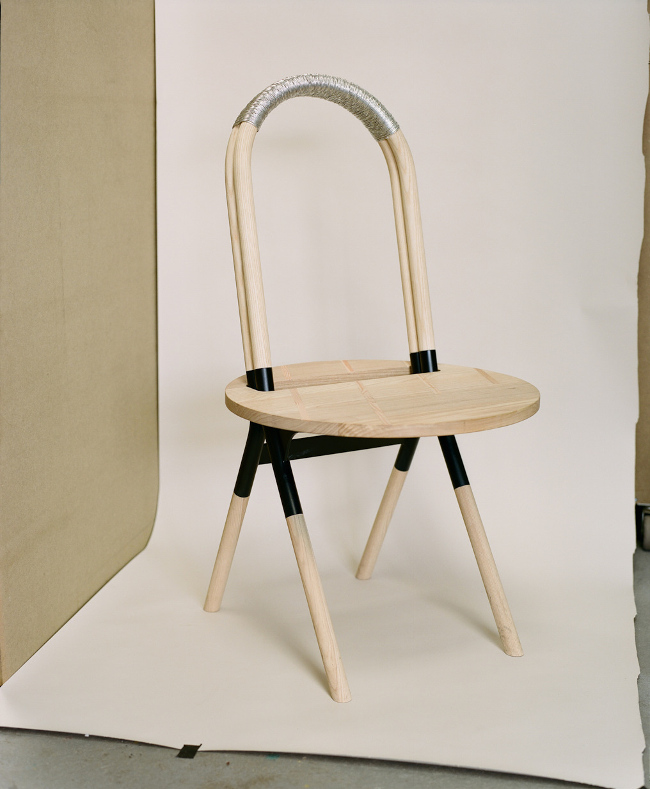
Bloomberg Chair from 'Reconnect' - a seating island – photography Pani Paul
Bloomberg Chair from ‘Reconnect’ – a seating island – photography Pani Paul

“The material we used for the collection was already on the market, but it was used in a very industrial sense,” says de Allegri. “We brought it to life, and showed the beauty of the material through a different way of using it.”

Now located in northeast London’s Blackhorse Workshop, a creative hub for ‘makers’, located in a quiet backroad in Walthamstow, the duo spend hours poring over materials online and in sample libraries, digging through fabrics and compounds that could be given a new purpose. Rather than highlighting the fact that they’re using sustainable material to produce furniture pieces, Fogale and de Allegri are advocates of an understated approach.

“We like that people might not really know that it is made from waste, I think it’s interesting,” Fogale says. “ doesn’t have to shout ‘I’m recycled, I’m made out of discarded glass and wood’. The material could be as precious as any stone or metal, but then made in a sustainable way.”

inside-the-duos-studio-blackhorse-workshop-2-photography-pani-paul-jpg

In the past, Fogale suggests, recycled material was often associated with ‘cheapness’ and bad quality, but that appears to be changing. Specialist manufacturers, such as London-based Smile Plastics, have been working with designers to release high-end recycled materials that look and feel organic – some are even designed to contain natural-looking blemishes). Fogale and de Allegri see this as an opportunity to push sustainable product design even further, while continuing to uphold their refined, minimalist aesthetic.

“Smile made this material out of recycled yogurt pots, by mixing the plastic and the aluminium foil of the pots, and they created this beautiful material which is very unique,” Fogale says. “That’s really interesting because it means you’re not designing just a chair, or a piece of furniture – you can also choose how it looks by controlling the look of the material itself.” “Each piece would be unique and you’d never have the same one twice,” de Allegri adds.

Reworking existing materials may involve complex chemical reactions, but it provides a simple solution to the environmental question, while resulting in individually characterful products that break away from the hegemony of mass production. And because of online tools and a growing appetite for customisation, Fogale and de Allegri can now focus on making bespoke pieces based on customers’ own desires.

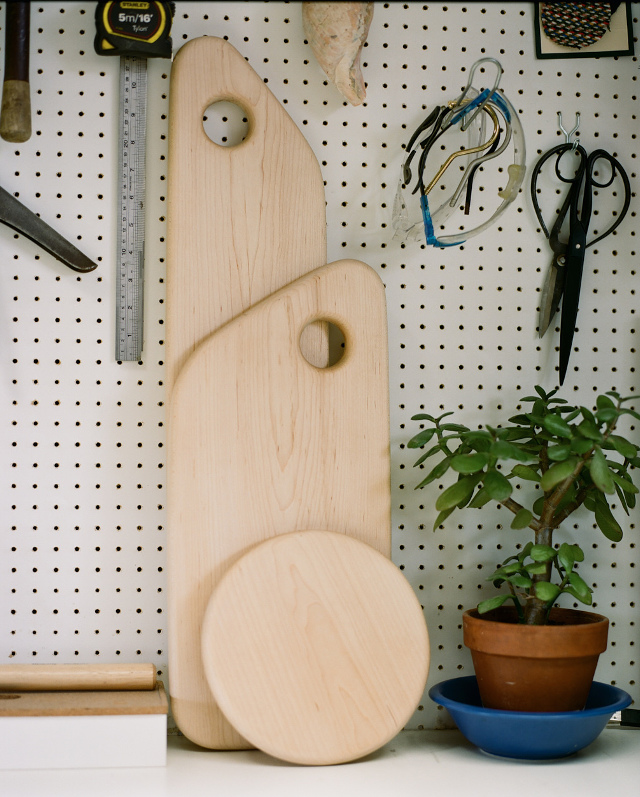
'-ISH side table' 2 – Photography Pani Paul
‘-ISH side table’ 2 – Photography Pani Paul

“People now want more customised products and things they can change, like the colour or the size,” Fogale says. “This is where the digital world is really good – it’s becoming really interesting because it’s almost a tool in-between the buyer and the designer: you can produce basically on demand.”

“However,” Fogale continues, “at the same time you risk losing your identity as a designer as we choose the colour we want our product to be because we think it looks good or works better. How much you actually want to allow people to be a part of that is quite difficult.”

Photography Pani Paul
Styling Scott Stephenson, Alex Petsetakis
Photography assistant Liberto Filo
Grooming Davide Barbieri at Carenusing Bumble and bumble

Levi’s® Made & Crafted™

deallegrifogale.com