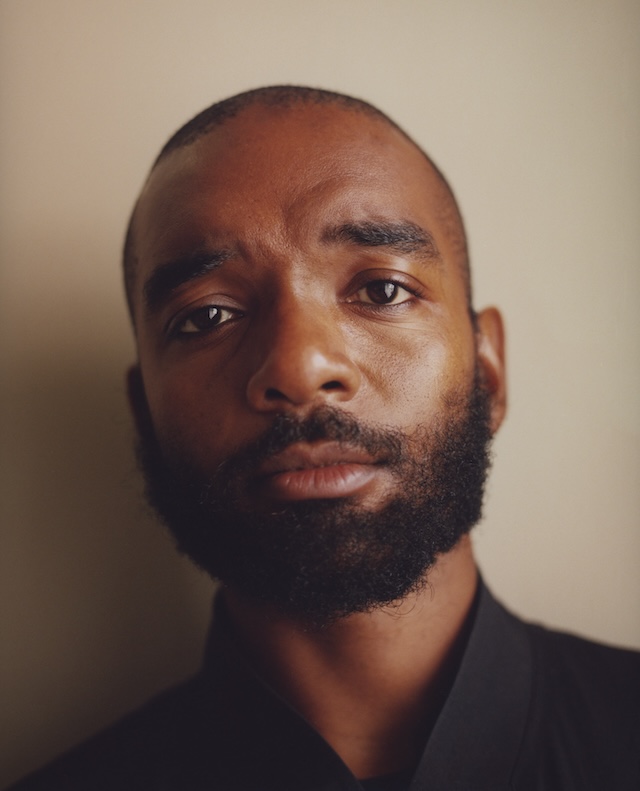
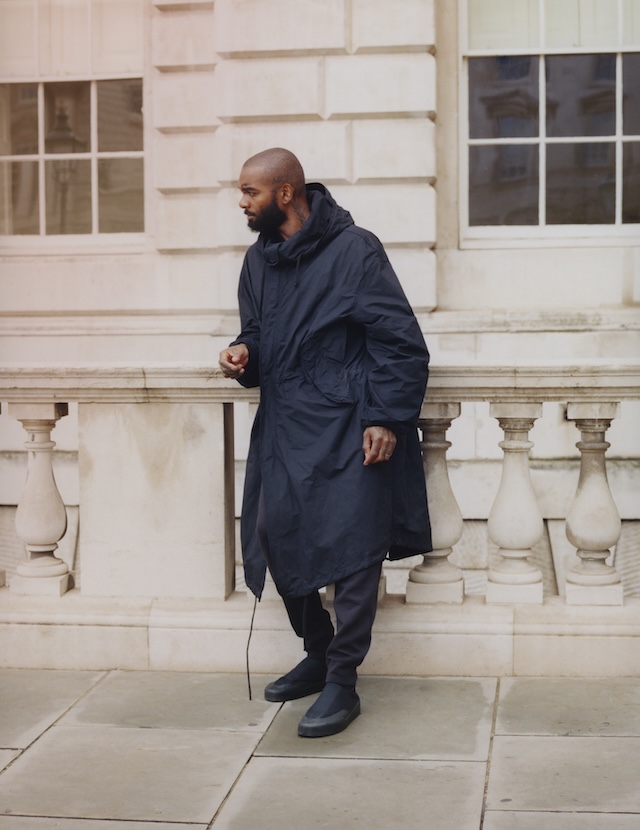
I’m interested in what I call ‘passive listening’. As humans, we unconsciously absorb sound daily – ambient noise, background hums – without actively focusing on it. Around 70-80 per cent of the time we’re consuming sound passively, so it’s important to be aware of what we don’t hear. That idea shaped The Ambient Machine, which came from noticing, during the pandemic, the unavoidable noises around me and wanting to rearrange them into my own preferred soundscape, almost like a ‘sound conditioner’.
I’m drawn to non-intentional music. Erik Satie tried to compose works people wouldn’t notice, but they were so appealing that they did. Later, Brian Eno developed the idea further, making soothing background sounds that were unnoticeable but still created a good feeling. They created the benchmark for ambient music, and the Ambient Machine is my own proposal for what ambient sound could be.
What’s different is the presentation. The Ambient Machine has eight tracks and several effects that can be reversed or slowed down. Customisation is important because people’s preferences for sound are so personal. It’s deliberately not connected to the internet or via Bluetooth, so once it’s set it stays, becoming part of the background. Half the sounds are recordings from outdoors, especially from my seaside home in Margate – waves, wind and water, which tend to calm people. Others are subtle melodic elements inspired by Japanese sound devices like wind chimes or shishi-odoshi (‘deer scarer’). We’ve made three editions so far, each with different themes.
I prefer working with vintage electronic instruments from the 1970s and 80s. They’re inefficient and expensive, but their pure, non-digitally processed sound has a quality you can’t get from a computer. For me, working with switches and knobs feels almost like sculpting – a more hands-on way of creating. The Ambient Machine’s design borrows from 60s furniture and electronics, with 32 unlabelled switches so people can stumble onto their own soundscape. I purposely left off labels, so discovery comes through play rather than instruction – an approach influenced by early experimental instruments like the Triadex Muse, a sequencer-based synthesiser developed at MIT.
Accessibility is important to me. Because of dyslexia, I never read manuals. I design so people can learn by touching, playing and discovering. As a child, I loved museums but always struggled with labels, which left me frustrated. Discovering interactive art as a teenager was groundbreaking – by engaging directly with a piece, you could understand what the artist wanted to say without needing language. That experience shaped my practice.
Most of my work today is interactive and often installed in public spaces, where people of any age, background or language can engage through play. For me, sound is a tool for communication that goes beyond text. Many of the conflicts we see in the world come from miscommunication, and I’m interested in how simpler ways of connecting – through plain speech or even sound – might help us understand each other better.
Sheila Heti is a Canadian writer known for her acclaimed novels How Should a Person Be?, Alphabetical Diaries and Motherhood. In this essay for Port, she explores the parallels between art and love, considering how writing and living alike depend on discovery, patience and the mysteries that emerge in darkness
I was having a conversation the other day with a writer about the need to be a little dumb about certain things. When it comes to writing a novel, you can’t know everything. You have to remain a bit unconscious. You can’t have the whole thing planned. Something else has to be given room to move – the part of the book you don’t yet know, but that already exists in its ideal future form somewhere in your subconscious. It’s hard to move forward while not completely knowing where you’re going. I remember a scholar of Jung, the English writer Ann Yeoman, saying to me about making art: “You have to learn how to enjoy walking in the darkness.” You have to like not being able to see exactly where you’re going. This is not an original idea. Probably every artist thinks it.
The other day I saw on Reddit someone quoting George Saunders’ writing, “If you set out to write a poem about two dogs fucking and you write a poem about two dogs fucking, then you got a poem about two dogs fucking.” The poster added the comment, “Could never quite figure out what it means but I think about it a lot.” Then another poster helpfully added that it probably meant “accepting what the work is offering, like meditation – just being in the moment with it. So I imagine his point here is that if you force art to be one thing, it’ll be the one thing, in this case, a poem about two dogs fucking, which is probably a shit poem. His point being that true art is found – and transformed – in the creation process.”
Part of why anyone makes art – I think I can say this – is the pleasure of discovery: that even though you are the one making it (the book, the painting, the song) you are more precisely the one discovering it. The reader (of the novel, say) discovers it, too: page by page. But the writer was the one who discovered it first. It’s a bit like being an explorer who is trying to see if the world is round, after they’ve been told it is flat. You write a page in a moment of inspiration. Is that all there is, the single page, that flatness? Or might there be more, might it be round and just the beginning of an entire world? Can you open the document, that single page, and somehow get your ship inside it, and begin to sail past the last sentence, the horizon?
I think the excitement of discovery that one feels when one is truly filled by the spirit of writing has something in common with the discovery of a new person who, at first sight, tugs on one’s innermost self and says “this is a person to love”.
Like the first page of a novel, suddenly written – the feeling that a gift has been given to you – is the surprise appearance of this person on the far side of the party, of the wedding reception, of the hotel lobby. You have the feeling that they had to be there, in that time and place; that they were put there to be seen by you now. It may not become love. It may become nothing more than an inner trembling, lasting only a few minutes until they walk out the door and into the street. But that seeing feels somehow destined, out of time, to belong to an eternal moment. The Colombian writer Andrés Felipe Solano told me and some others over dinner the other day about a woman he’d seen on a bus 30 years ago. She was only on that bus for four minutes. It seems he only saw the back of her head. But he never forgot the sight of her. Even now, he felt compelled to speak of her.
With all the men whom I have fallen in love with and gone on to be with – or never to be with, but only to circle for years on end – it happened in the very first instance. It is a bit like the book when you first start writing: as if it already exists in some future space. That’s how, retrospectively, I interpret those first moments of being struck. The soul somehow “remembering” the future – “ah, this is where it begins.”
I remember the first time I saw the first man I would love: the first week of 11th grade. He was standing in the hallway with all sorts of papers falling from his book bag. How could his papers be in such a mess, so early in the school year?
I remember the first time I saw the man who would later become my husband (then ex-husband): sitting down on the floor at a music event and zine fair. He was sitting with another woman (I’d later learn she was just a friend) and I felt an almost overwhelming wave of objection to him sitting with her. A wild, unjustifiable jealousy washed right over me.
I remember being 17, and for the first time seeing the man I would come to be with decades later, who I would remain with for the next 15 years (I’m still with him today). We were standing outside a movie theatre, and there he was in a suit and tie, dark wild hair, pale and tall. I had never seen such beauty.
What about all the other humans on earth? They are the victims of other people’s noticing. And some are maybe not noticed at all. Why is this man, for me, like a boulder thrown down from the sky, arresting me on the pavement, and not even as significant as a tiny pebble, ground into the concrete, for someone else? I wish I knew why, at first sight, we love the ones we do.
There is a wonderful idea that the writer Kurt Vonnegut put into his novel, Cat’s Cradle. It’s the idea of the karass. The karass is a group of people who, all together, are completing some corner of God’s work. There may be 10 or five or 100 people in that karass, and they never learn for sure that they’re connected by this thread; this thread which connects all of their actions so that some collective result might come about (something big, like a war, or small like a screw). Are these people who appear to oneself with such terrible suddenness, who distinguish themselves from the crowds of people, part of your karass? What will you and that man from the dinner together make that is part of God’s greater vision? It’s not always a love story, or a baby. Maybe he’s an editor. Maybe you’re a writer. Maybe the thing God wanted you to make, the reason you were put in a karass together, was just an article in a magazine. This article will fit into the millions and billions of things that must be made out of the trillions of connections among the world’s people for the universe to resolve into the final shape that God has in mind for it. God is like a single writer crafting their book: they can see its final shape already.
If some people are in our karass, then are there people in our anti-karass, who we should not be creating things with, or falling in love with? Does the invisible silver thread that connects us to some people, have in some way an opposite: threads that God doesn’t want in the book, connections that make bad things happen, like assaults or deprivations or guns or bad books? If so, how can we tell the difference between the lightning strike that signals “this person is in your life for the purposes of God writing the book they have in mind” versus “this person is in your life and together you will create a scene that God wishes they didn’t write”?
And yet – just as sadness, pain, suffering, jealousy and misery cannot be avoided – perhaps God should not (does not!) hope to avoid writing scenes that eventually will be deleted. This is all just part of the way that God discovers what the final book will be: the final book being the total vision of the world that God eternally carries around in their head.
But just because God will in time forget it, doesn’t mean we can’t still live it. It doesn’t mean that we won’t.
Recently I got some startling news, and my first impulse was to call my boyfriend and tell him, in a state of shock – to sort of transfer the shock that I was feeling onto him. It felt imperative that he know about the shocking thing as close to the instant when I found out. But the idea of calling him right away and transferring my shock onto him caused in me a terrible anxiety. It seemed that, for the first time in my life, I was able to slow down and say to myself, “Why don’t you wait until tomorrow to tell him? Maybe there’s a better way of conveying to him this information than calling him up right away and transferring – performing – your shock.” It felt taboo and uncomfortable to think about doing this – to wait until the feeling subsided; to slow down and wait until the moment arose in which the news could be delivered in a mild way, in a way that would not shock him.
The next day it seemed to me that I could deliver the news in a calm and offhanded sort of way, and that actually the news was not as shocking as I had first felt it to be. He received the news without any anxiety or feeling shocked, and this whole incident was something quite new for me. It was a bit like the George Saunders parable about the one who writes a story about two dogs fucking. If I had told my boyfriend the story about two dogs fucking, the moment I heard it, it would have been exactly that. But overnight the story transformed, new meanings unfurled and I was able to tell him – to discover for myself – a different tone, a different set of meanings, and the story I told him was something unexpected. It was like a story of two dogs eating strawberry shortcake. A story does not always mean only what it originally seems.
Rest and waiting are part of what makes a story, what makes the whole world, what makes any creation. Most of my life I have not known that rest and waiting are actually part of any recipe. You can’t put a strawberry cake in the oven and then pull it right out.
I had a conversation with Sally Rooney the other day, in which we realised, with surprise, that neither of us used the word “block” to describe the times when we were not writing, or when a book was stalled and could not progress, sometimes for months on end.
These were periods, too, of waiting.
The Jungian scholar I mentioned earlier in this article once described moments of non-creation this way: “It’s like breathing. Sometimes you’re breathing in, and sometimes you’re breathing out, and you can’t always be breathing out.” You can’t always be creating.
What was so good about not turning something that felt like an emergency to me into an emergency also for my boyfriend, was the realisation (which I attribute to maturity) that I didn’t have to let myself be thrown into his path like a boulder, even if I felt that I was being thrown like a boulder through the air. I guess what I understood was that just because you feel you are being thrown through the air, that doesn’t mean you can’t determine where exactly on the earth you land, or how loudly or lightly.
Rooney told me the other day that while we, in our culture, learn to visualise the future in front of us and the past behind us, there are parts of the world where it is the opposite: the past is imagined to be in front of you (where you can see it, because it’s already happened) and the future is approaching from behind you, pressing up against your back (because you can’t see it, it’s a mystery, unknown to you).
How different, we agreed, it had to be to see the future as approaching from the back. The future is a surprise! You don’t see it coming! How arrogant of us to imagine the future out in front of us, already foreseen and planned for; that we imagine we can see what it will be.
When I started this essay, I didn’t know what it was going to be about. This, for me, is always the way with writing. I’m sure it’s like that for many people.
And even though this not-knowing makes perfect sense – we are humans who exist in time, and so everything (essays, novels and relationships) naturally happens in the unfolding of time – it continues to surprise me. It sometimes makes me feel bad, that when I set off on the course of some new project, I don’t know everything about it, all at once. I feel like I should know everything at the beginning. After all: isn’t it coming from me? I grow impatient for the unfolding. I don’t want to welcome in the slowing down, or the waiting, that of course some part of me always knows is an inescapable part of the recipe. That man by the stairwell – who shines brighter than the others – I want to know right now the meaning of this noticing: what sort of future will we unfold? I don’t want to write the scenes for my novel that I’m going to end up deleting!
But when I look more closely at this impatience of mine, I sometimes wonder what I’m after: the end of life already, when everything has been unfurled to its outermost limit? And yet the effect of a person’s life continues beyond the limit of their deaths – in the lives of their friends and their family and other people who they’ve touched. So what is this faraway vision that I feel a longing to resolve into a picture that I can see, both from a distance and close-up with all the details apparent? The entire picture of the universe? With all the good things humans have ever done fitting together like a zillion-piece puzzle, on the floor, or on the dark rug, of eternity?
I know it’s like my Jungian friend said, “You have to learn to enjoy walking in the dark.” This is true not only of writing, but also of living. But how is it enjoyable? Doesn’t one always yearn, a little bit, to – for a flash – just turn the lights on? These flashes do make the darkened discovery a little more possible. Sometimes when working on a novel, you can see the whole thing in a flash – the object off in the distance that you’re going to create.
But these flashes do not always happen. Often you discover the lamp in the corner of the room by knocking into it and crashing it to the floor. Why did I have to wonder who “my person” would be, from the ages of 17 until 32, when the beautiful boy from my past, from in front of the movie theatre, finally became mine? Why did I have to stumble for so many years through the darkness, knocking down my ex-husband (in the dark) and other men (in a similar darkness), knocking into them (as they stumbled through the dark) and being knocked over?
Why must discovery always happen in the dark, and why must it involve so much slowness? Why is the fact of allowing time to pass, and the necessity of traversing rooms in darkness, two of the most important elements on the road to discovery? Thank goodness for those rare flashes of light which give us little clues.
It’s almost like the horizon of the sea, or the horizon of the present, or the horizon that is the most recent line you added to a piece of writing, really do importantly demarcate what can be grasped from what must remain, for now, unknown. It is not given to you to see beyond it – yet. So there will always be unknowns from wherever you’re standing.
What defines life and all kinds of creation are all those tantalising horizons. If you can remember to feel them as tantalising – the feeling of being tantalised is one of the greater feelings leading us forward through life.
Tobia Scarpa, born in 1935, is one of Italy’s most distinguished architects and designers. The son of Carlo Scarpa and husband to the late Afra Scarpa, he is celebrated for his poetic approach to buildings. He talks to Deyan Sudjic about the Seki-Han, an early design for Flos that followed the Fantasma lamp, which marked the beginning of his relationship with the company. Seki-Han is once again in production, reflecting the continuing relevance of Tobia Scarpa’s work
Photography Robert Rieger
Tobia Scarpa did not make his first visit to Japan until some years after the Seki-Han light was launched in 1963, but both he and his father were already fascinated by Japanese culture. In the late 1960s Tobia was commissioned to design an exhibition of Italian furniture staged in Tokyo, and travelled to oversee that installation in person. Italy at the time was developing its own version of modernity, filtering a range of influences and at the same time making the transition from skilled artisan workshops to industrial production.
Scarpa, both the father and the son, were born and educated in Venice. They are products of that unique city with its special craft traditions and a very specific historical context shaped by France and Austria – two of the powers that once controlled it. Tobia explains the significance that Japanese culture has had for him: “We need to take a step back to the first half of the last century, during which my father developed his knowledge and artistic sensibility. From the point of view of cultural influences, it was a very complex period. an evolved central structure was emerging, similar to that of France, whose quality of thought Italy aspired to, while the country was simultaneously looking with curiosity at Austrian culture and falling in love with Japanese culture. There still wasn’t sufficient energy or knowledge to bring order, but cultural forms were taking shape that were the sum of many origins, and Italy, all things considered, had a greater capacity to bring all these origins together.
“My father studied the Japanese world in depth, and there were always many publications on the subject at home. I love books, which is perhaps why I was already curious and familiar with this culture even before visiting the country.” In fact, it was the fees from Tobia’s exhibition commission that allowed him to fund his father’s first trip to Japan, “to visit all those places he had so longed for and deeply loved, known until then only through books.”
Carlo Scarpa was an architect and a designer who built comparatively little, but made a remarkably powerful impact with every project. The showroom that he designed for Olivetti in St Mark’s Square in Venice, the Brion family tomb and his work on the historic Castelvecchio Museum in Verona in particular have left an indelible mark on the architecture of his time. It is a tribute to both father and son that Tobia and his late-wife, Afra, established themselves with a body of work that is clearly their own and yet reflects his father’s poetic sensibility. “I learned everything from my father. He didn’t teach me anything, but he took me with him everywhere, and let me ‘steal’ everything from him.”
Seki-Han’s literal meaning in Japanese is ‘red rice’, a dish associated with celebration, and the phrase has taken on that added meaning. The light was launched in 1963, the year that Sergio Gandini took on the management of Flos, founded a year earlier in Brescia by Dino Gavina and Cesare Cassina, two of the key figures in post-war Italian design. “Everything was just beginning then and anything was possible,” says Tobia. “Everything could be invented and built. As a designer, I was able to use a pencil to generate ideas. I proposed things that didn’t exist at the time, and they weren’t always understood by those I proposed them to. We were able to do tests and simulations quickly, and so, through experimentation, products were born and Flos was born, and it grew through the evolution of dialogue with designers.”
Seki-Han is developed in two versions – a floor lamp and a pendant – designed for use either standing or suspended. “We wanted the extreme simplicity of the design to make it suitable for all situations where a formally essential floor lamp of minimal bulk is needed. The possibility of suspending it horizontally made it suitable for lighting worktables in spaces intended for offices.” Tobia and Afra met as architecture students and set up a studio together that worked on projects that ranged in scale from furniture to the Benetton factories. “Afra and I were always involved in all the projects. The studio was very small, and it still is today.”
Piero Gandini, who took the decision to put Seki-Han back into production, first worked with Scarpa in 1991 when Flos was run by Gandini’s father. Tobia says, “I was working on the Pierrot desk lamp, as Piero himself reminded me during one of his visits to my studio to talk about the Seki-Han lamp. When he first joined the company, he asked his father if he could develop a project independently with the help of a technician. He selected a lamp that I had recently designed. Gandini’s account of it suggests that every time we reviewed the project, I urged him strongly to find better technical solutions, but I can say that, not remembering the events very well, he may have exaggerated a little.” The rate of technological change is much faster for lighting than it is furniture, and the new Seki-Han features modern electronics and an LED light source.
“The impetus to put it back into production came from Piero, who had a childhood memory of this object in a room in his family home. One day he took the lamp, loaded it into his car and rushed to my studio with a proposal to reissue it for the market, updating its technological apparatus. It was the chance to breathe new energy into a dormant – or abandoned – project that over time retains the value of the thinking that generated it. It brings me great joy to see the new vitality of this product and I observe with curiosity the result that emerges from it.”
As a child born into a West African immigrant household, the concept of being of both and of neither has always held significant weight.
Costa Chica, a sparkling coastal crown on the Pacific, also symbolises this duality. Extending south from Acapulco to the bioluminescent lagoons of Chacahua, Oaxaca, this land is now witnessing severe loss of biodiversity, dried-up fishing communities, and land grabs by foreigners and wealthy white Mexicans. It is also a treasured place known for sovereign birds that dart through mangroves, and seaside settlements of self-emancipated Afro-descendants. I have watched terracotta-brown fishers, elders and swimmers moving through water with textured hair coils, recalling those who escaped colonial ships to create new life in Mexico.
After immigrating to Mexico 10 years ago, my sense of belonging has finally rooted in the ways I trace pieces of my West African ancestry to everyday life. Being raised on stews rich in red palm oil and goat, I can smell and taste natal flavours that bind me to this new home.
In Tenochtitlán, now Mexico City, vestiges of Costa Chica and Guerrero’s roots are manifested in the Michelin-starred Expendio de Maíz. Chef and owner Jesús Salas Tornés operates the kitchen as a collective, refusing hierarchy or dictatorship – a likely reverence to the cyclical societies of Afro-Indigenous traditions that endured entrapment and erasure. There is no menu, no head chef, no reservations and zero arrogance. Despite its high-grade culinary concepts, this is a restaurant grounded in fair pricing for patrons and investment in a microeconomy of hyper-local farmers and providers. On my first visit with a girlfriend and her daughter, we started with pig-shaped blue tortillas and queso de campo rolled into tiny hands. I was served the most divine maize-wrapped barbacoa, piled high with flowering coriander, and sitting in a rich bath of sauce.
The term barabicu – translated to ‘fire pit’ in Taíno, an ancient language of the Caribbean’s first nations – is a technique reflected in Central and West Africa, when food is wrapped with flame-resistant foliage like agave and palm leaves, and later braised in the earth for harvest ceremonies and communal eating. Traditional Guerrero and Costa Chica-style barbacoa starts with sirloin cap or goat (a meat with a smaller carbon footprint), smothered in tomatoes and chillies, and fragranced with aromatics like clove and cinnamon, wrapped and cooked in banana leaves. The cooking process renders the most tender meat in a slick, spicy sauce and ready to be gently tucked into tortillas.
Every time I take a small savoury bite into barbacoa, fried plantains or even okra, I’m reminded of all the Afro-descendants that brought over their heritage of foodways to Mexico: slim seeds of rice and black-eyed peas secretly braided into hair; centuries’ worth of recipes kept safely stored behind the cloudy eyes of great-grandmothers who made the voyage to Latin America, all just to whisper that ‘I belong everywhere’. That we are everywhere.
Photography David Hanes-Gonzalez, shot on location at Mercado Jamaica in Mexico City
This article is taken from Port issue 37. To continue reading, buy the issue or subscribe here
Photography Vera van Dam, styling Georgia Thompson
SAINT LAURENT BY ANTHONY VACCARELLOSAINT LAURENT BY ANTHONY VACCARELLOLOEWEDIORTop & Skirt LOEWE Belt TOD’SGUCCIISSEY MIYAKETop CELINE Bracelet CAMILLE SURAULTPRADALOUIS VUITTONSweater CELINE Bag BOTTEGA VENETADress FENDI Shoes SAINT LAURENT BY ANTHONY VACCARELLO
Empires fall, but symbols endure. In cloth, structure, language and form, Samuel Ross channels centuries of defiance and reinvention. After stepping into the role of artistic director at the London Design Biennale, a new chapter begins
Photography Christian Cassiel
The building of empires demands particular personality types. In the final quarter of the 19th century, as the Scramble for Africa began, a generation of young, sharp-elbowed and exceptionally skilled soldiers began to percolate up into the most senior ranks of the British Army. Many identified the colonies as the arena within which they might prove themselves, and perhaps fill their boots. One of the most successful specialists in the execution of these complex campaigns was Garnet Wolseley, a veteran of many punitive imperial expeditions and one of the most decorated soldiers of the colonial era. He was not only a brilliant tactician: he seemed to relish these kinds of operations. In 1857, as a member of the British forces sent to suppress the Indian Rebellion, Wolseley expressed a longing to exterminate the “beastly” locals, of a wish to shed “barrels and barrels of the filth which flows” in their veins. For many, the colonial project was not about control of territory, and for men like Wolseley, this was never just a job.
By 1874 Wolseley had honed and hardened his strategic skills, and around him the army had assembled a team of exceptionally effective insurgency specialists. He was called upon to lead what would become a career-defining assignment. His orders were clear: invade the Gold Coast, the uniquely resource-rich West African region, and defeat its armies, bring its leadership to heel and lay waste to its lands. Wolseley was nothing if not scrupulously thorough, and within months of arrival his forces had burned the capital city of Kumasi to the ground, destroyed the Asante royal palace – the Asante is an Akan ethnic group native to Ghana – incarcerated the king and plundered the state treasury. Garnet Wolseley would be knighted on his return to London. Upon the smouldering ashes of the old Asante kingdom, the British constituted a Crown Protectorate, led by a British governor and underwritten by British laws. But the British were not wholly satisfied; although they searched, although they interrogated and threatened the local population, they could not find the spiritual symbol of the Asante state: the legendary Golden Stool. To complicate matters, the civilian populace were almost perversely indefatigable; they simply would not fully capitulate. Even as the British instituted their new colony, the inhabitants of the Gold Coast began to push back, writing petitions, crafting newspaper campaigns, training their own lawyers to fight for their freedom. In what could have been a time of humiliation, the local populace found a renewed pride, and in what should have been a time of victory, the British seemed frustrated. And when the exasperated British governor demanded the Golden Stool so that he could publicly sit upon it, the local population simply ignored him.
The people had lost their leadership, their independence – but they refused to give up their dignity, their sense of self. They would coalesce around powerful symbols of continuity; they would seek unity in their heritage, art and customs. Cloth became a badge of pride and defiance. And when, two generations later, Africans began to broker for independence, it would be Ghanaians (the children of the very communities attacked in 1873) who would emerge from the old Gold Coast as the people of the first sub-Saharan African country to break free. On the evening that President Kwame Nkrumah took up the baton of leadership as Africa’s first post-colonial head of state in 1957, his whole cabinet would join him on the podium – not wearing Savile Row suits but proudly decked in African cloth. Every Ghanaian – not just those present, but the millions of Africans who watched and read about the independence celebrations, the millions who could draw some genealogical, spiritual, emotional link to West Africa, and the millions yet to be born – knew what it meant. They knew how cloth, that most fragile of creative media, had, like the African spirit, found ways to endure.
Photography Christian Cassiel
That irresistible power of African cloth continues to pervade down generations, continues to ripple out across geography, forging connections between peoples: Kente, a symbol of pride; Adire, a symbol of continuity; resist-dyed batiks material evocations of the past. Thwarting empires also requires particular personality types and sophisticated tools – and that wider, deeper campaign of aesthetic resistance spread upon the cultural winds to touch disciplines like the visual arts (the glorious El Anatsui and Yinka Shonibare immediately come to mind). That beautiful spirit of dignified defiance would cross geography and generation from Ozwald Boateng to Grace Wales Bonner, to the formidably thoughtful polymath Samuel Ross, each deploying cloth, shape, form and spirit to evoke these same poignant histories.
This year Ross adds another role to his impressive portfolio of projects, as he takes on the role of artistic director of the London Design Biennale. Ross is the right choice for this time. He is a man with a story to tell in a time when the world needs new narratives. He is steeped in these histories, this heritage, but has found ways to deploy them to shape his vision for the future. An eloquent and hugely charismatic designer, Ross says he feels compelled to “oratise”. He is an unusual fashion designer. He has used fashion as a foundation upon which to craft compelling bodies of practice in a variety of creative disciplines, whilst always finding mental space to mentor and sponsor younger generation designers. And with every manifestation of his formidable talent, it is evident his innovation is steeped in history.
Ross was born in Brixton, where his family lived in a flat above the market. When he was young the Ross family relocated to Northamptonshire. Raising a child in the countryside offered his parents the freedom to immerse their son into their unusual world. His father was a stained-glass artist and an activist who preached in churches. His mother came from a line of pastors: she had studied at Goldsmiths before becoming a painter. Ross was home-schooled, his parents augmenting the traditional school curriculum with philosophy, politics and the histories of struggle and liberation. From that unusual, loving beginning, Ross acquired a reinforced concrete moral compass and a passion for change. His parents would inculcate him with their race consciousness, their love of history and Pan-African politics, but also their healthy disrespect for traditional disciplinary boundaries.
This upbringing and this closeness to his parents imbued Ross with the feeling of being part of that older Windrush generation. He inherited their wisdom, learned from their historical perspectives and observed their quiet rage. Every year the family would visit the Caribbean, where they would spend long afternoons debating, discussing politics, deliberating upon passages of the scriptures and pre-colonial African history. Ross might be told stories of the Kingdom of Kush or muse upon African philosophy. He remembers it as an “idyllic, nurturing, unique upbringing”. As he says, “growing up was all about reinforcing our connection to West Africa and the Caribbean – I learned to first think and feel in patois, and then in English.” It is this history that would inform his fashion output in ways that are overt and subtle. It was an upbringing that offered Ross an unusual perspective on the world. He would go on to study graphic design at De Montfort University, before coming to the conclusion that fashion was where his destiny lay; fashion as the platform through which he might best deliver his ambition for wider change.
Photography Christian Cassiel
If Ross’s career hinged upon a single moment, then it would be an encounter in 2012, not long after graduating, when Ross connected with Virgil Abloh on Instagram. It was an immediate meeting of minds. In his early 20s, just out of university, Ross would begin a professional collaboration with Abloh, one of the most influential and sought-after figures in the fashion industry. Abloh was in the process of building a team and on an upward trajectory: he had just launched his label Pyrex Vision, and had begun working with Kanye West. It was the perfect start for Ross. They shared an African sensibility, as Ross put it: “Virgil was a West African, and I’m not quite first generation, but perhaps a 1.5-generation immigrant – we had things to say.” They shared a mission to communicate, “to tell that African story, and to do so through abstraction, modernism, minimalism.” It was a match made in heaven. Abloh possessed some of the inspirational traits of Ross’s parents. He brilliantly combined unlikely skills and modes of thinking and he was driven by a passion for social justice. Abloh was a Renaissance man with a moral agenda, who had studied civil engineering and architecture before becoming a designer, and he possessed an uncanny ability to distil complex ideas and capture the zeitgeist. “We spoke about the areas of the arts where we might contribute – we talked about new vernaculars and new religious thinking, but of course we focused on design and architecture”. And as with Ross’ childhood learning, much of the intellectual inspiration came from West Africa and figures like Francis Kéré.
Although their professional relationship would not endure with the same intensity, what Ross learned in those years with Abloh would open up Ross’ mind to how to work effectively in multiple disciplines. They would remain close friends. Abloh would go on to found Off-White, work with figures like Jay Z, lead Louis Vuitton’s menswear and have his work collected and displayed in renowned museums. Shockingly and tragically, Virgil Abloh would die in his prime, succumbing to cancer at 41. But one of Abloh’s many legacies would be the resetting of the bar. He had proved that fashion could be the arena for the kind of change that Ross had envisaged.
This was the perfect apprenticeship; the perfect catalyst. Ross would go on to design collections that armed their users for contemporary life, crafted and cut with a couturier’s eye and an artist’s vision. He would veer towards a dark palette but create visual richness and complexity through cut and line, through texture and fold. His work is a form of sartorial sculpture. You can detect layers and layers of history in his aesthetic, but the materials and the cutting feel of the future.
His two main commercial enterprises are A-COLD-WALL*, his fashion label which he has now sold, and SR_A SR_A, his industrial design company. His fashion serves to arm a generation; perhaps his signature garment is the reimagining of the gilet. Though crafted with Savile Row precision, it borrows from the aesthetics of body armour whilst having the lightness of a fencer’s lamé. These are clothes that speak to the 21st century. They are practical, unfussy, but quietly beautiful. They look bulletproof and they make you feel it too, but whilst balancing some of the aesthetics of utilitarian-ware, they are made with finesse, crafted from materials that speak of luxury.
In Ross’s industrial design output he also collaborates with the very best, working with companies like Apple, and their subsidiary, Beats. Getting close to design aristocracy like Marc Newson and Jony Ive, but wherever we went he carried that ‘Ross’s design integrity and wider consciousness. One of his most marked interventions in the Beats range was the mahogany headphones: a pair of headphones crafted in a sumptuous, melanin-rich tone echoing the skin of a person of African descent. As Ross would proudly say, “it’s the first headphone that sits comfortably upon Black people’s skin”. In an industry where content and consumers are deeply ethnically diverse, this feels important. Ross takes this kind of sensitive integrity into every project that he works on, creating an industrial design practice defined by striking beauty and moral authority.
Photography Christian Cassiel
As ever Ross wants more, pushing his industrial ideas and imagination further. He has begun moving into what he calls ‘functional sculpture’, working with volcanic ash and found objects. He has begun creating ranges drawing inspiration from West Africa to root us all back in these important stories.
Although Ross is hugely in demand, he has somehow found time to give back. He has established a foundation to support global majority and Black creatives. He has funded more than 60 young artists with 100 grants. This year he has taken on the role as the artistic director of the London Design Biennale. He wanted to use it as a platform to ask: how do we recontextualise what design means? As he says, “Design should be rooted in empathy – political but non-political.”
The building of empires demands particular personality types. If Ross is on his way to building an empire then it is one that answers many of the needs of today. He has the sensitivity, the guile and the bravery to take on big challenges, but he is armed with a deep knowledge base and a rock-solid moral compass. He has inherited that gift of understanding how to re-shape swords into exquisite ploughshares, to take anger and fashion it into beauty, to arm us with tools that draw inspiration from our past, and to remain fearless and optimistic about the future. And for the future, Ross continues to build his reputation in the atelier space with new seasonal collections. But as ever his imagination is uncontainable, that ambition to test and change discipline is undimmed. After overseeing the London Design Biennale, he is creating new large sculptural steel artworks for shows in Miami, and for Saatchi and Sculpture in the City. But one senses he is most excited about what lies beyond the immediate horizon. He has just purchased a Grade II-listed rural property surrounded by three acres of land and various annexes to house his new artistic and fashion projects. “I’m quite keen to establish a destination of sorts, gradually over time,” he explains. If the rebuilding of empires requires particular personality types, then Ross has the imagination and the indefatigability.
Exclusive photos of Port’s Issue 37 launch at Church’s and Quo Vadis
Port in collaboration with Church’s celebrated the launch of Issue 37 featuring Richard E. Grant with friends and contributors at Church’s, followed by a drinks reception at Quo Vadis. Special guests included Richard E Grant, Andrea Riseborough, Siobhán Donaghy, Brett Staniland, Scott Staniland, Calum Lynch, Florence Keith-Roach, Charity Wakefield, AJ Odudu, Dennis Okwera, Amelia Gething, Fiona Jane, Fehinti Balogun, Wilfred Cisse and Jacobs Scipio. Special thanks to Church’s, Quo Vadis and to everyone who has shown their support.
In a small alleyway in Kuching, the capital of Sarawak, Malaysia, an 80-year-old coffee shop becomes a site of memory and rediscovery
Photography Amani Azlin
It was the first time coming back to Kuching after my father died. Each year I’d return to eat at the places that were his favourites, to fit into his schedule (he’s busy, I’m on holiday), to make the annual trip to reconnect with his side of my Indigenous Bornean identity, and to eat the durian he always found for me even when out of season.
I haunt the places we went the last time I saw him, six months before the world closed down and a virus took him along with millions. I find that they are still the best: laced with nostalgia, the taste is sweeter. Being in the city that was his but without him is both dislodging and full of discovery. I have no schedule but my own to eat by.
Central Kuching, on the waterfront, is one of the oldest parts of town. It has become touristy, with its old shopfronts and small, winding streets. I sometimes forget that it’s still a place for locals. Friends of mine, cultural academics who are also coffee nerds, tell me about a spot in an alley, ironically named Hiap Yak Tea Shop. A Chinese kopitiam (‘coffee house’) that serves coffee and kaya toast is one of the oldest in Kuching, and it has been run by the same family for over 80 years. It is small, with a few tables and plastic chairs. It reminds me of childhood, when travelling upriver with my dad and stopping at riverside towns.
They serve a particular type of coffee, or kopi. It’s hot and served in small, cream ceramic cups with a green pattern and a knob of butter, a tradition that few places still do. The coffee is roasted dark, rich with chocolate and caramel flavours, and very often has sweetened condensed milk sitting at the bottom to be stirred. Everything about it is straight from a Malaysian and Singaporean’s nostalgia fever dream.
Sarawak’s food, drink and coffee culture is exciting, innovative and delicious – where traditions meet modern approaches that feel organic and natural. Specialty coffeeshops are rethinking the kopitiam, and are introducing Indigenous fine dining and traditional rice wines brewed by Gen Z. Yet these snapshots of the past are not about romanticising Sarawak: they are about remembering the rich and complex culinary heritage of this part of the world. This little kopitiam was a rediscovery of how my past sits beside my present and my future.
Photography Amani Azlin, shot on location at Hiap Yak Tea Shop in Kuching, Malaysia
This article is taken from Port issue 37. To continue reading, buy the issue or subscribe here
Rolex has launched a new collection, but that’s not the only remarkable thing about it
Photography Adam Goodison. Land Dweller, 40mm, Oystersteel with white gold bezel. Rolex at David M Robinson, £13,050 davidmrobinson.co.uk
Rolex is a brand that likes to do things slowly. Small changes, little shifts, it doesn’t deal in revolutions. You just have to look at the furore when it moved a crown from the right to the left on the GMT-Master II a few years ago – a sure sign that incremental changes at the Crown pack a rather large punch. So, you can imagine the levels of excitement in the halls of Palexpo – the space in Geneva where Watches & Wonders is annually held – when rumours rippled through that Rolex was not only announcing a brand-new collection, but one that contained a brand-new movement housing Rolex’s new escapement.
This is the first new watch from Rolex for 13 years. As its name – Land-Dweller – indicates, it joins the ‘Dweller’ family, following on from 2012’s Sky and 1967’s Sea. However, it is not a combination of these two nor does it really share much of their DNA, apart from a fluted bezel, looking good in steel, and a crown on its dial. This is an entirely new beast with its own unique heartbeat.
Reportedly the brief was first handed down from management five years ago. The team was tasked to design a timepiece that was modern, but which took inspiration from the integrated bracelet style of two specific timepieces. The first was the ref. 5100, a Datejust Quartz from 1969, the other the rare ref.1630 from 1974 – a two-tone Oyster Perpetual Datejust that looks like the famed Oysterquartz but preceded it by three years and is, in fact, automatic. The new addition also had to have a movement that ran at 5Hz (or 36,000 oscillations per hour), as opposed to the usual 4Hz (28,800p/h) speed that is typical at Rolex. There is a logic to raising the oscillating rate – the number of times the balance wheel swings back and forth. A higher frequency means a watch that is less sensitive to shock and accelerations. To do this however, Rolex had to redesign its regulating system.
What Rolex has done with its new escapement, which it calls Dynapulse, is completely overhaul the Swiss lever escapement. This method, by which the release of power from the mainspring is regulated, was invented in 1754 by Thomas Mudge and uses a small fork attached to the mainspring that, in turn, through a back-and-forth rocking motion, moves the escape wheel around as the prongs alternately come into contact with its teeth. Most of the watchmaking world uses this system. And now Rolex has come up with an alternative.
With the Dynapulse, two interconnected wheels that look like sci-fi flowers enmeshed together, take turns in flicking a two-pronged fork between each other as the balance wheel swings. The wheels are made from silicon using the DRIE (deep reactive-ion etching) process, which means that the tooth tips are polished, and their surface is curved not flat, so there is no sliding friction as the wheels connect and pass, but more of a rolling motion. This means that there is little need for oil, which is used but dispensed using a curved precision needle and on a nanolitre scale. Add in an extremely strong white ceramic balance staff that has been polished smooth on a nanometric scale, an ‘optimised brass’ balance and a hairspring in Rolex’s proprietary silicon, Syloxi, and you have a movement that is upgraded to the max.
That alone would have been enough newness for anyone, let alone Rolex, for whom a tiny adjustment is newsworthy. However, the Land Dweller also comes with a brand new bracelet design. The last time Rolex put a watch on some new links was the President – a three-link design with semi-circular components created especially for the launch of the Day-Date in 1956. Before that there was 1945’s Jubilee and prior to that the Oyster, which had been in the collection since the 1930s. For the Land-Dweller, we now have the Flat Jubilee – so named because it is basically the flattened underside of the Jubilee, with its same construction of two larger outer pieces and three internal links – except here, instead of being beaded, they are flat. As an added extra, Rolex has reinforced it using ceramic inserts at the first articulated link, limiting stretch over time.
The result is a bolder and more geometric Rolex than people are maybe used to. It isn’t a ‘professional’ watch but sits in Rolex’s ‘classic’ category sartorially somewhere between the DateJust and Day-Date; a refined design with a sporty vibe that feels destined to spend time on the deck of a yacht or in a bar with a night-time view of a cinematic skyline. The finishing on the case is unusual for Rolex, given that it has gone for a satin finish on the flat surfaces, polished sides and chamfers on the case. The honeycomb dial is a new pattern as well, for which Rolex has used a femtosecond laser – an ultrafast precise beam – to etch the pattern, which gives it its texture.
All of which adds up to Rolex’s decision to enter the integrated bracelet club; something it has not been a part of for many years. And it has certainly entered it with aplomb. This is a 10-strong collection in 36 or 40mm, with everything from steel with white-gold bezel to full platinum with a diamond-set dial and bezel. Obviously, it’s been a hit. This is Rolex’s world; everyone just lives in it.
GUCCIShirt HERMÈS Rollneck HERMÈS Trousers LOUIS VUITTON Belt HERMÈS
Shirt LARDINI Trousers LARDINI Sweater CELINE Tie LARDINI Shoes LORO PIANAShirt FENDI Trousers FENDI Boots SAINT LAURENT BY ANTHONY VACCARELLOShirt PAUL SMITH Tie PAUL SMITHCoat DUNHILL Shirt EMPORIO ARMANIWaistcoat LORO PIANA Trousers LORO PIANA Shoes CANALIShirt HERMÈS Rollneck HERMÈS Trousers LOUIS VUITTON Boots HERMÈS Belt HERMÈS