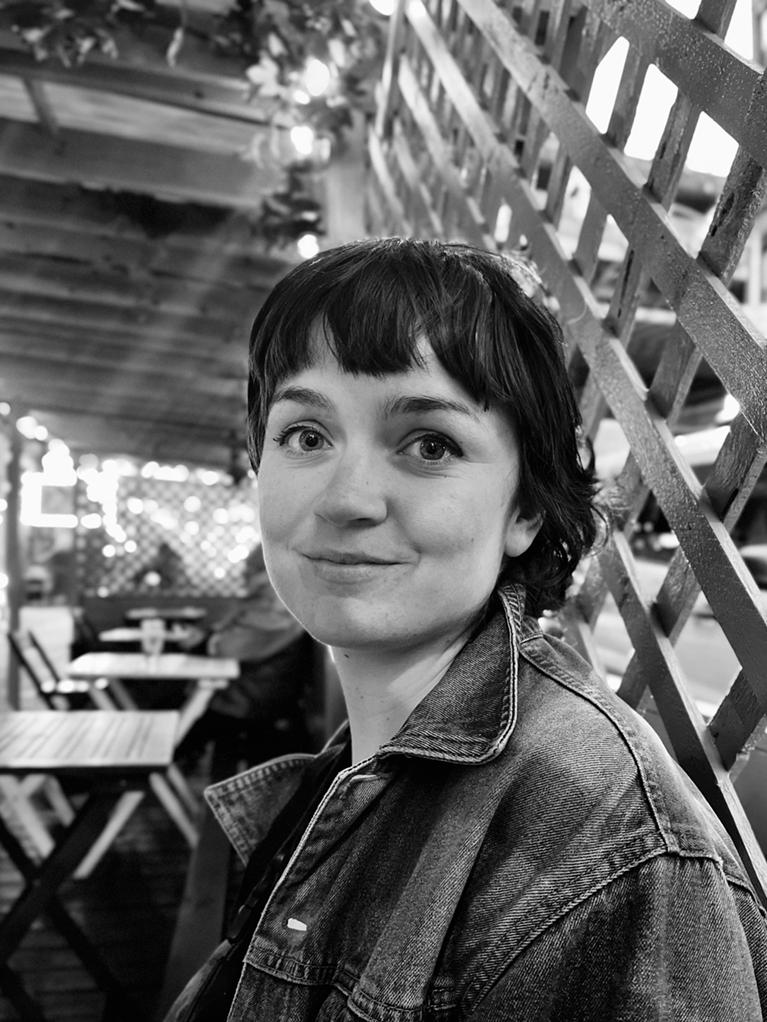
Benedict Cumberbatch

After working together on the new adaptation of Max Porter’s novel Grief Is the Thing with Feathers, Benedict Cumberbatch, known for acclaimed turns in Sherlock, The Power of the Dog and the Doctor Strange films, sits down with the writer to talk about grief, fatherhood, the circus of publicity, Olivia Colman and a quickfire round of ‘would you rather’. What follows is an intimate, searching and at times funny exchange between friends and collaborators, probing how to live, feel and create in chaotic times

Cumberbatch wears Prada throughout, watch Vanguart, photography Matt Healy

Benedict Cumberbatch: Oh, look. We got the same haircut and everything. 

Max Porter: Yeah, I did that deliberately. Talk to me. How are you? How’s it going? 

BC: Tube strikes in London are not much fun, and everything’s all right. It’s just that thing of transitioning back into a full schedule after a summer of ‘this life’s nice,’ and not getting my head into acting. I take full responsibility for it. But other than that, I’m good. Am I going to see you next week at Together for Palestine [a fundraising event for aid in Palestine? 

MP: No, we’ve got a screening that night. 

BC: Oh yes, [I’ll be at Together for Palestine] which is why I can’t come. 

MP: Glad it’s happening, glad it’s big, glad you got all the names. Are you filming? 

BC: No, I’m doing bits and pieces for and that’s kind of it work-wise. It’s just this and developing stuff, writing, going through the slate, getting stuff together with Sophie, and making sure the tennis racquets are in the right place, piano lessons are made on time, the bike’s serviced. It’s the endless domestic list, which leaves little bandwidth for work. How did the go in Toronto? 

MP: I already had love for you, but now I have a great deal of sympathy, having seen how those things work – the drum kit, the red carpet. I don’t know how you do it. 

BC: Everyone keeps saying that necessary. I don’t think it is. There’s another model out there no one’s bothering to deal with, because there are a lot of careers that benefit from this relationship between the press and hysteria around films. One thing it does is celebrate the collective, within the room, within the festival atmosphere. That community around what we do for a living is great. But half the people who want your signature aren’t going to watch your film. They’ll sell it for £300-£900. They’re not fans; they’re making money. I don’t begrudge them that, it’s a bleak world, but it exists alongside this endless need to answer the same questions. 

We had a golden moment during COVID to rethink things. For about five minutes we did. Then we went back to the old normal. You have to get through it, treat it like fun and find something amusing about it. But then you shed so much afterwards. We’ve got a beautiful, neurotic whippet dog. When she goes on a walk, she starts out okay, then starts seeing dogs and everything becomes terrifying. When she comes back, she rubs her body to get rid of the adrenaline and the cortisol of the fight-or-flight reflex that kicked off. The best way is to immerse yourself in nature, or spend five minutes being at the mercy of a six-year-old. Or with the dog. But really, nature is what you need – and isolation. 

MP: I want to sprinkle in quick-fire questions in and amongst the general chat. What’s your favourite tree? 

BC: My favourite tree is the oak. The majesty and the prehistoric might of sequoias is humbling. Both trees, in our land and in lands abroad, for me, are sentinels in the way that whales are. They are slow-growing reminders of life being more important than a political cycle or the profit margin in a quarter. And they humble us. They give us life, both above and below the ground. Those two trees, in their longevity, I find are extraordinary totems of time and our insignificance, but also what we actually need to focus on in our lives, which is our brief moment here, in this incarnation, and leaving it in a better state than when we found it. Not much of that going on at the moment.  

MP: Segueing to our film, The Thing with Features, one of the things that struck me when we met was that you don’t take the easy route. You don’t take this work lightly and your engagement with it is both professional and serious and, in this instance, and most instances for you, profoundly rigorous in terms of the craft. But this was also an intellectual and emotional engagement for you. You didn’t just get the script, you knew the book, and understood the toll it would probably take on you as a human being. But you also dive quite deeply into the questions of paternal care, literary influence, art, art-making as a parent, and the profound intersection of you as a dad, and you as an actor, playing dad with young actors on set. Can you talk about how you jumped in and whether you regret that now? Did it take its toll? 

BC: I don’t think I was aware of the cost until I did it. I knew it’d be costly, but you don’t know until you’re doing it. That’s part of the joy – the perversity, even. It’s a gift – the unknown in our industry and in art in general. It’s about discovery, and that comes at an uncalculated cost. 

The book is so cinematic, the psychological depth of it is naked and profound and alluring to an actor. You feel a lot when you’re reading it, not just because of the universal theme of grief, but this very specific lens. Some association too, not having been through that, but other forms of grief in my life. Also the milieu, the north London middle-class feel of it. It’s a world and a time, a retrospective unreliable narration from the kids’ point of view. Spoiler alert, but as that evolves it’s very specific. All of that resonated with me – our generation, the richness of the imagery, the imagination of it immediately flickered with the light of cinema. 

MP: You know I have this obsession with juxtapositions. Grief Is the Thing with Feathers is entirely that. It’s what the reader brings to the gap between things, the hinge of a metaphor. So I wanted to ask you, how was it to go from being spun by eight-foot-tall Crow in semi-screaming, semi-jayhawking, semi-wailing, semi-orgasming craziness to working with one of your close friends on a whip-smart comedy. How’s the juxtaposition of energy for you in that? 

BC: That’s the Benedict buffet. You need it. I remember James McAvoy saying, ‘God, you’re having a lot of fun.’ I said, ‘Yeah. Try playing George Tesman for four months and watching your wife blow her brains out every night.’ I went big on the comedy for that. 

MP: Is there a form of self-care in curating your career? 

BC: Work should never be therapy, otherwise you leave your personal development in the hands of characters that are over once the film’s gone. That’s not a very safe place to be

MP: Can I be nosy, was working together enriching for your friendship with Olivia? 

BC: Massively so. It’s a working relationship too, so you get far more insight. You spend a lot of time with someone you’ve only seen fleetingly before. Half my life is family, then work, so friendships suffer unless you’re lucky to be friends with kids’ parents. My New Year’s resolutions are simple: simplicity and friendship. 

Olivia is remarkable. It seems very easy for her. Not just because she grew up with Peep Show and comedy classics and knows that world, but she’s innately and supremely talented. She can do anything. It’s a very safe dancing partner, especially when it’s a friend. You risk more, it’s a bit faster and you can be very honest. She’s a great sounding board – never dismissive, properly on it. 

MP: There is this sort of appetite that this world creates in emotionally intelligent people to latch on to. Like when we met, you could have just shook my hand and said, ‘That was nice, thank you very much, and see you next time.’ But you were curious about me, you asked me questions about my life. We got quite deep quite quickly. 

BC: You’re not just part of an opening in my calendar. It’s a rarity to meet people that you feel very strong kinship with immediately. I over-romanticise our friendship, but it’s true. I look at some of my best friendships and how instantaneous they were. In a way, Adam ’s one of them. We did one job together, now we have a production company . 

MP: Have I told you my story about my middle son when I got back from the West Bank? He’s 13, and he’s completely in charge of his own life. He’s someone that gets his own clothes out, makes his own breakfast. Develops his own tastes. It’s amazing; he’s running the show. But I can’t milk him for emotional content. Anyway, I was malfunctioning, heartbroken, traumatised by what I’d seen on a trip to Palestine – apartheid, machine guns. 

BC: I can only imagine. It’s only now coming through in detail, away from social media, what’s been going on. 

MP: One night I was robotically stirring risotto and I didn’t hear him come in. I had been crying a lot, but I wasn’t crying at that moment. My son wrapped his arms around me, held me for about three minutes, then left the room. It was exactly what Feathers is about. A non-verbal, instinctual benevolence. He recognised I needed it. My ability to grieve for that faraway child I’ve never met is connected to my ability to love this one. There is no empathy gap to be crossed. It’s all in me. It’s the pain that is thrust upon me. As he says in the book, ‘let no man cease to fix it.’ It is how I love. May we hurtle back into our family units, covered in the scars and thickets and bristles of the work, and let them see it. Let them soak it up. Let them know that we’re weird. 

BC: It’s been amongst many fears of raising children, the fact we both have three boys. This is a story of male grief – what men feel or don’t allow themselves to feel, and the damage done. We are living through a culture of that. One of the most important things to teach boys is that it’s fine to feel. You are strong in vulnerability. 

MP: We’re running out of time, so here’s a couple of quickfire questions. Favourite bird? 

BC: White-tailed sea eagle. 

MP: Wrong. Crow. Favourite spread? 

BC: Honey. 

MP: Nope, Marmite. Favourite car game? 

BC: Yellow Car. 

MP: I love Yellow Car. Our new game is making sentences out of number plates. It doesn’t work. Would you rather suffer the loneliness of being misunderstood or the unease of having caused offence? 

BC: Fucking hell. Constantly ill at ease at causing offence. Both, really. 

MP: Swimming or fishing? 

BC: Swimming, definitely. 

MP: Would you rather squeeze a pimple or pluck a hair? 

BC: Squeeze a nipple? 

MC: Pimple. 

BC: Squeeze a spot. It’s painful isn’t it, but satisfying. 

MP: This is a really disgusting story to remember but when you’re really tired in the car and everyone else is asleep and you’ve got three more hours to go, I pluck nose hairs to keep myself awake. 

BC: Then I start sneezing and wake people up. Same with ear hairs. I’m getting rogue ones because I’m getting old. 

MP: But you’ve got people to look after you. 

BC: I get regularly plucked, I’m like a prepped chicken underneath this T-shirt. 

MP: Listen, I love you, and I’m looking forward to seeing you. 

BC: Are you coming to Zurich? 

MP: What’s in Zurich? No, I’m not. 

BC: All these film festivals… 

MP: No, but I’m seeing you in London, and we’re doing a day of press together where we can do ‘shacket’ club again. 

BC: Oh yeah, that’d be good. What shackets are you gonna turn up in this time? 

MP: I have two looks at the moment. My T shirt game is entirely either ‘Free Palestine’ or I’ve got this incredible new T shirt that says, ‘Listen to Sade’. And I am therefore having abnormally rich conversations everywhere I go about why Sade is the best. People are sharing their favourite albums – security guards in Toronto were like, ‘My brother – come here. Which record?’ 

BC: Amazing. I mean, she’s great. All I’ve got in my head is when she sings, ‘This is no ordinary love…’ 

MP: Well, she’s a goddess. I have a theory that the world suffers in the gaps between Sade records, and then when there’s a new Sade record we have a moment of hope and optimism. I think Sade’s in the studio working away right now, so hopefully we will have a new era. 

Cumberbatch wears Prada throughout. Watch Vanguart

Photography Matt Healy  

Styling Reuben Esser

Grooming Wakana Yoshihara using Pelegrims, 111SKIN, Naturabisse, Ouai and Oxygenetix

Production The Production Factory

Photography assistants Cameron Jack and Leigh Skinner

Styling assistant Mayu Fukuda


This article is taken from Port issue 37. To continue reading, buy the issue or subscribe here

Alpha, Milda

Grudova is the author of Children of Paradise and The Doll’s Alphabet, known for her surreal and unsettling fiction. In this original story for Port, we follow Milda, a woman released from prison to marry a stranger as part of a state effort to boost the birth rate. But her new husband has his own agenda – he wants her to join his underground political cell, offering to help find the child she lost when she was imprisoned for murder. Together, they must navigate a society where family is both a performance and a form of control

Milda was put in prison for killing her sweetheart, a foreign diplomat, after seeing him take another woman to the ballet. She met him working at a restaurant popular with diplomats and bureaucrats which served tiny fish sandwiches, thin chicken broths and champagne. It also sold French and Cuban cigarettes, electronic plug converters and thin mittens from behind a counter.

Milda had a baby while in prison, which was taken away and put in a nursery she did not know the name of. The state, realising the population was dramatically falling, put Milda in a scheme where men of the public could write romantic letters to her and other healthy young women, and if they proposed marriage, the women would be released early in order to have children.

Benji had various part-time jobs. He worked in a grocery store specialising in dented and damaged goods, and in a local museum which had a small-scale model of a volcano and a vast collection of human brains kept in glass, once belonging to famous intellectuals, revolutionaries and scientists from the local area. He wrote to Milda that someone broke into the museum when it was closed, and – along with the small selection of dry biscuits in the shop advertised as food eaten by astronauts in space – stole all the brains. There were bits of brain among slobber and broken glass on the floor. Whoever stole them had taken bites on the spot.

Where were the brains now? He asked Milda. Perhaps in stews, casseroles, puddings she replied. The prison food was plain buckwheat porridge, soy sausages, pale juice.

Milda wrote him descriptions of her daily prison life: how they made men’s shoes for a foreign market – hideous long ones in red and purple snakeskin – and some older women there were so lonely they hid love letters in the toes of the shoes. Though Milda thought only cads would wear snakeskin shoes and wouldn’t care for love letters at all.

She didn’t tell him about her son, which she had named Teo before he was taken away, or how she stole an enamelled vase from the restaurant where she had worked. The diplomat was furious at seeing it in her bedroom and said she ought to be sacked, and that he would write to the restaurant. It resembled a tattooed chicken: squat with little wings and legs, embossed illustrations of trees and people on it. She didn’t know why she stole it, perhaps to feel a little power or impress the diplomat – which it didn’t at all.

She had also stolen tepid champagne, putting the dregs of glasses into a big old plastic water bottle, and drank it at home to relax before the diplomat came over to make love to her. He made fun of her for wanting to attend Swan Lake, performed by a small touring provincial ballet company which didn’t have a live orchestra but a gramophone only. A gramophone looks like a golden swan said Milda, but he was not convinced. He took another woman, who was also a foreign diplomat from a different country than himself, to see a ballet based off a Tennessee Williams play. It had all the dialogue removed, Milda read in the paper reviews. It was just music and dance. Milda made herself angrier and angrier watching a bootlegged copy of A Streetcar Named Desire with Marlon Brando on silent with no subtitles, until she killed the diplomat. She went into the diplomat’s apartment uninvited because the doorman knew her already, and the diplomat hadn’t told the doorman he had a new woman now. She used a mallet she had bought to fix her bed because it was old and the metal was bent out of shape. It was only in prison Milda discovered the pregnancy and she supposed the rages of bodily change must have caused her to become a murderess because she had never thought of becoming one before.

Benji proposed to her, sending a cheap ring with a ladybird on it in the post, which secured her release.

Benji picked her up from the prison and gave her a large jumper to wear because it was cold. He was unpleasantly thin, and wore a belted grey coat and a ushanka, which he put on her head. His hair was blonde, cropped and full of dandruff. His ears were enormous, with blackheads along the lobe, and in one a tiny gold safety pin.

Milda was given a bag of her things when exiting the prison: the vase, a large stuffed toy shaped like a cricket she had spent a lot of money on – and had meant to give to the diplomat because he had once mentioned finding insects fascinating, but thought now, she could give it to her son – a translated P. G. Wodehouse book and a few flimsy floral dresses missing buttons or with holes in them. The restaurant had taken back her uniform, someone else was wearing it now.

When they were out of sight of the prison, Benji said, I apologise those love letters didn’t mean anything, it just had to look convincing to get you out. I admire what you did enormously, killing that diplomat involved in our government’s corruption and the foreign arms trade.

I killed him for romantic reasons, not political reasons, Milda replied.

I admire it all the same, he said, and I think you will be useful to my underground political movement, Alpha.

I have a son in a state nursery and that’s all I care about, said Milda.

Benji lived in a rundown apartment building called Cecil Court. He made her dumplings from a big frozen bag when they arrived. They ate them with spicy red pepper sauce and sliced-up radishes while he told her about Alpha.

Milda agreed to help with the activities of Alpha if Benji helped her find her child.

The other two members of Alpha lived in a hole off a metro tunnel because they were wanted by the state and Benji didn’t have time enough to bring them supplies.

Milda brought them roasted barley tea in large metal containers, tinned fish in sunflower oil, tinned apricots in syrup and chopped raw beef sandwiches on rye bread, along with all the newspapers she could, which she found abandoned on metro seats. They gave Milda articles they wrote in the dark, to be published in underground anarchist magazines. Both of the Alpha members in the metro wore spectacles, though they had no light in their tunnel besides a child’s flashlight.

Milda had to jump onto the tracks between trains and run into the tunnel where the hole was. She could never get back up on the platform herself and was aided by passengers who thought she was suicidal. She went at a different hour every day so she wouldn’t be seen by the same commuters again and again, which annoyed the two bored and hungry Alpha members who said routine, rather than spontaneity, suited them better in their distressed condition.

Milda and Benji were married with the ladybug ring and drank a bottle of Georgian wine to celebrate. They slept together when they were drunk, and Milda examined his thin, blue body in comparison with the diplomat’s who had been like a comfortable and hairy slug, well fed on ham and milk in his home country. This gave her a sensation she thought might be somewhat political.

Milda and Benji attended cultural events to spy on bureaucrats and politicians. Benji bought her theatre-going clothes from a by-the-pound second-hand shop – a pair of black loafers with gold braid on them, a fur coat, a white lace dress, stockings that went up to her knees but always fell down. When they did, Benji crouched down and quickly pulled them up, gently patting her ankle.

They went to see a theatrical adaptation of Anna Karenina. Benji brought them tiny opera binoculars to spy on the audience. Milda kept thinking she saw her diplomat, but he was dead. There were many diplomats like him drinking glasses of red wine, and kissing younger women in booths in a disgusting, lustful and shameless manner.

The actors wore thick plastic glasses out of place with cheap-looking 19th-century costumes made mainly of satin. Still, she was captivated and refused to look at the diplomats any longer as it made her too irate.

Milda asked Benji to take her out to dinner after, but he said he couldn’t because of his political reputation and going to the theatre was strictly work, a cover for spying. He hadn’t caught a line of Anna Karenina.

Through his political connections, Benji found the name of the nursery where children of bureaucrats and diplomats were kept. It was called Ducklings Nursery. Milda went and stood across the street and watched when the children were taken outside. Her son wore the sailor outfit of the nursery, and a long old fashioned-looking coat with a flared bottom that was too big for him and dragged in the dirt. He had longish black curls from his father, that’s how she could tell it was her son, though she found she could peel off these repulsive resemblances to the diplomat and throw them away, laying bare a hard sweet love. When she rang the bell of the nursery it played a strange tune for a very long time, but no one answered.

She wrote the nursery a letter to try and reclaim her son and they told her she would have to apply via the state family board. Milda wondered if she had any more children if they would take them away at the hospital and ask her to reclaim them too. She bought all sorts of birth control on the black market, jellies, diaphragms and pills, but her and Benji did not sleep together again, though they shyly fondled each other at night.

She sent presents to the nursery, and comforted herself with the mental image of the little children enjoying them: the stuffed cricket, Chinese white rabbit candies, paper doll kits, plastic bags of chunky costume jewellery.

She and Benji had to fill out many forms multiple times and take them to the state family board, detailing Benji’s employment. They recommended Milda find a job too. They also had to move to relocate the two Alpha members in the train tunnel with them. Benji found an old warehouse on the edge of the city, with big windows which let in plenty of bright light the other Alpha members were not used to. They had to wear sunglasses all day. They told Milda they couldn’t tell her their names, even though they trusted her. One’s face was covered in prominent, pale brown moles, like nipples, and the other had a pimple on his nostril which he prodded and examined but didn’t squeeze. They smelled from living in a hole and Milda bought them carbolic soap, but they wouldn’t bathe as they said they were too busy.

Milda wasn’t allowed to work anywhere with too many foreigners or the public because of her jail time but got a job feeding monkeys in a lab. The monkeys had microchips in their heads or were going to be put into orbit, and Milda cried to and from the lab every day thinking of their frightened red faces and how here she could hear their screams, but there was no one in orbit who would. She gave them candy and radishes to cheer them up but it only gave them diarrhoea. Once she had a few payslips she took them to the state family board and they added them to the file. They told her they would have to do a home visit. The spectacled Alphas agreed to leave the warehouse for the day. They packed a frugal picnic to take with them. Milda and Benji cleaned, and tore pictures from a children’s book and taped them all over the walls – tigers and bears in scout hats – and bought a cheap space heater so they wouldn’t think it too miserable or cold for a child. As Milda was showing the social workers from the state family board around the warehouse, she noticed her vase was gone, she had thought it might impress the social workers, an old, possibly expensive thing it was. They drank barley tea with relief after the social workers left. It had gone well. Benji made dinner just for them – radishes, soy meat and a spicy broth. He said the other alpha members would not return, and that they would be leaving the country that night, in fact, after carrying out something they had been planning for a while. It would be easier, just her Benji and the child, said Milda, but did they take my vase?

Yes, he said, it was the perfect container for a bomb, I’m sorry I didn’t ask beforehand. Milda replied, it was ugly anyway.

It was the only thing she had left that had been in the same room as her and the diplomat at the same time. It had that mystical power and now it was shattered somewhere among ruins, but she supposed that was a good thing for her to move on.

She didn’t hear from the state family about the results of the visit, and tried calling the nursery over and over again but the phone had the same annoying piece of music as the nursery doorbell. She told Benji she couldn’t get through to them, and he said, No, I shouldn’t expect you would.


Illustration by Alec Doherty

This article is taken from Port issue 36. To continue reading, buy the issue or subscribe head here

We Are We Are Not

Danielle Pender is a writer and editor, and the founder of Riposte magazine. Her work has appeared in publications including The Guardian and The New York Times. In this reflective essay for Port, she explores the complexities of returning home – how distance reshapes family bonds, and the quiet negotiations that come with reunion


For the last fifteen years I have ridden the East Coast Main Line from London to Newcastle, tracing the same miles over and over, yet arriving somewhere slightly different each time. Newcastle is home in the way that childhood places always are – embedded in muscle memory, a place you don’t have to think about to know. London is where I live now, but when I picture my family, the roots of it, I think of my mother, my brother and me. 

For years it was just the three of us, tightly bound inside a small house, navigating whatever came our way. We were in each other’s pockets in that specific way small families in small houses are – you know everything about each other, whether you want to or not. Routines, rhythms, moods, silences. What time someone would come through the front door, what it meant when they didn’t. The smell of someone’s shampoo lingering in the hallway. A shifting weather system of closeness and irritation and deep, unspoken understanding.

Now, my brother and I have our own families. We have expanded, our lives have changed, and in doing so, we have also dispersed. As the train slowly pulls over the River Tyne into the station, I think of a Heraclitus quote that Siri Hustvedt included in Mothers, Fathers and Others: “In the same river we both step and do not step, we are and are not”. A line that feels made for those who leave home and return – not as prodigals, not as tourists, but as something harder to define. Insiders who have grown alien to their own past. My mother, my brother and I were once a fixed unit inside that small house; now we orbit one another, connected but no longer in sync. We are and are not.

With people moving further from where they were born, modern family life is often reduced to a handful of sanctioned gatherings – birthdays, Christmas, the odd anniversary or weekend away. But what happens in between? What happens when you are no longer part of each other’s daily lives, when the casual, unexamined intimacy disappears? We meet as guests in each other’s presence, performing the shape of family but feeling its lack. The questions we might ask a stranger – What do you do? Who do you love? What keeps you up at night? – are the very ones we avoid with each other, afraid of exposing how much we no longer know.

For the past year, I have been writing a novel about a homecoming, which has drawn me to literature that explores this experience from different angles, offering both comfort and insight. In Long Island, Colm Tóibín’s Eilis Lacey returns to Ireland and finds herself caught between past and present – who she was before she left, who she is supposed to be now. This is often the way for families coming back together; each visit becomes a delicate negotiation, a process of reacquaintance in real time. 

When Eilis buys her mother new white goods for the kitchen, a gesture driven by generosity and a desire to mark herself as different, as a grown woman of means, her mother insists she doesn’t need them, leaving them as obstacles in the hallway rather than having them installed. The protest isn’t really about the appliances. It’s about control, about the unbearable proof that Eilis has formed a life outside of this house, that she is no longer someone whose choices pass through a parental filter.

Annie Ernaux writes about this change and distance with such precision – the way that home, once so familiar, can start to feel like a foreign country. In A Man’s Place, translated by Tanya Leslie, she writes about the gulf between herself and her working-class father, which widens as her education and career take her into another world. She describes the sorrow of seeing home through new eyes, of feeling both love and alienation at once. 

That tension haunts so many reunions. Gwendoline Riley captures it in First Love and My Phantoms, where adult children return to parents who are both familiar and unknowable, baffling and inevitable. There’s something particularly painful about these encounters, when love starts to feel like performance, when obligation replaces ease. The gap between people who should know each other best, but somehow, don’t.

What is it like for those who stay, watching someone return – someone who looks the same but feels subtly, irrevocably changed? The returnee carries an unspoken tension, a quiet air of judgment, whether deliberate or not. Their departure was a choice, one that, however unintentionally, suggests a rejection – of this place, this way of life. Whether their world is ‘better’ or simply different, the contrast lingers, unspoken yet inescapable.

In Gwendoline Riley’s My Phantoms, the mother is a particularly heartbreaking figure, repeatedly colliding with a daughter who has come back to Manchester to care for her, but whose presence is more duty than desire. Their dynamic is fraught; her daughter observes her life with barely concealed disdain, seeing tragedy where her mother perhaps sees only routine or comfort. The book forces the reader into an uncomfortable complicity, recognising the sharp edge of judgment in the daughter’s perspective and perhaps, uncomfortably, in their own.

But estrangement is not inevitable. In Close to Home, Michael Magee’s protagonist Sean returns to Belfast after studying at university in Liverpool, finding his brother and old friends caught in a different rhythm – one shaped by economic precarity and cycles of drink and drugs. The distance between them is undeniable, but love does not demand sameness. Magee writes these relationships with a deep, unflinching tenderness, recognising that while family bonds may stretch, they do not always break. 

In the novel’s final moments, Sean stands with his older brother, Anthony – a man hardened by experience, shaped by a trauma that could have driven them apart. Instead, Magee offers a scene so quietly devastating, so full of unspoken understanding, that it brings me to tears every time I read it:

“I tried to get away from him, but he was stronger than me and he wasn’t letting go. Get off, I said, and he giggled and kissed me on the ear and on the side of the head, my face, my neck and anywhere he could reach with his arm around me. And while he did this he told me he loved me. I love you to death, he said, and he kissed me and kissed me.”

The places and people we come from remain woven into us, no matter how far we go. Family holds a version of us that is fundamental and inescapable – the ones who knew us before we knew ourselves. We may no longer share the details of our daily lives, but that early imprint lingers, shaping us in ways we can’t always see. Whether that is a comfort or a source of pain depends on the circumstances. As Didier Eribon writes in Returning to Reims, “Whatever you have uprooted yourself from still endures as an integral part of who you are.”

For my mother, my brother and me, it is something I cherish. We witnessed everything that shaped us, and in that shared history, there is an unspoken understanding of how the past made us who we are today, no matter what other factors have influenced our identity. I will always be deeply grateful for that. I find solace in the sayings we still repeat, the in-jokes that need no explanation, the memories that resurface without warning – and the way we all look the same when we laugh.

I think about this as I walk across London Bridge one evening after work, caught by a deep and unexpected longing – not for Newcastle itself, but for the version of us that once lived there. My mother, my brother and me in her bedroom, playing charades, doing handstands onto her bed, laughing ourselves breathless. The physical closeness of it. The certainty that we belonged to each other. That incarnation of us is gone, but something remains, changed but intact. Like the body maintaining homeostasis, making constant adjustments to keep itself, itself.

To leave home is to fracture a wholeness you can never fully restore. But maybe restoration isn’t the point. Family is not static. It is movement – towards, away and back again. 

We are and are not, but still, some of us return.


Illustration by Alec Doherty

This article is taken from Port issue 36. To continue reading, buy the issue or subscribe head here


After the Debate

Philosopher Hilary Lawson on founding HowTheLightGetsIn, curating a space for open conversation, and what it means to navigate uncertainty in a fractured world

Photography by Matt Eachus, The Manc Photographer

Founded in 2010 by philosopher Hilary Lawson, HowTheLightGetsIn is a UK-based philosophy and music festival that brings together thinkers, politicians, scientists, writers and artists for a programme of debates, talks, performances and live events. With editions in Hay-on-Wye and London, past participants have included Steven Pinker, Slavoj Žižek, Ai Weiwei, Laurie Penny, Yanis Varoufakis, Deborah Levy and Noam Chomsky. This year’s Hay edition, themed Navigating the Unknown, featured over 300 events spanning politics, philosophy, science and culture, with a standout session exploring international law in the context of Ukraine and Gaza. The upcoming London edition, set for September, will take on the theme After the West, examining shifting global power structures and the future of geopolitics through a new slate of debates and speakers.

Today, with public discourse becoming increasingly polarised, the festival gives a moment of respite – and, importantly, a space for in-depth, cross-disciplinary discussion. In this interview, Lawson reflects on the origins of HowTheLightGetsIn, how the festival has grown from a small gathering to a major platform for ideas, and the editorial process behind curating its themes and debates. He also discusses this year’s focus on uncertainty, the thinking behind next season’s After the West, the challenges of keeping the content original and genuinely thought-provoking, and what it takes to build a space for open conversation, resisting status-led formats.

Hilary Lawson

How was the festival this year?

We had an absolutely great festival in Hay. I think it was the best one in a long time. We had lots of great friends, and people really enjoyed it. We were very pleased.

What were the highlights? Any standout moments?

It’s always tricky to pick highlights – we have 300 events, so it seems a bit invidious to choose particular ones. But we’ve just got one going out called The Rules of War, about whether international law means anything in the context of Ukraine and Gaza. We had Jeremy Corbyn and Varoufakis on one side, Rifkind and someone else on the other. It was a very heated and really interesting debate. There was a whole range of topics that went really well. I think that was widely felt by attendees, they really enjoyed it.

We film all of the events and release them once edited. They go out on IAI.tv, on third-party sites and our YouTube platform. Being at the festival is exciting, and for a good event we might have 500 people – The Rules of War had 700, so the tent was packed. But in a good month, we can have 10 million views on our online platform.

The Hay festival’s theme was ‘Navigating the Unknown’. What inspired that choice?

We chose that title because we thought it summed up our current situation in the world. Traditionally, we’ve imagined we’re just uncovering the unknown, bit by bit. But the idea behind the festival was more radical – that the world might be unknown in a fundamental way. Not just that there are gaps in our knowledge, but that everything we know is from our perspective, and others have very different views. We’re navigating a world where there’s no single truth, just competing perspectives. The whole thing is, in a sense, unknown. So the question becomes: what might we do about that?

Photography by Steve Turvey

Do you brief the speakers with the theme so they can respond to it?

The way we build the festivals is we start with a theme, which we choose because we feel it captures the cultural zeitgeist. For Hay, it was Navigating the Unknown. For our next festival in London, it’s After the West. We divide the intellectual world into a series of topics and apply the theme to each. Then we frame debates around those topics and find the most interesting people in the world to address them.

For example, in the Hay edition we had a philosophy debate on language and thought, titled Lost in Thought. It was about what thought really is and whether we understand it. I debated with Steven Pinker, who had a very different position. That’s how it works: we take a theme, apply it to various fields and create debates. Then we go find the most engaging voices.

You launched the festival in 2010. What was the initial idea, and how has it evolved?

The first event had 50 people. Now, in a good month, we get 10 million online views. A pretty radical change. There was no grand vision at the start. I’m a philosopher, and I felt philosophy wasn’t really part of British culture. It was seen as technical or irrelevant – a Monty Python sketch more than something meaningful. That seemed crazy. Philosophy deals with the biggest issues we all face as humans. Why weren’t we talking about them?

Academic philosophy had also become very introverted, arguing over the meaning of words, not ideas that mattered to people. If I said at a dinner party I was a philosopher, people wouldn’t lean in – they’d avoid the topic. So the idea was to create a space to talk about big philosophical questions with real engagement.

People told me no one would come to a philosophy festival, but right from the start there was huge interest. We discovered people were hungry for deep, thoughtful discussion, especially in contrast to the sound-bite culture of the internet. At first, we thought we needed to make things accessible or ‘simple’, but we quickly realised we didn’t need to dumb it down. People can follow complex topics if the speakers hold different views. You don’t need to know particle physics to follow a debate on it – you get the stakes through the clash of perspectives. We’ve had Nobel Prize winners in the audience. One even asked a question during a debate. But you don’t have to be a physicist to find it gripping. You just need good conversation and disagreement.

 
Photography by Matt Eachus, The Manc Photographer

Who is your audience? Do you cater to a specific demographic?

Remarkably, our audience is evenly spread across age groups. We have sixth formers, university students, and people in their 70s and 80s. There’s a slight peak in the 25-35 age range, but it’s broad. And we get engagement from all over the world. Our biggest online audience is in the US, but you can name a town anywhere and we’ll likely have thousands of people who’ve watched our content from there.

What are some of the biggest challenges you face in putting the festival together?

Our biggest challenge is editorial. The practical side – such as building the festival site and the logistics – that’s handled brilliantly by our team. But we’re constantly trying to generate fresh ideas. People assume we just look at new book releases or recent articles, but most of those don’t really spark something new. We’re not about selling books or celebrity panels, we’re about ideas.

We need a new concept for every debate. For example, we’ve got one coming up called Making Europe Great Again. It explores whether Trump’s demands for Europe to pay for its own defence might push Europe to become a powerful global voice. Rather than seeing it as a crisis, could it be an opportunity? Another one is The Big Bang Miracle. The Big Bang theory is widely accepted, but it was initially proposed by a Christian physicist. We’re asking whether the theory was influenced by religious ideas – does science really come from a neutral place, or are our theories shaped by personal beliefs? That’s the level of thinking we want. And it’s hard.

 
Photography by Sam McMahon

What does the future of HTLGI look like? Will the format evolve?

We’ve already started expanding. We began with debates and solo talks, then added what we call ‘hat sessions’, which vary the format – sometimes more interactive, sometimes different groupings. We now have Academy courses, which are longer and more like structured lectures. We’ve also built a huge library of content over the past 15 years, covering nearly every major topic with the biggest thinkers. Increasingly, universities subscribe to our platform so students can access this material. That’s a big area of growth.

We’d also like to expand globally. We’re exploring the idea of doing a festival in India, for example. India is growing fast – it’s the new economic power – and we want to be part of that cultural and intellectual conversation. Right now, although we include many American and European voices, we have fewer from India, China, Africa. That needs to change. Our tagline is ‘changing how the world thinks’, and to do that, we need a genuinely global range of ideas.

The festival also includes music and comedy, why is that important?

It’s a key part of what we do. People often ask why we include music and comedy. Apart from it making the experience enjoyable – I’m a festival-goer myself – it also changes the atmosphere. Without those elements, the ideas can feel more hierarchical, more like a conference, where the people on stage are the ‘authorities’ and everyone else is just watching.

We deliberately don’t use titles like ‘Professor’ or ‘Dr.’ – just names. In the world of ideas, status shouldn’t matter. Only the strength of your ideas. There are no VIP areas either. You might find yourself in the coffee queue next to a Nobel Prize winner. And that’s intentional. The best conversations often happen informally – over a bite to eat or some chocolate-dipped strawberries from a festival stand.

We don’t pay our speakers either, not because we’re trying to save money, but because we want people to take part because they care. We cover travel, but we want our biggest names to show up because they love the discussion, not for the fee. And we don’t allow anyone to do only a solo talk about their book. That’s marketing. We want real conversations where people can be challenged.

HowTheLightGetsIn is running from 20th-21st September 2025, find out more here

Dad Bod

Vijay Khurana is a writer and translator. His novel The Passenger Seat was shortlisted for The Novel Prize in 2022 and is forthcoming in 2025. His stories have appeared in publications including NOON and The Guardian. He has also presented on Australian radio station triple j. In an original story for Port, he circles the subjects of memory and tension

Illustration by Alec Doherty

Fridge
The fridge is making unfortunate noises so I go to my wife and I say Rash, we need a new fridge. Rash’s laptop is inverted and looming. She whooshes air-in-a-can into its glowing keyboard as dead skin snows on her turtleneck. She looks great in that shade of rust. And who’s supposed to pay for that, Rash asks. Rash, I say, It sounds like whale song in there. The dairy might be too far gone already. Will you at least come and listen? Why don’t you try doing your exercises, she counters. (For my birthday she sent me to a specialist who informed me that 99 per cent of people do not know how to breathe properly. We think it just happens, he said, But it’s no less learned than pottery or windsurfing.) Rash holds her laptop so precariously above her that I worry for the bridge of her nose. But before I can warn her she brings it to her breast and cradles it, making circular motions over the screen with her special cloth. I go back to the kitchen and chew a speckled gum pellet. Something new has sprung up in the interim, an empathic trombone. One of the sides is almost too hot to touch. I can hear Carmella’s dogs talking excitedly in the living room. Kneeling before the fridge door, I trace the magnetic seal on all sides. Nothing seems to be escaping, and yet—

Projector
Carmella is newly two and getting her into and out of her high chair is murder on my back. Rash is smaller than I am, less brittle. We have different understandings of what pain might be. We had meant to book a holiday before Carmella’s second birthday, because from two they need their own seat on the plane, which Rash says would be money down the spout. Under two and they’re free, but they have to sit on your lap the whole time, which isn’t recommended for long-haul. We never went on holiday. Instead we bought a projector, and now Carmella watches five-foot talking dogs on the living room wall. I don’t know how she can bear the projector’s fan, but she just gurgles there on the floor, gazing up at Robo, Trax and Slider. Maybe she believes herself a cartoon too.

Mirror
Given her size, it is strange that Carmella has not acquired a diminutive. Even Rashida, very much a grown-up and in fact four years older than me, is Rash. But Carmella is Carmella. I have plucked at Carma, Mellz, Melly, Mell-Mell, Car, Cammy… none of them are the slightest help. If I stand at the hall mirror, I can hear fridge and projector fan and dogs and air-in-a-can all together. I try this for a while, closing my eyes and imagining the pull of an underground platform when the train is imminent. I once told my father that Rash earned more money than I did and Dad said, I’m surprised you earn anything at all. His skin is papery and his health is not what it was. He has no weakness to speak of.

Drain
Carmella wants me to change her show to the next episode. She doesn’t like this one because the dogs have gone to space, their faces obscured by bulbous helmets and their treacly voices dressed in radio static. She communicates her displeasure by a repeated bringing together of the lips while she breathes, pah-pah-pah-pah-pah. She might be addressing me, but she says the same thing to Rash. Everybody in this house is exhaling without end. Later I hold a spongy wedge of brie to my wrist. It is tepid at best. The cheese is tepid at best, I call out to Rash, who is now typing at great speed. One of the dogs replies: But we can’t have a picnic without lemonade. My daughter makes a noise like a drain. She is always doing this, begging to differ.

Accidentally
Rash’s job obliges her to travel. This morning she departed for a series of spiked clusters with names like Eindhoven and Paderborn. I watched from the porch as she disappeared into a taxi, levering Carmella’s drowsy arm even after the taxi had turned the corner. When we got back inside, the whole place smelled of fresh nail polish. After her last trip, she located her own postcards on the hall table and affixed them in a neat row on the fridge door, secured by magnets displaying the numbers to call if you swallow poison accidentally or wish to sell your home. The postcards are word-side-in except one, on which she sketched a continental breakfast in biro. One day Carmella will begin to see me as a subject. She will create images in which I appear as a series of vacant shapes connected only by association, with an indiscriminate face, blazing hair. This may well be something to look forward to.

Kettle
Towards evening I feed Carmella a bowl of unadorned penne, then run her puddle-deep bath. I kneel on the tiles, wiping traces from her either end. When she is safely reunited with her dogs, I fill the kettle and hold the button down until I can feel what is inside jostling to get out. From the bathroom comes the last gulp of a plughole thick with hair. I place a towel over the kettle spout, distributing the steam as evenly as possible, then wrap the towel tight about my head. I grope for the kitchen table, repeating myself in the wet warmth. I inhale as far as I can and count backwards from eight. The fridge falls silent. Then a thick plosive and shower of something sharp. I unwrap the towel and rush to where Carmella is glued to her dogs, surrounded by broken glass. Why don’t we go exploring, says one of them, the blue one, as I approach the window. One of the four panes has come inexplicably free, dispersing itself across the floor and leaving a neat rectangle through which air is now freely passing. We need a new window, I call to Rash, before remembering she is not here. I exhale into my palm and imagine the doorbell ringing and a man in an over-poured polo shirt standing on the mat. Good job, he might say. You didn’t do too bad, but we’ll take it from here. The dogs employ teamwork to overcome an obstacle as I wrestle Carmella onto my lap and force felt loafers onto her tiny feet. Her skin is immaculate, nor will it suffice.

Illustration Alec Doherty

This article is taken from Port Issue 35. To continue reading, buy the issue or subscribe here

Literature from the Barrel of a Gun

Selma Dabbagh is a British Palestinian writer of fiction, whose work is mainly set in the contemporary Middle East. In this original essay for Port, she explores how literature, especially from Palestine, confronts the violent erasure of identity and existence

Illustration by Alec Doherty

On 28th August 2024, more than 65 Palestinian filmmakers signed a letter accusing Hollywood of dehumanising Palestinians on screen for decades, a process that has helped to enable the ongoing genocide and devastation in Gaza. We are told, all too frequently, that literature and culture generally humanise ‘the other’. But cultural production can also prime people to allow for killing en masse; it can reduce a people to targets, ungrievable bodies, dispensable ‘others’ stripped of history and humanity.

‘When in doubt,’ seems to go the unwritten dictum of Hollywood scriptwriters, ‘just kill an Arab.’ And they do, over and over, in countless thrillers and action movies. Arabs portrayed in film continue, in the main, to be depicted as nameless, odiferous and duplicitous. None more so than Palestinians, a national identity that for years has been repeatedly and deliberately fused with associations of terrorism. Around 14 million people globally have been characterised, year in, year out, through projects of cultural distortion, as having no individual agency other than to cause harm. They are depicted as devoid of basic needs or desires such as having jobs and families or falling in love. Instead, Palestinians are portrayed as a distinct species bred to kill innocents, making it, according to this perverse logic, justifiable to kill them before they do so. The heterogeneity of Palestinian existences continues to be flattened and denied. The most, it seems, to be allowed for in terms of potential humanity, is that of the pitiable victim.

As a reader who became a writer, I approached Palestinian literature from an awkward angle. I have an English mother and a Palestinian father, and grew up in Kuwait which, as a teenager, bored the hell out of me. Like many aspiring writers, my portal out of the ignominy of my unprepossessing surroundings was literature. I read only in English, particularly Russian and French classics, admiring works where the female protagonists had power and lovers most. Being Palestinian was nothing special in Kuwait at the time: around one in four people in the country fell into that category before 1991. But the unhappiness my father’s violent refugee experience brought to aspects of our family life felt, to paraphrase Tolstoy, like a very specific unhappiness, a private and wretched trauma; one that the world should know about, but somehow could not be shared. When I moved to England at 16, it became even more of a secret hurt, rarely exposed. The word identity was not in my vocabulary, and my approach to wounds was to not lick them too much.

Most Palestinian literature available in English at the time — and I am talking about the ’80s and ’90s here — was produced by small publishing houses and consisted of poetry or mediocre translations of novels. At that age I was rarely still enough in myself to be able to give poetry the focus it required. Mahmoud Darwish, the icon of Palestinian poetry, was a name I knew, but I assumed he belonged to others, like the boys at school in Kuwait who wore keffiyehs.

That all changed when I read Ghassan Kanafani’s Men in the Sun, a collection of short stories that featured Jaffa, Gaza and Kuwait, while living in Cairo in my 20s. I read my father’s childhood stories in a house by the sea. Expulsion from Palestine in 1948 became multidimensional and palpable, as did the world of the country where I grew up. Rather than being escapist, literature became a way of discovering my core emotional fibre. It was a route to self-inquiry that was as self-affirmative as it was probative.

In recent years, the quality, diversity and quantity of Palestinian literature available to the English language reader has transformed and expanded beyond recognition. I believe that literature, together with art and films, both documentary and feature, coming from Palestinians in Israel, the occupied West Bank, Jerusalem, Gaza, the Arab world and the broader diaspora, writing in Arabic, English, Hebrew, French and Spanish, is some of the most exciting, innovative and challenging work available globally. It comes naturally to Palestinian writers to see the political in the personal and to make the personal political. Moral choices that pit the communal against the familial imbue every quotidian interaction. Characters are pressurised by states of siege. Actions have consequences. Honour is valued and at stake. Freud claimed humour and altruism as the only positive psychic defence mechanisms for dealing with trauma and anxiety, and they abound in the worlds of Palestinian poetry and novels. For humour, I would direct the reader to the work of Mazen Maarouf’s Jokes for the Gunman and Suad Amiry’s Sharon and My Mother-in-law. For altruism, it goes by another name, more one of a generosity of spirit and concern for others. It runs deep in the spirit of every line, with even the grieving, starving survivors of genocide struggling to find ways to help others, in Don’t Look Left; A Diary of Genocide by Atef Abu Seif (2024) and Messages from Gaza Now, the accounts sent from Gaza by Hossam Madhoun in the period since 7th October 2023. If what we see in Gaza is a “rehearsal of the future”, as the Colombian President Gustavo Petro stated at the recent UN Climate Summit, then these are the works that demonstrate how to prepare oneself for coming times.

In the past, it was my experience that literature translated from Arabic linguistically failed to translate culturally. This was not the translator’s error; there are just regional variations in taste and behavioural codes. I always sensed that there was a higher degree of tolerance for what is deemed to be ‘sentimental’ to those coming from more puritanical Anglo-Saxon cultures. Not to mention other variations in cultural norms, for example with regards to women. Translators and publishers act as gatekeepers to another culture and are sensitive to, and influence, how people of another language are perceived. In other words, what the English language reader is exposed to is subject to fashion, and some of these trends, such as the ‘saving Muslim-women’ genre, are now dated and dismissed. Kudos should be given to initiatives like ArabLit and translators like Marcia Lynx Qualey, Wen-chin Ouyang, Katharine Halls and others for pushing back on patronising, politically motivated demands of publishers for veil-covered women on their covers; opening pathways for new voices and realities to come to the fore.

When it comes to literary styles, there is no defining form. Palestinian literature is an eclectic, absorptive mixture of languages and global sources of inspiration. The Palestinian ‘cause’ is an anti-apartheid quest for liberation. The post-Nakba trend, particularly in the ’60s–’80s, for art and culture embodied the revolution, and Ghassan Kanafani was the epitome of the resistance writer, combining political work with fiction and historical writing. He was assassinated by the Israelis in 1972, together with his niece. At that time, the revolution that embraced cultural output was influenced by the legacy of Marx, Trotsky and the Fourth International. The battle was then and is now, not just for land and freedom, but against erasure at every level, from buildings to documentary records, archives, libraries and photographs. Physical erasure of the Palestinians by Israel has now reached the heights of high tech, including, it has recently been reported, the mystical erasure of WhatsApp accounts of those killed in Gaza, the last remnants of relatives’ voices and messages being eradicated with their bodies. The banning of Palestinian artists at festivals, the refusal of venues to host events, the censoring of content, the sacking of editors of magazines that call for ceasefires — this too is erasure, not as visual or physical as the destruction of over 500 Palestinian villages in 1948, or the destruction of every university in Gaza and over 200 archaeological and cultural sites, but another (outrageous) affirmation that Palestinians are not, according to powerful narratives, supposed to exist. Literature becomes a tool, among many others, to be innovatively deployed, to write people back to life.

And Palestinian writers and artists are responding to their threatened eradication with eloquence, style and fury. The writing ranges from the visceral and explosive, to the contained and reflective. For work in English, one eye could be seen to be turned to the powers in the West, urging them to recognise Palestinian humanity, presence, history, complexity, interiority. This approach of writing intending to ‘inform the West’ was one the Palestinian-born writer Soraya Antonius (1923–2017) adopted in her novels of the 80s and later questioned: “Today,” she wrote in 2001, “I think this was rather a colonisé reaction, implying as it did that Westerners were inherently godlike in their impartiality and that their injustice was born of misinformation.”

Style is not just a question of preference, but of circumstance. For those living under bombardment or occupation, or both, the short form (Nayrouz Qarmout, Maha Abul Hayyat) or the diary (Raja Shehadeh, Atef Abu Saif), or letter (Hossam Madhoun) can prevail. In exile, the Nakba generation, like my father, were frequently treated with incredulity when relating their history and identity. They wrote to recreate a destroyed world and took to their memoirs. Themes of exile, diaspora and transit repeat for all Palestinians, wherever they are. For readers who feed off the delicacy, fine tuning and balance of a phrase, I would recommend the poets – not just Darwish, but also Samih al-Qasim and Mosab Abu Toha. Palestinian novelists outside Palestine write in styles that have been compared to the epic-like remit of Stendhal (Isabella Hammad) or the spareness of Raymond Carver (Adania Shibli). The young essayist NS Nuseibeh’s Namesake is a searing, contemplative account of, among other things, the microaggressions of racism and Islamophobia experienced in Britain.

Since the genocide on Gaza began, a morbid genre of poems has emerged: elegies anticipating writers’ own deaths. Some call for no more than a grave, or to die in one piece, or not to wait for their own death for days under the rubble, as seen in these lines from a poem published on social media by Ibrahim Al-Ghoula hours before he was killed in an air strike, together with his wife and five-month-old baby daughter:

I don’t want to end up in a bag!!
Everything is negotiable except my death!
I want a full shroud, 192 cm long.
I don’t give up any part of my body,
I want it whole.

It must not only be about death. Poet Rafeef Ziadah’s We Teach Life, Sir goes to the heart of the battle. There is a desire pervading Palestinian writing to overcome destruction with humanity, community, family and love. The urgency transmits. Palestinian literature refuses to accept that art is one thing and politics another: the fusion is as compelling as it is essential. In our tens, in our millions, as they say at demonstrations, we are all Palestinians.

Illustrations Alec Doherty

This article is taken from Port issue 35. To continue reading, buy the issue or subscribe here

Different Things We Mean

An interview with Greg Jackson

Photo PASCAL PERICH

Greg Jackson’s first book, Prodigals, was a short story collection concerned closely with its protagonists and their relationships on a small scale. Reviews praised its intelligence and eye for structure, and in 2017 he was named one of Granta’s Best of Young American Novelists. His debut novel, The Dimensions of a Cave, extrapolated longstanding concerns to a scaled-up narrative, set in and beyond an expansive world, and he talked to Port around its concerns and themes as well as his thinking on the written more broadly.

So how did you start writing?

I guess I had this idea for a little while. I’ve always been a big fan of Conrad, and I had the idea of writing something that was along the lines of Heart of Darkness in some ways, but instead of being kind of this late-19th-century early-20th-century version of a trip into what, for the protagonist, was an unknown geography and a mysterious place in the world, I thought maybe a modern take on it would involve a journey into a simulated space, into a technological space – that was the germ of the idea. I’d worked for a while in sort of the mid-late-2000s with an investigative journalist in DC writing books, and a lot of what those books were about, and the work we were doing, was looking at the American so-called war on terror and the response to 9/11 and all of these wars that came out of it: the intelligence efforts, the military adventurism, the scandals and infighting within the government, within the political agencies. I had a background, a bit, in that world and I’d always wanted to figure out something to do with that experience. I guess those ideas kind of came together.

Were you always doing some kind of written work?

Yeah, essentially. When I left – what we call college – when I left university, I spent a year in New York. The magazine n+1 had just started a year or two before, so I worked there and did kind of menial jobs to make money. I wanted to do my own writing, but it’s very hard working multiple jobs, and also when you’re working on a magazine, as you know, you’re spending a lot of time with other people’s work, not as much on your own.

There’s a desire to rush into writing fiction, but when you leave university, you don’t necessarily know that much about the world – apart from inside the walls of academia and educational institutions. So I wanted to spend a little time learning about stuff I didn’t know, working out in the world before just going into fiction. I happened to get this job in DC and I worked there with this investigative journalist for several years and did that, basically, for a while, until I went and got an MFA.

The sense I get reading your fiction is that it’s a tool for understanding questions that you’re generally interested in, from loads of different angles. It often feels like there is some central, not thoroughly looked at question that you’re getting lots of different perspectives on. If you do agree with that characterization, how did you end up there? What is it that appeals to you about it?

I think that’s a very astute observation. Although not one I’ve had myself, so, turning it over in real time thinking about it, I think I’ve always felt a little bit drawn to philosophical thinking, but not quite with the rigidity of academic philosophy, or what we tend to think of as philosophy, and so seeing novels, seeing fiction as a way to get at these deep questions – sometimes more philosophical and abstract, but sometimes also the practical philosophy of how we go about our lives, how we structure them, how we find meaning, I think these are things I think about. I think fiction offers a way to think about them through characters, through dilemmas and contradictions, and opposition between people. In some ways that reflects more of my own sense – not that it’s impossible to come to a conclusion or have your own ideas – but I often feel like I see a lot of value and insight and importance in different ways of looking at things instead of kind of coming to one view and defending that.

I like putting these things in opposition, within the dramatic structure of fictional settings, between characters. I think of novels of ideas in the past, thinking of people like, you know, Dostoevsky or Thomas Mann, or something like this. If you have that kind of open-minded or open-ended view of people and the inherent and timeless tensions and dilemmas between them – it can be more satisfying, I think, to try and map that whole sphere of thought and of contradiction and of opponency rather than trying to argue, as a polemicist might, for one way of seeing things.

That makes sense to me. There are central political questions in the novel, that if you were to spend that amount of time on them in any way that felt definitive, would feel very different and I’m not sure it would do anything that it does in the fiction. How do you feel about the idea of political art – I saw that you were at some point working on a book about this?

I definitely have written a bit about that and thought about that. I think my ideas probably have changed or evolved to some degree. I think maybe all of ours have – I’d actually be interested to know if you feel this way yourself – but I feel like when I was thinking about this initially in around 2014, 2015, that era, so much has changed between then and now, perhaps especially in the American context, at least our political context. It feels like we’ve undergone a very cataclysmic period, not just because of cataclysmic individuals, but because of our entire cultural response and digestion of what’s been happening.

I think the one thing that I’ve always felt, that I still feel now, is that there are different things we mean by political art. The general way that we talk about it now is art that is very personal, that involves aspects of individual life or individual identity, that have a profound connection to what we take to be political questions. I think that that’s a totally fine and reasonable interpretation of political art, and certainly a fine and reasonable and useful thing to do, but I was sort of interested in whether art could actually engage with the substance of politics – what we usually mean when we say politics, which is the ongoing process of governance, of democratic messiness, of how we’re governed, of bureaucracy, of the relationship between the large structures that sit above us as citizens, individuals and the actual life of individuals that both constitute and live within and under those structures. I wanted to see if I could write about politics per se, not about a more traditional individual story that has political valances.

I was thinking a little bit about you know, A novel like All The King’s Men by Robert Penn Warren. It’s very rare that there’s a novel, or at least a very canonically lauded novel, that’s that much about actual politicking, the actual endeavours of politicians – not that my novel is so much like that, but I took that as an interesting challenge, as something that wasn’t done as often. By no means is this to denigrate any other approach, I’m just saying this was my approach to political art.

More of a novel of process than a document, maybe, is the difference between those two approaches?

I think talking about it, this has sort of fallen by the wayside… there was this idea maybe in like the 90s and into the 2000s of the systems novel, which I think is a slightly ambiguous or amorphous term, but I do think what it’s maybe trying to do at its best is trying to unite these different scales on which we live. The scale of our individual daily lives, of course, and then we spend a lot of imaginative time and cognitive time living in the apprehension and comprehension of world events, of things that are happening in politics with politicians, things the government is doing on our behalf, or other governments are doing.

We feel the downstream consequences of this, we feel under the authority of power, and the mistakes and maybe the occasional beneficence of these decisions – but trying to actually do the work, charting how those different scales hang together – that seems to me what the systems novel at its best was trying to do, and that was certainly one of the goals in writing this book. I would emphasize that this is not exactly what I’m planning to devote my life, or all of my fiction to – I’m very interested in smaller scale fiction as well, more daily human life and decisions.

I really loved the story about the storm from your first book, in which I feel like the question is how do you properly convey what you want to convey to someone that’s actually there with you, when you have basically everything at your disposal? It feels like a negotiation of that, and the truest bit to me was the sort of botched joke, where he says ‘You were born in an oil refinery’ and she says ‘Don’t be crude’. Quite a genuine moment out something set up as forced. That made the story click, to me. How does humour help you, as a tool? Because I think that’s also that’s the primary way we attempt to engage with political process questions, through satire, and I’m not necessarily sure that that’s a helpful way of doing it.

I’m so glad you like that story. That’s actually one of the ones I feel most fondly about. Completely In the opposite direction of what we were talking about with the systems novel and large-scale things – there’s part of me that just loves drilling as deep into a single person or two people and these dynamics, just going really deep into that psychological complexity of how we encounter one another, which is probably what we all spend a lot of our time wrapped up in.

I think you’re right that I think satire can go too far, it can be a kind of a balm or a response to a sense of kind of political helplessness or impotence. I love a lot of the satirical representations of politics – I do think in Dimensions of a Cave I channel in this sort of bantering joking, slightly Armando Iannucci, Aaron Sorkin type of thing. I wanted there to be at least that degree of levity, or playfulness or fun because I think that some of the material is kind of weighty and maybe, at points dark. I wanted to balance that. But I certainly didn’t want it to be satire in the sense of – these people are morons everybody’s just completely corrupt or beyond the pale, the lines between heroes and villains are easily drawn. Basically everybody’s a villain unless they’re a kind of bumbling fool – I find that too reductive.

I sort of see humour as a philosophical stance on life. I think it’s the philosophy of doubt and of modesty and of not taking your own convictions So seriously that you can’t entertain other people’s, and give them space to have differences and different opinions.

I think we all have this experience, where we’re in a kind of argument and it gets kind of combative, and ifsomeone can make a joke where you both laugh, you’ve both given permission to let go a little bit, and not be operating in this mode where it’s just you know: I’m right, you’re wrong; I’m the good guy, you’re the bad guy.

I think humour is – maybe this is one of the things we love most about it – kind of a permission to change your mind, and not have to be stuck in or rooted in positions you’ve clung to or you’ve dug yourself in on. It’s a kind of ethos of humility.

I think the one liability with humour is that it can be deflating, by deflating tension it can work against a building seriousness or gravity. I never know exactly what the right proportion is. I think there’s obviously some very effective fiction that really stays deeply in one sort of tenor, and you don’t get much in the way of humour and that can have a lot of power. I feel conflicted, personally and I wonder what you feel.

I think there is a sort of sniff test that sometimes happens – if I find something takes itself too seriously I less inclined to give myself over to it. Even if it’s an inconsequential thing, the idea of fallibility or openness is inviting. There’s a good Lydia Davis essay with the idea that you can endear yourself to readers by asking them to fill gaps.

I think that’s right, I think that Lydia Davis bit is really really on point. If there are ideas in fiction, if there are viewpoints expressed, you want to leave room for the fact that different readers have different ideas and beliefs, and to give people the space to enter the fiction. Something I definitely feel in some fiction, that I rebel against, is when I feel I’m just supposed to agree.

Did you read that Sanctimony Literature essay [by Becca Rothfeld] from a few years ago? It’s a reading of some recent autofiction as basically doing that in a sanctimonious way.

Yeah, that sounds familiar. It’s really hard – different authors have very different degrees of this, even the way in which the book teaches you to understand it as this is what I the author think or this is me looking with some criticality on myself or a version of myself. Maybe that sanctimony, if it crops up, is partly a slightly bad conscience. Maybe that’s not quite the right way to put it. I think there’s a feeling of a lot of angst in auto fiction, about the idealistic impulse to write fiction and to love literature, but also the sort of slightly sordid way in which, when you write literature, you want to be successful and read. There’s something a little bit tawdry or unseemly about that, and I think that that tension – between the pure idealism of art on one side and the inevitable careerism and desire for glory or greatness on the other –produces a lot of this weird conflict in autofiction, but that’s sort of a digression.

I do think so much of this comes down to sensibility. If the sensibility is genuine, humble enough, has enough perspective on itself, has enough generosity to the reader, I think you can succeed with any subject matter or material.

I’ve seen you say that fiction is a way for you to grapple with questions you can’t elsewhere. Where has that taken you in this novel? Has that process changed your thinking in any way?

Of course, if you spend a lot of time doing something it probably has changed you. We were talking before about this idea that so often in public or in external interactions with people, you’re asked or expected to take your point of view, to have a point of view, to have an opinion, to represent that. I think a lot of times I feel: sure, I can express my point of view if I have to. I find that fiction is a way for me to draw out how much I feel there are authentic contradictions, insuperable dilemmas in these different ways of looking at the world. Putting those into a fictional vehicle or vessel and being able to explore them at depth and have them put pressure on one another I think I always find more satisfying than trying to just argue for a simple one sided or one dimensional point of view.

The art that I really admire and I mean art in the broadest sense – literature, but also other sorts of art – really grapples with the complexity and nuance. As artists go about their public lives, I feel like there’s more a tendency to want to affirm what seems to be the right point of view, or the right values, as opposed to dwelling in the nuance or complexity. I think in that sense maybe it’s deepened my commitment to being a little bit iconoclastic.

Is there any fiction that you feel does this, or you find particularly instructive?

What you gleaned about working on a book about political fiction – It started as a very long piece about Grace Paley, a writer I really love. I think she writes very political art, and she certainly writes from a particular political angle, she’s very left wing. I just think that she does such a good job of not falling into this trap of not making space for the reader, the person who might have different points of view to talk about things in t a very open, warm way – to find ways to make somewhat complex political questions or issues, that have kind of gotten calcified in the discourse by particular ways of talking, to make them quite simple and bring them down to a very human level. I find that very inspiring. It’s just a beautiful way of addressing politics and I think again, it’s an element of sensibility that transcends this kind of ideological sphere or spectrum where you feel like you’re really being asked to agree or disagree.

Sticking with somewhat political things. I think writers like Sebald and Bolaño mean a lot to me. They also have very different sensibilities, but their sensibility somehow enables them to talk about, in some ways dark, in some ways often politically freighted material, but there’s something that feels so open and life-giving and generous to the reader about their approaches. There’s tons of film from the 20th-century that just astounds me with its moral complexity, its humour.

Where do your approach to realism, your approach to generosity, and your approach to authenticity sit? How do those things interact for you as fictional questions?

Sometimes I wish that I had the sort of dogged tenacity to write in a more strictly realist way, just because I feel like there is a kind of discipline to that. There’s a sort of power that emerges. Maybe it’s a kind of modern, attention-fractured aspect of our life; I get a little excited or antsy as I’m writing and I sort of want to go more directly toward what I think are the key ideas or themes, the psychology and the philosophy that underlies things, and I think sometimes that prompts a certain slight shortcut away from the most strictly literal into a slightly hyper-literal, or sometimes more metaphysical. Even in a story like ‘Dynamics in the Storm’, which you brought up, it moves from quite realistic, literal narration to a plane on which you take what’s being dramatised as not 100 per cent literal. I like that because it kind of allows me to keep tacking towards what I find most interesting, or most central or core.

To what you were saying about authenticity – maybe I felt this was even more prevalent in Prodigals, in my previous book – maybe this is getting harder these days, but it felt to me like trying to be as authentic or honest on the page was a a version of that generosity toward the reader. Trying to address readers as a mass of people that you’re trying to come across well to or present yourself in a certain way to, that loses that authenticity. I think readers feel that very deeply and even if some books like that probably are very successful, I think that readers don’t feel that it gives them an internal sense of freedom or liberation from all of the ways in which we live in a public world that asks us to be certain ways as opposed to the true range of experience and of feeling and of belief that actually exists inside of us, in our privacy.

I think because of the type of fiction that seemed to be most popular around the time that I started writing and while I was writing The Dimensions of a Cave – writing from a very personal place, often in a way that creates a blurry line between the author and the protagonist – I wanted to write something that was imaginative in the sense that it wasn’t a world that I knew directly, it was not characters that I had interacted with or that were based on real people. I’ve been trying to do this more, it’s tricky. I didn’t want any of the characters to reflect or represent me – obviously the novel and the characters circle around things that I’m interested in, but I really am trying not to create characters who I feel are kind of versions of myself.

I think there are some novels that totally lose the idea of wanting people to feel real in service of something else – you seem quite hesitant to do that.

Yeah there’s this old maybe you know, EM Forster idea of the round versus the flat character. Obviously the characters that you spend more time with are rounder than the characters who just show up briefly, but because I didn’t want anyone be me, this kind of subjective entity that’s the companion of the reader’s subjectivity, I wanted everybody to be a little bit autonomous and full as characters in their own right and not to fall into too much simplicity about any of the people, to always give them the possibility of surprising you.

I got the sense that a central question for you was and is the presentation of information and how we present things to one another; how things get rendered. Does any sort of internet sensibility figure into your approach?

Just from a personal perspective, I try pretty hard to be very not online. But obviously I live in a world that’s created by all of the technologies that we’re ensconced in and I keep pretty closely abreast of what’s going on.

The novel has at its core an idea of virtual reality or simulation that’s a little bit beyond what we have right now. it is a literal aspect of the story, but it also supposed to be metaphorical in some regard. I think that that this metaphor of virtual reality, operates on a number of different levels – one is going back as far as the beginning of storytelling, of fiction as the first virtual reality.

We live in stories, we put stories, explanations, meaning on top of the external world that we encounter, and that goes back almost, probably, to the beginning of our species. But the question is, despite the inevitability of living within our own subjectivity, can we have access to reality? Can we somehow use our subjectivity to know objectivity, or to approach objective reality in some regard? I think one thing that the novel suggests or proposes is that a lot of this is through our interactions with one another, that we have to build a kind of shared or consensual reality that we all inhabit, and that the necessity of living in a mutually comprehensible reality – where we understand at least some baseline facts, some baseline realities in a communal way – is necessary to our ability to harmonise our lives and to coordinate our actions. To do the things that are, you know, most important and sustaining for us.

The idea in the novel, that you could go into what becomes a bespoke, private world of your own dreaming, where your own past, your own desires, your own projections figure into the reality that you inhabit… it’s obviously a very seductive idea, it may be something that we get to technologically at some point, but I do think it’s also supposed to be somewhat of a metaphor for the world that we’re already in, the world governed by the internet as it currently is constituted and as it currently operates. We have much more ability than we did in the past to choose the realities that we live in, to inhabit bespoke private realities. We can, you know, seek out the people, the voices, the ideas that harmonise with what we want to believe, that present the world as we think it is or should be, that tell us things work in the way that we think they work, that you know this thing we want to have happen is for the best. I think that that’s a very dangerous and scary place to be. It’s very natural to want your vision of reality to line up with reality, to want to be told that you’re right.

People and their nature might not be exactly what you hope it to be – if you don’t confront those things, that might be comforting, but that’s gonna not only completely sever you from other people as they actually are, but in time I think that degrades, perhaps fatally, our ability to live together and make plans together, make communities together; to achieve communal action for the things that are really important.

Mutual comprehensibility seems to be a question that interests you, in whatever way you’re approaching it.

I think it’s one of these things where if something’s really hard for you, you spend so much time focused on it that you become very sensitively attuned to it. I at times have felt almost like it’s impossible to communicate with another person at all, to say anything that I really want to say clearly and make them understand it.

I think this is one of the things that maybe draws a person to writing, that you have this space and this time to really say what you want to say, and say it as well as you can, without the difficulties of speaking in real time.

There’s something so fundamentally satisfying about making yourself understood and being understood. I find that very exciting and beautiful, but I also feel like it’s so difficult. Maybe that’s both why I spend so much time in writing thinking about this, but also why writing appeals to me in general. The idea that you could spend all this time really saying something very well, and it just a little fraction of the time for someone else to read it. It seems almost a generous thing – as opposed to blathering on. Just give me half an hour of your time and I’ll spend weeks trying to say something really carefully.

I like that as a framework. What are you reading the moment?

That’s a good question. I think this was this was a self-protective thing that I did, but I think it’s also a fairly reasonable thing to do – while I was writing this book, I did a lot of research for different parts of it, but I tried pretty hard not to read things that I thought were too close in subject matter, because I didn’t want to see see oh someone else is working on the same thing, has the same ideas; I didn’t want to feel that influence that I had to fight against it.

So now I am letting myself engage with some of the things that are more maybe in line with some of the ideas. One thing I read recently that I like – Megan O. Gieblyn’s book God Human Animal Machine. It’s a really cool philosophical intellectual adventure that looks at all of the modern ideas of study of consciousness, and of neuroscience, computation, AI, philosophy, and tells the story of that but also connects it a lot to her own background growing up as an Evangelical Christian and the theological currents and aspects that she knows so well, and how much they dovetail with a lot of the commentary and the thinking around AI and the brain and what consciousness is. I really loved that.

This is totally different – every few years I spend the better part of a year diving really really deep on one author that I love and I spent most much of this year on all things Joyce. Last year was the Joyce centenary and I got back into it through that, and read Ulysses much more carefully and closely than I’d ever read it before. Then I just read all of Joyce, the rest of Joyce, and a million books about Joyce and then I just wrote a long essay. It’s probably too long to ever be published. I sort of look at it in a few different angles. One is the battles against obscenity and for freedom of artistic expression, but another is AI and large language models and kind of looking at Ulysses as a the most impressive human version of a kind of large language model approach to literature – looking at what Joyce does and how that both gives us insight into this kind of natural language processing AI, but also what human genius and literature still can do, and the current paradigm of AI can’t do.

Is there anything I’ve missed that you’d like to add?

Actually I much more enjoy talking in the way that we’ve been talking – more about the ideas and how literature works and things like that. I much prefer that to delving into the nuts and bolts or plot of the novel.

It feels so reductive somehow, to give elevator summaries of the plot, or the themes. I think that there’s this problem where you’re taken to be the definitive last word – the expert on your own work. Kind of what we were saying before about leaving space for the reader; I really don’t believe that at all.

I try not to have too tight a grip on exactly what I think the book should be saying or what people should take away, because I really don’t even think literature is just a physical book unto itself. I think it is completed by the imagination and mind of the reader. It’s like halfway there, and every reader, what they supply, all those gaps they fill in, that’s where literature resides. It’s as it catalyses the mind of the reader. So in that sense, I just don’t like to purport I have the last word on what things mean, or to put too fine a point on what I want someone to take away from a book. Usually, whenever people tell me, “I had this thought about something you wrote, but, you know, maybe I’m off base, or maybe it’s wrong,” and they spell it out. It just always seems like yes, that’s great. I don’t think I’ve ever been like, no, you didn’t get it.

The Dimensions of a Cave is published by Granta Books, out now.


Subverted, but Honoured

A conversation with celebrated poet and editor Rachael Allen

Rachael Allen is warm and easy to laugh. We met over Zoom earlier this year and, with brief delight, she explained her beverage and cake choice only for her headphones to immediately falter. She called me back later and, over the next hour, told me about her preoccupation with heartbreak, love of horror movies and deep concern for animal rights.

God Complex (Faber, 2024) had an acute sense of anticipation; Allen’s work has a singular approach to image – both of her collections create landscapes suffused with the disturbing and distinct. Kingdomland (Faber, 2019) is full of haunting images that are difficult to shake – in ‘Many Bird Roast’, for example: “there are dogs in the outhouse and all over the world/ that we do not eat/ and one small sparrow in a pigeon in a grouse in a swan/ that we will certainly eat.” The body that contains multiple other bodies feels like an incredibly apt example of Allen’s work; a concern with the potential of what something may contain – and expose – while in turn exposing the horrors of everyday life.

As well as working as a poet, Allen is an accomplished editor; having worked as poetry editor at Granta, it was recently announced that she is moving to Fitzcarraldo Editions to launch their new poetry list. It was evident, as she spoke about the influence her authors have had on her work, that she reads and edits with marked joy, care and attention.

The first thing I wanted to hear about was your general writing process and how God Complex came into being.

My first book, Kingdomland, is a series of sequences, with interlocking or interruptive poems that thread through the collection, and these were my attempt to make the book more coherent, to create a narrative consistency. I wanted Kingdomland to be a book length poem, but I wasn’t able to make this work while writing it, and I knew that I really wanted to write a book length poem, or something longform with a more consistent and coherent narrative in the future. God Complex came about with this intention in mind, but otherwise its structure came quite holistically. I was writing a novel and poems over the lockdown period and realised that the narrative and tonal intention of the two projects were the same; in both I was creating a fictionalised account of a person who is acknowledging ecological or climate collapse, while moving through a kind of romantic human break-up or grief. I did lots of slicing with both and threw them together. It took a lot of scything and massaging and sewing to make it feel like it had a narrative direction. It was a bit monstrous for a while (perhaps still is), but I think I did it in the end.

You’ve touched on this briefly – I feel like the world building in both Kingdomland and God Complex feels so similar in that… it’s kind of like a nightmare. They have such similar preoccupations. It’s interesting you mention you wanted to write a book length poem – do you feel like there is a throughline between the books, or to what extent do you view them as separate projects? In a way, I feel like Kingdomland represents a kind of girlhood, and then God Complex is progression to womanhood – how do you see it?

That is so great, to have them read in that way, especially when God Complex still feels so new and I am still establishing what it is for myself. Every time I think of each book – and I’m grateful for you indulging my intellectual preoccupations in this way as well – but every time I think about these two books of poems, I think about the failed novels that sit behind them [laughter]. With Kingdomland, while writing poems I was also writing a novel about like… feral rural children – I’m from Cornwall, and a lot of my childhood was spent pissing off farmers in fields and being a reprobate hanging around by the bus stop, and while the novel didn’t work, I did want Kingdomland to have a similar sense of adulthood on the precipice, and a kind of sinister inevitability about moving through the space of girlhood. With God Complex, I had actually thought about the two books as having a relationship. I was thinking with my third book of poetry – although I don’t think I’ll do this anymore – if I were to write something in the same vein, they would form a loose trilogy. I love the trilogy of novels by Ariana Harwicz, which follows female characters in or experiencing domestic or difficult familial or romantic relationships and situations, with this hyper maximalist abject language. Die, My Love (tr. Sarah Moses & Carolina Orloff) follows the narrative of a housewife bursting at the seams of her home life, and then Feebleminded (tr. Annie McDermott & Carolina Orloff), charts a mother and daughter’s maniacal relationship, where they’re both wild for men or not getting the attention they require. Then there’s Tender (tr. Annie McDermott & Carolina Orloff), which is a more gory addition to the pre-established themes of womanhood. I think maybe the relationship was not intentional as I was writing it, but it feels like it could be now (Harwicz calls her books an “Involuntary Trilogy”), or that perhaps I was doing that without thinking about it. But noting that movement from girlhood to womanhood over the two books, I’ve actually never thought about that before. That’s very cool. So thank you.

Gladly! In that vein, what were the influences on God Complex

Definitely Ariana Harwicz, Die My Love is my favourite from the trilogy, and a really amazing book, and I think just the way that Harwicz situates and describes the limitations of a woman’s body, or a marginalised body – and the ways in which we all press against those confines – in this kind of really outrageous, bombastic, totally ecstatic-maniacal lexicon. Her books are written in Spanish but I read them in English, so this of course may be how the books are translated. There’s a hysterical energy in the language that I feel very drawn to. I’ve been very invested in women’s writing, specifically a kind of genre of women’s writing (and visual art) that inhabits and reclaims the kind of abject desiring “hysterical” woman. Another influence for me in this vein was Elizabeth Smart’s By Grand Central Station I Sat Down And Wept, a line from which is one of the epigraphs for God Complex. My other epigraph is from the film Saint Maud, which was a huge influence on this book. There’s a necessary horror embedded in the main character of the film, a woman who is precarious, desiring, devotional, and lost. Stylistically, I adore poets like Denise Riley, Will Alexander and Mei-mei Berssenbrugge and also a lot of male poets who have a kind of irreverent, stylistically associative turn of phrase, poets like Michael Earl Craig, Bill Knott, Vasko Popa, Geoffrey Nutter, poets who write quite weird lyrics that I find funny and absurd. I’m very interested in the absurdity of a turn of phrase, what we can do with and in a poem’s (smallish) proximity for sincerity and humour. I work as an editor, and my authors are probably my greatest influence. A writer like Holly Pester is a gift on earth. I just edited her novel, and her writing has a deeply self-reflexive sense of performance while being in itself performative. She is both hyper-aware of the frame of the form and deeply immersive in her writing – but perhaps her hyper-awareness creates the immersion. Another author I work with, Daisy Lafarge, is a hero in regards to thinking about animal-human-plant relationships, as is Sylvia Legris, both writers I’ve been so lucky to work with, who I really admire and adore.

I’ve not finished Days of Abandonment (by Elena Ferrante) yet but the figure of the woman who lives downstairs; that woman [the Poverella], the hysterical grief, I feel that, as an energy, is really present in God Complex.

That’s really good, that’s exactly what I wanted!

You do something I’ve been calling “cubism”, for want of a better word, like here on pg 33: “Is it/ being thrown through a window as a grown woman/ thrown through a grown window as a changed man/ thrown through the grown woman, a good window?” This – to me – feels like a linguistic exploration of a grief, seeking to unpack an experience by unpacking the language used to describe it. Could you tell me how you view the relationships between grief and performance and absurdity in God Complex?

I think a part of this book was to think about varying states of grieving, and what feels like an acceptable kind of grief… what we acceptably call grieving and what we don’t, really, and this book stems from the grief of being heartbroken, and the hysteria or the mania that accompanies love that is stopped, or a love that is damaged or irreconcilable, or unrequited, or bad for us. All of the books that I mentioned as influences make space for the harrowing aftermath of heartbreak, but there’s also a level of high performance to them, a kind of theatrical or bombastic tone, or a recognition of the ludicrous. It’s not that they are over the top or camp, but there’s a level of serious emotional energy with a sense of the ridiculous. There can be a kind of silliness to how high-energy heartbreak is, and I wanted to self-reflexively acknowledge how ridiculous and how repetitive and how silly and how universal it is to experience a heartbreak and feel like your world is going to end and know that everybody in the world has probably felt this way too, but for you in that moment, it’s like “I see no hope or health or happiness or future”. The pits of having a romantic love, or a friend love in some way, damaged or distorted or taken away – it can be really traumatising, but it does get better. I’m interested in self reflexivity; I mean, the reason I love poems so much is because of their inherent frame, they’re always commenting on themselves, they’re always undermining themselves. Poet and academic Veronica Forrest-Thomson talked about this in her book Poetic Artifice, how we can acknowledge the artificial shape of the poem formally to its strength. So if I’m writing about heartbreak, I might as well undermine feelings of extremity while also looking for an emotional response, because the frame of the poem is set up for both immersion and undoing, it’s like crying in the mirror, or in a TikTok, or something.

I love the phrase inherent frame. I really liked the moments where you really explicitly say, “that’s from a book” on pg 15 and later on pg 44 “I took that from another book”. I think the moments where you’re pointing at different things, where it’s almost like you’ve broken the fourth wall and you’re winking at the reader and saying “just so you know, I know this isn’t mine, but I’m integrating this into my grief.”

That’s such a nice way of thinking about it, I’ll claim that as my intention, but really I’m just scared of plagiarising by accident. I’ve already realised I have plagiarised by accident once in this book. Kind of. But I’m so scared of plagiarism that I enjoy to overtly state when something is borrowed, like, don’t come for me! This line is from something [laughter]. But I do feel like the context of wanting to break the wall anyway allowed me to do that a little bit, to be playful, I suppose. That’s another part of the conversation I wanted to have around the book, about play and humour. I don’t know whether the book is funny but I like to be funny and enjoy funny poems. One of my friends who is a Sagittarius and brilliantly upfront, she read it and very bluntly told me she didn’t expect it to be funny, and I was like, “is it?” [laughter] but then, she was like “well, it’s melodramatic”, and that probably is the word I was trying to find in the previous question: melodrama. Yeah, melodrama, as both like a real and felt direction but also silly, like opera.

Yeah, it does kind of have a kind of like, operatic element – the voice is just absolutely throwing themselves out to the feeling of grief. You touched on it really briefly but I feel as part of the melodrama – and you mentioned Saint Maud – there’s a real acute sense of horror and surrealism and absurdity. I feel like I will be thinking about the line on pg 47 which reads: “In this pain I was a charred donkey in an office chair.” Do you feel like horror is a big influence on you? Or surrealism? When you’re in the process of working are you thinking “I want this to feel like horror?” 

I love horror films, and the horror genre, and I guess that also feeds a bit into the last question. Horror, as well, is something that has a history of camp, ridiculousness, humour and formula; rules, I suppose, and silliness or disdain for and within those rules, great silliness that I admire and love so much. I think how a film, or a book, can move from ridiculousness and silliness to abject terror and fear within the space of minutes or sentences is so admirable, or even just be both at the same time, and I love how horror has this very specific set of rules and constraints that are always being amended and flipped around and changed and subverted, but also honoured, like poetic forms. Genre more broadly will be more aware of itself because of its formula, which again creates this self-reflexive shield. In regards to why I like horror films so much, I just feel they communicate the truth of the world in regards to its violence, and its disconnect and its nihilism and its threat. That’s why I think the best film work, and the best literary work is still in something like the horror genre, now. When I think about how class or race politics are being communicated in horror, it feels like the most powerful medium to create work towards social justice, because acknowledged structures of violence are enacted and ambiently accepted in marginalised communities and spaces and towards people, in my case, I think a lot in my work about the material constraints of working class women and male violence. Jordan Peele’s Get Out and Us navigates and communicates a contemporary experience of blackness in America in a hyper self-reflexive mode. There’s really amazing international horror films I think about, like Under the Shadow, an Iranian horror film set in the 70s during the Iranian Revolution, and it so aptly isolates the threat of an oppressive human force via the imagined spookiness of a spirit or a haunting. But my biggest influence on this book was the film Saint Maud, directed by Rose Glass. Have you seen it?

I haven’t.

Saint Maud was particularly appealing to me because of the subverting of formula to indicate or represent a kind of class politics. The enormous, inherited, creaking and spooky feeling house at the centre of the film, where Maud is sent to look after an ailing but incredibly rich and bohemian older woman, becomes a place of care, safety and solidity – permanence – while the precarious sublet that Maud has to move into next is dangerous, haunted, and abject. The film flips the mode of the enormous scary house being the threat, and develops through this an underlying narrative (or perhaps critique) of what would otherwise be usual or normative or even threatening in the horror genre: a massive house, without much consideration for the class structures that enabled such homeowning – which is of course representative of the middle class enclave of owning property, which is perhaps the true horror. 

I feel like one of the most acutely horrible things that keeps happening in God Complex is there’s this consistent blurring of boundaries between the human and the animal, in a way that feels disgusting – or not disgusting, but very uncomfortable. You’ve been quite vocal previously about speciesism and animal rights. This is coming from someone who feels very similarly; I’m vegetarian, and am quite preoccupied with animal life. I think the thing you said about horror  – that it kind of gives you a kind of buffer almost or, refractive mirror to do something with – to say [to the audience] “I need you to look at this differently, from a different angle”. Could you talk about animals in your work and, specifically, I think, power and the power dynamics between human and non-human life? In Kingdomland you have a poem called “Many Bird Roast” and you come back to that image of the goose again, in God Complex. In God Complex, the speaker is transformed into a dog, and a cow, there are all of these quite “domestic” animals that live in your work.

Thank you so much for picking up on all that, I so appreciate the care and attention and time you’ve given the books. I am invested in animal rights, and I know this is in my writing, but I think it can be hard to know how to practise that more materially. Kingdomland is a book that is very interested in the cultural responses and associations around eating animals and meat. The first chapter of my PhD looked at Ariana Reines’ first book of poems The Cow, an experimental poetic journey through intensive animal agriculture, interrogating the metaphorical device of the animal – the Cow as Cow, and the Cow as meat, but also Woman as Cow, and the marginalising and subjectivising language around (and combining) women and animals. Her book complicates, distorts, and studies the ethical (and material) implications of metaphor in this way. The Cow is a really significant book for me because it was one of first books I read with a specific focus on human-animal crossover in regards to disease, consumption, and bodily treatment. I grew up in farming communities, and I always found the closeness to the animal admirable – or perhaps I find it admirable now, I probably didn’t think about it then – I recognise and feel close to a kind of a farming sensibility towards animals, which is: I’m going to look after this creature before I slaughter it or I am going to fish these oceans in a manageable and knowledgeable way. I actually hold the farming communities that I grew up in, and the fishing communities, within the same mode of thinking that I have towards animals, which is to not eat them: both positions hold a deep love, knowledge and respect for animals. I don’t think that everybody is able, or is in the position, to live a life plant-based or vegan or vegetarian; it can be a difficult thing to do in regards to material contexts and constraints. I think the parts of God Complex and Kingdomland, where there is almost like a fascination or a dissection of the animal body, or the symbol of the animal body, is because I just find, generally the cultural treatment of animals here, in America – I guess loosely, like maybe in The West – to be deeply troubling. I lived near a massive racecourse while I was writing parts of this book and it was really distressing to know what was happening to the horses a couple of times a week, and to hear them dying periodically. As I alluded to in the book, it’s true that if a race horse is worked too intensely by the person riding it, it will drown in its own blood. To think that we facilitate something like that and call it “a sport” is unholy to me. I think the way that we eat animals here – not including the small-scale farming and fishing that I mentioned earlier – is deeply apathetic and problematic; we are removed from acknowledging how we’re eating meat, how that animal is killed. There are a lot of thinkers who have helped my thinking; this incredible book by Nicole Shukin called Animal Capital changed my whole way of approaching our enmeshment with animals, and is a really amazing piece of scholarship as to just how intrinsically embedded we are – at all moments of our lives – with bits of creature, whether through a human-led agency, like killing an animal or putting bits of them in a roll of film or putting them in clothes, or making filtration systems out of their skins, or just because we are crawling with insects and fungi. I think the artistic and intellectual interest for me is metaphor and symbol. What does an animal symbolise? How do we manage that in a language / form that doesn’t subjugate? How could we be contributing to further oppression or marginalisation? What language do we use to describe animals, and meat, and the ways in which they are used by us? There’s an amazing poem by Juliana Spahr called “Transitory, Momentary” where she talks about how certain oil fields are named after the geese that migrate over them, an incredible and heartbreaking noting of how humans make and, in all sincerity, name a toxic space of land built purely for exploitation and capital after the animal they are displacing from it. And what will remain? Brent oil fields or the brent goose? There’s just some kind of incredible intellectual and artistic exercise there that highlights how obtrusive, interruptive and damaging our language structures can be towards the nonhuman. These conversations should also always start with the acknowledgement that there are humans who are not given the status of “human”, to whom are we giving this status? This is a question from which animal rights movements and theorists begin from, and thinking about how there can be combined power in the margins of culture and society.

This question feels very linked to me, to what you’ve just said, but in case it doesn’t, I can explain it; I feel like colour is a really big thing in your work. Green and pink really revolve about God Complex, – you’ve got the lungs, the edge of the house on fire. the algal bloom, the green of the hardware store, “we would not survive this greenly” on pg 78 – at first it felt very green, and then this pink came in. I wondered how you operate within a mode of colour and if you see yourself returning to colours? What do those two colours mean to you within this collection?

These preoccupations with colour are perhaps not intentional, but were definitely a part of the process. I worked with an amazing artist called Ben Sanderson to create a number of the poems in God Complex. He’s a Cornish-based artist, so I feel this place-based kinship with him, and we wrote a pamphlet together called Green at an Angle. His work is interested in organic textile and plants and the histories of botany, how you can render plant life and plant history within a painting or textile. His paintings also feature a lot of pink and green! Another poet I really love, who I mentioned previously, Sylvia Legris, is similarly interested in the anatomy of a plant, especially in the book I published with her, Garden Physic, and I did want to have this book be slightly more plant-y, but I couldn’t escape the feeling of toxicity that I feel is rendered in all kinds of bodies – and how green can be relaxing and caring and calming, but it is also representative of toxic states of being. I think about the huge algal blooms that emerge in water when the weather’s too hot and water has too much nitrogen because of the chemical and runoff flow from all the cow fields and it feels like this horrifying, surreal image of broken plant life – this algal bloom, whose success means all of the other living creatures in the water are being suffocated because the water has been fed too much nitrogen from the cow shit. More formally, I’m interested in how colour can work as a refrain in a book. Going back to a colour might mean different things, but it connects us to the original impulses, which for the collection, I did want to be all at once thinking about organic matter and inorganic matter, and how one can represent the other. In terms of the pink… it’s perhaps something to do with interiority and metaphor or materiality. Maybe with the line charred donkey on an office chair, or the pink lungs of a house on fire, I’m interested in shifting states of materiality. Transformation: when does one body become another body, or not its body? When does a body merge with the landscape? Maybe that’s where the pink / blood colour comes from? 

That’s very much how I read it, but I was just curious if that was your intention. You mentioned it was written over lockdown – and you just talked about bodies merging with bodies, and contagion, particularly love as a contagion is a major, I guess, revolving point [of God Complex]. Do you feel like this preoccupation has anything to do with it brewing over COVID?

Yes. There are two poems in the book from a project that I worked on with the artist collective JocJonJosch, three men who make incredible performances and sculptures about bodies and masculinity. I’ve collaborated with them a few times, and I wrote a sequence in response to a period of time where they were working with pig intestines that they filled with cement to make sculptures, or dried and threaded across the room like rope. Around this I was researching interspecies disease as I was writing my thesis chapter on Ariana Reines The Cow – specifically the moments in the book where she looks at bovine spongiform encephalopathy (Mad Cow Disease), which was one of my biggest fears when I was a kid. So I wrote all these poems in response to JocJonJoschs’ talking about a zoonosis, and then COVID happened. This is the concern of many writers, like Daisy Lafarge, whose book Lovebug is kind of about interspecies disease; the idea of animal pathogens and animal disease and human bodies, how that relates to the idea of human love, and metaphor.

From everything that you’ve just said, I’m really just thinking about the word “membrane”. It’s not really a question, but there’s the idea of like, a membrane being a border and a border being a membrane and –

That is exactly, like exactly, what I would like to think of as a kind of organising principle – formally, and thematically – “where does it stop?” Skin, animal, home, tree, leaf, etc. – I love that. I love thinking about the concept of the membrane. That’s exactly it. Thank you.

One of the lines I kept coming back to in God Complex was on page 25: “In living I wanted to disrupt the history of women’s stories in/ my life, but it turned out I couldn’t.” You’ve briefly touched on this, about the implicit relationship between theory and womens’ bodies and animals’ bodies and how those things are melded – I won’t get into all of that. The thing I wanted to ask was, how do you figure the struggle for female agency? And I guess the movement from girlhood to womanhood, like we spoke about at the beginning.

I think one of the most depressing things about becoming a human adult is how cycles of violence and abuse continue to be perpetuated against women at the hands of men. I grew up in a community where – anecdotally – my mum would be going to her friend’s houses to effectively save their lives, and every woman in my family, bar my mum (and that was something that was used as a badge of honour, that she wasn’t, you know, knocked about) has been a victim of domestic violence, and in some cases that resulted in those people being killed by their partners. There was an ambient acceptance that men are violent. I see this violence and its acceptance still. It feels like an inescapable, depressing tube of history that I think many women, most women, have experienced. It’s every day and it’s everywhere. It is the most horrifying, and most frustrating, and most damaging, and most preoccupying, aspect of my life and so many women’s lives who I know, and I extend that to so many other communities who are victims of this kind of violence. I think predominantly here of transgender communities. I feel like the patriarchal context, and the patriarchal oppression, runs really deep. This is probably the most important thematic thread and binding thread in both Kingdomland and God Complex

God Complex is published by Faber & Faber.

How Not to Skin a Rabbit

Fernanda Eberstadt has published five novels and two books of nonfiction – most recently Bite Your Friends, a memoir on the body as a site of resistance to power. She also writes widely for publications like The New Yorker, Frieze, and European Review of Books. In this original essay, she viscerally revisits a domestic encounter with, among other things, viscera

Illustration ALEC DOHERTY

Chez Bascou, tot es bo! was the butcher shop’s cheery slogan.* It was the year 2000. We were living in a house on a vineyard in French Catalonia, a kilometre from the sea. My husband and I were each writing a book about the area, and everything was indeed bo – not just Monsieur Bascou’s sausage which came in long intestinal coils for outdoor grilling, but our new life, where on balmy nights all the neighbours sat out late in the communal courtyard, drinking the vineyard’s potent Rivesaltes and watching our children run free, building forts in the tall reeds and swinging from the rusty thresher.

Not so bo was hunting season, when Monsieur Bascou and his mates wandered across the courtyard, rifles cocked, in pursuit of the rabbits that made their warrens in the sandy soil. French law says you can’t fire within 150m of a house, but French Catalans are a headstrong bunch, and by Sunday evenings the courtyard was littered with spent cartridges. We outfitted our kids in hi-vis fuchsia and marmalade-orange anoraks, but they still looked to me like little bunnies as they scampered through the vines.

“Do you eat rabbit?” Monsieur Bascou asked me by way of a peace offering, when I protested.

“Sure,” I said, imagining neatly filleted columns of oven-ready pink. The following week he presented me with a carrier bag containing two dead furry beasts with long ears.

I’m a Manhattan girl. I was raised on pre-sliced bread and canned spaghetti and restaurant meals. But when I find something unnerving, I can get a little grim and go-it-alone stubborn. These were the days before YouTube could teach you how to tie your shoes or overthrow the government, but that didn’t mean I couldn’t figure out, by myself, how to skin an animal. People always said rabbits were easy-peelers, that their fur comes off like a pair of pajamas, all you needed was a sharp knife. Wasn’t this the second rule of the kitchen – keep your knives sharpened?

I dropped off our kids at pre-school, came home and barricaded the kitchen door. It was an épreuve, according to Foucault’s concept of the ordeal as a test of truth. I laid out the first rabbit on the sacrificial altar of the kitchen table, buried my face in its matted fur that still smelled of earth, autumn rain, vines, and said a little prayer of thanks.

Some day, not too soon, I hoped, other living creatures would have a chance to eat my body too.

+

First I hacked at the rabbit’s head with its accusing eyes and teeth, its impossibly long ears – was that where all its power of survival lay, in supersonic hearing? You made a first cut, so that the furry coat could then peel away, but where was the magic entry point? The feet – all four – all eight of them – needed to come off too, and they were even trickier.

A nursery rhyme that my mother used to sing me started jigging nervously in my head:

Bye baby bunting,

Daddy’s gone a-hunting,

To fetch a little rabbit skin,

To wrap his baby bunting in.

I still thought that if I could only do this thing cleanly, I might possibly wind up with a rabbit skin for each of my baby buntings.

+

Reader, I made a hash of it. No matter how I poked at those rabbits, their luscious fur refused to be parted neatly from the body beneath, the slippery flesh slithered away from my grasp, there was nothing to grip hold of, and the pelts ended up in bloody tatters. And yet even as I botched this basic test of carnivore capability, there was something thrilling in the endeavor. Mostly I remember the reek of it, the hot acrid boil of blood, shit, bile, the undersea coral of intestines, the liver and kidneys so raw and angry and purple, the heart in its opalescent casing. Mammalian life so freshly fled, and the strange fascination, the unease of seeing what should never be seen, a fellow animal’s innards exposed.

By the time the long labour, the slow slog of rending and disembowelling, was accomplished, the two rabbits had begun to resemble something you might actually encounter in Monsieur Bascou’s shop: I was drained but exalted.

Now we were onto firmer, less murderous-ecstatic ground: the question of how to cook these beasts, how to make a feast so royal that it would justify the bloodshed.

+

Back in my 20s, I’d spent six weeks in Palermo, writing about urban restoration and Lampedusa’s The Leopard. I had lived with Gioacchino Lanza Tomasi, an opera director who was Lampedusa’s adopted son, and his wife Nicoletta Polo. Nicoletta was a fantastic cook. She’d taken me around Palermo’s markets, taught me about seasons, and introduced me to those dishes that reveal Sicily’s Arab-Norman-Catalan-Aragonese underbelly, dishes where pasta improbably encounters sardines and currants and wild fennel, or cakes are named after a saint’s severed breasts.

For Monsieur Bascou’s twin rabbits, I chose a Sicilian recipe, featuring an overnight marinade of dark chocolate and red wine, using the cheap, high-octane witches’ brew of Syrah and Grenache produced on the vineyard where we lived. The original recipe  I’ve long ago lost, but when I email Nicoletta Polo, who now runs a cooking school out of her palazzo in Palermo, she sends me her own favorite variant from the Ragusa and Modica area – which “is famous for its extraordinary chocolate,” she writes.

So here you go, the why-not-have-it-all recipe – game, booze, chilli pepper, and bitter chocolate in one pot.

CONIGLIO AL CIOCCOLATO

Serves 4

1 rabbit
70g bitter chocolate
1 onion
1 carrot
Flour
A handful of almonds
1 small glass of dry Marsala
Extra virgin olive oil
Salt
Black pepper or chilli pepper, to taste

For the marinade:

300ml red wine
1 glass of wine vinegar
1 carrot
1 onion
1 celery stalk
A small cinnamon stick
2 cloves
3 juniper berries
2 bay leaves
5 sage leaves
2 garlic cloves
1 lemon, cut in wedges

Method

Clean the rabbit and cut it into small pieces.

Prepare the marinade in a large bowl: put the pieces of rabbit in it and pour in the wine and vinegar, then add the chopped celery, sliced onion and carrot, a pinch of salt, the lemon and all the herbs and spices. Leave to marinate in the fridge for a few hours, preferably overnight, turning occasionally. After this time, drain the rabbit pieces, dry them and lightly flour them.

Chop an onion and sauté it briefly in a saucepan with a few tablespoons of oil. Add the rabbit pieces and let them brown evenly, then add the chopped carrot and salt and deglaze with Marsala wine. Cook for about 10 minutes, then pour in half a glassful of the marinade strained through a colander and add the almonds. Cook, adding more liquid from the marinade if necessary: five minutes before the rabbit is ready, over a very low heat, add the coarsely chopped chocolate and a grinding of chilli (or black) pepper, stir to mix well and cover the pan. Serve the rabbit piping hot.

+

Our feast the next night – a communal dinner, with our neighbors and their kids joining us – is solemn. The children, who when they’d heard the words “chocolate rabbit” had hopeful fantasies of Easter egg hunts dancing through their heads, are puzzled but willing. They are all still young enough to try anything. The stew, with its dark molé-like sauce, its hints of cinnamon and clove, is rich, strange, unsettling. Our dreams that night are fevered.

+

“How could you eat a bunny? They’re so cute,” my friend objects when I tell her the story of Monsieur Bascou’s rabbits.

I ponder. It’s an interesting question. If we are going to eat living creatures, do we avoid the ones we find appealing, the ones that could be household pets? To put it more crudely, should we only eat what we dislike? Is eating an animal an act of violence, disassociation, conquest, or can we also regard our prey with gratitude, respect?

+

After six years living on the vineyard in French Catalonia, my husband and I bought our own house further north.

On autumn and winter weekends, the surrounding fields are overrun with hunters’ wooden high chairs, men in orange vests, baying hounds, the crack of guns. Our new neighbours are more upright, law-abiding than the Catalans, nobody would dream of tramping through your front yard with a rifle cocked.

One Sunday they kill a boar in the cornfield below our house. Gilles, the next-door farmer who is secretary of the hunt, offers us a cut of the spoils. I’m already wondering how to deal with the boar’s bristles, imagining myself barricaded once again in the kitchen, this time with a more fearsome, better-armed opponent. Tusks! I experience the familiar tangle of fellow-feeling and bloodlust; I love boars and I want to eat them. When Gilles delivers us a plastic-wrapped slice of generic flesh, the swell of adrenaline, of dread-terror-excitement, abruptly ebbs away.

In the Garden of Eden, Adam and Eve were vegetarian. Adam was allowed to name the animals, but not to eat them. It’s only after the flood, when God exterminates all creation except for Noah and his crew, that there is a new covenant and God tells Noah, “Every moving thing that liveth shall be meat for you.”**

The biblical God is murderous, and we are too.

You might say that humans are allowed to eat animals precisely so that we don’t eat each other.

As I get older, I find it increasingly hard to explain my own consumption of meat – to justify why another creature should
die just so I can experience for the hundredth time the complex sensory delight of pork-belly ramen. But self-disapprobation only makes my carnivorousness fiercer. Two weeks of vegetables and I’m practically ready to eat my dog.

Some day I’d like to own my bloodiness a little more honestly and learn not just to skin but to raise and kill what I eat. In the carnivore kingdom, as in Bascou’s shop, tot es bo.


* Catalan for “Everything’s good at Bascou’s.”

** Genesis 9 : 3


This article is taken from Port issue 34. To continue reading, buy the issue or subscribe here


Insistent and Beyond Choice

Author and playwright Sheila Heti discusses her latest book, reworking a decade of diaries

Photography MARIUS W HANSEN

Diaries are off-limits, private musings of private minds. To read them would be wrong, insensitive, near-illegal – so I’m told when I put the question to Google. But what about when they’re typeset, bound, in a bookshop?

Sheila Heti began compiling a decade’s worth of her own diaries after writing her wildly original and often amusing 2012 novel How Should a Person Be?. She loaded half-a-million words typed between her mid-20s and mid-30s into an Excel spreadsheet, and ordered the sentences from A to Z. Of course, there was more to it than that – whittling down the wordcount, lending the lines rhythm – but that’s the gist. The result, Alphabetical Diaries, is a compendium of the author’s thoughts, feelings, wonderings. It’s about living. Being with the right and wrong men. Buying and wearing nice clothes. Having or not having children. Lipstick. Love and sex and desire and shame. Money and lack thereof. Reading and writing books. It’s curious, philosophical, funny, earnest.

I ask where the seed for the project came from, and Heti tells me, “Maybe it was that I wanted to see who I’d been all those years. Maybe it was a curiosity about which repetitions would come up or what it would do to the story of one’s life to alphabetise it.” But she says those were secondary concerns. “The primary concern was that I’d just finished a book and I wanted to stay on the computer and keep working.” Which, judging by the number of books she’s published – 11 to date – isn’t something she struggles with.

And yet, when we speak via our screens in early January – Heti from her home in downtown Toronto – she admits she only woke up 45 minutes ago. “Somebody was yelling in the street, and I thought, why is she waking me up at seven in the morning?, and then it turned out it was 10,” she says, laughing – over the course of our conversation, we’ll both do a lot of this. Even so, she has her first coffee of the day in hand, is nestled on a comfy-looking armchair by a window letting in the not-so-early milky morning light, and is fresh-faced, friendly and ready to go.

So, what was it like, revisiting her past self on the page? Emotional? “I don’t think so, for one thing because the sentences are broken up – so I wasn’t looking at my life in a narrative way, going through scenes.” She offers to show me, and together we zip through long lists of isolated sentences on her shared screen. To begin with, she didn’t edit for fear of ruining the experiment, then the experiment became a book. “I never changed the meaning, but I did cut 90 per cent of the words.” The lines that remain resemble scraps and fragments, individual pieces that, as you read, gradually form a semi-complete puzzle, loosely Heti-shaped.

I wonder whether she learned anything new about herself or had any surprises (nasty or nice). “I guess it makes you think about your life more archetypally,” she says, looking towards the window. “When you’re living your life narratively, you think, Okay, there’s this one guy, and he’s different from the next guy, and then he’s different from the next guy, but when you alphabetise it, you realise, Oh no, I’m just always thinking about… a guy.” We laugh. “I think we have this feeling, going through life, of things happening to us, but the repetition makes you appreciate the fact that actually you’remaking things happen to you, over and over again, because your character enjoys or needs them.”

In her deeply personal and formally inventive novels, Heti writes beautifully and honestly about what she’s lived and thought about and felt. Motherhood is an exhilarating meditation on maternal ambivalence, while Pure Colour considers art criticism, grief, God. But she doesn’t think of those books as confessional or particularly exposing: “By the time the experiences are in book form they feel separate from me as a person.” With the diaries, it’s a little more daunting – perhaps because, unlike the characters in her novels, the character she’s putting across to readers here is “more mysterious”. She worried when they were excerpted ahead of publication in The New York Times that they would come across as trivial or narcissistic. Then again, as she points out, “Everyone’s diary is solipsistic – it’s a place to be thinking about yourself.”

Whether she’s working on novels or diaries, Heti’s process is intuitive: rather than thinking about why she’s writing, she just writes. “Everything can be worked out later,” she says. “But if you don’t go with your instincts, there’s going to be nothing to work with.” She doesn’t write to a schedule, and she never has. “But I love working and I feel bad when I’m not thinking about a project, so it gets done.” If there are gaps, she figures they need to happen; maybe she’ll have a dream, and that will spark something. She compares writing to being in a relationship, the way it slips and shifts and one way or another works itself out. “I’m not trying to make myself into a different kind of person in order to write books. I think the trick is to figure out what kind of person you are and then come up with a process that suits you.”

One thing that’s never wavered is her desire to be a writer. A sentence in the first chapter (A) reads: “All I ever wanted when I was younger was to be a writer, to be able to sit in one place and write things forever, and not feel like I had to do anything else.” She isn’t sure what prompted that ambition. She was an artistic child who preferred putting on plays to playing sports. “Sometimes you don’t know where these things come from,” she says, after giving it thought. “They just come strongly, and they’re insistent and beyond choice.”

She’s also managed to fulfil her desire to write in one place. Besides small stints in other places, she’s lived her whole life in Toronto, where she was born to Jewish-Hungarian immigrants on Christmas Day in 1976. Alphabetical Diaries is peppered with the tussle between her hometown – “Toronto felt to me yesterday like putting on soft pyjamas,” – and the life she could be living in New York, “full of parties and glamorous people, never feeling sad, alone, left out, apart”. Does she regret not being there? “I’m happy in Toronto and staying here was the right decision for me for a million reasons,” she says, reeling off a list that includes affordability and healthcare, grants, the absence of noise, having her friends and collaborators around. “If what I most wanted was to be a writer, it made sense to stay.”

Which reminds me of another line in the book: “Everything has to be sacrificed for writing.” Heti clarifies: “I don’t think that’s everybody’s path, but I’ve always loved Kierkegaard, Simone Weil – the people who have sacrificed everything for writing.” She tries to choose experiences that are interesting and will expand her knowledge of what it feels like to live. To go into the emotional stuff with a sense of courage. To use her life as a testing ground and not take herself too seriously. Still, I wonder aloud whether the prospect of sacrificing everything for one’s art could come across to some as bleak. Heti smiles. “I don’t think it’s bleak. I think it’s exciting, thrilling. A bit like being an adventurer on the high seas.”


This article is taken from Port issue 34. To continue reading, buy the issue or subscribe here