Photography Luca Ward, styling Julie Velut


Photography Luca Ward
Styling Julie Velut
Hair Kachi Katsuya
Casting Lauren van Meeuwen
Model Ruby P @ Milk
This article is taken from Port Issue 35. To continue reading, buy the issue or subscribe here
Subscribe to Port Magazine annually and receive each issue to your door.
Get PORT in printSubscribe to Port Magazine annually and receive each issue to your door.
Get PORT in printPhotography Luca Ward, styling Julie Velut
Photography Luca Ward
Styling Julie Velut
Hair Kachi Katsuya
Casting Lauren van Meeuwen
Model Ruby P @ Milk
This article is taken from Port Issue 35. To continue reading, buy the issue or subscribe here
Out of the blue, out of this world, Vanguart’s UFOs for the wrist prove there’s still plenty of space in Switzerland

Internationally, it’s neutral. Nationally, something of a trilingual melting pot. But whether you speak French, German or Italian, Switzerland bears one partisan belief: it’s the true home of horology, with history proving it’s their way or no way.
Thanks to its famed neutrality, Switzerland’s watch industry thrived during the war while others were repurposing their tools for bomb timers and cockpit instruments. As Orson Welles’ character Harry Lime quipped in Carol Reed’s 1949 film noir The Third Man, Switzerland became the “home of the cuckoo clock.”
Following the 1980s quartz crisis, Switzerland reinvented the humble mechanical watch as an eternal investment, which inherently harks back to the quaint cottage industry of the Jura mountains – a region in western Switzerland known for its limestone peaks, dense forests and horology hub La Chaux-de-Fonds. This revival rested firmly on the foundation of prestigious heritage brands.

But that’s changing. Since the 1990s, French startup Bell & Ross, for example, dared to disrupt the puritanical codes of the pilot watch. While still relying on Swiss know-how and resources, they revolutionized the design and proved there’s room for new faces in a familiar field. This encouraged stripped-back techno startups like Richard Mille in 2000, MB&F and its steampunk creations, the flying saucers of Ulysse Nardin’s Freak series, Urwerk et al. Even indie brands like the Grönefeld brothers have decamped wholesale back to their Danish homeland.
So where in this brave new galaxy does that leave an upstart like Vanguart? Positioned at the ‘vanguard’ of conceptual horology, as its portmanteau attests, Vanguart is bravely advancing the sci-fi experimentalism of kinetic sculpture in timepieces.

It’s also brave for standing on the shoulders of Swiss giants, but with none of the hoary mentality that so often shackles the established brands to their heritage. Take Vanguart’s debut, the Black Hole: a planetary body spinning above its apex in the form of a flying tourbillon carriage, regulating the flick of its mesmeric, concentric hours and minutes rings. For 2024, Vanguart pares things back to that flying saucer of a tourbillon, hovering centre stage and powered by a rotor like no other – a ceramic ring orbiting the circumference, whose orbit is only discernible thanks to a single diamond-set satellite.
Mehmet Koruturk (chairman), Axel Leuenberger (CEO), Jérémy Freléchox (chief technical officer) and, last but not least, Thierry Fischer (creative director) revealed to 10:10 how they brought the future back to horology’s heartland, with a wilfully artistic, less academic attitude.

10:10 You have quite the dream team, it appears.
Mehmet Koruturk We have the dream team. Axel started his watchmaking career at Audemars Piguet’s APRP hothouse, by the side of Giulio Papi himself , while Jeremy worked for Girard-Perregaux before joining APRP.
MK I was a complete outsider! Whilst I have extensive experience in broader luxury (fashion, automobiles), my professional work in high-end watchmaking was just beginning when I met these guys. I discovered the haute horology world in a deeper way while working for Genii Capital and more specifically through the sponsors of its flagship asset: the Lotus F1 Team.
Axel Leuenberger We had a dream to make a ‘black hole-vortex’ type of tourbillon a reality few years ago. Beautiful encounters and shared visions have made us become partners and grow the project.
10:10 That’s an interesting way in – how, exactly?
MK I created and founded the creative agency Magnat as a hobby to link watch brands with brand ambassadors: the first collaboration we set up was between Axl Rose of Guns N’ Roses. It’s through this collaboration I first met Axel and Jeremy. Long conversations over two years ended up with all of us (Thierry joining too) exiting our jobs and founding Vanguart in 2017. I was truly inspired by what they had already achieved.

10:10 The design of the Black Hole: inspired by the Millennium Falcon, perhaps?
Thierry Fischer There isn’t really an obvious transposition of one universe or another. All four of us are from the generation of the 80s and 90s who were immersed in sci-fi and fantasy, cars and spaceships. I think anyone who looks at the shape of the Black Hole case sees something from that imagination that many share in common.
10:10 Was the concentric jumping display module an evolution of an existing style of mechanism? Or a totally new concept?
AL That was a totally new concept, based on a design of Thierry. The entire movement is dedicated to this particular complication, started from a blank page.
Jérémy Freléchox From a blank page. Proprietary, and entirely conceived and assembled in our atelier.

10:10 What sort of set-up is Vanguart HQ? Don’t most new high-end brands necessarily rely on the cottage industry of parts suppliers in and around the Jura mountains’ historic cradle of horology, La Chaux-de-Fonds?
JF Once again, the planets aligned when we became partners. A mutual friend had to hand over his premises in La Chaux-de-Fonds. It was a video creation office for Breitling, in fact. We then moved into a place full of history, a place renovated with great taste. Moreover, it was previously the old Vulcain brand’s building – where so many of their famous alarm wristwatches rang-out for the first time! So, we are now emerging from startup mode, fully fledged…
TF The Black Hole was an ideal launch; it allowed us to push our collective vision as far as possible. We’ve now been able to carry the purity of its design aesthetic forth – to evolve into the Orb. And beyond, of course…
Vanguart Orb from CHF180,000 plus VAT; Vanguart Black Hole from CHF290,000 + VAT; vanguart.com
Photography George Harvey
10:10 Issue 11 is included with Port Issue 35. To continue reading, order your copy or subscribe here

Rugby wunderkind Marcus Smith is a play maker in league with an equally precise watchmaker

The ‘fly-half’ in rugby union is a pivotal position. The player forms the link between the forwards and the backs, and by virtue of their passing decisions dictates nigh-on every play. American football’s equivalent would be the quarterback, which – outside of the rugby crowd or, whisper it, the privately schooled patriarchy – is arguably the better-known role. Certainly the more glamorous, if we’re being honest.
However, rugby’s rather dusty, institutionally British reputation is starting to feel fresher than ever.
There is no finer example of this than the London Harlequins’ very own fly-half Marcus Smith, who’s making waves on the pitch right now. Cosmopolitan, social-media-savvy, better half to doting west London model Beth Dolling and at just 25 years of age already steering the English side to world dominance.
‘Steering’ being the operative word, since Smith exacts better leverage than most on the global stage. Something that a car company, fashion label or energy-drink manufacturer might clumsily wield – but instead, something that a historic Swiss watchmaker has had little trouble in aligning with.

Like the tightly coordinated components of Tissot’s horological squad (three examples of which Smith proudly sports here), Twickenham’s premier playmaker is known for his precise control over his team’s possession. Whether he’s dictating the tempo with a well-timed pass, placing a kick into space, or executing a snap tactical decision following a scrum, Smith reads and orchestrates, then adjusts on the fly, just as a watch movement’s oscillating, ticking escapement mediates the flow of energy through its geartrain. It’s a deceptively delicate role that rugby’s often-dismissed brutishness belies.
Born in Manila to a rugby-mad British father and a Filipina mother, Smith started playing rugby at the age of six for the Nomads club, before his family relocated to Singapore. He moved to the UK at the age of 13 and subsequently received a sports scholarship to attend Brighton College, where he captained the school’s 1st XV. He enjoyed an exceptional first season sporting the Harlequins’ famed quartered colour shirt, scoring 179 points in 26 appearances, and being included in Eddie Jones’ England training squad for the Autumn Internationals and the Six Nations, as well as being nominated for BBC Young Sports Personality of the Year.

Smith shone once again in the 2020/21 season leading Harlequins to the Premiership title, finishing the season as the Premiership’s top scorer with 278 points (his eight tries in the season was the most by any fly-half). A meteoric rise that shows no sign of abating – one week on from securing the Premiership title with the ‘quins, the fly-half made his full England debut and scored a try as England defeated the USA. A pinpoint performance against Canada followed a week later, and shortly after coming off the pitch, Smith learned of his call-up to the British and Irish Lions squad in South Africa. You wouldn’t know any of this from Marcus Smith’s Zoom window, though. The man is fresh from a Tuesday-morning training session – and this is long before joining his teammates; he’s still self-training at the height of a hot British summer, which illustrates the drive that got him here.
“I’m privileged to be in a league that’s ultra-competitive,” he says. “My dad used to play but not at professional level,” Smith remarks of the parent who drove him to matches and practice. “These days the rules of the sport are constantly evolving, the guys are taking more pride in their physicality, I have to constantly adapt and suit… I’m just honoured to have a brand like Tissot to support me, to inspire me – as they do themselves – to improve my precision, my efficiency.
“At this level, I’ve quickly learned the best thing is to be myself and enjoy it. I wouldn’t define myself ‘just as a rugby player’ but I’m honoured that role gives me a vehicle to showcase whatever talent I have.”

Adding to his quick wit on the pitch, Marcus Smith’s footwork is unusually elegant and deceptive – just like the smooth motion of a seconds hand sweeping across the dial. Smith’s nimble creativity allows him to slide past defenders, evoking a sense of grace that masks the sheer muscle now underpinning every position in rugby’s modern game. Given Tissot’s 170-plus years of quiet agility, adapting to every technological turn and economical up or down affecting Switzerland, we’d say their partnership with Smith is fitting. Tissot pioneered the touchscreen watch with its 80s icon, T-Touch long before ‘smartwatch’ was even a word. But if you think that’s what Smith defaults to, you’d be wrong – as one glance of his Instagram account attests – infinitely more tailoring on show than tries.
“I’ve been in tracksuits and training gear all my life,” he says, “and, on the run, of course it’ll always be my T-Touch Sport on my wrist. But it’s so nice to be with a brand that allows me to switch up, to smarten things up.
“That’s what my Tissot PRX chronograph is for – I just love its intricate, light blue subdials. Or the new three-hander – the first PRX in carbon, all-black and great with a suit.”

Photography Alex F Webb
Styling Lauren Rucha
10:10 Issue 11 is included with Port Issue 35. To continue reading, order your copy or subscribe here

Designers thinking differently about fabric

In Murcia, Spain, somewhere between 80 and 60 years ago, Mar Ribaudí’s grandfather needed a new pair of shoes. “His family was super poor,” the designer and eponymous founder of Maribaudi tells me, calling over the internet from her Barcelona studio. “He had to learn to make esparto shoes in order to have shoes,” she says, “which is crazy to me!”
Growing up, Ribaudí would often watch her grandfather shaping and weaving the grey-green esparto fibre, “and I wanted to learn, so he taught me”. Esparto grass and its derivatives are commonly used materials in southern Spain due to their strength and flexibility, making sandals, baskets, mats and more. “I have a hard time saying I’m a brand because for me are art pieces. Everything has research and a strong meaning and concept behind it.” A few weeks ago, she finished crafting a pair of thonged esparto shoes, the thick woven grass sole resting on a peach-toned layer of leather atop a short, stacked heel.


“I like to approach things in a deeply personal, sustainable way. It makes it hard to be commercial, or doable, even. But I like to use unconventional materials,” she explains, naming ceramic, wood, leather and thread as those within her current repertoire. “I like to make functional clothes too, but I really value experimentation and novelty.” Many of her materials “are just the things I find, from living my life, travelling, or things someone gives to me. Then I edit them in some way and make something new.”
I ask about how an ongoing series, titled ‘Dirty Buttons’, came to be. As it happens, Ribaudí was sourcing materials near where she lives in Igualada. “They let me go into a storeroom where they had all these buttons and zippers and things. That’s where I found all these antique buttons that had been used for a collection maybe 20 years ago. So I called the series ‘Dirty Buttons’ because that’s how I found them. And I just wanted to use them – buttons are so beautiful! They’re usually used as a functional thing but they’re also just a great embellishment.”


Ribaudi’s emphasis on “creating things rather than selling ” is shared by French designer Céline Breton, who is equally hesitant to classify her work as that of a fashion brand. Instead, it is a “knitting investigation”, her primary interaction with labels (like the Barcelonian Paloma Wool, the London-based Yuzefi, or NYC’s Interior) being as a freelance consultant. “I call it an investigation because it’s more than just experimentation for me. I’m trying to change our conception of knitwear – it’s seen as this boring thing. That’s absolutely not the case in my opinion, because there are so many possibilities with it. There are so many material fibres you can use in knitwear that you’re not really supposed to, but that’s what makes it interesting.”
Breton, who has lived in Paris for the past year and a half, is only a little jaded about the current state of affairs in the scene. “I think it’s always very confusing for anyone who’s living in Paris: you hate it and you love it. I’m always struggling with fashion a bit. It’s the same as with Paris: I love and I hate it. But fashion for me is mostly a way to create a new philosophy, or a new way of being yourself.” While she began working in “a more fashion-y field”, she quickly moved into textiles, and was always more interested in “the texture rather than the shape” and “how the fabric interacts with the body”. With a note of mischief, she adds, “I love taking a really stretchy fibre like elastic and mixing it with something really rigid like raffia or nylon.”


What’s important to Breton – who primarily works with deadstock yarn sourced from Italy – is to be “surprised by the fabric, and what’s going on with the machine”. “I try not to be too one track-minded about what I want to do. I’m working in a really naive, sensitive way,” she says, “it’s all exploring and reacting depending on the results. I’m not really thinking about the market.” Perhaps it is wisest to embark on sartorial ventures in this manner, with the scorched earth of a briefly-functional economy kept firmly in hindsight. For California-born designer Michelle Del Rio, even the most cursory interactions with commercial fashion can prove toxic. “I don’t look at what’s trending or on the runway because I don’t want to populate my mind with these things. There is this constant newness, and that’s not fashion to me, because something that has longevity. Something that’s well-made and takes time to make.”
Del Rio is currently based in Ireland, in the middle of a cross-continental move from New York to Paris. Though she’d felt a desire to make clothes for as long as she can remember, she says, “I only learned how to sew four years ago.” Del Rio began her career working at an AllSaints store. This was where she encountered local fashion students: people who “knew what Celine was and who Phoebe Philo is! I had no idea; I was like 21 and I didn’t grow up in that world. But it inspired me to do more research and go back to school to do a fashion degree. Other than that, I’m pretty much self-taught. I don’t have a background in advanced pattern making or anything.”


She confesses: “I’m not really that invested in the world of fashion at all – I just like to make clothes. I don’t understand how other independent designers can make 10- or 12-piece collections every six months. That’s so much money. I’m a self-funded brand, so it might be different for others, and not to disrespect anyone, but I just feel like that’s such a waste of clothes. It just seems like too much.”
Drawing on her heritage in Colombia, Mexico, and Spain, Del Rio’s work begins with cultural references: “Right now, it’s Wayuu pom-poms, but I’m still very into tassels. There’s this fringe cape you see in Spain right now, and you wrap it around with the fringe coming out – it’s also very prominent in Mexico and Colombia. So I’m looking at a lot of capes and hoods, like the kind my grandmother would wear to church to cover her head.”
Often, music will provide the greatest inspiration. “Tango, bolero, flamenco, bulerías: I listen to that and I can automatically see garments,” she says. “I don’t sketch. I listen to music and I just drape. Fabric comes later. It’s always shape first, and movement.” There are numerous lessons to take away from the new vanguard of slow fashion designers – about couched expectations, creative audacity, and working at pace – but perhaps this is the most important: Don’t overthink it.
Photography JENNA SARACO
Styling JULIE VELUT
Hair LACHLAN MACKIE
Casting NICO CARMANDAYE
Models DENZEL LARYEA at THE SQUAD, CONSTANCE at MODELS 1
Taken from Issue 32, styling and set design Lune Kuipers, photography Gaëtan Bernède.




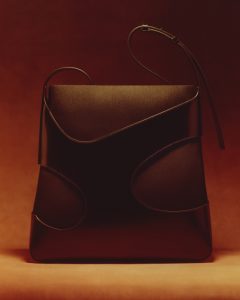
Photography Gaëtan Bernède
Styling and set design Lune Kuipers
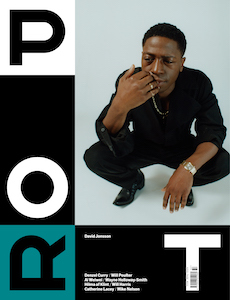
This article is taken from Port issue 32. To continue reading, buy the issue or subscribe here
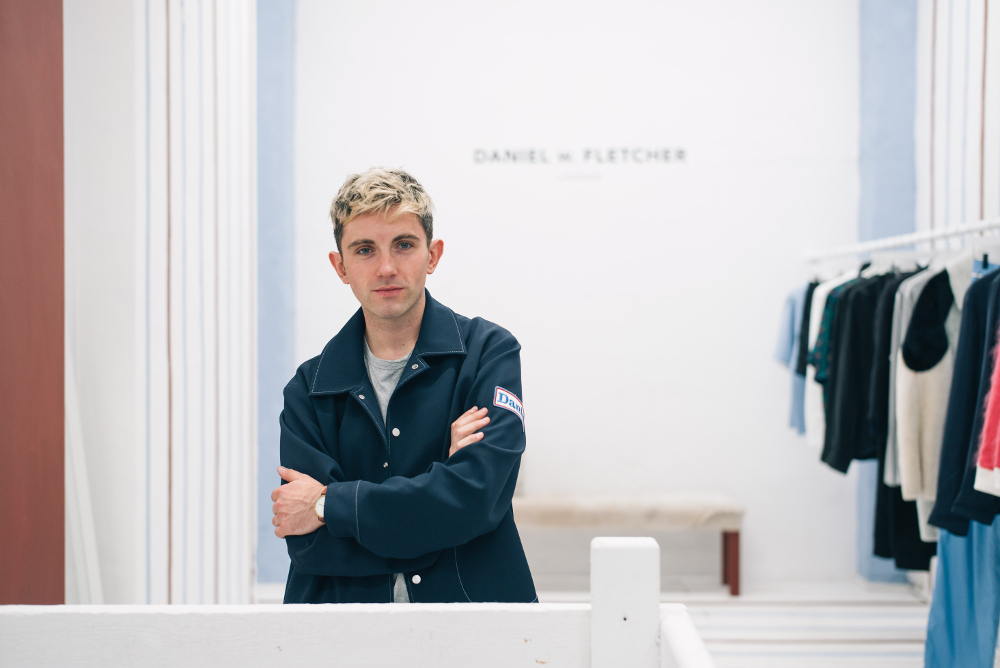
British fashi0n designer Daniel W. Fletcher explains how the Iranian-born architect continues to inspire his work
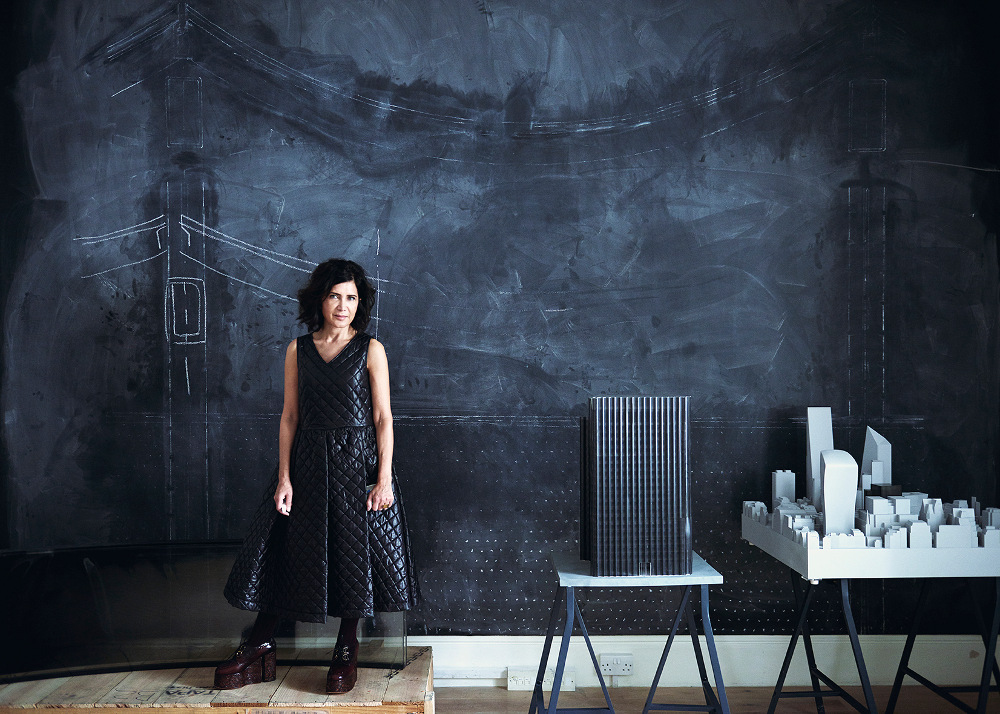
I have been privileged to have known Farshid Moussavi for a few years now, we met whilst I was working for Victoria Beckham during my final year at Central Saint Martins, as Farshid designed the Victoria Beckham store on Dover Street. Farshid has always inspired me with her drive, ambition, and unique outlook on the world of design. Her views on the relationship between style and function have pushed me to consider my own work in a new light.
Farshid has consistently created buildings that are both aesthetically astounding and extraordinarily considerate of the user, which speaks to my own desire to create garments that can deliver strong political messages through a fashion medium and yet are still wearable. She has directly addressed the depth of thought that is required to develop objects that are connected to people’s lives, not merely objects that exist for their own sake.
It is this same attitude to design that drove me to use fashion as the forum for my beliefs, and that continues to shape everything I do when building a collection. Looking at her incredible career and achievements, it is impossible to ignore the fastidious way that she approaches every project she takes on. Farshid has developed a visual language that speaks to people across the world – every designer’s dream – as demonstrated by the huge number of countries her work has found a home in.
As a designer still at the beginning of my career, to have a mentor and friend like Farshid has had a huge influence on every step of my creative process. While our fields of practice may be different, I apply her attitude to research, and her focus on the people her work is designed for, to everything I do.
Daniel W Fletcher will be showing at London Collections Men in June 2017