New York City Now: art and the urban environment

In the second instalment of a three-part series, William Kherbek examines the New York art attempting to seek out responses to urban space

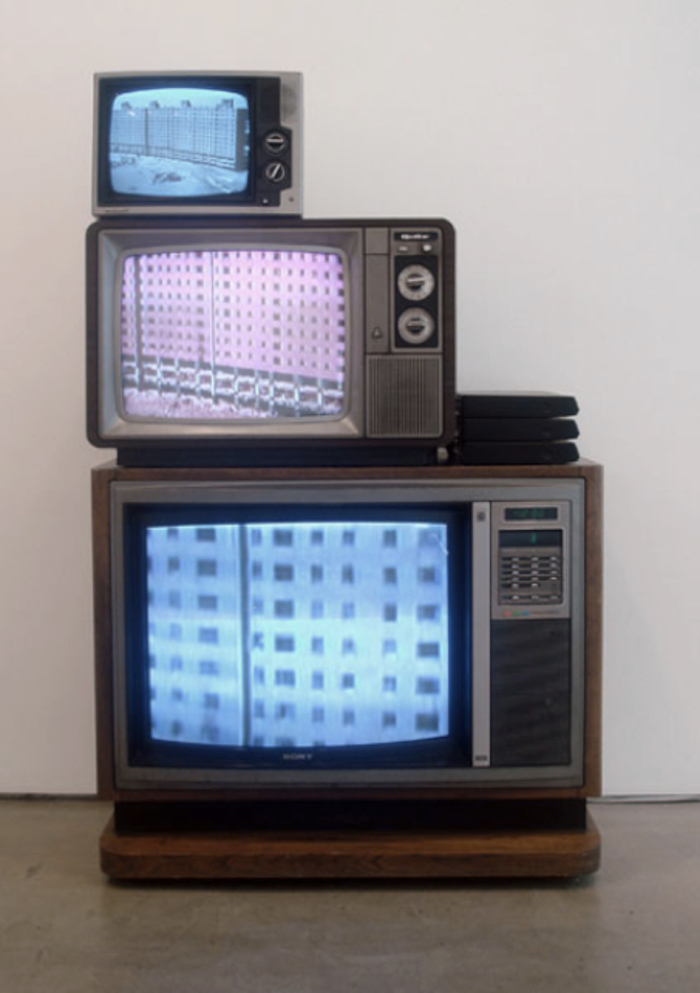
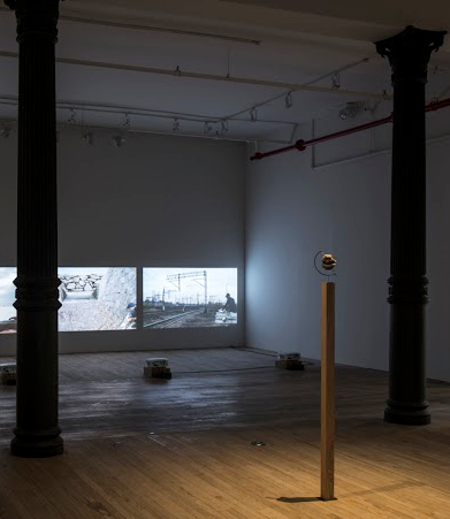
Jonathan Calm, Scudder Towers Down, Special Pulse Project
Jonathan Calm, Scudder Towers Down, 2008

At this year’s Pulse Art Fair in New York, one of the special project pieces was a video work by Jonathan Calm entitled Scudder Towers Down, comprised of slow-motion video footage of the controlled implosion of a housing estate. Watching it, I couldn’t help but be reminded of the episode of the HBO drama The Wire in which a hated housing development is demolished to the cheers of residents.

Once upon a not-very-long-ago time, starry eyed and socially aware architects planned utopian projects in which communities would not simply dwell, but where they would have all the conveniences of modern life, shopping, laundry, recreation and green space. What went so wrong that these projects ended up becoming a byword for deprivation, disenfranchisement, and, as many notorious estates in the US and UK attest, found associations with violence? The answer, it seems, lies not in our star architects, but in ourselves. Something such utopians didn’t appear to count on was how little human nature was likely to change just because it was housed differently. Indeed, few stopped to consider the resemblance of such projects to another well-known example of architecture wherein all of a person’s needs are met by the state: prisons.

The tendency of human beings to exclude, to create hierarchies, and to put problems out of sight so that they can slowly fade out of mind, is now impossible to ignore. New York, which is facing a housing crisis that rivals the problems of London, presents one of the great crises/opportunities available to artists concerned with examining the contemporary urban condition.

A show at New York’s Gagosian Gallery brings together works by the late sculptor, John Chamberlain, and French industrial designer, Jean Prouve, and looks back to the ‘good old days’ of better living through urban planning. Chamberlain’s twisted metallic totems served as an elegant counterpoint to astonishing Prouve creations like the Villejuif Demountable House – a construction originally intended to create an IKEA-style ready-to-assemble schoolhouse.

In many ways, Prouve’s vision is completely distinct from the fixity of housing projects like those shown inScudder Towers Down. The optimism his work embodies feels equally distant from the contemporary urban political discourse, so there’s a winsomeness inscribed in such works that Prouve, the clear-eyed solution seeker, would probably have hated. But, history seldom confers the legacy an artist seeks for their work.

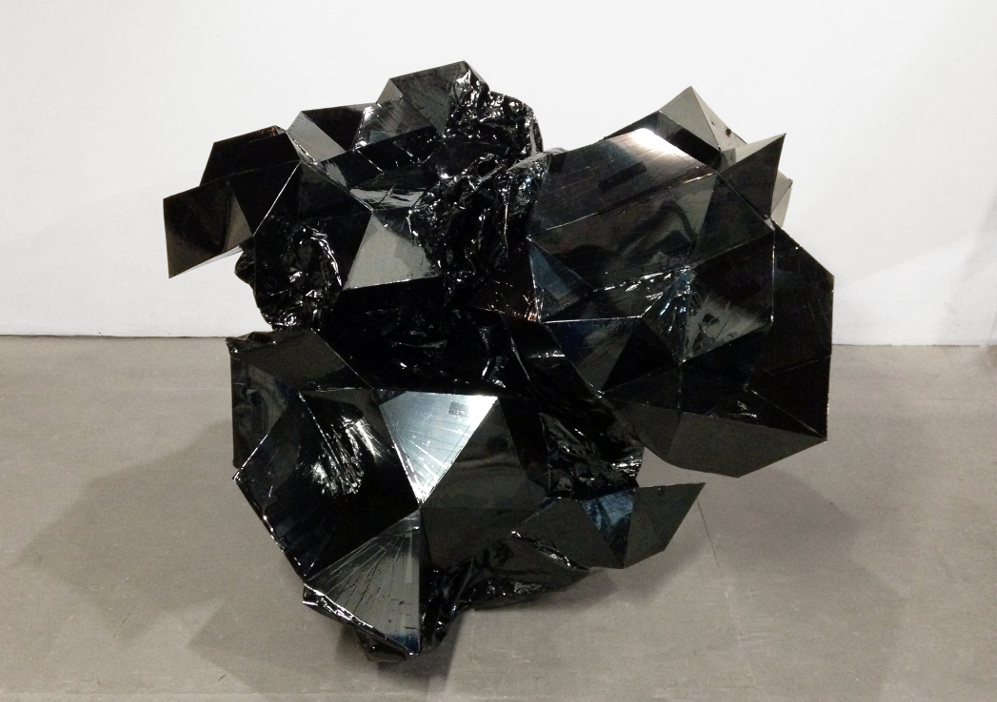
Charlotte Becket, Curdle, Beyond 1.1

In Beyond 1.1, an exhibition currently running at New York’s Tanja Grunert Gallery, Charlotte Becket’s Curdle suggets mobility was not conceived as the prerogative of the city, nor its residents. Becket’s work, a kind of kinetic sculpture of geometric forms, was not a million miles from something Toby Ziegler would do. It is something like a geometer’s nightmare, a multisided automated black mass, reshaping itself in a corner of the room as a motor whirs noisily away: part boulder, part trash-monster. Humourous, yes, but also deeply evocative of a conurbation where refuse always seems to be taking over. It invoked the character of New York’s downtown scene of the 1970s – a marriage of the low-fi and sci-fi sensibilities of Gordon Matta-Clark and Robert Smithson.

“I am interested in the slippage between place and experience, and the collapsing boundary between tangible physicality and hallucinogenic perception,” Becket told me, reiterating the importance of geography in the structuring and conception of her piece. “Geographic structures speak to temporality, mutation, beauty and violence and are totally indifferent to our existence,” she added. “We impact our environment, but it always finds its equilibrium, even if we can no longer survive in the circumstances we’ve created.”

“We impact our environment, but it always finds its equilibrium, even if we can no longer survive in the circumstances we’ve created.”

Gregor Neuerer, Various Tones,  Cathouse FUNeral
Gregor Neuerer, Various Tones, Cathouse FUNeral

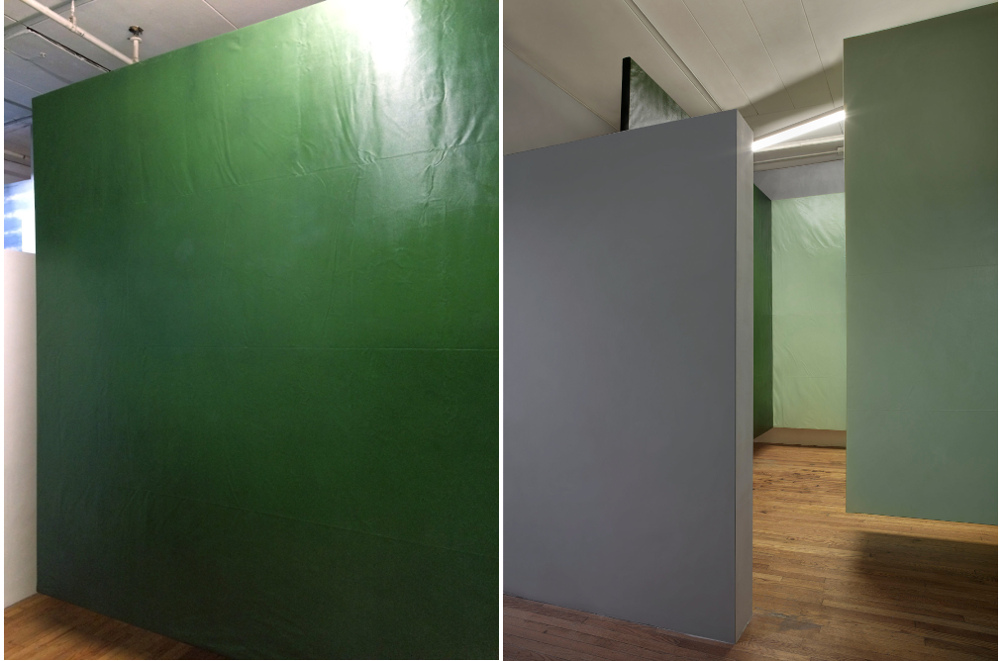
Space is at a premium in New York, and in Manhattan in particular. Over the river in Brooklyn, Gregor Neuerer‘s show, Various Tones, at an erstwhile funeral home-cum-gallery called Cathouse FUNeral was a meditation on colour in space. The show consisted of a number of large canvases placed over the gallery walls, forming a room within a room.

The panels were varying shades of green, greens Neuerer encountered in public spaces from billboards, adverts and the like, many for health products or services. Neuerer’s literal green room had the ominous insinuation that everything’s supposed to be good for you and was both eerily calm yet menacing – do something healthy or else, it hinted. The emerald shades were anything but organic, yet they had an ecology of their own; the smooth and rough melding of various hues against one another seemed to generate a palpable physical tension.

Sebastian Lloyd Rees, Vendor, Room East

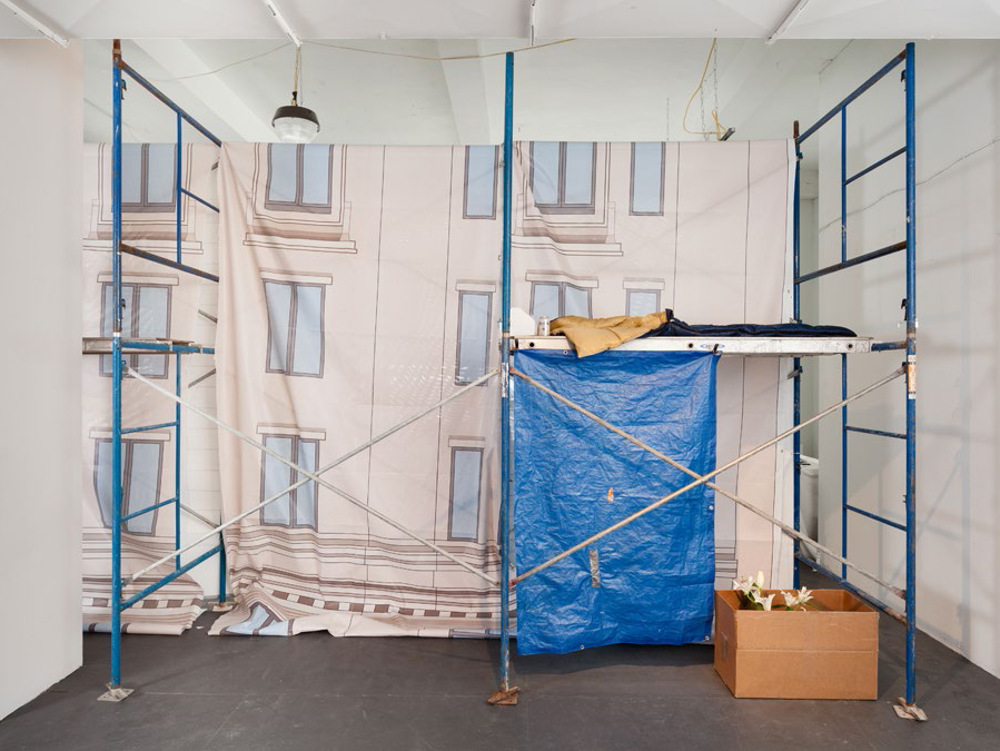
The work of the city itself was a key feature of Sebastian Lloyd Rees’ exhibition Vendor at Room East in Manhattan’s Lower East Side. Vendor could be thought of as a material haiku composed of the ephemera and efflorescence of urban life, including shipping boxes, lottery tickets, flyers, shop adverts, all presented in a deliberate but deadpan fashion, veering just on the right side of pretension masquerading as anti-pretension.

The weathered hoardings in the upstairs gallery behaved like a simultaneous manifestation and critique of the ‘found object’ culture that a lot of post-recession art embraces. In their deformations and discolourations caused by urban pummeling – from both humans and mother nature – the hoardings espouse a terse eloquence that, in being presented without comment or artistic manipulation, only grows with attention.

Read part one of New York City Now: art and politics

Serralves Museum: Álvaro Siza Vieira

Alyn Griffiths explores the grounds of Porto’s Serralves museum 16 years after its completion and talks to the architect behind it, Álvaro Siza Vieira

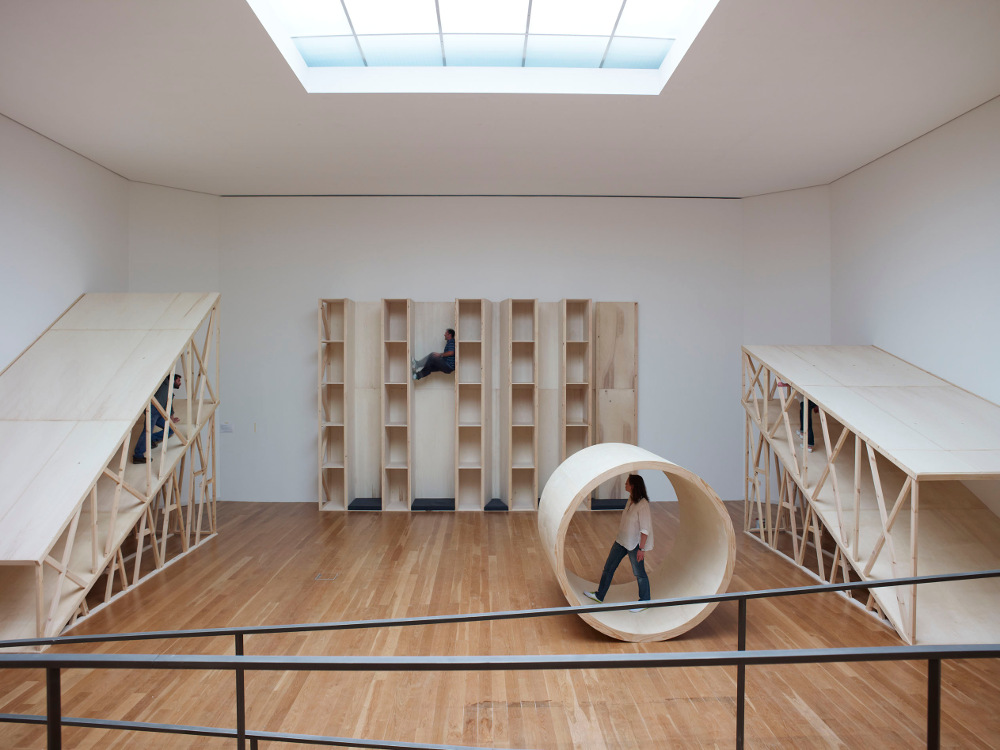
Robert Morris Exhibition, Serralves Museum, November 2011

Tucked away in a residential area to the west of Porto’s historic centre, the Serralves Museum occupies a significant position, both geographically and culturally, in the Portuguese city. An 18-hectare landscaped park provides a picturesque setting for the country’s most visited contemporary art museum, which presents solo exhibitions and themed shows by leading artists in a building designed by one of Portugal’s best-loved architects.

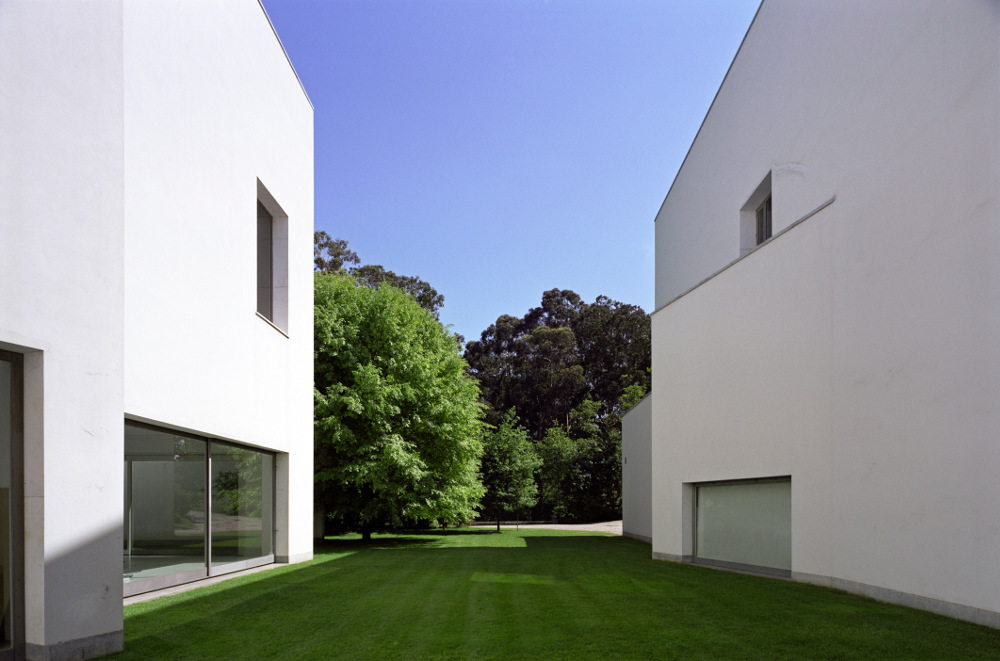
Serralves Museum Exterior Elm Patio
Serralves Museum exterior elm patio

Last year marked the 15th anniversary of the museum’s opening and the 25th anniversary of the inauguration of the Serralves Foundation, which was set up to support and oversee its financial and artistic development. In 1991 the Foundation made the enlightened decision to commission Pritzker Prize-winning architect Álvaro Siza Vieira to design the new museum in the grounds of the Serralves Estate. According to the 81-year-old architect, the project was symptomatic of a very different era, when philanthropy was still fashionable and institutions were able to justify building ambitious new homes for their collections.  

“Twenty-five years ago I did not have to fight with the crisis,” he points out, “so today this building would probably not be built because there would not be the money.” 

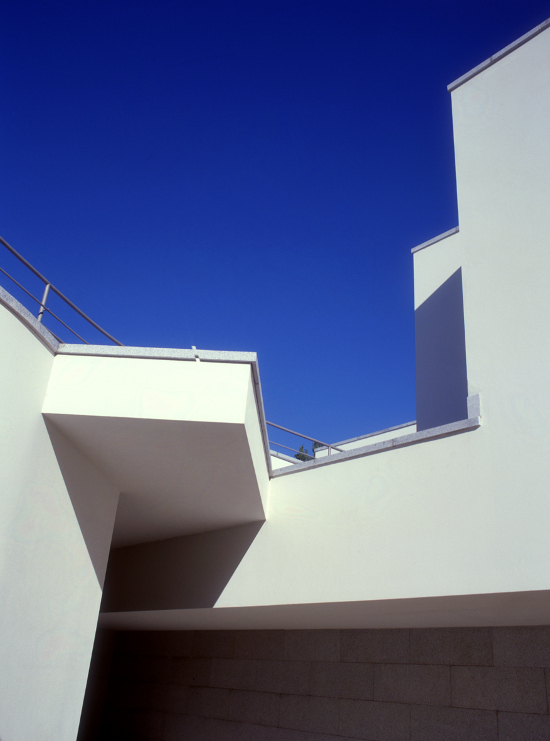
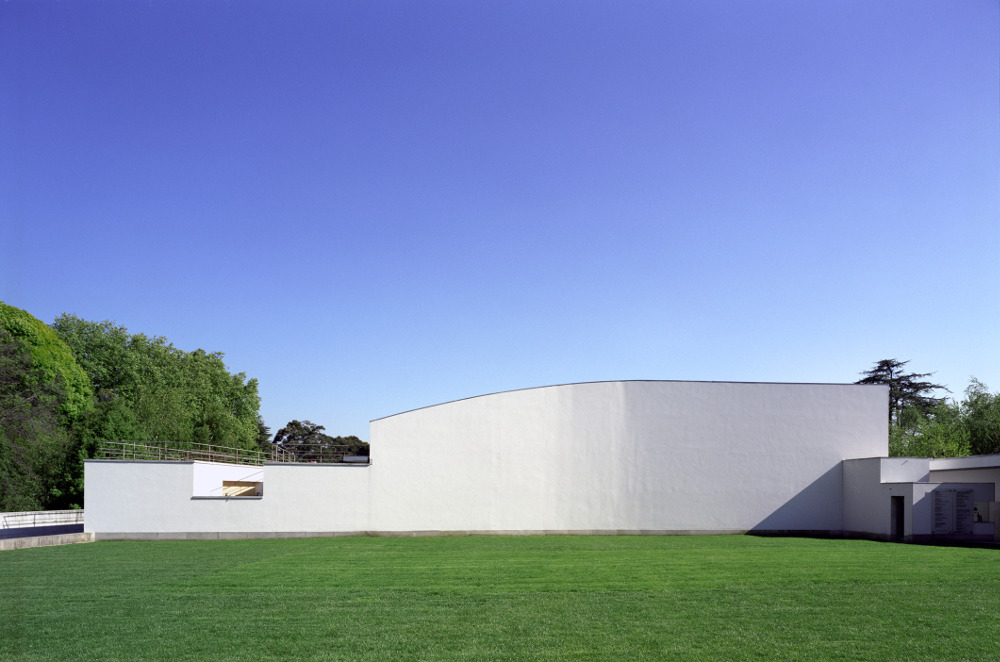
The museum was completed in 1999 and demonstrates Siza Vieira’s masterful ability to integrate architecture into the landscape. Its carefully composed series of interconnected volumes was inspired by the topography of the gardens, which extend into the heart of the lower ground floor’s U-shaped plan and enhance the interaction between indoors and outdoors. An atrium containing a staircase leading to the museum’s restaurant and educational facilities on the upper level evokes the grand foyer of a famous Art Deco villa situated at the end of a tree-lined avenue in the nearby grounds.

Serralves Museum Exterior Restaurant Balcony
Serralves Museum Exterior restaurant balcony

The sequential arrangement of the galleries creates an intuitive route through spaces of varying dimensions that provide a flexible backdrop for the continuously evolving array of artworks on show. Natural light enters the rooms and corridors through skylights and carefully positioned apertures in the ceilings, while windows that look out onto the lush gardens appear unexpectedly in stairwells and bays that project from the facades.

Serralves Museum Exterior Auditorium Wall
Serralves Museum exterior auditorium wall

Siza Vieira claims that if he were tasked with designing the museum today he would do things differently, both because of today’s economic climate and because his attitudes and approach have evolved in the intervening years.

“When you have a building to design you have the experience, you have the form and you see the site and the landscape and you speak with people that are promoting it,” he explains, listing the key influences in his design process. “You are in a certain state of mind and 25 years later all these things are different.”

Despite the inevitable changes that have occurred since its completion, the Serralves Museum has endured as a functional and engaging masterpiece that will doubtless continue to attract lovers of both art and architecture for decades to come.

New York City Now: art and politics

In the first of a three-part series on art in New York, William Kherbek picks at the intersection between the arts and politics

Charles Atlas, The Waning of Justice, Luhring Augustine

The year 2014 saw political activism and technology interact in perhaps the most broad and sustained campaigns yet seen in the US. Crusades against online misogyny, police killings of unarmed black citizens, support for living wages and environmental protection all found hashtags and audiences. Such movements weren’t always successful in drowning out the status quo-worshipping din that is the media’s chamber of echoes – it was, after all, the “#whitestOscarsever”. Nevertheless, inroads were ploughed, even in the often quietistic world of visual art. The nexus of art and politics is always fraught territory. Inevitably, and usually without reason, artists attempting to engage in social critique – beyond a bit of “isn’t-it-all-such-a-pity” handwringing – are accused of naivety. As aesthetic movements like Futurism and Socialist Realism have shown, the line between political art and facile propaganda is rarely drawn in day-glo spray paint. So, it was surprising and heartening to see how much serious political engagement was on show in one of the busiest art weeks in the New York City art calendar.

The Armory Show: Carlo Massoud's Arab Dolls
The Armory Show: Carlo Massoud’s Arab Dolls

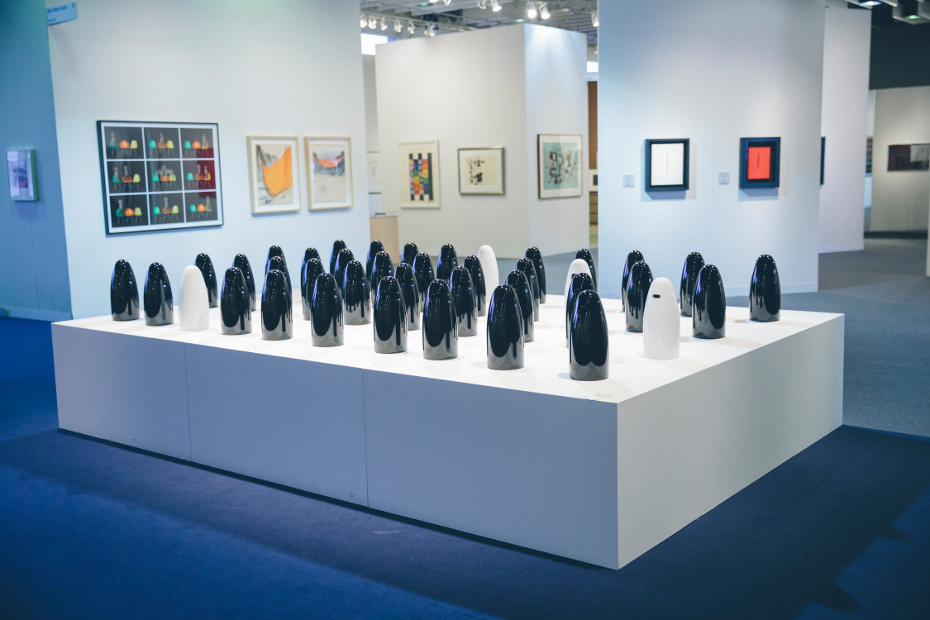
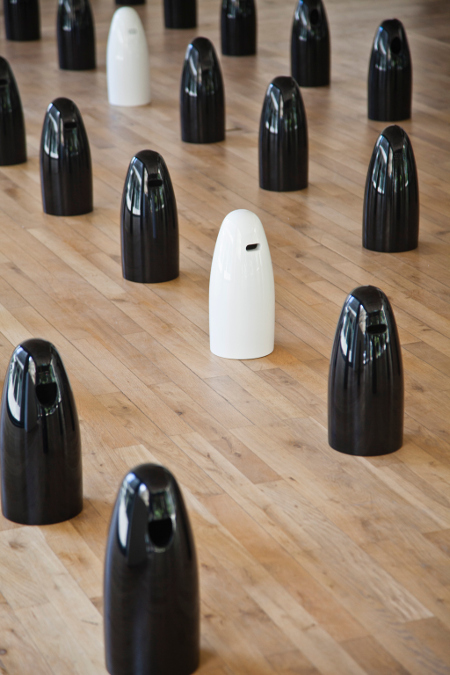
The Armory Show in particular had a self-conscious political edge this year. At the centre of a fairly depoliticised Armory Modern was Carlo Massoud’s Arab Dolls: Maya, Zeina, Racha and Yara. Arranged like bullets moving along an assembly line were the dolls; the four models referenced in the work’s title were given individual names that corresponded to the differing apertures where their faces might be. Some were oblong, others bore variegated dots like the holes of an intercom. The dolls’ polished surfaces of alternating black and white evoked the religious garment that Europe seems to fear most: the burqa. Massoud’s work is rich in its evocations but tight-lipped as to its conclusions.

The metaphoric implications of Maya and her sisters’ bullet-like forms and the reduction of the female identity to the shape of a tiny opening are powerful statements in themselves. However, looking at the shiny surfaces more closely, the viewer sees an even more dangerous image: his or her own reflection. The politics of the contemporary Middle East were also at the centre of The Armory’s collaboration with the cultural organisations Art Jameel and Edge of Arabia, which included a talk by four artists involved in the Culturunners project – an endeavour that facilitates artistic and technological collaborations between socially concerned artists and communities.

“We are creating a new form of public space,” said Palestinian-Saudi artist, Husam al-Sayed. “We are interested in culture – we don’t have one agenda that we want to push.”

Arab Dolls - Maya, Zeina, Racha, Yara
Arab Dolls – Maya, Zeina, Racha, Yara
Invisible Disparities, Ernesto Klar, Postmasters Gallery

For al-Sayed and his co-panelists, including Ava Ansari, Azra Aksamija, and Matthew Mazzotta, culture’s meaning is close to Raymond Williams’ famous dictum, ‘culture is ordinary’, representing the outgrowth of the daily participation of communities in the creation of a social enterprise. To create cultures, particularly in digital space, the democratic character of creativity is even more fully expressed. “It is a never-ending journey,” al-Sayed concluded, “and we are all involved”.

The Armory show was not the only place to see meaningful, questioning political art in New York. The week also saw the opening of the show Invisible Disparities by Ernesto Klar at Postmasters Gallery. The multimedia work was dominated by five video projections. Four projections were shown simultaneously on one wall of the backroom of Postmasters. In these projections, Klar – dressed in the faceless, quasi-official uniform globally recognisable as the signifier of maintenance workers – used his tiny portable duster to hoover up the dust of sites including UNESCO headquarters, Petra, and areas where mass slaughters in the Rwandan genocide took place. On the opposite wall, Klar and his duster could be seen traversing the timeless desert.

“We are creating a new form of public space. We are interested in culture – we don’t have one agenda that we want to push”

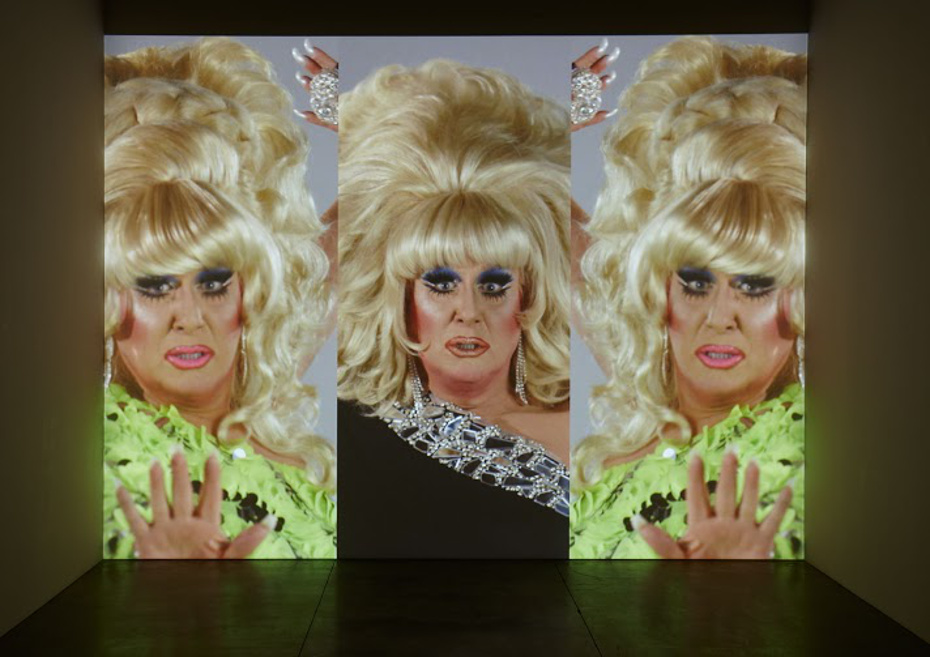
The Waning of Justice, video projection

There is something of Francis Alys’ deadpan performances in sites of political apoplexy in Klar’s work, but its metaphoric richness isn’t reducible to mere influence-worship.

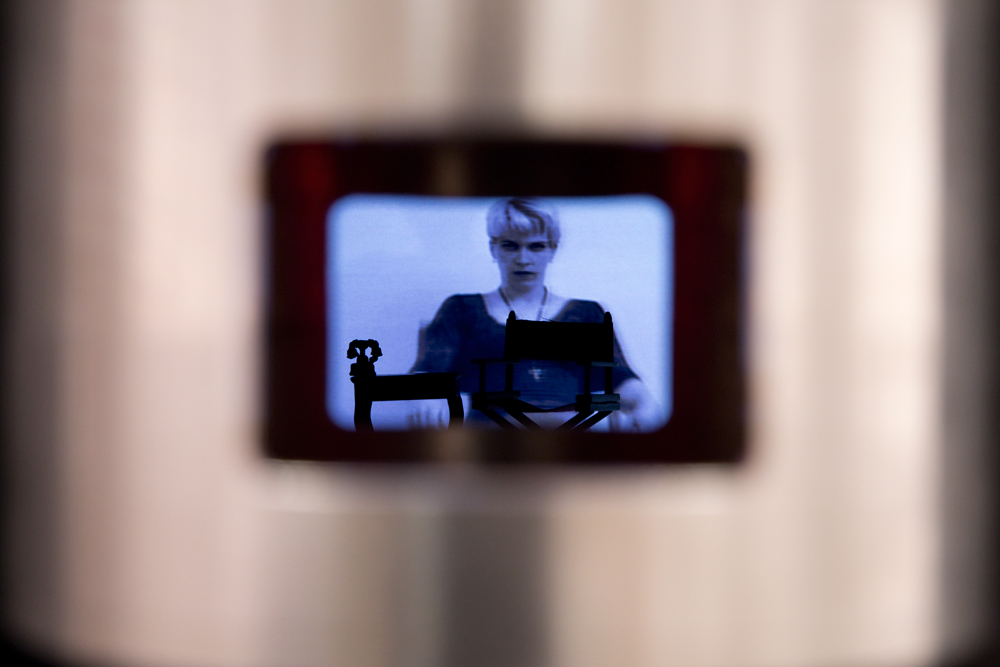
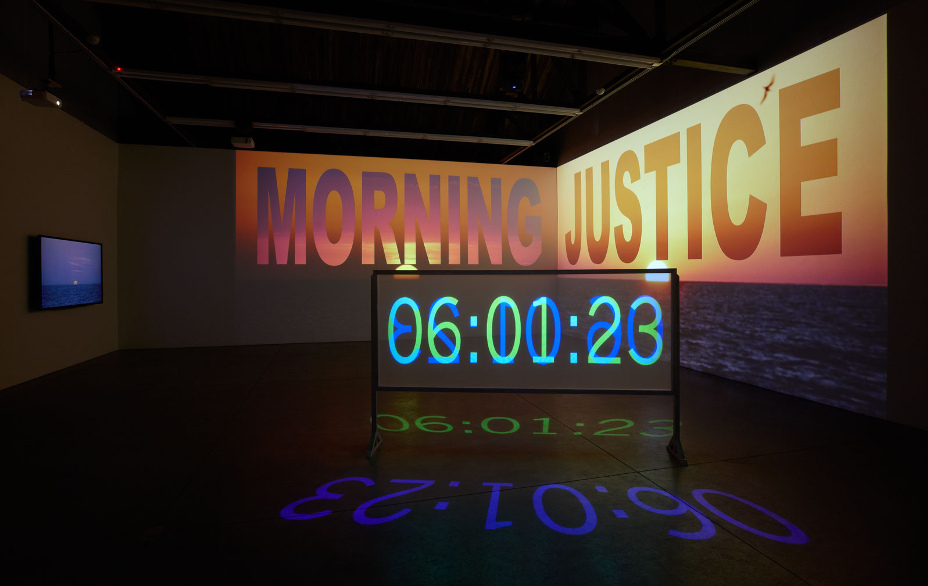
Never one to shy away from the political and the inflammatory, the filmmaker Charles Atlas’ show, The Waning of Justice, at Luhring Augustine presented one of the most coherent and direct political critiques on show in New York at the moment. Atlas’ The Illusion of Democracy was shown at Luhring Augustine’s Bushwick space in 2012, and The Waning of Justice in 2015 signalled a continuation of Atlas’ exploration of politics. His newest exhibition consisted of several video projections – some of sunsets and nature, and one of an impassioned performance by a drag artist giving a rendition one of the most coruscating and sophisticated indictments of US politics over the last decade. Politics in New York City art is alive, well, mad as hell, but still fabulous.

Niki de Saint Phalle: a retrospective and a rediscovery

Madeleine Morley uncovers the Guggenheim Bilbao’s retrospective of French artist Niki de Saint Phalle, whose colourful and exuberant work celebrates the diversity of the female form and battled an oppressive patriarchy

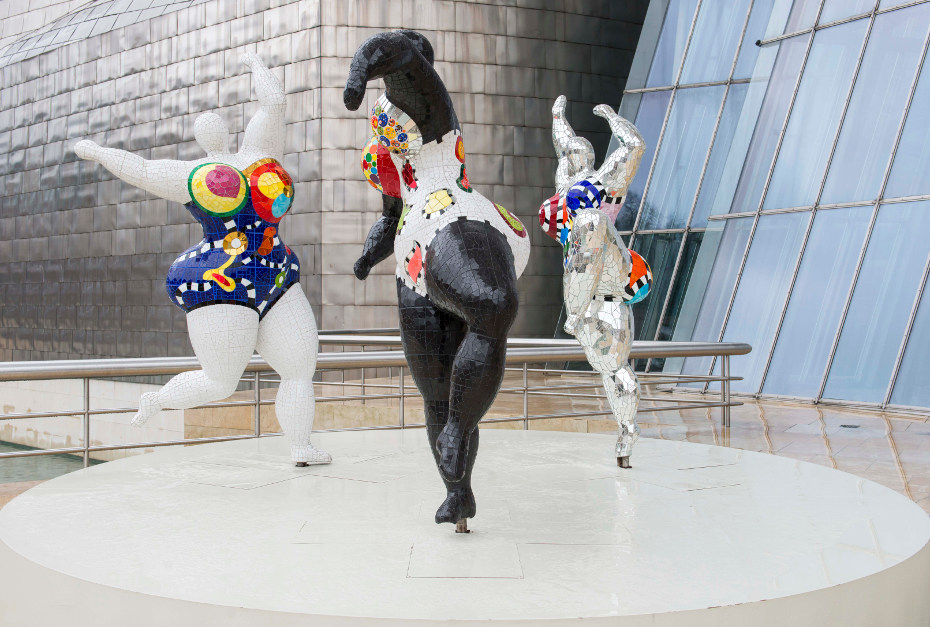
The Three Graces, Guggenheim Museo Bilbao, 1995

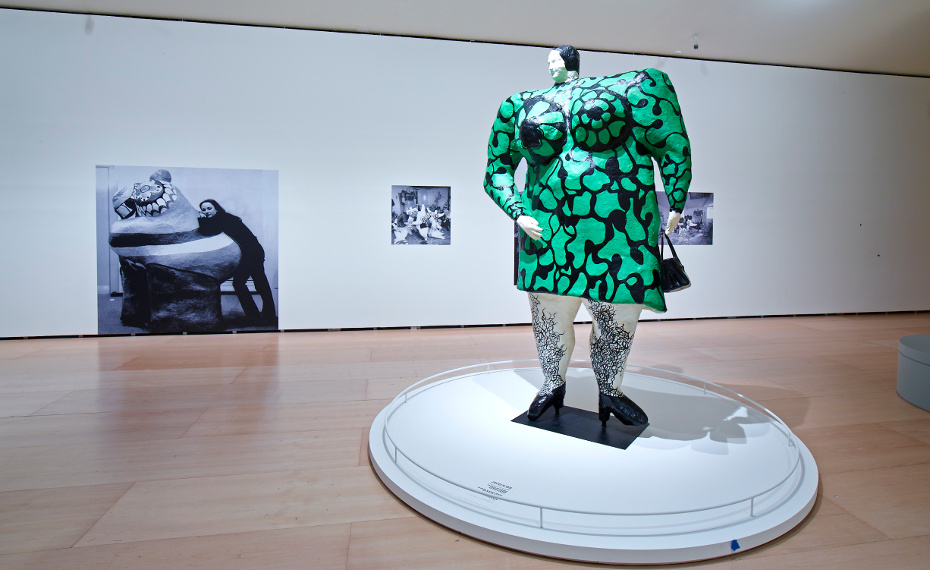
The estate of the French painter and sculptor Niki de Saint Phalle, led by her granddaughter Bloum Condominas, have wanted to put on a major retrospective of her work for years, especially since her death in 2002. For various reasons, it’s never happened, so any current perception of de Saint Phalle – a prolific, extremely diverse artist – has tended to rely on her famed, exuberant “earth mother” Nanas sculptures. Think of these as her hits – the glossy pop-songs that are remembered while less immediately catchy songs gather dust.

“This exhibition is a re-discovery of her work – the things you might think of her aren’t necessarily true, and the retrospective will show you that” says Camille Morineau, the co-curator of the comprehensive exhibition that is at last happening, at the Guggenheim in Bilbao, Spain. “We need a younger generation talking and writing about Niki,” adds granddaughter Bloum, who has worked closely with curators Camille and Alvaro Rodrigues Fominaya to make this show happen. “We need people to explore her from a young perspective, so people can see how contemporary her work is.”

Niki’s colourfully monumental art deals, in part, with being a woman in the excessively body-conscious world of the 50s and 60s. Powerfully interested in women’s roles, her approach, attitude and strength should make her an artist that is widely discussed today.
Bilbao’s Guggenheim is the perfect place to showcase de Saint Phalle’s work in its entirety, from the Nanas she gave birth to, as well as her other, darker and less familiar projects. The space looks different depending on where you stand, like the artist herself, always confounding expectations. De Saint Phalle was many different women, not just the bohemian mother of the Nanas she is so often remembered by.She was Niki the teenage model, the angry woman, the loving housewife, the abused daughter, the inspiring collaborator, the blushing bride, the grandmother, the femme fatale, the swaggering hero, the avant-garde feminist, the celebrity on Andy Warhol’s arm, the self-taught, radical artist; this show reveals how these various selves infused her art. The exhibition’s structure is chronological, spanning six constantly changing decades. There are around 200 works included, beginning at the very start of her career as a model in the late 40s and early 50s for Vogue and Life magazines. Throughout the Guggenheim’s spiralling rooms, we see how her art was in dialogue with the process and progress of her life.

Having married young, she had a child and lived a typically well-off American lifestyle, before suffering a nervous breakdown in 1953. De Saint Phalle was institutionalised and treated with shock therapy like her equally unclassifiable but determined predecessors Sylvia Plath and Zelda Fitzgerald. They too were frustrated by the world of domesticity and its suffocating effect on any form of individual creative expression. Due to the strain on their mental health, they were all ultimately labelled ‘hysterical women’. Bloum tells me about how de Saint Phalle’s therapist said she should ‘blame herself’ for the sexual abuse she’d experienced from her father as a child: it is this kind of offensive patriarchy that de Saint Phalle battled against, both personally and creatively.

“Think of these as her hits – the glossy pop-songs that are remembered while less immediately catchy songs gather dust”

Madam or Green Nana with Black Bag (Madame ou Nana verte au sac noir), 1968

She embraced art as therapy and then decided on art as a career, before moving to Spain for inspiration. Her early work shows a woman trying to re-arrange the restrictive world around her into a new narrative. Fragments of domesticity like coffee beans, pottery, dolls and toy soldiers became the homespun medium of her collages. These materials of girlhood and motherhood were reconfigured into new shapes and images as she decided to break out of the traditional female role.

For the retrospective, Camille, Alvaro and Bloum have positioned de Saint Phalle very much as one of the first major feminist artist of the 20th century. They use these first, liberating pieces so that we see her later, less obviously volatile garden decorations and Nanas in the context of protest and resistance.

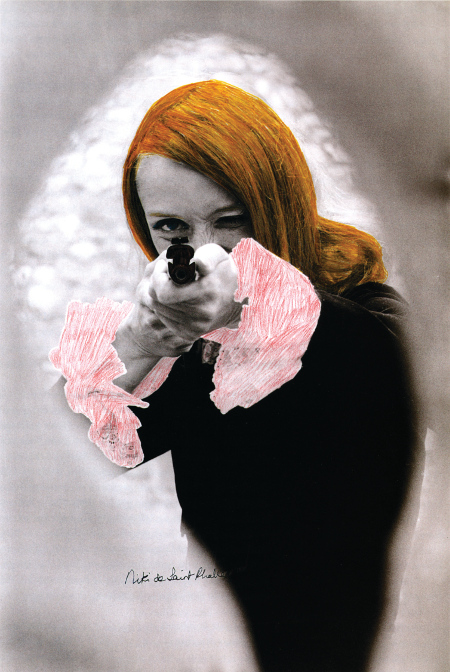
In the 60s, Niki was working on her early, explosive Shooting Paintings. They were dramatic performances, where she shot at pristine white plaster casts, the white of lace, so that they’d burst with colour when paint dripped from the bullet holes; these were more explicitly about her response to a nasty, repressive world. She was the first to use guns in art in this way, and it was as if she was releasing her thoughts and inner turmoil through the destructive act. De Saint Phalle once said: “I was shooting at myself – I was shooting at my own violence and the violence of the time.”

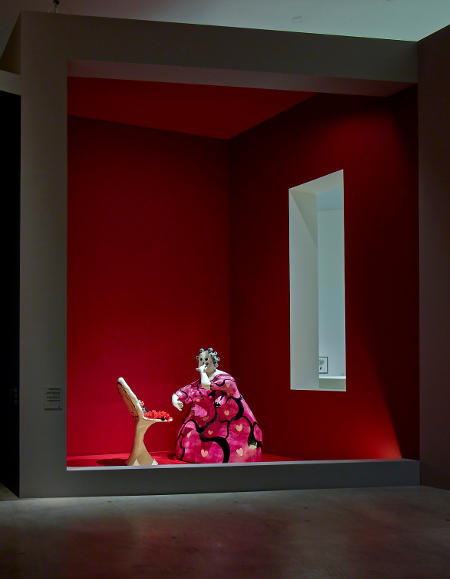
The Toilette (Make Up or Mirror of Life), 1978


“The jubilant sculptures have been described as goddesses, as witches, as grandmothers, as shrines – they’re women who are uncorseted, confident, voluptuous and free”

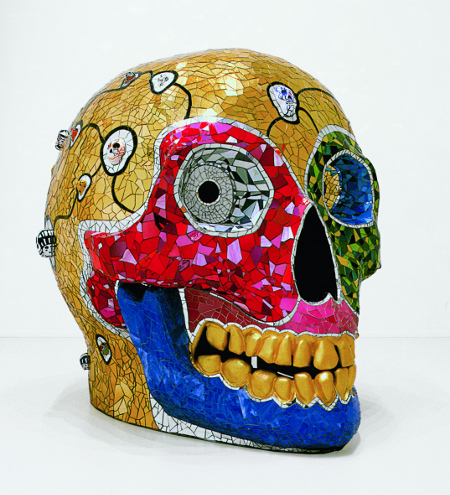
Skull (Meditation Room), 1990


“I’m not a person who can change society but I can present a vision. That’s all that I can do” – Niki de Saint Phalle

As the work burst from white plaster into colour, it revealed that de Saint Phalle was a subversive: she too burst with force and spontaneity although she appeared to be just a pretty model on the outside. “It’s easy to forget how dangerous this act was in the 60s,” says Camille. “This would have completely shocked people at the time.”

The slashes of colour erupting from her Shooting Paintings anticipate the gaudy colours of the Nanas sculptures. Instead of letting emotion – the wounds of life – drip out of the work as with the early Shooting Paintings, the Nanas boldly display emotion and colour on the outside. “She was missing heroines and role models as a kid,” Bloum explains, “so she decided to make some herself.” The jubilant sculptures have been described as goddesses, as witches, as grandmothers, as shrines – they’re women who are uncorseted, confident, voluptuous and free.

“I’m not a person who can change society but I can present a vision. That’s all that I can do,” de Saint Phalle says in a video projected over her creations on display. Although easily dismissed as relics of the hippie 60s and 70s, the voluminous sculptures still pack a modern punch and hint to potential future possibilities, ones that seem equally relevant for women today. The Nanas seem to have been guardian angels for de Saint Phalle. In the same room where they are displayed at the Guggenheim Bilbao, prints of diary-like drawings and love notes reveal a very self-conscious woman, obsessed with diet pills and sexy stockings. The nearby Nanas are perhaps totems from a world where people aren’t disturbed by these anxieties, and her way of creating images and rituals is an antidote to their corrupting influence.

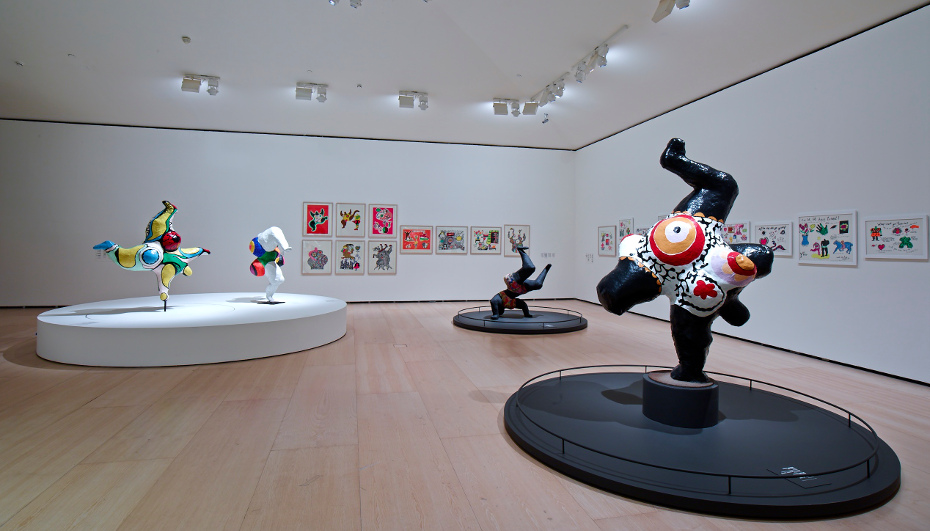
From left to right: Bathing Beauty, 1967-68, Dancing Nana Anna, 1966, Black Nana Upside Down, 1965-66, Nana with her Leg in the Air, ca. 1966, Guggenheim Museo Bilbao

Niki the person was magnetic but anxious and temperamental; the artist was in control of her life and used art as a restorative guiding spirit. Her 70s Devouring Mothers sculptures and her film, Daddy, are works that turn to her interior life and they jar with the sheer joyfulness of the Nanas. They’re darkly humorous pieces that she used as a way to come to terms with her difficult childhood, which the Nanas were unable to protect her from. At the end of the 70s, de Saint Phalle also married fellow artist Jean Tinguely – a tumultuous though inspirational relationship that fed into her angst as well as her artistic inventiveness. The couple self-fashioned themselves as the Bonnie and Clyde of the art world and the relationship had a striking influence on her work – she influenced him and he influenced her.

Because this exhibition brilliantly captures an entire life in action, we also see de Saint Phalle as a kind of grandmother figure to all children. We see her designs for parks and playgrounds where she extends her vision of joy to public spaces, imagining a world designed not in mundane blocks but as outbursts of whimsy and intrigue. Outside the museum, on the Guggenheim balcony, three of her Nanas dance deliriously in the Bilbao sun, glimmering like the shiny surface of the immense structure. They’ve found a real home.

Frank Gehry, the Guggenheim Bilbao’s architect, and de Saint Phalle were apparently going to collaborate on a building together, but it never went ahead – a world designed by minds like these would be extraordinary. This show positions de Saint Phalle as an artist with stunning vision, one that challenges the ordinary and shows how fantasy can be a very necessary and practical part of reality. She was always growing, her colours getting richer, her shapes more dramatic, and in light of the full body of her work, she keeps growing.


Film still  from Daddy, 1972
Film still from Daddy, 1972

One Day, Something Happens: Milena Dragicevic

Serbian painter Milena Dragicevic discusses her take on abstraction, choosing models and the influence of Willem de Kooning

Milena Dragicevic, Supplicant 101, 2008

“The Supplicants are not psychological studies or portraits but ‘stand-ins’ for something else. They are not masks, mutants or hybrids. They are simply unknowable”

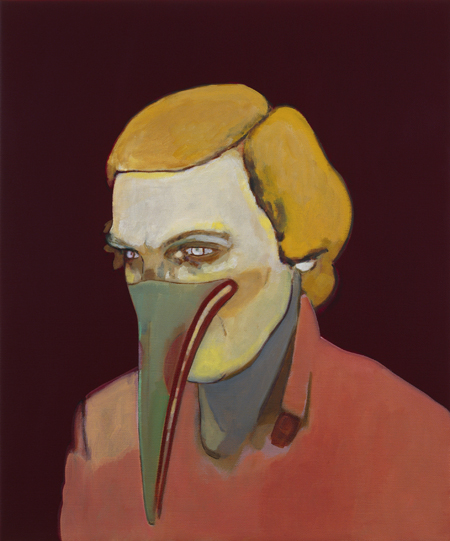
I don’t think I ever made a decision to paint. I do know I made a decision to become an artist and painting somehow naturally followed. I would describe myself as an artist who uses a code of abstraction but tries to keep one foot in reality. The question of abstraction versus figuration in painting is something that completely perplexes me and I usually just ignore it. I began my ongoing Supplicant series in 2006 because at the time I needed a simple starting point. De Kooning once said that nothing could be simpler than a circle in the middle of a canvas and I thought that a face could be that simple device. Faces are voids or protrusions where an intervention or interception can occur: it is that which I am painting and not the figure per se.

The models I choose are usually female friends or acquaintances. I start with photographic headshots and the more I do, the more it feels performative because I am aware of the power of the face in that it is both viewer and viewed. I eventually pick one image that lends itself well to intervention and then drawing helps me understand how the intervention may play out. I mainly use tracing paper because it allows for speed when redrawing and dissecting forms. I do accept that once painting begins, U-turns may become necessary. My interventions or interceptions are moments caught in a process of unfolding and refolding both my material and intuition. It’s like trying to capture the passage of possible objects or fragments and never needing to know how you got there in the first place. The Supplicants are not psychological studies or portraits but ‘stand-ins’ for something else. They are not masks, mutants or hybrids. They are simply unknowable.

I am not really influenced by many painters. I tend to look more at sculpture, design, architecture, film and ancient art and I often borrow from marginalised artists. I love looking at cheap catalogues from shows that no one remembers. I want to work with something that already exists in the real world and I’ve come to think of my work as silent collaborations but with a ‘tag-team’ attitude. The Supplicants and my more recent series Erections for Transatlantica, 2011, and Pampero, 2014, act as an anachronistic place where something always happens. Hopefully they provide spaces or loopholes to be borrowed and reconfigured by other artists.

Words Milena Dragicevic

Excerpt from One Day, Something Happens: Painting People by Jennifer Higgie, curator and co-editor of Frieze magazine. Out now on Hayward Publishing.

Figure and Rhythm: reassessing Leon Underwood

Pallant House Gallery’s artistic director Simon Martin on why he is dedicating a retrospective to one of the most neglected artists of the 20th century

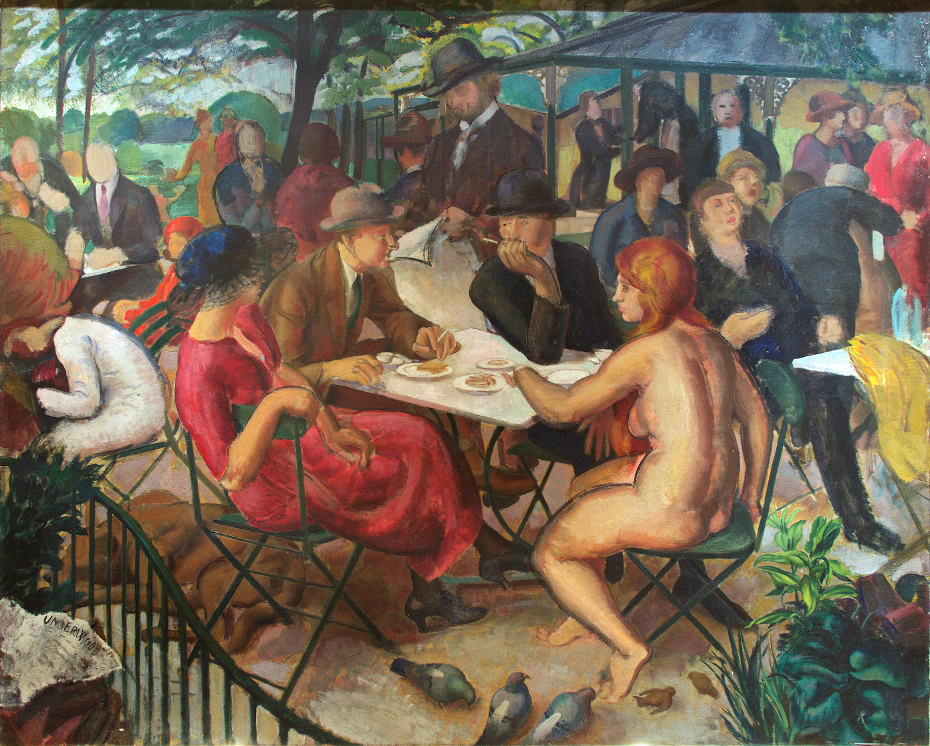
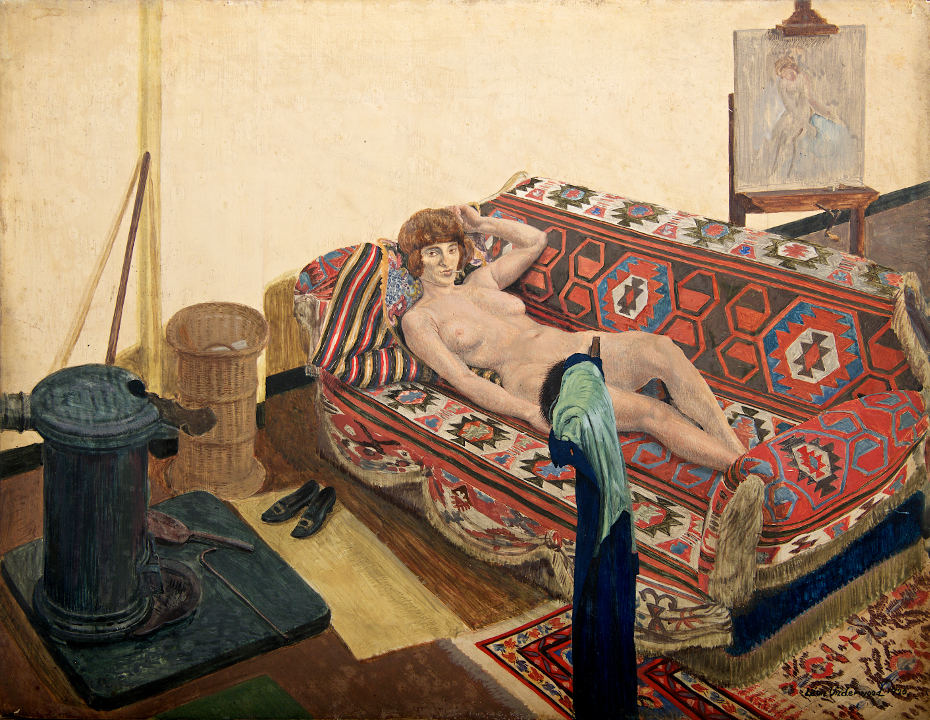
Leon Underwood Venus in Kensington Gardens, 1921
Venus in Kensington Gardens by Leon Underwood, 1921

More than 40 years have passed since a retrospective has been dedicated to Leon Underwood (1890 – 1975), an unsung hero of British art that helped cultivate some of sculpture’s brightest talents including Henry Moore and Barbara Hepworth. This month, a new show at Chichester’s Pallant House Gallery entitled Figure and Rhythm will bring together Underwood’s often overlooked paintings, wood engravings, etchings and sculptures, as well as accompanying works by Gertrude Hermes and Blair Hughes-Stanton. Here the exhibition’s curator, Simon Martin, tells Port why he believes Underwood deserves far more credit for the role he played in moulding the landscape of modern British sculpture.

Within a year of attending the Slade School of Fine Art to study drawing under Henry Tonks, Leon Underwood had become the assistant teacher for life drawing at the Royal College of Art. He later opened the Brook Green School of Drawing at his home studio; the students under his tutelage included Eileen Agar, Blair Hughes-Stanton, Gertrude Hermes, Vivian Pitchforth, Henry Moore and Raymond Coxon. The men and women who passed through the doors of his school are praised as the most influential of the interwar period and yet he has lacked widespread consideration. As former director of Tate Britain Sir John Rothenstein stated: ‘No artist of his generation… has been so little honoured and indeed so neglected.’

So how is it that Leon Underwood – unlike his widely celebrated pupils – has fallen so much from view? Perhaps it was to do with his versatility. He was a painter, sculptor, draughtsman, printmaker, and illustrator, and due to what R.H. Wilenski described as his ‘restless progress’, Underwood did not have an instantly recognisable ‘style’ that could be easily categorised. When a remarkable series of etchings produced between 1921-22 demonstrated the strength of his draughtsmanship, London’s Chenil Gallery displayed them alongside the then famous Augustus John. Art historian Christopher Neve even described the etchings as ‘unsurpassed of their kind in the period immediately after the war’.

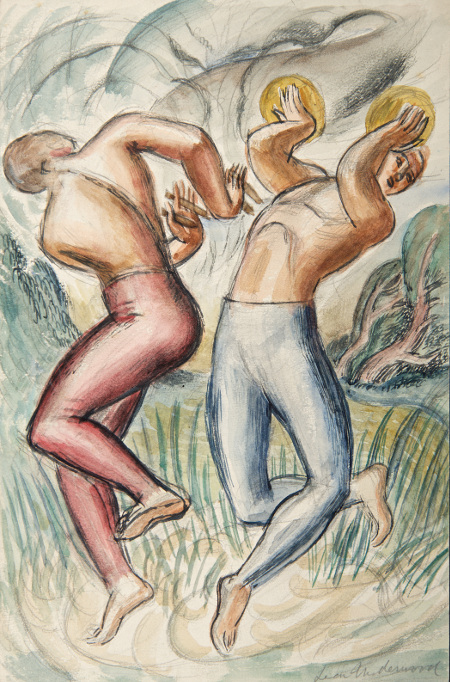
Two Musicians by Leon Underwood, 1925

“No artist of his generation has been so little honoured and indeed so neglected”

Reclining Model in the Studio by Leon Underwood, 1920

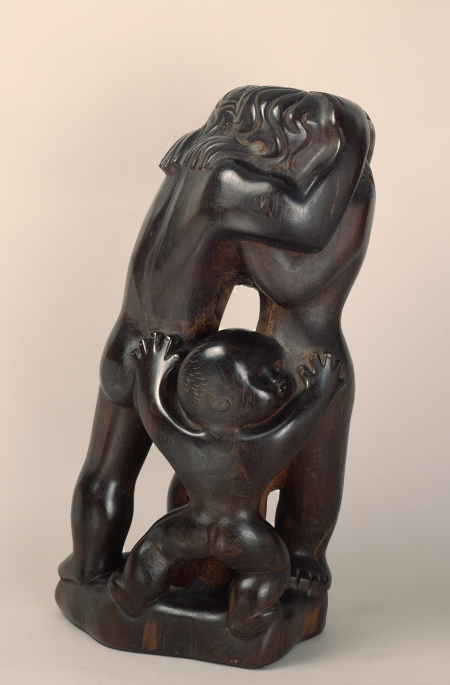
The Family by Leon Underwood,1936
The Family by Leon Underwood, 1936

When wood engraving was introduced to the Brook Green School in 1923, Underwood and his pupils began to experiment with tools and techniques to achieve new and unusual effects. This was to be a precursor to his formation of the English Wood Engraving Society in 1925. After moving to New York in 1926, Underwood subsequently became a leading figure in wood-engraved book and magazine illustration. His illustration of Phillips Russell’s book The Red Tiger, 1929, had the greatest impact on his career, and introduced Mexican themes into his work.

While other British artists were deliberating over the question of how to ‘go modern and be British’ Underwood sidestepped the debate entirely by drawing on his first-hand experience of native traditions and ‘primitive’ cultures. He wrote seminal books on the masks, bronzes and wooden figures of West Africa and became fascinated by the relevance of prehistoric art to the 20th century.

The medium of sculpture seemed to fuse the directness and vitality of tribal art with Underwood’s understanding of European traditions, and works such as Recumbent Knight (Catafalque), 1935, heralded his return to sculpture. Later in the decade, his appreciation of ‘the rhythm of materials’ was to inform a series of dramatic sculptures, which reflected his belief in the ‘life-giving force’ of the figure and his goal of artstically expressing a sense of ‘pure plastic rhythm’.

Underwood’s complex ideas and, sometimes, esoteric philosophies, did not always endear him to the mainstream. Whilst his work was always changing, he was devoted to the representation of the human figure and particularly to drawing from life. It’s this theme of ‘figure and rhythm’ which brings together the body of work shown at Pallant House Gallery, through which Underwood’s legacy and his position in the history of modern British art ought to be reassessed.

Figure and Rhythm runs at Pallant House Gallery until 14 June 2015

Words Simon Martin

The Master’s Monsters – Goya’s private sketches

Madeleine Morley takes a look at the private drawings of Francisco Goya, Spain’s last Old Master Goya – The Witches and Old Women
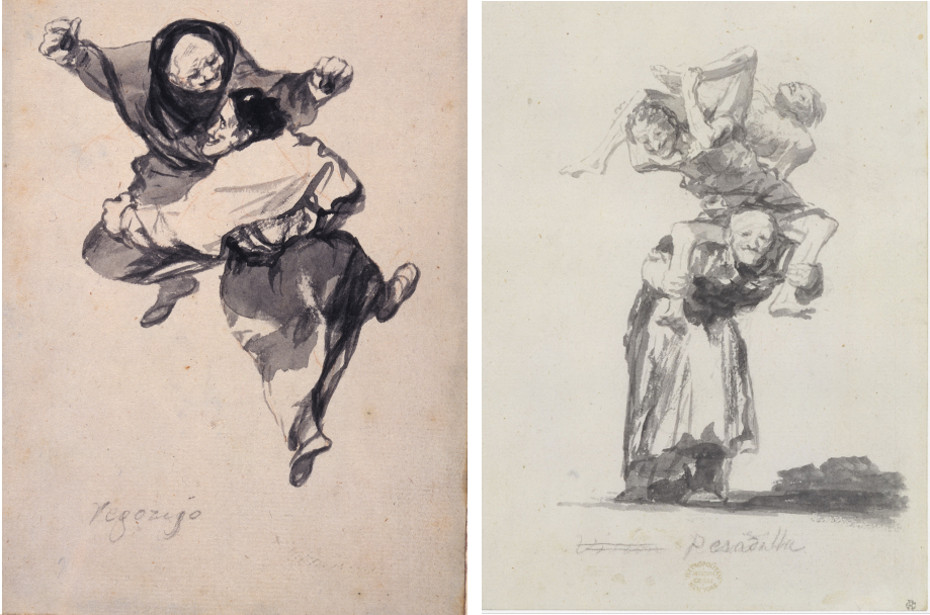
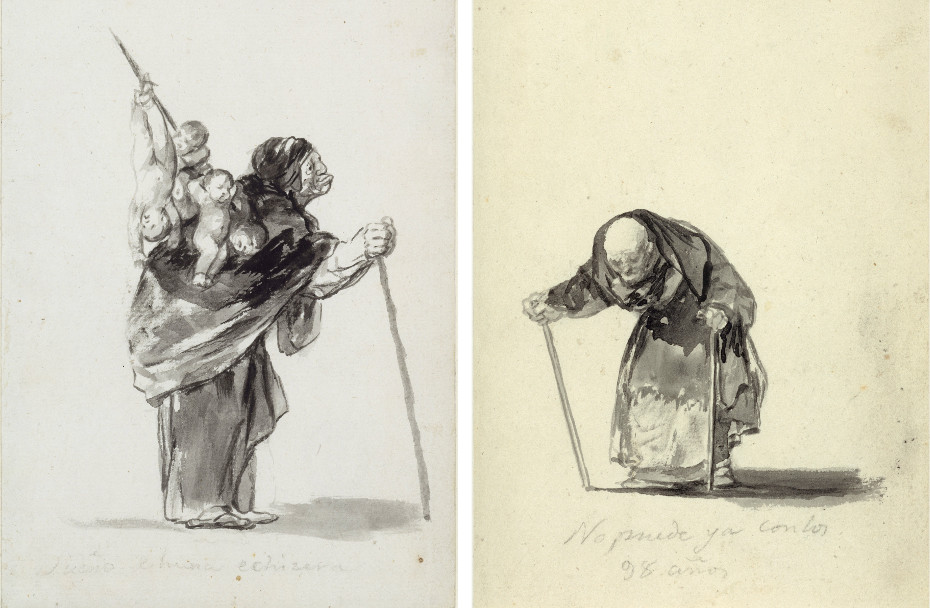
An image depicts two old women jumping into the air and embracing joyfully, a second shows an elderly man tumbling down the stairs, and in the third a woman has a bundle of babies strapped sinisterly to her back. These three drawings, currently displayed at the Courtauld Gallery, were made in 1793 when Goya was severely ill; he’d been stone deaf for 20 years and had taken to producing private albums of images.

The albums were like visual diaries, containing sketches that expressed the artist’s fears and desires, responses to the realities and subsequent anxieties of growing old and increasingly ill. The three images are from the fourth album Goya created, otherwise known as the ‘D’ album; a series of 23 pictures renamed Witches and Old Women in reference to what’s depicted on each page. Only 22 remain, and for the first time in over 200 years, through forensic scrutiny and thorough detective work, the Courtauld Institute has brought these pictures back into their original sequence. Sat in the prints and drawings room at the Courtauld, co-curator Stephanie Buck tells me about the artist’s process in relation to the sequencing of images.

‘He would have had the book in front of him and as he turned each page, the next idea would have come from the image he’d just produced.’ As a result, the themes in the album overlap and intertwine, transitioning subtly from drawings of floating figures to nightmarish visions to depictions of old age and struggle. As Stephanie says, ‘By putting them in the original order, we get close to Goya’s line of thought.’

This layout of images around the gallery’s wall becomes a trail echoing Goya’s processes, both in terms of thought as well as the physical labour that went in to each drawing. Stephanie shows me a picture that is just about to be framed and hung for the exhibition: it’s one of the floating images, and brownish ink at the top of the sheet belonging to Goya’s hand marks it as drawing number ‘3’. Leaning close to the page, I can see where Goya has scraped the paper, physically removing a layer to erase something that he wasn’t happy with. These drawings aren’t just images, they’re objects that have been marked and reworked, and looking closely at these physical traces gives us an insight into the mind of one of Europe’s most mysterious Old Masters.

Goya – The Witches and Old Women 1

Peering closely at the knotted, wizened faces of Goya’s characters, you see that he was not only a skilful craftsman; the breadth of strange scenarios and intricate depictions reflect a boundlessly inventive imagination.

In drawing ‘3’, entitled ‘Singing and Dancing’, a figure sits crossed legged on the ground with a guitar. A potion or bowl of wine is in front of them, and an old woman floats in the air above. The sitting figure holds his/her nose and looks under the floating woman’s skirt – it’s a playful, silly image, evocative of flirtation or teasing or funny moments with a friend. ‘There is this relationship between the two but the story is not self evident, so we make the story ourselves,’ Stephanie explains, ‘Its creative looking and everyone can get something different from it.’

Most of the drawings depict fantastical moments like this one, yet like all of the best myths and folk stories, magic is a metaphor. ‘The pictures are about human behaviour in all its facets, from total happiness to sexuality to horror and vice,’ says Stephanie. The feeling of happiness is conveyed in the floating, and cruelty is depicted in the more sinister images of witches kidnapping babies. ‘It’s the emotions involved that we can relate to – witchcraft becomes a way to reflect the depths of human behaviour.’

For this exhibition, the dialogue created between sketch and viewer is an intimate one: the blank backgrounds eliminate a setting for us to anchor narratives onto, so we must work with Goya to fill in the blanks of his stories. The drawings are ruminations on big and overwhelming themes like life and death, folly and vice, and the show celebrates the way that the imagination, both Goya’s and our own, makes sense of human emotions and the inevitable passage of time.

Goya – The Witches and Old Women 1

As Stephanie says, ‘There is something very general and universal embedded in this little album’. The work is concerned with a prophetic artist’s own mortality and the anxieties of bodily decay, and to see it reunited after so many years is reassuring: it confirms the artwork’s enduring relevance.

Soaked, Not Resting: negotiating the unprimed canvas

A new exhibition examines the canvas staining techniques used by Helen Frankenthaler and Aimée Parrott, two unique artists separated by a generation

Soaked, Not Resting is a new show at London’s Pippy Houldsworth Gallery, which sets out to explore the work of two unique artists and their use of canvas staining techniques. The Mayfair-based gallery is displaying pieces by the late American artist Helen Frankenthaler and emerging British painter Aimée Parrott, both of whom employ ‘soak-stain’ processes to manipulate unprimed canvases — a practice made famous by abstract expressionists such as Jackson Pollock. Conor Mahon speaks to Parrott and the exhibition’s curator, Jon Horrocks, about artistic breakthroughs, their technical approaches, and Frankenthaler’s legacy.

When did you first encounter Frankenthaler’s art?

Aimée Parrott: Early on in my BA at University College Falmouth, I saw The Bay and was astounded by it. Compared to a painter like Jackson Pollock, Frankenthaler’s work seemed to be less aggressive and more expansive; her paintings were simultaneously bold and light.

What I grew to admire in her work – and in work by painters like Joan Mitchell – was the combination of figuration and abstraction. For me, their paintings don’t seem to be about a reductive purity, but rather the relationship between memory, experience and the act of painting.

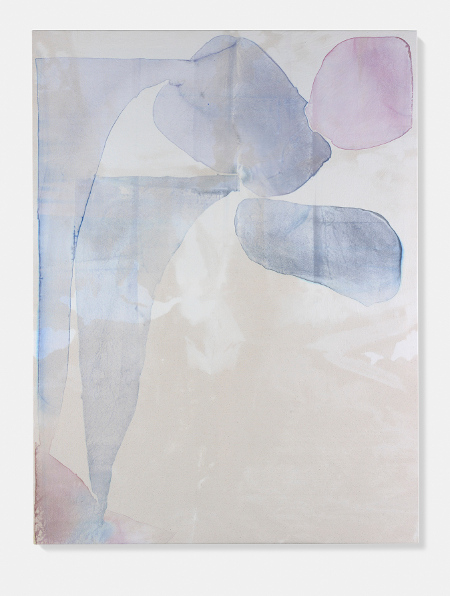
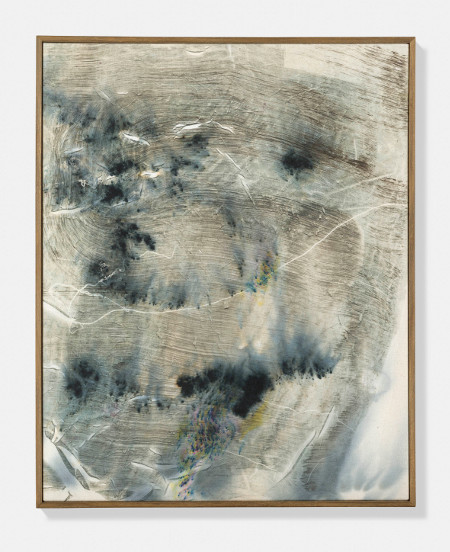
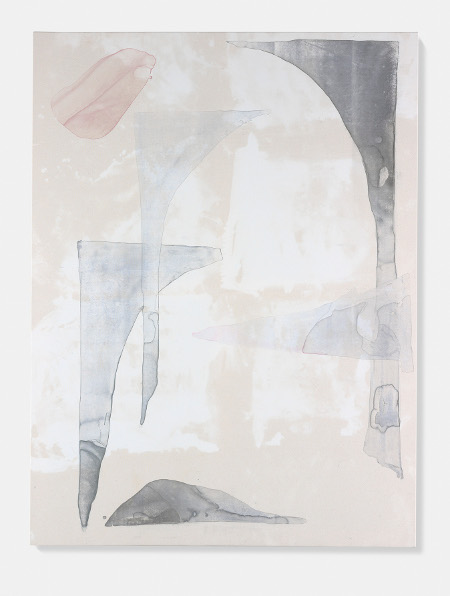
Aimée Parrott, First Hand, Second Hand, 2014 – watercolour and acrylic medium on bleach-treated canvas

Aimée Parrott, Secondary Wrinkles, 2014 – dye and printing ink on calico

How has Frankenthaler’s manipulation of the canvas influenced you?

Aimée Parrott: I think the staining technique she used made such an impact on me because it emphasised a certain duality in painting; the surface is as much a part of the work as the paint that sits on it. Frankenthaler once said: ‘I have always been concerned with painting that simultaneously insists on a flat surface and then denies it.’ I feel that the emphasis of this double vision instills a dynamism in the thing you are looking at. The use of raw canvas allows the mark to sink beneath the surface, becoming an integral part of the fabric – a stretched out object, like a skin under which one can trace action.

“Soaked, not resting” was phrase Frankenthaler used to describe a breakthrough when creating Mountains and Sea. What eureka moments did you experience when creating this series of works?

Aimée Parrott: I think that my most recent breakthrough was probably the creation of the ‘over-lap’, where the surface of the painting is reproduced by scanning and then printed onto another fabric hanging loosely over the original. I think the simplicity of this technique lends the work a physical ambivalence between original and reproduction, between painting and sculpture. Superimposing one piece onto another creates a sort of syncopated rhythm so that it exists in direct relation to the next.

When did you first encounter both artists’ work?

Jon Horrocks: I’ve known Frankenthaler’s work for many years and always had a soft spot for her paintings. I first encountered Parrott’s work at the Royal Academy Graduate Show in 2014 and was instantly blown away by the removed, ghost-like quality that characterised her mark making.

How and why did you bring their paintings together?

Jon Horrocks: We wanted to position the physicality of the canvas historically by recalling the developments by America’s colour field painters of the 1950s and 1960s, who famously drew attention to the flatness of the canvas’ surface. Soaked, Not Resting examines the ways Frankenthaler and Parrott negotiate that picture plane.

What were the main challenges in curating this exhibition?

Jon Horrocks: We didn’t want to be overly prescriptive and force a direct link between the two artists. To avoid this, we didn’t show Parrott the works we had selected by Frankenthaler prior to the show, which allowed the similarities and differences in the work to come out naturally.

Aimée Parrott, Tears, 2014 – watercolour and acrylic medium on bleach-treated canvas

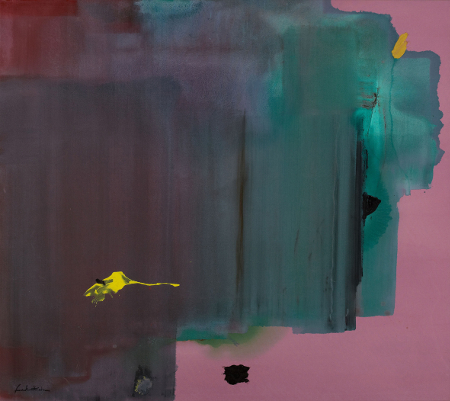
Helen Frankenthaler  Quattrocento, 1984  acrylic on canvas
Helen Frankenthaler, Quattrocento,1984 – acrylic on canvas

Can you tell us more about the technical side of both painters’ work and why their relationship with the canvas is so intriguing?

Jon Horrocks: Frankenthaler is renowned as an exponent of colour field painting, for pouring thinned paint directly onto raw and unprimed canvas. Frankenthaler did away with heavy, material brushstrokes and, instead, used squeegees, sponges and household brushes to manoeuvre the paint horizontally across the surface.

Parrott uses this ‘soak-stain’ effect to a similar end. Her large watercolour paintings use an open screen-printing technique where pigment is transferred directly onto the canvas through a polyester mesh.

The result from Frankenthaler is an emphasis on the flatness of the canvas; Parrott instead plays with pictorial depth by building up veil-like layers of colour that coalesce into amorphous forms.

Soaked, Not Resting runs at Pippy Houldsworth Gallery until 21 February 2015