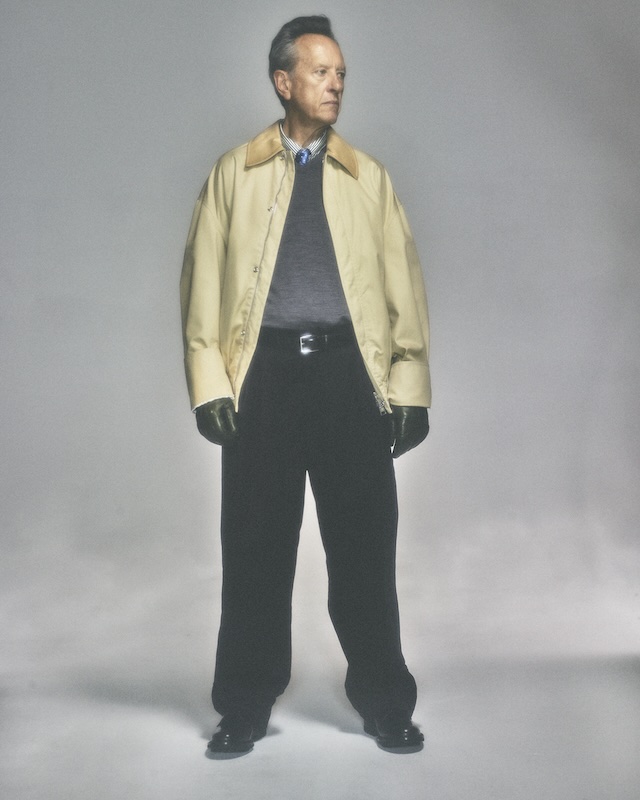
Richard E Grant likes to think of himself as a sharp flavour added at just the right moment. It’s a modest description for an actor whose career spans Withnail and I, an Academy Award nomination for Can You Ever Forgive Me?, and collaborations with the likes of Scorsese, Campion and Altman. Now, in his “condiment years”, Grant looks back on the friendships, films and insatiable curiosity that continue to define his life and work
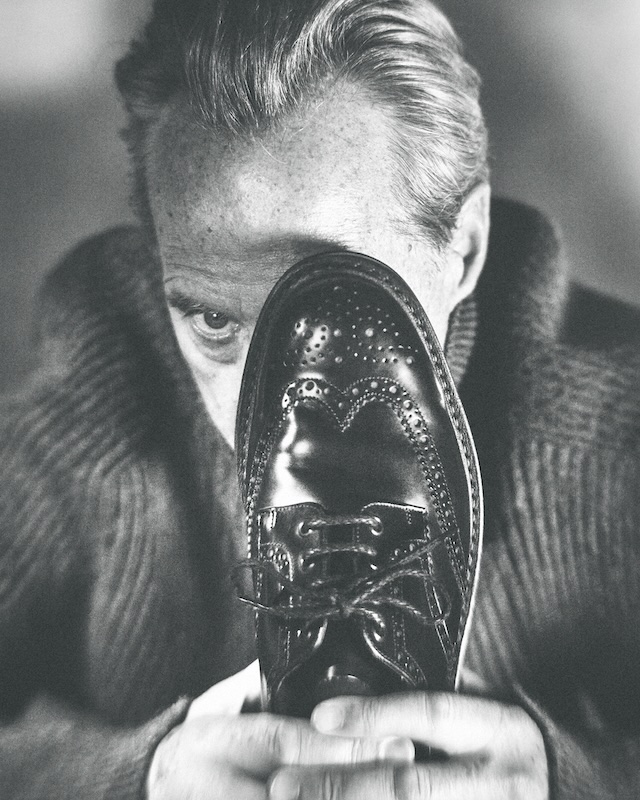
“My wife said that I was in the condiment years of my career,” Richard E Grant recalls fondly, sitting in his study on a bright September morning. “I’m brought into a film like vinegar or mustard or a spice. I feel that is a very accurate description of what I’m doing at this age.” Grant, with a long and storied career under his belt and the likes of Martin Scorsese, Jane Campion and Robert Altman among his previous directors, is in his element. This year alone he appears in no fewer than four feature films, while a quick glance at Grant’s IMDB profile confirms a further 10 upcoming projects across genres and formats, from a voice performance in Wildwood, the much-anticipated animated film from Laika, to playing the father of magazine icon Isabella Blow in The Queen of Fashion. The “condiment years” are being kind to Grant, who is fitting in our conversation before an afternoon of ADR voice work in central London. He’s busy – but that’s very much the way he likes it.
“I write every day, I collect stuff, I work in my garden,” he explains. “I’m like an ant, I suppose, I don’t sit still for very long.” Even when he’s not at work, Grant is at the theatre, the opera, a museum or the cinema, or (more often than not) reading. “I think that’s partly to do with where I grew up,” he suggests. “There wasn’t television, there was only the BBC World Service on the radio, so reading was a way into the outside world.” When I ask, offhandedly, what he’s been reading lately (Parallel Lines by Edward St Aubyn, by the way), Grant mentions he has “five or six” titles on the go at any given moment. “I’m a voracious reader, I get through about three or four books a week,” he explains. I suddenly feel both woefully unambitious about my timekeeping and impressed by his boundless energy. “When I was a little boy, my father used to say I was hypercurious, and that hasn’t changed,” Grant muses. “I like to squeeze as much out of my life as possible, because you only get one go at it.”
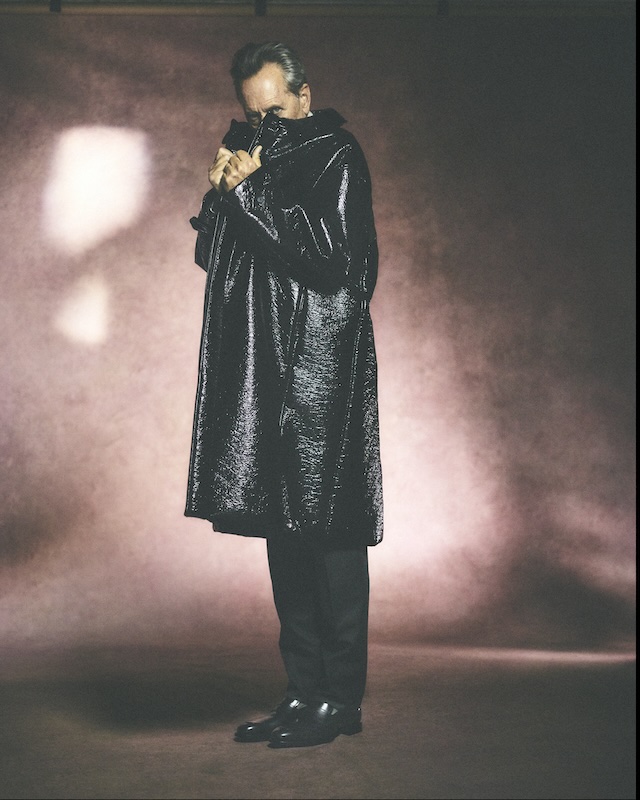
This inherent excitement about the world and everything in it has shaped Grant’s career, leading him in 1982 from Eswatini to seek his fortune as an actor in London, where he would break out in bombastic fashion a few years later as the eponymous flamboyant alcoholic in Bruce Robinson’s wine-soaked dramedy Withnail and I. “When I worked with Daniel Day-Lewis on The Age of Innocence I prostrated myself and thanked him for turning down Withnail, because without that I wouldn’t be sitting here talking to you today,” Grant says. Perhaps it’s kismet as much as curiosity. The two forces have also brought Grant to James Vanderbilt’s Nuremberg, in which he plays Sir David Maxwell Fyfe, part of the prosecution team tasked with trying and sentencing the surviving members of Adolf Hitler’s inner circle at the end of the Second World War. His small but pivotal role – a condiment part – comes years after Grant found himself studying the rise of Hitler for his History A-Level. “It felt like familiar territory from a very formative age,” Grant explains. “And the beauty of it was – as well as all the reading I’d done, including the biography of Maxwell – the footage of the real trials are readily available to watch on YouTube, so I could really see the man I was playing in exactly the moment I would be playing him. I’ve never had that opportunity before, and it was incredibly exciting to me.”
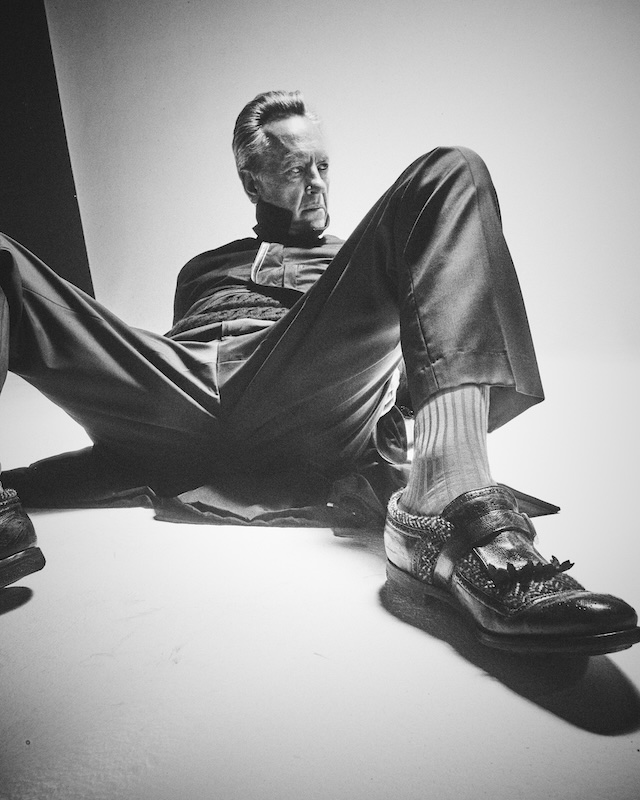
The film, some 13 years in the making, is based on the experiences of psychiatrist Dr Douglas Kelley, who assessed the defendants’ mental capacity to stand trial – chief among them Hermann Göring, known as the “right hand of Hitler”, who remained unrepentant for his part in the Holocaust until the day he died by suicide, swallowing a cyanide capsule the night before he was to be executed for war crimes. In Nuremberg, Grant is part of a starry ensemble: Russell Crowe plays Göring, with Rami Malek opposite as Douglas Kelley, and Michael Shannon cast as US lead prosecutor Robert H Jackson. They’re joined by Leo Woodall, Colin Hanks and John Slattery. For Grant, it was an intimidating but electrifying experience. “The day on set that we shot the climactic courthouse scene where Jackson finally confronts Göring, I knew that Michael and Russell obviously had a lot to say, because the scene on paper was about 25 pages,” Grant recalls. “I only had a small part of dialogue, so I thought, ‘Great, I can relax today and be ready to shoot my part tomorrow.’” But then, just before lunch, Vanderbilt informed him that Crowe and Shannon wanted to shoot the entire scene in one take. Without a rehearsal. Grant smiles as he recalls the memory. “I couldn’t let James see me panic obviously, so we went ahead and did it. And not a single person flubbed a line. At the end, when I said my final line, and we see Göring realise he’s been defeated… it felt like there was a minute of silence. Then the entire crew of 600 Hungarian extras stood up and applauded.” He thinks for a moment, then elaborates: “I have only experienced that once before, when I shot The Iron Lady, and Meryl Streep delivered her first Falklands speech to parliament as Margaret Thatcher. A roomful of men in pin-drop silence, just awe-struck.”

Grant speaks about his experience on Nuremberg with demonstrable passion. He recalls the way that the cast, despite the incredible weight and darkness of the subject material, found camaraderie and kinship during the shoot. “We were all staying together in the same hotel, so we’d go out for dinner and drink together, staying up late,” he grins. “It was a real friendship-forming time, and we’re all still in contact.” I mention that I’m a great admirer of Michael Shannon, and saw his excellent performance in Eugene O’Neill’s A Moon for the Misbegotten at London’s Almeida Theatre (which, naturally, Grant also caught before the run ended). “I’d never dared dream I would be calling Michael a friend before this,” he says, “but he has the most lethal, dry wit,” Grant remarks fondly. “And a face that looks like it could have been carved into Mount Rushmore.”
Nuremberg is the final film of Grant’s spectacularly busy year, but there’s another I have to ask him about: Julia Jackman’s delightful genre-defying 100 Nights of Hero, in which he briefly appears as the villainous omnipotent deity Birdman. How did he end up having a tiny role in a queer indie fantasy film that counts Emma Corrin, Maika Monroe, Charli XCX and Nicholas Galitzine among its achingly chic cast? “I had an in,” Grant laughs. “My daughter was the casting agent, and she – without my knowledge, I must say – put me up for the role. I was very happy to be involved, because it’s based on such an unusual graphic novel, and Julia was a director I admired. But it was a nepotism hire,” he jokes. Grant’s daughter, Olivia (who did an excellent job casting Jackman’s film), also had a say in one of her father’s most iconic roles. “When my daughter was about eight years old, she was totally possessed by the Spice Girls,” Grant says. “So when she found out I was being offered the role of their manager in Spice World, she was absolutely ecstatic.”
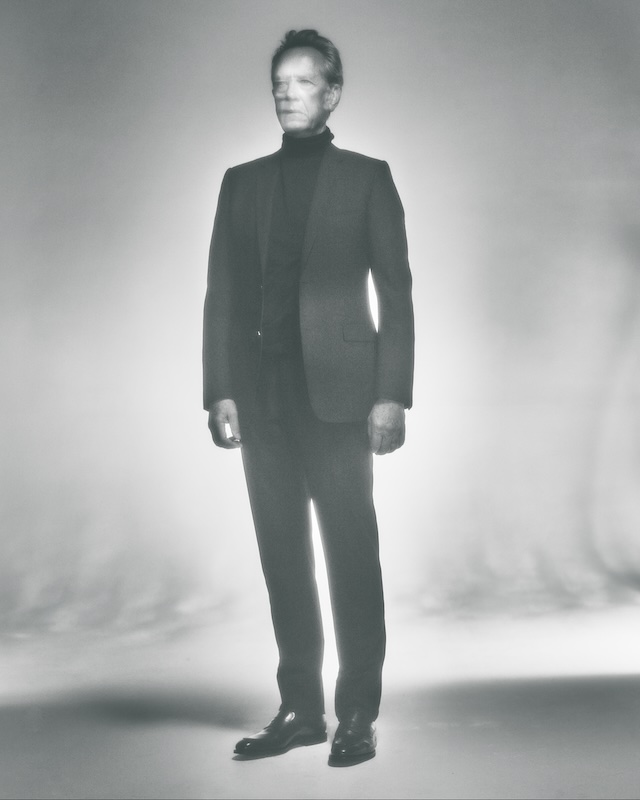
“I was berated by some people in my profession for taking that part,” Grant continues. “But Adele, with whom I share a birthday but not a bank balance, is a huge Spice World fan, and she kindly sent me some tickets to her sold-out tour at the O2… so it paid off in the end.” It was that very performance as Clifford the Spice Girls’ manager which brought Grant to the attention of a young Lena Dunham, who would later ask Grant to guest star on her smash-hit series Girls as Jasper, who has a brief dalliance with Jemima Kirke’s Jessa after they meet in rehab. Recently Dunham came calling again, offering him a role in her London-set Netflix sitcom Too Much as adman Jonno. “I never thought that Spice World would have that sort of legacy, and it comes with its own sort of cult following,” Grant says. “But then again, I never thought that I would be BAFTA and Oscar-nominated for a role at 62, for a film where I had replaced another actor last minute.” He’s referring to his turn as the charming rogue Jack Hock in Marielle Heller’s sublime crime drama Can You Ever Forgive Me?, for which Grant received critical acclaim and a nomination for Best Supporting Actor at the 2018 Academy Awards. (Chris O’Dowd had been slated to play the role before the part ended up with Grant.)
Considering the garlands that Can You Ever Forgive Me? received at that point in his career, I ask Grant if there are any films from his past that he looks back on and thinks deserved more attention than they got. “I don’t tend to think about things like that unless I’m forced to, like you’re doing now.” He gamely considers my question all the same. “I had a great time working on The Portrait of a Lady and I don’t know if that film ever found its audience,” he says. “Nicole Kidman and Viggo Mortensen were delightful, but Jane Campion is so specific as a director, and at that time I don’t think I’d worked for a female director on a movie before, and I will never forget the atmosphere she created on set, because she was surrounded by this incredible team of women working on this adaptation of a book written by Henry James and giving so much to the female gaze and interpretation of that text,” Grant explains. “It made for a very different atmosphere, and it made a deep impression on me.”
Grant has continued to work with many female filmmakers since, now counting Dunham, Heller and Jackman among them, as well as Emerald Fennell, Phyllida Lloyd and Thea Sharrock. “You can’t generalise, but I will,” he says mischievously. “When I work with a female filmmaker, it always feels more collaborative, and that people’s opinions matter. Working with Emerald Fennell was extraordinary because she sounds so posh, and she is, but this crew of 200 were ready to jump off a cliff for her, because she has this gift of making everyone feel their opinion counts, and that it informs what everyone’s doing. You feel valued as somebody on her set, and included, and if she offered me work for the rest of my career I’d be very delighted.”
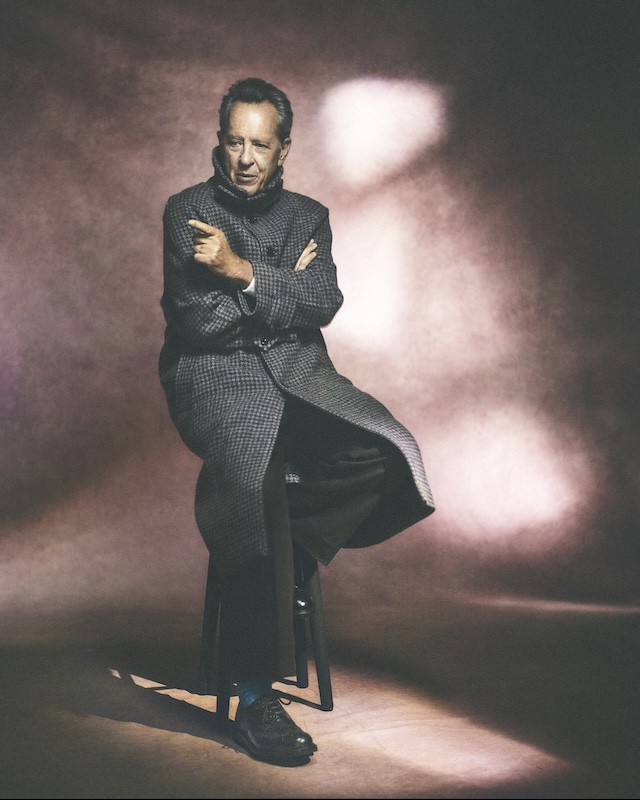
Then again, he’d have to make more time for Fennell’s films. A scan of his thriving Instagram account this month shows Richard has been to see the V&A’s new Marie Antoinette exhibition; cuddled some puppies at the Toronto International Film Festival with his Nuremberg co-stars, and even popped down to see Ralph Fiennes directing As You Like It in Bath, starring Charlie Rowe, whom Grant acted alongside in 2010’s The Nutcracker in 3D. If these are, as his wife once told him, the condiment years, it seems Richard has developed an incredibly refined palate.
Grant wears Church’s
Photography Douglas Irvine
Styling Nilo Akbari
Photography assistant Tom Buller
Styling assistant Roksi
Grooming Bjorn Krischker @ The Wall Group
Production The Production Factory

This article is taken from Port issue 37. To continue reading, buy the issue or subscribe here


