Photography by Port’s kids – Laurie, Mungo & Clay – using disposable cameras
When you think of your dream home – or perhaps even your more flawed, but tangible actual home – what do you consider to be the heart of it? When you were growing up, did your family congregate in the living room, or in the crumby, over-lit mess of the kitchen? And do you do the same? None of these questions are Hinge prompts, although they ought to be. There are, perhaps, two kinds of people in this world: living room people and kitchen people. Finding out who is who is, I believe, the crux to getting to know someone well, and quickly. How can you truly judge your compatibility with someone if you don’t know whether they see a kitchen as the heart of their home? I was recently relieved and delighted to find out my boyfriend is also a kitchen person.
In my fondest recollections of growing up, it was always the kitchen – my granny’s kitchen, in fact – that we congregated in, that hummed with life and energy and love. My earliest memories are sitting there, eating thick toast slathered in Kerrygold and trying to get involved, while around me the people I knew best in the world gossiped, laughed, played card games and smoked incessantly (It was the 90s!). If we ever decamped to the living room, this meant something very bad and wrong was happening. Possibly a funeral. It’s little wonder that as an adult I’ve attempted to recreate this, eating breakfast perching on shared counter space, constantly running the radio in the background while trying to entice stray cats through the back door.
That the shared kitchen has become a necessity is, if not a silver lining of the housing crisis exactly, then at least a serendipitous, pleasant quirk of private renting. Having left our family homes, we find ourselves moving into increasingly anonymous spaces, dividing our living spaces into smaller and smaller boxes (landlords would call these ‘rooms’, although sometimes I am not sure that they can be legally named as such). Sequestered into bedrooms, with living room politics too sensitive to breach – how to divide a Netflix account between six people, and ensure that they all avoid spoilers in unison? – we’ve found ourselves in the kitchen again. The only truly shared space for a generation resigned to eternal communal living, it’s in kitchens that we pre-drink and cook together, gossip over toast in the morning, squabble over who’s used whose KeepCup before rushing out to work – everything that I remember from my childhood except chain-smoking (it is no longer the 90s).
It’s an understatement to say millennials’ endless shared living is not perfect. There are times when it feels like a life sentence. There are other times when it feels like the platonic ideal of a commune, a WhatsApp group with your friends briefly brought to life. Our kitchens are hubs of family – chosen or blood – and community. It is why it’s so easy to put your hands on so many quotes about the space, from the literary to the saccharine. From your mum’s painfully unchic “in this kitchen we dance, sing, laugh…” corkboard, hanging next to a fridge overladen with kitsch magnets and family photos, to Alfred Hitchcock’s often-attributed kitchenalia quote: “Happiness is a small house, with a big kitchen.” Anthony Bourdain went so far as to designate the space its own language: “kitchenese”. I, for one, am fluent.
This article is taken from Port issue 36. To continue reading, buy the issue or subscribe head here
Danielle Pender is a writer and editor, and the founder of Riposte magazine. Her work has appeared in publications including The Guardian and The New York Times. In this reflective essay for Port, she explores the complexities of returning home – how distance reshapes family bonds, and the quiet negotiations that come with reunion
For the last fifteen years I have ridden the East Coast Main Line from London to Newcastle, tracing the same miles over and over, yet arriving somewhere slightly different each time. Newcastle is home in the way that childhood places always are – embedded in muscle memory, a place you don’t have to think about to know. London is where I live now, but when I picture my family, the roots of it, I think of my mother, my brother and me.
For years it was just the three of us, tightly bound inside a small house, navigating whatever came our way. We were in each other’s pockets in that specific way small families in small houses are – you know everything about each other, whether you want to or not. Routines, rhythms, moods, silences. What time someone would come through the front door, what it meant when they didn’t. The smell of someone’s shampoo lingering in the hallway. A shifting weather system of closeness and irritation and deep, unspoken understanding.
Now, my brother and I have our own families. We have expanded, our lives have changed, and in doing so, we have also dispersed. As the train slowly pulls over the River Tyne into the station, I think of a Heraclitus quote that Siri Hustvedt included in Mothers, Fathers and Others: “In the same river we both step and do not step, we are and are not”. A line that feels made for those who leave home and return – not as prodigals, not as tourists, but as something harder to define. Insiders who have grown alien to their own past. My mother, my brother and I were once a fixed unit inside that small house; now we orbit one another, connected but no longer in sync. We are and are not.
With people moving further from where they were born, modern family life is often reduced to a handful of sanctioned gatherings – birthdays, Christmas, the odd anniversary or weekend away. But what happens in between? What happens when you are no longer part of each other’s daily lives, when the casual, unexamined intimacy disappears? We meet as guests in each other’s presence, performing the shape of family but feeling its lack. The questions we might ask a stranger – What do you do? Who do you love? What keeps you up at night? – are the very ones we avoid with each other, afraid of exposing how much we no longer know.
For the past year, I have been writing a novel about a homecoming, which has drawn me to literature that explores this experience from different angles, offering both comfort and insight. In Long Island, Colm Tóibín’s Eilis Lacey returns to Ireland and finds herself caught between past and present – who she was before she left, who she is supposed to be now. This is often the way for families coming back together; each visit becomes a delicate negotiation, a process of reacquaintance in real time.
When Eilis buys her mother new white goods for the kitchen, a gesture driven by generosity and a desire to mark herself as different, as a grown woman of means, her mother insists she doesn’t need them, leaving them as obstacles in the hallway rather than having them installed. The protest isn’t really about the appliances. It’s about control, about the unbearable proof that Eilis has formed a life outside of this house, that she is no longer someone whose choices pass through a parental filter.
Annie Ernaux writes about this change and distance with such precision – the way that home, once so familiar, can start to feel like a foreign country. In A Man’s Place, translated by Tanya Leslie, she writes about the gulf between herself and her working-class father, which widens as her education and career take her into another world. She describes the sorrow of seeing home through new eyes, of feeling both love and alienation at once.
That tension haunts so many reunions. Gwendoline Riley captures it in First Love and My Phantoms, where adult children return to parents who are both familiar and unknowable, baffling and inevitable. There’s something particularly painful about these encounters, when love starts to feel like performance, when obligation replaces ease. The gap between people who should know each other best, but somehow, don’t.
What is it like for those who stay, watching someone return – someone who looks the same but feels subtly, irrevocably changed? The returnee carries an unspoken tension, a quiet air of judgment, whether deliberate or not. Their departure was a choice, one that, however unintentionally, suggests a rejection – of this place, this way of life. Whether their world is ‘better’ or simply different, the contrast lingers, unspoken yet inescapable.
In Gwendoline Riley’s My Phantoms, the mother is a particularly heartbreaking figure, repeatedly colliding with a daughter who has come back to Manchester to care for her, but whose presence is more duty than desire. Their dynamic is fraught; her daughter observes her life with barely concealed disdain, seeing tragedy where her mother perhaps sees only routine or comfort. The book forces the reader into an uncomfortable complicity, recognising the sharp edge of judgment in the daughter’s perspective and perhaps, uncomfortably, in their own.
But estrangement is not inevitable. In Close to Home, Michael Magee’s protagonist Sean returns to Belfast after studying at university in Liverpool, finding his brother and old friends caught in a different rhythm – one shaped by economic precarity and cycles of drink and drugs. The distance between them is undeniable, but love does not demand sameness. Magee writes these relationships with a deep, unflinching tenderness, recognising that while family bonds may stretch, they do not always break.
In the novel’s final moments, Sean stands with his older brother, Anthony – a man hardened by experience, shaped by a trauma that could have driven them apart. Instead, Magee offers a scene so quietly devastating, so full of unspoken understanding, that it brings me to tears every time I read it:
“I tried to get away from him, but he was stronger than me and he wasn’t letting go. Get off, I said, and he giggled and kissed me on the ear and on the side of the head, my face, my neck and anywhere he could reach with his arm around me. And while he did this he told me he loved me. I love you to death, he said, and he kissed me and kissed me.”
The places and people we come from remain woven into us, no matter how far we go. Family holds a version of us that is fundamental and inescapable – the ones who knew us before we knew ourselves. We may no longer share the details of our daily lives, but that early imprint lingers, shaping us in ways we can’t always see. Whether that is a comfort or a source of pain depends on the circumstances. As Didier Eribon writes in Returning to Reims, “Whatever you have uprooted yourself from still endures as an integral part of who you are.”
For my mother, my brother and me, it is something I cherish. We witnessed everything that shaped us, and in that shared history, there is an unspoken understanding of how the past made us who we are today, no matter what other factors have influenced our identity. I will always be deeply grateful for that. I find solace in the sayings we still repeat, the in-jokes that need no explanation, the memories that resurface without warning – and the way we all look the same when we laugh.
I think about this as I walk across London Bridge one evening after work, caught by a deep and unexpected longing – not for Newcastle itself, but for the version of us that once lived there. My mother, my brother and me in her bedroom, playing charades, doing handstands onto her bed, laughing ourselves breathless. The physical closeness of it. The certainty that we belonged to each other. That incarnation of us is gone, but something remains, changed but intact. Like the body maintaining homeostasis, making constant adjustments to keep itself, itself.
To leave home is to fracture a wholeness you can never fully restore. But maybe restoration isn’t the point. Family is not static. It is movement – towards, away and back again.
There’s a semi-circular pouffe that plays a central role in Kusheda Mensah’s home. It’s a simple shape, thigh‑height and thickly cushioned, upholstered in a fine off‑white and brown checkerboard Kvadrat twill. It stands, it rolls, it’s readily repurposed and moves around the room. For her young children Sior and Soleil, who are four and two years old respectively, it’s a seesaw or a step‑stool – another excuse to be always in motion. For Kusheda, the pouffe doubles as an unlikely (but very gorgeous) desk chair; though she has had many studio spaces, she works mostly from home, happy and at ease in the window of her south‑east London living room.
Though it’s far from the best‑known piece her brand, Modular by Mensah, has made, this pouffe is a pleasingly powerful expression of Kusheda’s practice as a designer. Bold, functional and playful. “Things can be so simple,” Kusheda tells me from her spot on it, on a Tuesday morning early in spring. “I’m always thinking about how I want people to feel.”
Modular by Mensah first launched in 2018, as part of a showcase to the great and good of the design industry at Milan’s Salone Satellite, a fair dedicated to the most promising designers under 35. From the moment the doors opened, she drew a crowd. Her first collection, Mutual, harnessed rich, warm colours, tactile textures and expressive shapes to encourage interaction – and in so doing, enhance social wellbeing. “A seat is a seat, a pouffe is a pouffe – people sit down, they get up, they go,” she says. “Modular by Mensah is about creating shape that changes the flow in a room. In public spaces – a foyer, say, or a gallery – it’s hard to feel like ‘I’m here now, let me just relax.’ I want people to feel able to be still, to engage with their environment, but also to engage with one another.” This aspect – creating a focal point that encourages conversation, interaction, exchange – is crucial for her. “Without community, who are we?” she asks. “A big part of why Modular by Mensah exists is to bring people together. That is so important to me, personally, and my practice was born out of wanting to do that for other people too.”
Now, seven years since it was founded, the spirit at the core of Modular by Mensah is stronger than ever – but Kusheda’s practice as a designer is growing, evolving and deepening around it. She has grown, birthed and nurtured two small children in that time – a seismic shift that feels all the more tangible because we are friends and neighbours, and I’ve been doing something similar, sometimes together with her, in my own home two doors down. (She is the kind of comrade that an expectant parent dreams of sharing the toddler years with: warm, thoughtful, fun, real – generous with her time and energy, always, even when both are in short supply.) In early motherhood, life becomes an elaborate rear‑ranging; the pieces are painstakingly carved out, set next to one another, then thrown up into the air to scatter and reorganise again. Where once the ‘modular’ in her name spoke to the way objects coexist in a space, now it speaks to something greater, more abstract, and rich with possibility. Different materials. Different fabrication techniques. Different people. There are so many different parts that make up the whole.
Kusheda came to furniture design by way of textile design, which has always been her first love. Born to Ghanaian parents and raised in London, texture and print are embedded in her cultural identity. “When I was growing up, my mum was always picking out fabrics for a particular occasion, looking at colours, textures, symbols,” she says. She studied Surface Design at London College of Communication, where she was drawn first to printmaking, before she began exploring the ways structures could disrupt or redirect how a space is used. Lately, she’s been experimenting with printing again. “How can one symbol be broken down and multiplied through printmaking to create an immersive experience?” she asks, thinking aloud and talking loosely through some recent tests. Printing offers her a welcome return to process, absorption and experimentation.
Symbolism plays out in her work in larger ways too. Last year she began exploring language, creating large‑scale sculptures inspired by Adinkra – visual symbols that represent concepts, proverbs and aphorisms in language in Ghana. “There are so many symbols that the Ghanaian community and the culture relate strongly to,” she explains. “I was exploring phrases in Twi [a variety of the Akan language] and there was one that stuck out to me: onipa ya de. It means, ‘being human is sweet’. It’s a reminder to embrace humanity and enjoy one another.”
This phrase became the title for a seating installation that she exhibited last summer as part of the 2024 edition of the Harewood Biennial, an event which celebrated craft and connection while elevating artisanal heritage. In the collection, angular and curved pieces slot into one another to create seating, exhibited within a library room. Visitors could curl up solo inside a curved form, or perch next to strangers and loved ones alike, on functional objects which represented communication and interaction on both a micro and macro level. It’s a space she’s excited to continue exploring.
A few months after the Harewood show opened, Modular by Mensah debuted another new collection at London’s V&A, as part of the London Design Festival. Against the backdrop of one of the museum’s majestic Medieval and Renaissance rooms, Unhide showed seating which combined metalwork with fine, sustainably‑sourced leather provided by Bridge of Weir Leather, to create an elevated and ambitious new collection.
Still sculptural, still playful, but with new structure – another hint of things to come. At the Festival’s opening night, Sior and Soleil clambered gleefully over the banquette‑style elements, as if modelling to the mostly adult crowd how their mum’s work could be used.
Their joyful and intuitive interaction with these rigorously crafted pieces was a powerful reminder of the ways in which raising children can expand a creative practice. Kusheda’s vision is dynamic, innovative, vital and bold because of, and not in spite of, the ways that parenting shapes her point of view. The work is harder to get done, certainly – but it’s infinitely better for it. “I give so much to motherhood. I give so much to my career. Both are part of my identity,” she says. It’s exhausting and enriching work, but she always has one eye on the legacy she’s building. “As a Black designer, as a mum, I’m creating that representation for my children – or any precious little child, honestly, that deserves a leg‑up somewhere. My peers and I are opening the doors. It’s hard work. But one day, other people will be able to just stroll through.”
The accolades reinforce the point. In 2022, Kusheda was one of eight designers to be nominated for the coveted Hublot Design Prize. A few weeks ago the World Design Congress named her one of 25 trailblazers leading the Design for Planet movement. There’s an exciting collaboration with independent design brand Hem in the works, due to launch later this summer.
And in spite of all the spinning plates, the competing deadlines, the drop‑offs and pick‑ups and unexpected sick days, there’s a sense of space in Kusheda’s design practice right now: a fertile ground in which she’s trying out new things. Screenprinting. Textile design. Ideas for education. Books. A studio space, maybe.
These new building blocks are all becoming part of her approach – strong, flexible, always evolving, always growing. This is modularity, in practice.
Svitlana Grotsees her son, Kostiantyn, and her future children as an investment in a country that has lost too many of its finest. “My dream is that every Ukrainian feels the responsibility to give new life to our country,” she says
“I’ve never been afraid of death before,” says Svitlana Grot.
Then she had a baby.
Svitlana serves in the Armed Forces of Ukraine. “I was never looking for death, but the thought that I might die didn’t frighten me,” she says. Everything changed when her son, Kostyantyn, was born. For instance, she never hid in shelters during air raids. “Now I have to,” she admits.
Ukraine’s population is plummeting. In the first half of 2024, the mortality rate was three times higher than the birth rate, according to the Ministry of Justice. A United Nations forecast estimates that by 2075, the population could halve to 23 million. Natalya Shemyakina, medical director at Leleka maternity hospital in the Kyiv region, has also noticed a decline in births. “Before the invasion, we had up to 200 births a month,” she says. “Now, we’re down to around 100.”
Bella Khadartseva is expecting her first child. Her strength comes from her partner, with whom she chooses to build a family despite the chaos of wartime. “Raising strong, smart, and healthy children is the best thing we can do,” she says simply
Shemyakina was the obstetrician-gynaecologist who delivered my son. Platon was born on 16th December 2024. That morning, the Kyiv region was under another wave of drone attacks – while we were getting into the car to rush to the hospital, my partner spotted an Iranian-made Shahed drone flying over our roof.
Childbirth amid shelling has become the new normal for Ukrainians. Leleka and other hospitals have turned their basements into bomb shelters – Shemyakina has worked there numerous times. She has witnessed the labour of women who lost their husbands to the war – some killed at the front, others by shelling.
“The most important thing we must do for Ukraine is create new life, because so much is being taken from here,” says Natalia Wisłocka, who is nine months pregnant. A Polish woman working in cultural diplomacy, she moved to Kyiv in 2020. Despite having the option to leave, Natalia has decided to give birth and raise her child in Ukraine. “Kyiv became my home, and I want my son to be Ukrainian,” she says.
Having children during a war is not necessarily a good idea. Sometimes, when I scroll the news, I’m so overwhelmed by despair that I feel ashamed in front of Platon – for bringing him into this darkness. The thought that calms me is that the only thing capable of standing against death is love.
Here are the stories of the women who feel the same way.
Marusia Lukiantseva loves mornings with her son, Kyrylo, the most. “When I feed him and his tiny fingers touch and scratch my face, the whole world seems to pause,” she says. Is she afraid to raise a child in a country at war? Of course. But she wants him to grow up near his father. So they stay together, as a family
On the morning of the 8th of July the Russians launched a massive attack on Kyiv, striking several medical facilities: the children’s hospital Okhmatdyt, the private clinic Adonis and the Isida maternity hospital. Thirty-three people were killed.
That same day, Marianna Partevyian and her three-day-old daughter, Eva, were at Isida – but in a different ward. “The staff told us: there’s no other option, everyone must go down to the shelter,” Marianna recalls.
Marianna’s first pregnancy ended in the seventh week. She remembers hearing her baby’s heartbeat just as the doctor said, “The miscarriage has already started.” After that, she promised herself to do everything the right way.
I know what she means. A year before my son was born, I too lost a child. Even though I hadn’t planned for that pregnancy, the experience was soul-shattering. It was even more devastating when, after the termination, doctors told me my egg count was extremely low and getting pregnant would take persistence – and a small miracle. The miracle happened. He’s lying in his crib now, snoring like a T-Rex as I type these words.
Fleeing the war, Natalka Mashkova left everything behind in Kharkiv – a city on the border with Russia – her family, her business, the apartment she had bought just three months before the invasion. The birth of her son, Mark, became her escape from reality, shifting her entire focus to him. ”I love putting Mark to sleep,” she says. “It’s our time, just the two of us”
Marianna found strength in her partner, Yaroslav. He told her, “The soul has already chosen us, so don’t worry – everything will happen as it should.” A few months later, she got pregnant. Eva was born in the early morning of the 5th of July, a month before her due date.
Now, eight months into motherhood, Marianna feels her daughter is teaching her patience, gratitude and positivity. “I’m really grumpy,” she admits. “But when Eva smiles at me, I can’t not smile back.” She loves those quiet moments in the morning when Eva wakes up, nestles beside her, stretching and cooing softly. For Marianna, having a child during the war is a simple choice. She believes in Ukraine and wants to be a part of creating its future.
Marianna was born in Kyiv. When she was a year old, disaster struck at the Chernobyl Nuclear Power Plant, and her family moved to Armenia. Then, in 1988, war broke out between Armenia and Azerbaijan, and Marianna returned to Ukraine. “In a way, I had already been a refugee,” she says. “How long can one keep running?”
Having children is a challenge in itself – let alone during a war. For TomaMironenko, strength comes from the love her son, Platon, has brought into the world. “It’s like Platon generates happiness and light,” she says. “Watching so many people around him filled with love is inspiring”
When interior designer Iya Turabelidze reflects on the war, to try to make peace with everything that’s happened to her country, she turns to her son, Aeneas, for solace. “To me, he’s become a symbol that means we keep living,” Iya says. “Sometimes I think he wouldn’t exist if it weren’t for the war.”
Aeneas is Iya’s youngest. Her daughter, Etta, is seven. Her son, Adam, is almost four. Aeneas will turn two in June. He was born as the air raid sirens wailed. “That sound became the soundtrack of my third pregnancy,” Iya says.
When she first found out she was pregnant, she took her kids to the playground in Taras Shevchenko Park, in the centre of Kyiv. The next day, that playground was destroyed – hit by debris from a Russian missile during a massive strike.
I remember that attack well – my partner and I live a block away from that park. That morning, we woke up to explosions and watched missiles carving their path through the sky. When we reached the underground shelter, I sat next to a family and overheard a boy, about 10 years old, asking his father whether the missiles we heard being shot down were cruise missiles or ballistic.
For Iya, that day was traumatic too. She left Ukraine but couldn’t stay away for long. She was back by her seventh month of pregnancy, and it came at a cost. In May 2023, when Iya was nine months pregnant, Russian forces carried out 17 air attacks on Kyiv – a record level of intensity. Some days, the capital was hit twice within 24 hours. “Every night I lay in bed, embracing my sleeping children with a large belly, wondering whether we would survive,” she recalls. “It’s really hard being a pregnant mother of two.”
Every child, every pregnancy is a challenge, Iya believes. “A new baby is both a new life and a small death – the moment they arrive, you are reborn. War or no war, when a child is ready, she comes.”
Iya Turabelidze is a mother of three. Her youngest, Enej, was born during the invasion. “Children teach us everything,” she says. “To cherish every moment, to be patient, to understand that perfection simply doesn’t exist”
Svitlana Grot and her husband, Artem, had planned a gender reveal party but it never happened. A few days before the event, they learned that their close friend had been killed at the front. “Artem called me and said, ‘Let’s just go and find out the sex,’” Svitlana recalls. “We discovered we were having a boy.” The couple decided to name their son after their fallen friend. His name was Kostyantyn. He had been fighting since 2014. He left behind a son.
Both Svitlana and Artem serve in the military. Artem is a veteran – he lost a leg in 2019. Throughout the Russian-Ukrainian war, he has buried many close friends. He lost people he considered the best, the strongest, the most honourable. Most of them never had children. “These people left behind nothing but our memories of them,” Svitlana says. “So for Artem and me, having a child is securing a small immortality.”
Artem had dreamed of having a child since the moment he went to war. Being so close to death changed him, Svitlana says. When she told him they were expecting, they cried together – a lot. “For him, it was immense happiness. For me too. But I think it meant even more to him,” she says.
She continued serving until almost her sixth month of pregnancy. Pregnant women aren’t deployed to the front, so she worked in Kyiv. Artem was anxious every time she was on duty. But he collected himself. As a serviceman, he has the utmost respect for the military.
Kostyantyn was born in October 2024. Svitlana is now on maternity leave, and she has decided to spend a year with her son. Every day, she learns something from him: like composure, and endurance. “I’ve been in stressful situations before,” she laughs. “But these are different.”
The first month of motherhood was brutal. The hormonal imbalance, the sleep deprivation, the struggle to understand her baby’s needs – combined with the radical shift in her life – hit hard. “I cried for a week,” she says. “Not because I felt bad or wasn’t happy about my baby, but because I had this feeling that I had died in that maternity hospital. And some other woman was born. I needed time to get used to her.”
Now she feels differently. “Despite wanting to sleep, despite the lack of time for myself, despite sometimes feeling a bit cut off from the world, motherhood is beautiful to me.”
As a teenager, Karolina Zvada dreamed of having three sons. Now, she is raising two sons and a daughter: Maksym, Sofia and Artem. “Looking at my children, I can’t help but feel proud of myself,” she says. “My husband and I took a really big step”
Art historian and curator Olga Balashova went into labour in the middle of the night. In wartime Ukraine, that meant she was alone and her partner couldn’t be there. Because of Kyiv’s curfew, Illya had to wait. By the time he arrived, her contractions were two minutes apart. Their daughter was coming. “It was an incredibly beautiful and deeply special experience. For a while, you don’t even feel like a human at all,” Olga says. “And when you finally meet this baby that was inside you all along, there’s just nothing like it.”
Though the decision to have a child was intentional, Olga never saw motherhood as her life’s purpose. She’s deeply committed to her work and kept going right up until the moment Olexandra was born. The project that consumes her is reshaping art education. “We’re developing a vision of what art in schools should look like,” she explains. “Once the active fighting stops, our national priority will shift from defence to education.”
Olexandra is almost two months old now. She joins her mother’s work calls, sits through Zoom conferences. “She’s my focus,” Olga says. “Every evening, I read the news and can’t wrap my head around it. But compared to her, it all seems so inessential.”
To Olga, motherhood means being ready to do anything for your child. “When she cries, I always tell her, ‘Just let me know what you want, and I’ll give you everything you ask for.’”
Two days before the war, Ukrainian artist Katerina Lisovenko unveiled a new painting, Untitled. On a black canvas, a woman stands holding a child in her arms. Both of them have their hands raised, middle fingers up. Defiance is written on their faces. When Olga first saw it, she thought of it as a metaphor for Ukraine – where the most vulnerable, the women and children, keep fighting back no matter what. “To me, the image of that woman was an allegory of our country,” she says. “Now, it feels like a reflection.”
“One of the unexpected perks of motherhood is the invisible network of mothers that has always been there, we just never noticed it before,” says Olga. She’s absolutely right. All these women radiate light and love. And every morning, as I watch my son wake up and smile, I feel as if I too carry some of that light.
I can’t wait for him to grow up just a little, so I can tell him the story of how brave we were – him, me and all these women.
In a rich and rollicking conversation, longtime friends and collaborators Spike Lee and John Turturro reflect on their first film together, Do the Right Thing, the influence of Akira Kurosawa and Lee’s remaking of High and Low, and a shared creative history shaped by trust, teaching and time. From stories of Sinatra and Spielberg to lessons passed down in Lee’s NYU classroom, the two trade memories from their lives in cinema
John Turturro: I know you’re a Kurosawa fan, even before you got involved with High and Low.
Spike Lee: That’s my guy.
JT: Is that one of your favourite Kurosawa films?
SL: Yes. But I also have to give love to Rashomon, because I saw Rashomon during my first year in graduate film school – Ang Lee and Ernest Dickerson were my classmates. The way Kurosawa did it, with people telling their version of a rape and a murder? That really stuck with me.
JT: That’s a big influence. Do you remember the second Kurosawa film you saw?
SL: To tell the truth, I saw Kurosawa films before I even knew who he was. I had an older friend who would take me to see Kurosawa’s samurai films. I loved the action, the blood squirting. It wasn’t until my first year of film school that I really understood who the great master Kurosawa was.
And just the other day, we found out Highest 2 Lowest was selected for the Cannes Film Festival. We’re out of competition, but I’m just happy. This will be the first time Denzel Washington has a film at Cannes. He’s been to Cannes before, for The Mighty Quinn, but this is his first time with a film in the festival.
JT: I’m excited to see it! So when you came to this new project, you had seen High and Low probably a long time ago?
SL: A long time ago. I’ve shown High and Low several times in my New York University classes – this is my 30th year teaching at the graduate film school. Denzel was already attached, and he reached out to me and said, “Do you want to do this?” This is our fifth time working together: Mo’ Better Blues, Malcolm X, He Got Game, Inside Man and now this.
But the crazy thing is, I didn’t even realise Inside Man was 18 years ago. Time goes fast. Sometimes you have that kind of relationship where you don’t need to see somebody every day. You’ve got that connection. It’s just there. We’ve got history.
JT: Was Denzel a fan of the original?
SL: Oh, absolutely. He wouldn’t have done it otherwise. And it’s a real collaboration, like Kurosawa and Toshiro Mifune – they did 16 films together. That’s how I feel about me and Denzel. That kind of creative partnership is like a marriage. Would you agree with me, my brother?
JT: Yeah, that’s right. You’ve got to have a good friendship to survive all of that.
SL: You can say that again.
JT: You’ve been a professor for 30 years now. I know your mother was a teacher.
SL: My father taught bass too. My grandmother was an art teacher in Georgia during Jim Crow. She taught for 50 years, never had a single white student. Van Gogh was her favourite painter. She saved every Social Security cheque to pay for her grandchildren’s education. I was the oldest, so she put me through Morehouse and NYU and gave me the seed money to start.
JT: That’s incredible. You really are the child of teachers.
SL: I just love it. What I’ve done over 30 years is just tell the truth about the industry, and introduce to the films, artists, directors and actors they might not have seen. And I learn from them, too. If you’re a professor and not learning from your students, you’re doing it wrong.
JT: It’s a hard business to make a living.
SL: I tell them this ain’t no joke. This is hard as fuck. Last week I took my class to see Sunset Boulevard on Broadway. Next week we’ll watch Billy Wilder’s film version. Before that, we watched A Face in the Crowd. That film was made in 1957 and it predicted everything.
JT: You met Billy Wilder, right?
SL: He kept an office at Paramount and I cold-called him saying, “Mr. Wilder, this is Spike Lee.” He said, “Oh, I like your things very much.” I asked to come by – he left my name at the gate. We had lunch. He signed two things for me. I also met Elia Kazan. I got On the Waterfront signed by both of them.
I also got a beautiful self-portrait signed by Kurosawa – he signs autographs with a paintbrush and white paint. We’ve met some great people who are no longer here. Let me ask you this – when you put in the work and meet these people and they know who you are, not just from the press, and they saw your work – that shit is, woo!
JT: I don’t think it gets better than that. They influenced you, and you gave that back.
SL: That’s why I love having guests like you in my class. One time I brought in Spielberg. I didn’t tell the class. We snuck in the back. They were bugging out.
JT: Is there one person, musician or writer that you haven’t had the chance to work with yet?
SL: I’ve had the pleasure of working with Stevie Wonder, Michael Jackson, Prince, Miles Davis, Aretha Franklin… the one person I wish I’d met was Frank Sinatra. I did a film called Do the Right Thing.
JT: I’ve never heard of it! Must be a cult classic or something.
SL: You were in it, playing Pino, who didn’t get along with Mookie, but I got along with your brother. There’s that scene in Sal’s Famous Pizzeria where Bugging Out asks why there are no brothers on the wall. Eventually, my character Mookie throws a garbage can through the window, and Sal’s place burns down with all the celebrity photos on the wall, including Frank Sinatra.
Of all the people on that wall – De Niro, Shields – Frank was the only one who had a problem. Years later, I was making Jungle Fever (you were in that too) and I wanted to use three Sinatra songs, including ‘Hello, Young Lovers’. I reached out to Tina Sinatra, his daughter, and she told me flat out: “Spike, I’m sorry, but you can’t have them. My father’s still mad that you burned his picture.”
JT: I never heard that before. That’s still funny, though.
SL: It went on for months. Tina just kept saying, “My father says no.” Eventually she told me, “Spike, you’re wearing me out. Why don’t you write him a letter?” So I wrote a 10-page letter telling him how much I respected him and loved his music. And we got the songs. Later, I heard that Sinatra screened Malcolm X in his home theatre in Palm Springs. Pierce Brosnan told me Frank really loved the film. That meant the world to me. I never met him, but that moment stayed with me.
Oh, and let me tell this story. I’m getting ready to do the casting for Do the Right Thing. I’m thinking about who I want to play Vito. I see this guy in Five Corners, I don’t know who he is. He’s dancing with his mother, doing the waltz, then he throws her out the motherfucking window, then he sneaks into the Bronx Zoo and beats a penguin with a baseball bat. I said, “That’s my guy!”
JT: I was in Venice, California, and I remember getting the script from Studio Duplicating on vinyl leather, a beautiful dark print. I read it and thought, this is the guy who did She’s Gotta Have It. I was excited. I remember meeting you at 40 Acres . You had a desk and you had scripts piled up really high, I could barely see your face. You asked who I wanted to play. I said Pino would be better. It felt like the right role.
SL: Richard Edson wanted to play Pino too. But that role – you rode the subway with it.
JT: Is there a movie that you feel didn’t get the proper love when it came out?
SL: Bamboozled.
JT: That’s what I was going to say. You showed me a rough cut. It stayed with me.
SL: People thought I’d lost my mind. But look, plenty of great works get pissed on when they first come out. Then, as time goes by, stuff gets rediscovered. You lick your wounds, keep stepping. That’s what I tell my students.
Tahar is in search of truth. Over the past two decades, the actor has built a career defying expectations, refusing easy labels and throwing himself completely into every role. But as he reflects on his most intense performances – including A Prophet, The Mauritanian and his latest Monsieur Aznavour – he reveals that some characters never quite leave you
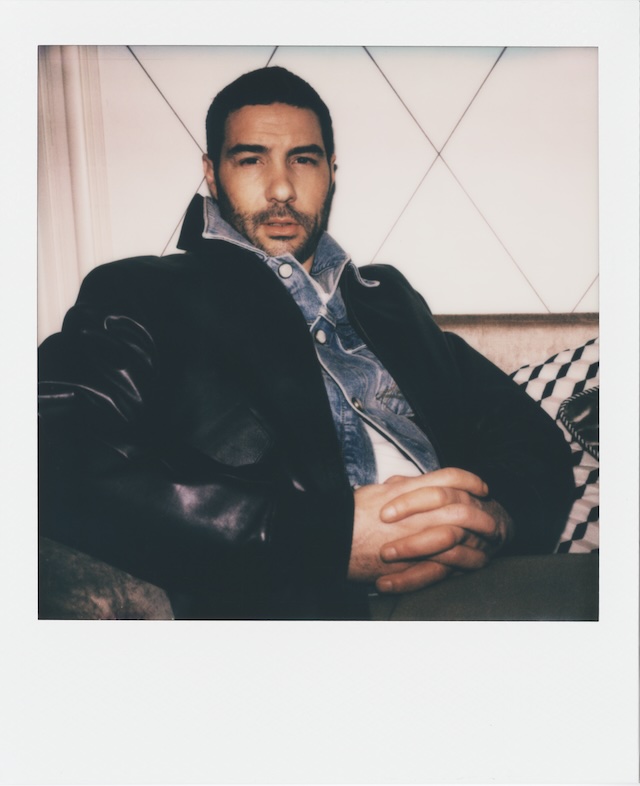
One hour. That’s all the time we have to build the set, set the scene, establish rapport, learn our lines and begin our search for the story within the story. The actor in question is 43-year-old Tahar Rahim, and he is practiced at this. The interviewer in question? Me. I am a little less practiced, but open to being tutored. Our set is a cosy hotel room in the centre of Paris, where Rahim is curled up on a velveteen sofa, dressed down in a t-shirt, jeans and socks, smiling and yawning.
“Do you know the French expression ‘mise en abyme’?” he asks me, seven minutes in, ruffling closely-cropped dark hair. It is the idea of things infinitely recurring within a work of art. A painting which contains a painting of the painting and so on. The literal translation is ‘casting into the abyss’, which seems to suggest the phrase is as much about the search for patterns, as it is about the repetition alone.
All of this is important context for our interview – I use ‘our’ here, not ‘my’ or ‘the’, intentionally – because Rahim, one of the greatest French actors of his generation, is someone who is creating with the intent to find, to discover. And what is he searching for? The freedom of youth, in a life being lived without regrets.
Rahim’s work might have swept the edges of your senses. He played the French serial killer Charles Sobhraj in the hit BBC series The Serpent, for which he was nominated for a Golden Globe. In 2021 he starred in The Mauritanian, a devastating Hollywood production based on the memoir of Mohamedou Ould Slahi, a man from Mauritania who was held in Guantanamo Bay without charge for 14 years and relentlessly tortured.
More recently, he played the iconic singer Charles Aznavour in his posthumous biopic Monsieur Aznavour (in the UK, you’ll likely remember Aznavour’s song ‘She’ from Notting Hill), and also Ezekiel Sims in Madame Web.
But how did it all begin? In France he exploded onto the scene with a compelling coming-of-age portrayal of a young prisoner in Oscar-nominated film A Prophet (2009). It’s a performance so convincing that you could almost believe that that version of Rahim is still out there, or in there, living his life deep within the criminal underworld.
Rahim knew he wanted to be an actor from the age of 14, growing up in Belfort, north-eastern France. He’s the youngest of ten siblings, and beloved. But, he says, “When I was doing bad things, I had them all on my back. Ten people!” When he talks about his childhood he lights up like a spinning top. He had a happy childhood, he says, spending time with friends, swimming, playing football. It was a multicultural upbringing. His family is Algerian, but his friends were from all over the world. He couldn’t travel like some kids, but he did have an elevator. “If I wanted to visit Africa, I would push button five to visit my friend’s family. If I wanted to go to Asia, that was on the 11th floor,” he says.
He would drink Turkish tea and eat sweetmeats on one floor, then stumble across his friend’s Moroccan mother watching Bollywood films on another. In a Senegalese family’s living room, he would crowd in with them to watch films and eat rice and fish – their hands all digging into the same bowl. “She would cook it like crazy,” he grins of that particular friend’s mother. It was food, travel and culture, all in one small city, imagined inside one small apartment block. Mind-expanding and exciting. “When you’re a kid, you dream of going through and getting inside of the TV. You just want to cross the screen. And that’s exactly what I felt when I would cross their doors.”
But, as alluded, Rahim was sometimes a little bit naughty. From his early teens, he and his friends would break in the back entrance of the local cinema to watch films. Eventually his friends didn’t want to visit any more; they were over the novelty. For Rahim, though, the films never got boring. He continued to sneak in alone. While there he’d enter an almost trance-like state – the feel of the crushed velvet under his fingers, the smell of popcorn, the hugeness of the screen almost swallowing him up, or letting him step inside.
But the manager of the cinema, a bluff man with a big moustache that Rahim illustrates by twirling his fingers, started to clock on to his scheme. “The Tom and Jerry game started,” he laughs. “Really, he wanted to catch me. And I was like, catch me if you can… It went so far that he printed a picture of me and he put it in his office.”
Years later, famous enough to be hosting a screening and Q&A of a new project at a cinema not too far from Belfort, the manager stuck his hand up in the audience and asked Rahim if he remembered him. Of course he did. They spoke afterward, and the manager ended up gifting one of Rahim’s friend’s children a free year-long membership to the cinema. “That’s what he should have done for me!” Rahim says.
In the past, Rahim has spoken about not making the most of his success after A Prophet. “I was scared of becoming a prick… I was afraid of that, because I wasn’t raised this way,” he says. How was he raised? Well, he says, his mother was his hero. “The strongest woman I’ve ever met. She didn’t know how to read, and she learned how to pass her exams, to have her driving license…” But, he adds, his mother gave him “a sense of being always protected, being always loved, whatever happens”.
I wonder if this is the thing that has allowed him to continue to take risks in his career. To allow it to become his obsession. In the past he told a journalist that “Acting isn’t an obsession for me – and it mustn’t be an obsession, it should be just a job.” I wonder if he still believes that. His pedigree suggests otherwise. He’s learnt new languages for roles, including a dead form of Scottish Gaelic. For an upcoming film role, Julia Ducournau’s Alpha, he lost so much weight he became emaciated. He did the same for The Mauritanian, alongside subjecting himself to something close to torture, asking the production team to shackle him with real shackles, to waterboard him, to make the set as freezing as possible.
“I said that it wasn’t an obsession?” he says when I ask him about his earlier statement. He shakes his head. “No, when I work, I’m really obsessed by my characters, by the movie, by the whole thing. I breathe it, I sleep it, I dream it, I live it. But when it’s done, I’m finished. Except for The Mauritanian.” That film took him a few weeks to come out of character. He fixates on the fact that even though he put his body through an extreme experience, he could never really understand what Mohamedou went through.
I ask what he thinks of when he gets stuck on that, as it feels as though he’s experiencing guilt. “Maybe you’re right, I don’t know. Maybe I felt guilty to pretend in front of someone who lived through this.”
The Mauritanian is regarded as Rahim’s breakout role stateside, his red carpet to Hollywood, for which he received Golden Globe and BAFTA nominations. Beforehand, he worked hard to make his mark there. He knew it wouldn’t be an easy ride. “I knew it. It wasn’t like, okay, France, I’m somebody here. I found it very exciting, because my point each time is that I’m trying to discover a new field of acting. What I’m seeking is the feeling I had with my first movie, to be virgin again, and to start at the very bottom of the ladder. I see my job as a sport…”
Does that mean that you can win, and you can lose? I ponder. He shakes his head. “I’m gonna quote the great Mandela: ‘I never lose. Either I win or I learn’.”
He has faith and he believes in fate. It was fate when he met his wife, the actor Leïla Bekhti, on the set of A Prophet (“I tried to seduce her,” he giggles, tapping his heart. “I knew that she would be the love of my life”). And it was fate that Monsieur Aznavour, his other 2024 film, would end up giving him a taste of a different type of accomplishment, too. “It was the first time I had such a big success in terms of admissions,” he says. “I felt that magical thing when people come to see your movie, like tons of people, and they applaud and do a standing ovation and they cry.”
Even my taxi driver tells me to pass on congratulations to Rahim for the film, which is regarded as a fitting tribute to one of France’s most beloved singers.
There is not enough time with Rahim. He is busy, bright, bubbly and a good storyteller. And good stories take time. Just as we’re getting to midway through my questions, there is only time for one more. I wrap up hurriedly. The story we have found together is one of yearning, searching, that desperate need for some kind of truth in the most fractious time period either of us has ever lived through. Thankfully, as the curtain falls, Rahim doesn’t break character.
The actor has designed fashion collections, directed plays and starred in films stretching from Of Mice and Men to Being John Malkovich. His latest, Opus, is a psychological thriller in which he portrays Alfred Moretti, a reclusive pop star who invites journalists, including Ariel Ecton (Ayo Edebiri), to his remote compound under the guise of a listening party for his long-awaited album. Here, he speaks to Port about his instinctual approach to craft, the theatre’s enduring pull, and why the best roles are often the ones still unwritten
John Malkovich wears Dior throughout, photography Alec Soth
What’s it like being John Malkovich?
It’s fine. Busy.
When you’re not playing yourself, how do you get into character?
I never play myself, as I don’t have much in common with the characters I’ve portrayed. I’ve never been in their shoes or done the things they’ve done or often even lived in the time periods that they’ve lived. I read the script and simply try to imagine. In a movie, you are a figure in someone else’s dream, so one of the first things I would try to do is understand how the director views the material and the story.
Do you think of style as something one chooses to have, to craft over a lifetime, or are you born with it?
I suppose if style is something that interests someone, it has probably arrived over time, I would think. I would doubt one would be born with it; I would imagine one would develop or refine it over time, providing one even has an interest in it. I’ve always referred to style as being the only constant in life, but I meant it more in the sense of style as being the way one moved through life – a way of regarding the world and perhaps a way of perceiving the world around you, and maybe even a way of behaving in that world.
Do you ever become obsessed with things: pens, or clothes or shoes? If so, what are you currently looking at?
I’ve been obsessed, I suppose, with all kinds of things and the way they look. That could be cars, tiles, chairs or fabrics or just about anything. I bought a pair of ankle-high, what used to be called après-ski boots, in Bulgaria six to eight years ago. My wife makes fun of me because I’ve never actually worn them, although I’ve dragged them to several countries over time. I would rather them not get ruined, so I am still just waiting for the right occasion, which I’m pretty sure will turn out to be the 12th of never.
What is it about theatre that you value over film?
I don’t know that I think much about valuing one or the other over or under. Theatre is living, and film is not. Film might be able to capture and show something that lived or was once living, which is obviously not the same thing. I think I’m probably just more suited to theatre. If one were to think of theatre and film as instruments, I would think of them as two different instruments, sort of distant cousins.
What drew you towards your new film Opus – was it the character of Moretti, the film’s meta-approach to fame, or something else entirely?
I met and liked Mark Anthony Green, the writer and director of Opus. That’s actually the reason I did it. It wasn’t really about the character or who or what he was, nor what he did or didn’t do. I like Mark Anthony’s calmness and his manner and his vision. I’ve had some excellent experiences with first-time directors, and the experience with Mark Anthony was a real pleasure.
What did the role demand from you that felt new or unexpected?
Though I used to sing when I was young – in choirs and then at university in coffee houses and bars and what have you with my guitar – I hadn’t sung much in 40 years except in an opera a bit, and once on a Russian TV show some years ago. So, recording and performing songs, both in a studio and live in the movie, was quite a new experience, and my dancing career was launched with the release of this film – though I suspect that career will be mercifully brief. In truth, there aren’t tons of things in the human experience that could seem incredibly new to me at my age, though there may be ways of expressing them that might be unfamiliar, or at least not commonplace to me. I often somehow end up doing things that are unexpected to me, but then I think to a certain extent that we are constantly being born, and I have a tendency to let my instincts and impulses guide me in work, rather than having everything be carefully planned beforehand.
How has your approach to acting evolved over time?
I’m not so sure that my approach has changed over time. I devote more time to preparation now, but I think the approach is really the same. Show up, be prepared and let my instincts lead.
Which roles have been the most rewarding or meaningful to you, and why?
Generally speaking, those roles would be in the theatre because those are the roles which one explores most profoundly. One lives next to that character for several months, or longer, whereas in movies, you do each scene – generally speaking – for one day. Sometimes scenes last a whole two days. In a movie you may do three takes or 10, or even 15, but in the theatre, you could easily do that in a single rehearsal and often do. It’s the difference between a passing acquaintance or encounter, and an enduring love or friendship – both can be beautiful, but they are not the same thing.
The meaningful ones would just be meaningful to me, perhaps not to anyone else. It’s meaningful to me if I think or feel beforehand that I may not be able to do it. Any well-written role is rewarding, I would say. I’ve been afforded the opportunity to play some interesting characters, sometimes ‘serious’ ones – if characters in movies or plays can be considered serious – and sometimes decidedly less serious ones. I’ve enjoyed both and enjoyed playing both.
As for favourites, maybe John Wilmot, the second Earl of Rochester in Stephen Jeffreys’ play The Libertine; Buck Howard in the film The Great Buck Howard; Alan Conway, the grifter queen in the film Colour Me Kubrick; the Vicomte de Valmont in the film Dangerous Liaisons; Lennie in Of Mice and Men; an android and his creator in the film Making Mr. Right (though enjoy is maybe not the word I would use here), Tom in The Glass Menagerie; Pale in Burn This and Gustav Klimt in the film Klimt. I enjoyed many others as well, but of course, just because I enjoyed them doesn’t make them good or not good, it just means they were interesting for me or interesting to me, often because of the people directing them, and my colleagues or the writers, of course.
Is there a character you would love to play?
Yes, the one not written yet.
You’ve always seemed more interested in the work than in fame. Has that been a conscious choice?
No, I don’t think it’s a choice at all, actually. The work is interesting to me, fame not so much.
What’s something about acting that still surprises you?
How much fun it can be, how quickly it makes the time pass and how easily it can be forgotten by me.
Is the current political climate in the US something that surprises you, or do you think it’s part of a wider and perhaps predictable global trend?
I would say the latter.
Who currently is your favourite writer and why?
I am not up on current writers. I was emailing with an old friend a few days ago who is in a book club, and she mentioned a number of books her club had read, and I knew none of the books and only one of the writers. That is not good. I have been a big fan of DeLillo, Faulkner, Naipaul, Bolaño, Márquez, Sabato, Anne Tyler, Vargas Llosa, among many others. I’ve been working on a Bolaño piece as a classical music collaboration for the last three to four years, but favourite is a big word.
Do you have a hero?
My dad, probably. Václav Havel, kind of. Both are no longer with us. Hero is a big word too, though.
What is your most treasured possession?
Sanity.
What is the future of cinema? Will people still be going to public cinemas in 100 years?
I doubt it, but I’m usually wrong. I’m not a gifted prognosticator.
From his breakout performance as Martin Luther King Jr in Selma to playing Henry VI at the Royal Shakespeare Company, David Oyelowo has consistently sought roles that challenge both himself and the narratives that surround Black actors. In Government Cheese he takes a turn into surrealist comedy, playing a man caught between redemption and survival. He speaks about risk, reinvention, and why every performance should feel like a leap into the unknown
In the surrealist comedy Government Cheese, actor David Oyelowo’s character, Hampton Chambers, breaks into a synagogue. Desperate to live a more honest life post-incarceration and hoping this will be his last immoral act before committing entirely to the straight and narrow, the father of two insists this misdeed must be done “respectfully”. Starting with a small prayer, he and his friend don black yarmulkes before entering the religious institution to rob its safe. “I can’t wear this, it’s blasphemy,” his friend protests. “It’s blasphemy if you don’t,” he replies. The scene perfectly exemplifies the show’s absurdity while highlighting how desperation can lead someone down a dark path. For Oyelowo, that tension – between morality and survival – was what drew him to the project. “It is indicative of his character – caught between a rock and a hard place of his own making,” Oyelowo says over Zoom from his home in Los Angeles. “He needs to go down the path of righteousness, and he just can’t quite stay the course.”
For many fans it will be a pleasant surprise to see the British actor in something so whimsical, having made a name for himself through a number of hard-hitting roles on film and stage. But what Apple TV’s Government Cheese reveals is how the 48-year-old is unafraid to step outside of his comfort zone. “The script was unlike anything I’d read before,” he says. “What I loved was how Bible stories – whether the flood or Jonah in the whale – somehow intersected with this guy’s life in a parabolic, surrealist way.”
After relocating to California from the UK in 2007 in search of more opportunities, Oyelowo found his breakthrough role in the US in 2014 when he portrayed Martin Luther King Jr in the historical drama Selma. The film follows Dr King during his 1965 march from Selma, Alabama, to the state capital of Montgomery, in a bid to secure equal voting rights. “I had loved the film Malcolm X growing up, so being central in a film like that was a big deal for me,” he says. Before Selma, he says, there were few portrayals of Dr King in film despite him being “arguably, one of the most important figures in the 20th century”.
That same year HBO’s streaming film Nightingale was released, which IndieWire dubbed the best performance of Oyelowo’s career so far. In this film, Oyelowo plays a war veteran descending into madness after committing a heinous crime. The one-man movie, which won him a Critics’ Choice Television Award for Best Actor, takes viewers on a harrowing journey as his character’s breakdown becomes increasingly more unpredictable. “That’s a prime example of me wanting to scare myself. I remember I walked into my agency at the time and said, ‘Look, I really want to shake things up. I want to do work that is unexpected to me and the audience,’” he explains. “And then they sent me this script, which had me going, ‘Oh dear – I may have finally got more than I can do here,’” he jokes.
Oyelowo’s exceptional talents extend beyond the screen. In 2001, he made history as the first Black actor to play the King in the Royal Shakespeare Company’s production of Henry VI. At the end of last year, he starred as Coriolanus at the National Theatre, where he transformed into a man with distinctively bulging muscles for the role. He sees this as part of the job. “How I feel in my body, how I look, how I sound, whether it’s the quality of the voice or the accent, these are all the tools for stepping towards the character,” he explains. “If you are heavier on set, you carry your body in a slightly different way. Your voice even sounds a little bit different and the way other characters react to you is different.”
For Oyelowo, theatre can be a true test of an actor’s abilities. “Doing plays, especially Shakespeare, is the Everest for actors; if you can do that you feel like you can do almost anything,” he says, noting that being on stage is also when he feels most connected to viewers. “There’s this unspoken contract made between the audience and the actors that we are going on this journey,” he adds. “We’re all going to stick with it and see where we land on the other side of these two to three hours, and that’s a very special thing.”
It’s no surprise that Oyelowo feels at home on stage, given its role in his early acting career. A film and TV enthusiast growing up, he had done a few plays but never saw acting as his future. That changed at 15 when a girl from his church invited him to the National Theatre – on what he hoped was a date. “I’d done a few plays that I’d really enjoyed, but it was never something I thought I was going to spend my life doing,” he says. While romance didn’t blossom with her, he fell in love with the craft instead. At the National Theatre he was struck by “a bunch of young people who really took it, I don’t want to say seriously, but they were passionate,” he says. “I eventually got cast in the lead for a play.”
He points out my Nigerian background and similarity in the views our parents might have had of the creative industries. “I actually think it’s changed now, but certainly when I was younger, the idea of being an actor or being in the arts was not something that my parents were over the moon about,” he says. “I can spot from your name that you are probably Nigerian like me, so you’ll know what I mean.” I did. That said, a turning point in gaining his parents’ support came at the National Theatre when his late mother visited one of his performances. “I just remember her looking at me a little bit differently. I think she had seen something in me during that play that she didn’t know was in there.”
In every role that he plays, Oyelowo hopes to move away from the negative stereotypes about Black people. “As a Black person and a very proud African person, I am drawn to stories that reveal the other side of the narrative,” he says. Society still carries “too many negative stereotypes and misconceptions of who and what we are” he adds, citing this as a result of what has been seen on TV and in film. “I was so proud to play Dr King because he’s an aspirational character as opposed to a criminal, slave or despot, which I think we’ve seen too much of,” he says. “It’s also why I’m so proud of A United Kingdom, where I play an African king who’s in love with his wife, but also loves his people and fights on their behalf.”
Ironically, Government Cheese is about a criminal, yet it feels like an understandable exception to Oyelowo’s rule. The series teeters between both a crime and a redemption story, but never fully settles with either. Based in southern California in the 1960s, the eccentric Wes Anderson-esque show is created and directed by writer and filmmaker Paul Hunter, and executive produced by Oyelowo himself under his production company, Yoruba Saxon. It follows Hampton Chambers, who tries to get his life on track and win back the love of his disappointed family after being formerly incarcerated for low-level crime. “He’s constantly trying to cheat his way into his future, but his heart is in the right place in relation to wanting to provide the best for his family, wanting to move ahead and wanting to be successful,” Oyelowo explains.
Chambers creates a unique invention which is sure to lift him out of his financial struggles: the Bit Magician, a self-sharpening power drill. “Woven into his coding is this thing of ‘just take this little shortcut’.” Alongside this storyline “you have this very quirky family that don’t think of themselves as quirky, but as an onlooker, you’re going, what is this family? And I can relate to that,” he says. Oyelowo himself has four children and admits that his family is “quirky in their own way”. He adds, “Like most families, if people were to have a lens on us when we assume no one’s watching, it would be like, what the heck is this family?” he jokes. “So I relate to Government Cheese, less on the criminal side, which is something I’m glad to be able to say. But I also relate to his spiritual journey within that; I’m a Christian and anyone who’s been on a spiritual journey knows that it’s not a straight line.”
On many occasions, Oyelowo described Government Cheese as a story about making something out of nothing. “It’s called Government Cheese because it’s hinting at ingenuity, aspiration, making the most of what you have,” he says. “It’s indicative of what so often happens for people who have less.” In some capacity, it feels as if Oyelowo is speaking of himself, having gone from growing up on a council estate in north London to being a household name in many countries across the globe. “What I love about the show is it’s a celebration of people who have little, but live full lives on the basis of being able to punch above their weight.”
Porro launched Nao Tamura’s Origata console, designed by the Japanese New York-based designer, in 2024. It’s made from a folded aluminium sheetDieter Rams designed the original version of his 621 table for Vitsœ in 1962, in injection-moulded plastic. In 2014 it was re-engineered to take advantage of advances in plastic technologyAlvar Aalto designed Screen 100 in 1936 for Artek, the Finnish company that he set up. It’s a special favourite of Paul SmithPatricia Urquiola designed the Dudet 526 upholstered armchair for Cassina in 2021Bellhop was originally designed for the Design Museum’s restaurant as a table lamp by Barber Osgerby in 2016. Flos now makes a table lamp and a suspension versionPiero Lissoni designed the Eda-Mame sofa for B&B Italia in 2018Giampiero Tagliaferri designed Minotti’s Pattie armchair in off-white, made with structural plastic and a swivelling mechanism, in 2024Gio Ponti designed a range of chests of drawers in the early 1950s for Molteni&C. They are now being manufactured based on original drawings from the Ponti archive, using elm wood and brass feetPoliform’s Mush coffee table was designed in black elm by Jean-Marie Massaud in 2022Le Miniature collection pays homage to iconic furniture pieces by recreating them in miniature form, designed by Poltrona Frau Style & Design Centre. This includes the Miniature Archibald, a version of Jean-Marie Massaud’s Archibald Armchair, originally designed in 2009Joe Colombo designed the Additional System seating in 1967. It was in production until 1974 with Sormani. Tacchini put it back into production this year
Photography assistants Amar Gill and Daiki Tamija
Production Lalaland Retouch Touch Digital
This article is taken from Port Issue 35. To continue reading, buy the issue or subscribe here