At the headquarters of the world’s most famous four-wheeled luxury brand, Don Morrison discovers that it’s attention to detail and a refusal to compromise that creates an icon

Nothing sounds quite like a Ferrari. Think of the rich, fruity tenor of Luciano Pavarotti locked in a manic duet with the deep growl of a Vickers Supermarine Spitfire Mk IX. This is the sound of speed, power, money and, yes, music. Ask Eric Clapton, who owns a garage full of the iconic Italian sports cars. ‘I love the sound of a Ferrari,’ he said not long ago, ‘and, as a musician, I can tell you that these engines really do have their own soundtracks.’[/one_third]That is no accident. Ferrari engines are designed to turn especially fast, producing peak power – and maximum noise – at 8,500 to 9,000 revolutions per minute, versus the standard 5,000 or so. At those higher speeds, exhaust bypass valves on many Ferrari models open to produce more torque and, not coincidentally, louder and throatier ‘exhaust notes’, as such noises are known in the trade.

For some people, the call of the Ferrari is irresistible. These people tend to have a lot of spare dosh – £120,000 to £270,000, depending on model and options – and they clearly want to be noticed. The rest of us can take pleasure from the music that lingers in their wake, much as we might enjoy the distinctive exhaust notes of, say, Pavarotti or Clapton. And we haven’t yet talked about the visual pleasures on offer, the sleek, sinuous planes of sheet metal and glass that make a Ferrari seem to be leaping forward even when standing still. Or the soft leather upholstery, also available in cashmere. Or the sure, nimble, race-car handling. Or the in-your-face coolness that comes with driving one of the most exquisite sports cars ever made.
Made, not so incidentally, in very, very small quantities – fewer than 7,000 in a good year (against nearly 100,000 units for Porsche). Ferrari could sell thousands more if it chose, and waiting lists are longer than the straightaway at Silverstone.
‘Ferrari is the only manufacturer in the world to have been specialising in exclusive high-performance sports cars while racing in Formula 1 throughout its history,’ says Amedeo Felisa, chief executive officer of Ferrari SpA. ‘No other car producer can boast such an uncompromising approach to engineering and production.’Other companies produce high-end sports cars: Porsche, Jaguar, Lamborghini, Maserati, Aston Martin – fine machines all. But nobody makes them quite the way Ferrari does: by hand, of course, but also with technological innovations imported from the company’s famous Formula 1 racing programme, and a dedication to quality that borders on the manic.
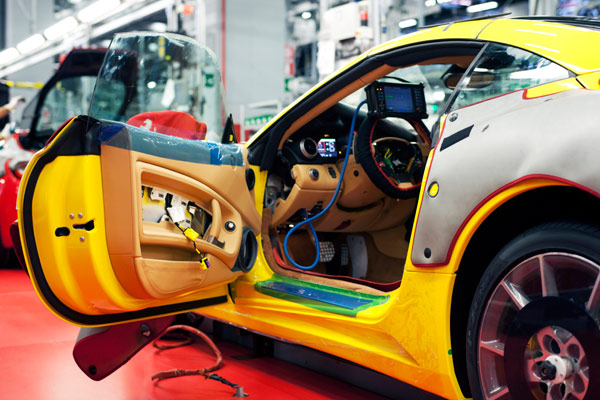
In an era of ruthless cost-cutting, interchangeable components, robot-crammed factories and proliferating cup-holders, Ferrari is one of the last vestiges of old-fashioned values in the auto industry. Ferrari is also a mainstay of contemporary popular culture, saluted in song and film. The Internet Movie Car Database lists more than 1,500 of the vehicle’s cinematic appearances, from On the Beach (1959) to Take Me Home Tonight (2011).That does not include the iconic 1980s television series Miami Vice, in which Ferraris played a major supporting role. Most of those co-stars were actually replicas, since the plotline demanded spectacular crashes from time to time. No one would wish that fate on the real article. More than 75% of all Ferraris ever made are still being looked after lovingly by their owners, who put an average of 5,000 km a year on them. Says Felisa: ‘Ferraris are dreams, not cars, and our customers are people who want to fulfill their dream. They look for luxury and craftsmanship, high-end technology and heritage.’
The Ferrari heritage was born in 1928, when an Italian mechanic and racer named Enzo Ferrari opened Scuderia Ferrari, the ‘Ferrari Stable,’ to sponsor and equip local racing drivers in his native Modena. He adopted as his symbol the cavallino rampante (‘prancing horse’), a black stallion on a yellow (Modena’s colour) shield, which has adorned Ferrari cars ever since. In 1938 Enzo Ferrari was hired to head the racing department at Alfa Romeo. He kept the scuderia going as a small maker of machine tools and aircraft parts, and in 1943 moved his factory a dozen miles south to Maranello, where it has remained.

After the war, Enzo Ferrari introduced a small line of street-legal cars, though his main focus remained the race track. Scuderia Ferrari competed in sports car racing and, when Formula 1 was introduced in 1950, jumped in with all four wheels. Ferrari is the only team to have raced every year of F1 history and holds many of the sport’s records: for podium finishes, points, pole positions, fastest laps – you name it, Ferraris have won it. Michael Schumacher drove for Ferrari, as did Eddie Irvine, Niki Lauda, Mario Andretti, Phil Hill and a cabriolet of other greats. The recent addition of superstar Spanish driver Ferdinand Alonso alongside Brazilian Felipe Massa has Ferrari fans awaiting the 2012 season with unusual eagerness.


Racing remains a major focus for Ferrari – the firm does not break out its Formula 1 spending, but it is thought to be immense. Ferrari executives consider it a good investment, raising the firm’s profile and providing technical breakthroughs that later show up in its road cars. One recent example is KERS (Kinetic Energy Recovery System), which transfers energy generated during braking back into the engine to boost performance and reduce fuel consumption. Indeed, KERS is so effective that it has been banished from F1 competition, though Ferrari is lobbying to have it reinstated – and planning to introduce it in road cars in a few years.

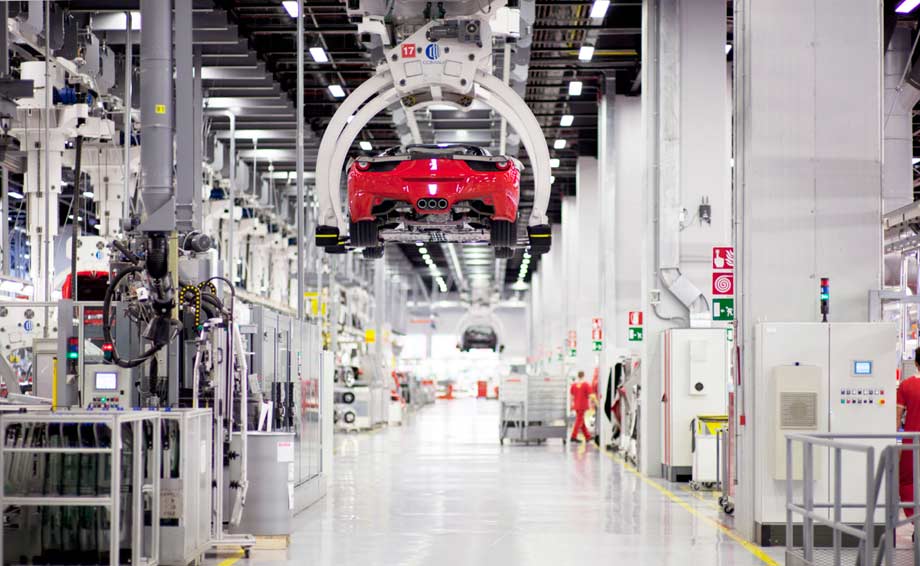
The Ferrari factory at Maranello, a pleasant little town in the northern Italian province of Emilia Romagna, is a sprawling campus of old brick buildings and daringly modern ones, like the Jean Nouvel-designed palazzo where the new Ferrari California GT is assembled. The complex has its own wind-tunnel and, just down the road, a full-size test track. If you own a Ferrari or can find a dealer to vouch for you, the company might lay on a VIP tour of the premises. Otherwise, the place is off-limits to the public, except for the Galleria Ferrari, a small museum of classic and new models.Unlike the dark, satanic motor mills of Detroit, the Ferrari factory is a clean, well-lit place, graced with banks of indoor plants and trees. The greenery is the idea of Ferrari Chairman Luca di Montezemolo, who is determined to strengthen the company’s traditionally worker-friendly culture. The company won the 2007 Best Place to Work in Europe Award, given by a US-based research group. As Montezemolo likes to say: ‘To build exceptional cars, we need exceptional people.’

The chairman is certainly an exception. Scion of an aristocratic family from Piedmont, he studied law in Rome and international affairs at New York’s Columbia University. But his real passion was racing, which he indulged behind the wheel of Fiats and, briefly, as a member of the Lancia rally team. One day in 1972 he was invited onto a popular Italian radio phone-in show to discuss racing. He put one blowhard caller straight in particularly forceful terms. Enzo Ferrari, who happened to be listening in his office, phoned the show and asked, ‘Who is that tough young kid with the balls to answer that idiot?’ He thereupon sent the tough young kid a copy of his memoir, inscribed, ‘To Luca di Montezemolo, who has the courage of his words and his actions.’ Months later, Ferrari hired him be his assistant. The assistant eventually left to work for Fiat, but three years after Ferrari’s death in 1988 he returned as his successor. Montezemolo revived the firm’s flagging road car business and put its F1 programme firmly in the winning column. He multiplied sales tenfold to their current level of around 2 billion euros a year, with profits of roughly 300 million euros. He has served as head of several other companies and investment funds, and has led Italy’s football World Cup effort, its America’s Cup yachting team and its confederation of industry – all while running Ferrari.


Montezemolo is now one of Italy’s top celebrities. Last year Paolo Nespoli, the only Italian on the International Space Station, used his one allowed phone call from orbit to chat with Montezemolo. (‘You make me proud to be an Italian,’ the astronaut told him).
A few months later, as Prime Minister Silvio Berlusconi’s hold on office began to weaken, the Ferrari boss was widely tipped to replace him. Montezemolo demurred: who would give up the best job in Italy for the worst?

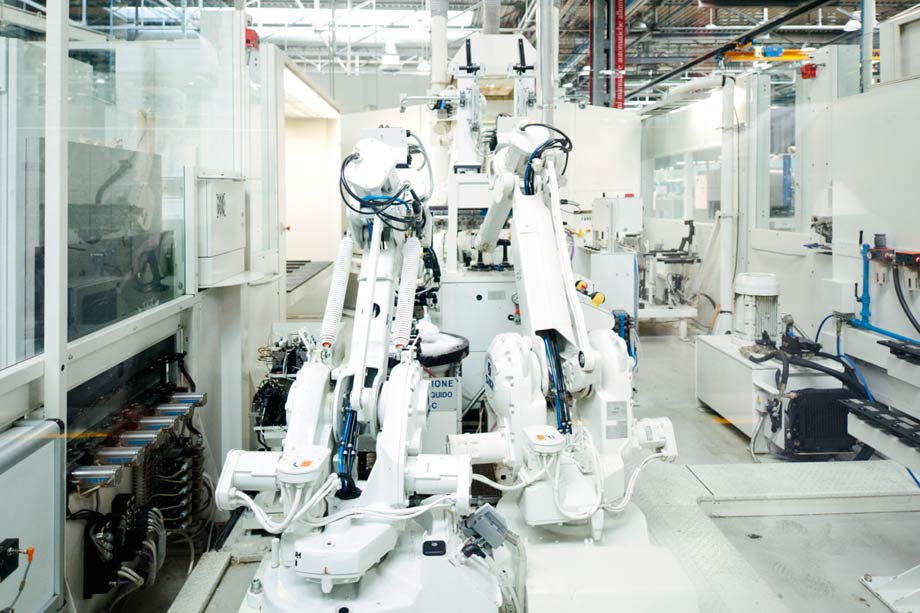
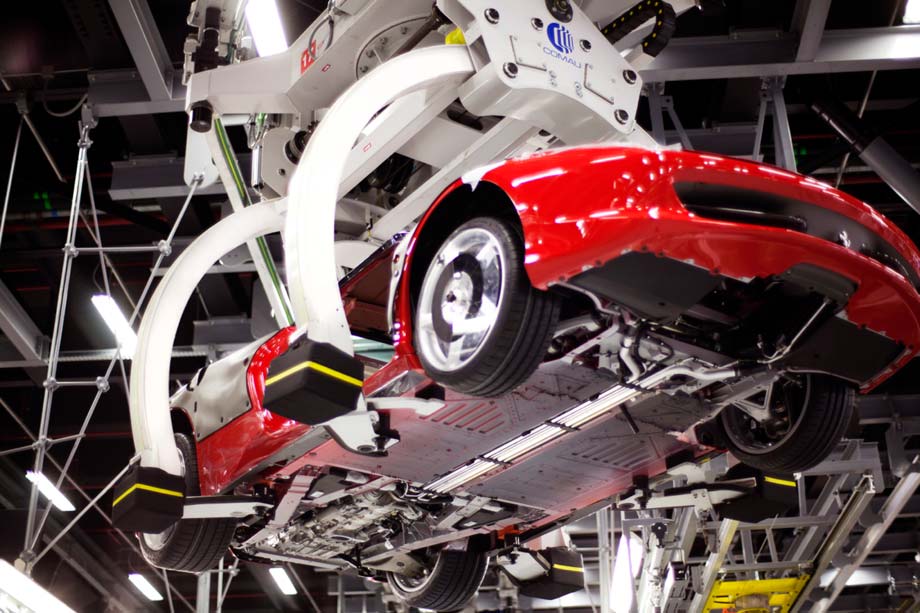
Montezemolo lives in Bologna, about 25 miles from Maranello, but he is a constant presence at the factory. Instead of robots, it swarms with actual humans – dressed in red, the Ferrari racing colour – tightening bolts and stitching seat coverings. About eight vehicles are lined up at a time on what passes for a production line. Ferrari is the only car-maker in the world with an on-site foundry to make the major castings for its engines, as well as specialist alloy parts for its Formula 1 racers. The factory boasts a state-of-the-art paint shop (robots can be found there) so advanced that it does work for rival Maserati. ‘This level of technology and its inherent flexibility are a major advantage for such a small production volume,’ says Felisa, the CEO.
The plan is to keep that volume small. Enzo Ferrari said that he would always produce ‘one car fewer than demand’, and the scarcity principle lives on among his successors. The firm has announced a production limit of 7,000 units for the moment, rising eventually to 10,000.Such conservatism does not prevent Ferrari from introducing new models with impressive regularity. The popular Modena was retired in 2004 and its successor, the F430, in 2010. The current line-up includes cars with varying combinations of engines, seating and body styles: the California GT, a four-seat touring car with a mid-front engine; the 599 GT Fiorano, a two-seat, front-engine tourer; and the 458 Italia, a two-seat, mid-engine sports.Just introduced is the FF, a four-seat luxury coupe with four-wheel drive (the FF stands for four seats, four wheels). Motorheads love how the all-wheel mode automatically disengages as the car moves into higher gear, a Ferrari innovation.With the introduction of the FF, Ferrari executives say the product line is, for the moment, complete. ‘Ferrari will not move away from its traditional offering of V8 and V12 sports cars and grand tourers,’ says Felisa. That means no sport-utility vehicles like the Porsche Cayenne, or sedans like the Maserati Quatroporte. Indeed, no four-door cars of any kind. ‘We stand 60 years, and we never needed four doors … It’s not part of our heritage.’Ferrari’s attention to heritage has not prevented it from responding to modern concerns about fuel prices, vehicle emissions and climate change. In 2007 the company launched an ambitious five-year plan to slash emissions by 40% across its product range. Ferrari remains committed to the Kinetic Energy Recovery System as a way to cut emissions and fuel consumption. It unveiled the HY-KERS, a petrol-electric version of the 599 GT, at the Geneva Auto Show in 2010. The vehicle, which remains experimental, uses its electric motor not just to boost fuel efficiency, as do conventional hybrids, but also to increase performance – since electric motors can accelerate more rapidly than their petrol partners.
In addition, Ferrari is also engaged in research on near-frictionless internal combustion engines, which would naturally be less polluting. Meanwhile, the company is making itself more efficient. Among other innovations, it has installed an ingenious power plant in the Maranello factory to supply the energy, hot water and cold air needed to produce all its cars.One of the few question marks hanging over Ferrari is its future ownership. In 1969 Enzo Ferrari, facing financial difficulties, sold a 50% stake in his company to Fiat. The Italian auto giant acquired more shares after the boss’s death and currently owns 90% of Ferrari. (The rest is held by Enzo’s son Piero, now 66 years old and a Ferrari executive.)Fiat has had its ups and downs during the current global economic crisis, and there is intermittent speculation that the firm might sell some its Ferrari interest or even spin off it off in a public share offering. Executives of both companies routinely decline to comment.
“Even the distinctive Ferrari sound – that muscular, mesmerising mating call – is a sought-after commodity”
Whatever lies ahead, Ferrari is not likely to lose its commitment to craft and tradition. Even Fiat, a sprawling multinational that produces 2.5 million vehicles a year and controls both Chrysler and Maserati, has allowed Ferrari to go its own way.Any future owner worthy of the privilege would be smart not to mess with the Ferrari mystique. That ineffable quality transcends Formula 1 racing, rich playboys and the needs of Hollywood directors for cars that make a visual statement. Ferrari has become one of the world’s premier luxury goods brands, with a rich scuderia of high-end line extensions that earn the company 40 to 50 million euros a year. The Ferrari Store, the company’s online retailer with a score of bricks-and-mortar outlets around the world, sells Ferrari clothing, leather goods, watches, sunglasses, fragrances, Ferrari shoes by Tod’s and a Ferrari netbook computer by Acer. Ferrari has ruthlessly dumped licencees that do not meet its exacting quality standards, as a few manufacturers of toy replicas found to their chagrin not long ago.

Even the distinctive Ferrari sound – that muscular, mesmerising mating call – is a sought-after commodity. Apple has an authorised iPhone app called Ferrari Sound that will replicate the exhaust notes of various Ferrari models at varying speeds. For £1.19 you can have a Ferrari in your pocket, available for listening any time your ego needs a boost. Or, for another few hundred thousand pounds, you can have the real thing.
Don Morrison is an author and journalist living in Paris
Photography Alessandro Rizzi


