- Betty Wood caught up with Slinkachu on the opening of his new exhibition
Global Model Village at London’s Andipa gallery to discuss his new collection, his
miniature adventures and the meaning of his work
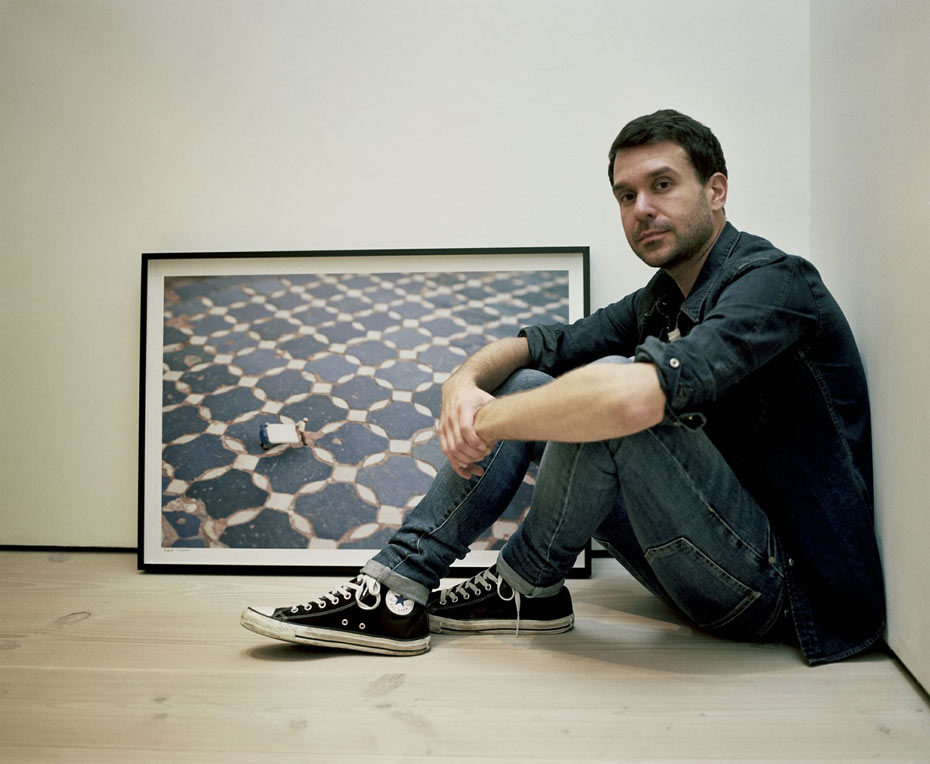 Above: British street artist Slinkachu with his piece ‘Faded Grandeur’, 2010. Lalla Hasna Park, Marrakech, Morocco
Slinkachu has quickly established himself as one of the most iconic British street artists with his use of ‘little people’. These 1cm high miniature figures ‘go about their business’ in our Gulliverian world, unnoticed by the people whose feet go crashing by them, often crushed underfoot or brushed away by road sweepers as they are abandoned to their fate on our streets.
First things first — how did you first become involved in miniature sculpture?
The idea really came out of nowhere: I was an art director at the time and I would thinkup ideas all day for things. One day we were outside having a brainstorming session for a product to make an advertisement, and the idea came into my head randomly. I thought it might be quite a fun hobby to do outside of work.
The first ones I did, I went out and bought some train sets figures — really simple ones — painted them and stuck them around. I took some photos of a few of them, but I wasn’t taking photos of all of them at the time. It was only a few months later that I really started getting into photography and telling stories with the characters.


Your new book and exhibition Global Model Village takes on a more international feel than your earlier pieces — was there much of a variation in the reception of your work?It was interesting; in London, usually [I find] people either completely ignore me, or they’ll come up to me and recognise what I’m doing, particularly if I’m doing it in East London. mostly, people ignore me. It’s the same here as it is in Germany or Paris — people ignore you [in the West].
In Marrakech particularly, it was completely the opposite. Whenever we were trying to shoot, they were constantly coming up to us, either trying to sell us something or
were asking ‘what are you doing? This is so weird! Are you crazy?’ You definitely get different responses from different places!You draw on some dark themes for your work, from the morose to the sinister — are there any subjects that are too taboo? Does your medium allows you to go where other artists might not feel comfortable?
There’s nothing , but I very consciously avoid doing anything too fantasy like. The stuff I’m drawn to and that interests me the most is the melancholy: the idea of abandonment, of being lost in theworld. All of my work hinges on that. Some images go more towards the comedy side of that, but hopefully underneath the surface, darker themes emerge. I think comedy works best when there’s a serious issue behind it.Sometimes people will come to me, and they’ll have read [an image] entirely differently from how I would have. But I find that really interesting too.
.Above: ‘The Food Chain’, 2011 by Slinkachu. (Ghost Street), Beijing, China
 ‘All Alone’ (context shot), 2012 by Slinkachu. VDNKh area, Moscow, Russia
How much does your new show Global Model Village mark a departure from your previous work, and how much is it a continuation of the themes of Little People in the City, or Concrete Ocean?It’s similar in a way because a lot of the work I actually started before the stuff for my last show. [Global Model Village] — particularly the book — is an amalgamation of work I’ve done over the last three years. There are definitely themes, and even some images from the last show . Looking at the last book, I can see the progression. I’m much happier with the photography and generally happier with the ideas in the book, and with the expression of those ideas.
.‘All Alone’, 2012 by Slinkachu. VDNKh area, Moscow, RussiaAnd you shoot digitally?
Yes. I’m too much of a perfectionist; I’ll shoot 300 shots for one installation and them go through minutely analysing the focus to see if it’s 1mm off… The figures are so small! The difference between the hand being in focus or out is about half a millimeter, so I really do go through it.
How much time to you invest on a single instillation?
The most complicated take a few hours to make. Then I probably spend half an hour to an hour shooting them. Putting them out is usually very easy. I spend the longest time trying to find the location.I think Exit Strategy,(Hong Kong 2011) took the longest; I spent about 2 days walking around trying to find the right building. I knew that I wanted to have all of the flats in the background, and I knew there were lots of places like that in Hong Kong, but not many where you could actually stick the figure to the wall and get the right image. That took a long time to find the location.
The images usually need retouching: if there’s a bit of fluff stuck on the figure’s head, you don’t see it on the camera, but when you blow it up on your screen it looks massive! In all [I spend] 10 -15 hours max for each one. But it’s fun — I get to do a lot of different things, location photography, model making… The ideas probably take the longest.
 How do you keep coming up with ideas? Do you ever dry up?
Oh definitely. I think everybody gets to a point where you have to stop and do something else because you’ve run out of ideas or hit some sort of block. It does happen to me; I try and take a few months off and do something else, and not think about it. Then come back to it. I’ll probably do that after the show — there’s a few different things I want to try.
Is it frustrating or flattering when you see people doing very similar stuff to your artwork?
I have differing responses depending on who it is! I have seen some which is clearly professional people copying my exact photos.

That can be a bit annoying, and obviously it doesn’t have the same meaning or context as me leaving it on the street…On the other side of that, I get a lot of kids and people sending me photos of things they’ve done inspired by my work, which is great, because if I can get a kid out in their back garden taking some photos then that’s a good end to it.
I know you’ve said that you don’t revisityour little people but I’ll ask anyway; do you ever go back to look for them?
I honestly don’t very often; I used when I would do some on the way to work. I’d get up really early, get off the tube line and go and shoot for half an hour. If I was coming back after work, I might go and see if it was still there. Those are the only ones I know either did or didn’t last very long. Most of them I don’t check at all, particularly recently, as I don’t tend to go back to the places because I’ve been shooting in different countries. The only one that we did go back to was one in Berlin (History, 2011), which of a the beside a monument. Someone had actually left the figure and the plinth, but took the cigarette away…
.
.‘Skyscraping,’ 2011 by Slinkachu. Brooklyn Bridge Park, New York, USA
 Slinkachu with ‘Into the Wind’, 2011. Bolshoy Moskvoretskiy Bridge (Red Square/ Kremlin), Moscow, RussiaPortrait photography Jasper Fry
It makes you wonder what does happen to them — I bet there are Slinkachu originals in living rooms around the world…
I think it people see them, they definitely take them. There’s only one time a guy emailed me and said he recognised the location and had gone out to find it and it was still there, but had fallen over and he’d stuck it back. That’s what he told me anyway! I think in some cases, people probably see them, recognise who’s done them and take them. In most cases, people won’t see them at all — they probably just get destroyed or kicked over.
That’s why I started to photograph them — that was the record of where they’d been and all that was left of them. I quite like that thought, that you don’t really know what’s happened to them and all you have is this one, small memory of them .
Global Model Village is available in hardback now. The exhibition opens today and runs until 27 October. A 6 day pop-up exhibition will be taking place in New York 3 October – 7 October 2012. For more details, visit Andipa.com
Andipa Gallery, 162 Walton Street SW2 2JL
Subscribe to Port Magazine annually and receive each issue to your door.
Get PORT in print


